
TL;DR:
- Digital foresight converts early signals into strategic options before competitors notice. Leaders should assign a signal owner, run a rapid AI-assisted pilot, and hold foresight debriefs to stay ahead in uncertain environments. Embedding continuous digital foresight enhances decision quality, resilience, and innovation across organizations.
Digital foresight delivers anticipatory advantage by turning early signals into strategic options before competitors even notice the shift. If you are a leader trying to act on that now, three things will move the needle in the next 30–90 days:
- Assign a signal owner. Nominate one person responsible for scanning and surfacing emerging signals to the leadership team weekly.
- Run a rapid pilot. Pick one domain (supply chain, talent, regulation) and run an 8–12 week AI-assisted scanning exercise against it.
- Convene a foresight debrief. Schedule a cross-functional session to interpret what the pilot surfaces and translate findings into at least one strategic option.
HBR analysis documents a significant spike in uncertainty references in corporate earnings calls through 2025, with no sign of abating. That is not background noise. It is the signal that systematic foresight has moved from competitive advantage to operational necessity.
Table of Contents
- Why digital foresight matters for organisations today
- What does a digital strategic foresight process actually look like?
- How does foresight change practical decision-making?
- Which digital and AI-enabled tools actually help with foresight?
- How do you implement digital foresight in your organisation?
- What does recent research show about AI and foresight capability?
- What are the most common pitfalls when building digital foresight?
- Key takeaways
- The case for treating foresight as a daily habit, not a quarterly event
- Ontherice: a practical starting point for your foresight pilot
- Useful sources and further reading
Why digital foresight matters for organisations today
The core argument is straightforward: organisations that sense change early make better decisions than those that react to it. Digital foresight is the capability that makes early sensing possible at scale.
The benefits are concrete and measurable across five dimensions:
- Anticipatory advantage. You identify weak signals before they become mainstream trends, giving you time to shape a response rather than scramble to one.
- Resilience. Scenario-tested strategies hold up under disruption because they were stress-tested against multiple plausible futures, not a single forecast.
- Better resource allocation. Capital and talent flow toward opportunities with evidence behind them, not just the loudest internal voice.
- Faster innovation. Early signal detection shortens the distance between market shift and product or service response.
- Regulatory readiness. Foresight surfaces policy signals early enough to prepare compliance responses before deadlines arrive.
For UK organisations specifically, the WEF guidance on future readiness highlights three capabilities that matter most: perceiving signals, prospecting impacts, and testing solutions. UK leaders face a particular combination of pressures where foresight pays off fastest: post-Brexit regulatory divergence, rapid AI adoption across financial services and professional sectors, persistent supply chain fragility, and a tight talent market for technical skills. Each of these is a domain where early signals exist in public data long before they crystallise into crises.
The Q1 2026 research on digital technology adoption and foresight finds that AI, big data analytics, IoT, blockchain, and social media applications collectively strengthen all three pillars of strategic foresight: environmental scanning, strategic choice capability, and integration capability. The shift is from reactive annual planning to continuous, informed decision-making. That is not a marginal improvement in process quality. It is a structural change in how organisations relate to uncertainty.

What does a digital strategic foresight process actually look like?
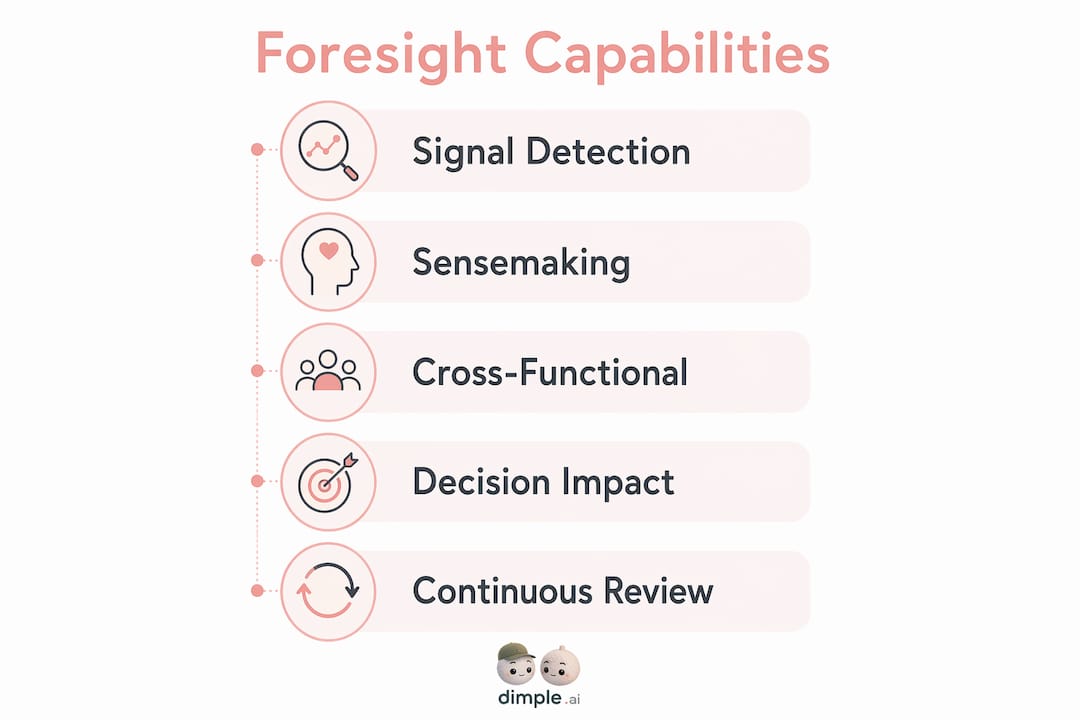
The process has five stages. Each one is faster and higher quality when digital tools are embedded in it.
- Scan. Continuously harvest signals from diverse sources. The goal is breadth and early detection, not depth at this stage.
- Sensemaking. Interpret what the signals mean in combination. This is where human judgement is irreplaceable.
- Scenario development. Build two to four plausible futures that bracket the uncertainty. Avoid the trap of building one "most likely" scenario.
- Test and stress. Run your current strategy against each scenario. Where does it break? Where does it hold?
- Integrate and monitor. Embed the scenarios and signals into governance cycles, resource allocation decisions, and product roadmaps. Then keep scanning.
Where to look when scanning
A well-structured trend opportunity scanning process draws from multiple source types simultaneously:
- Patent filings and technology licensing activity
- Earnings-call transcripts and investor presentations
- Regulatory consultation documents and parliamentary committee reports
- Academic preprints and conference proceedings
- Social listening across professional networks and specialist forums
- Specialist signal feeds covering your sector
The diversity of sources matters as much as the volume. A signal that appears in patent data, regulatory consultation, and social discourse simultaneously is far more credible than one appearing in only one channel.
How to structure sensemaking sessions
AI-based foresight workshops show that the most effective sensemaking sessions combine AI-generated pattern detection with structured human interpretation. Bring together people from strategy, operations, product, legal, and finance. Use red-team framing: assign one group to argue why each signal matters and another to argue why it does not. Build competing narratives and then test them against your current strategy.
Pro Tip: Cross-functional involvement is not optional. Foresight sessions dominated by strategy or innovation teams alone tend to produce insights that never reach the people who could act on them. Operations, legal, and finance need to be in the room from the start.
How does foresight change practical decision-making?
Abstract arguments for foresight rarely move leaders. Two concrete use cases illustrate the decision-level difference.

Product roadmap pivot. A technology company scanning patent filings and developer community activity spots a shift in underlying infrastructure preferences twelve months before it reaches mainstream analyst coverage. Without foresight, the product team continues building on the existing stack and faces a costly rebuild eighteen months later. With foresight, the team redirects 20% of engineering capacity early, arriving at the transition point with a working product rather than a debt-laden one.
Supply-chain contingency planning. A manufacturer monitoring supplier financial health signals, shipping-route disruption data, and regulatory changes in key source markets identifies a concentration risk in a single geography. The foresight team builds two contingency scenarios. When disruption arrives, the company activates a pre-negotiated alternative supplier rather than entering a spot market at peak prices.
The before/after pattern across both cases is consistent:
- Decision quality improves because options are generated before urgency collapses the choice set.
- Timing improves because the organisation is not waiting for a crisis to trigger analysis.
- Resource allocation improves because capital is committed to opportunities with scenario evidence, not just executive intuition.
Early signal detection is what makes the timing advantage real. The measurable outcomes leaders care about — reduced time to pivot, better capital allocation, lower cost of risk mitigation — all trace back to the same root cause: knowing earlier.
Which digital and AI-enabled tools actually help with foresight?
The tool landscape for foresight falls into five functional categories. Understanding what each category does prevents the common mistake of buying a dashboard and calling it a foresight programme.
- Signal detection and harvesting. Tools that continuously scan public data sources, patent databases, news feeds, and social platforms to surface emerging signals. This is where AI pattern recognition adds the most speed advantage.
- NLP trend scoring. Natural language processing applied to large text corpora (earnings calls, research papers, regulatory filings) to score and rank emerging themes by velocity and novelty.
- Network and patent analysis. Graph-based tools that map technology relationships, inventor networks, and citation patterns to identify where innovation is concentrating.
- Scenario modelling. Structured tools for building, documenting, and stress-testing scenarios against strategic plans. Some integrate directly with financial modelling environments.
- Visual dashboards and signal boards. Interfaces that make signals and trends visible to leadership teams without requiring them to engage with raw data.
How to evaluate vendors
When selecting tools, UK organisations should weight five criteria:
- Transparency and explainability. Can the tool show you why a signal was flagged? Opaque AI outputs create foresight paralysis, not foresight capability.
- UK data compliance. Does the tool handle data in line with UK GDPR and, where relevant, sector-specific regulations? Check data residency and processing agreements carefully.
- Integration capability. Can the tool connect to your existing data workflows? Tools that require manual data export and import will not sustain a continuous scanning habit.
- Signal coverage. Does the tool cover the specific domains and geographies that matter to your strategy? Generic global coverage is less useful than deep coverage of your relevant sectors.
- Accuracy tracking. Does the vendor publish prediction accuracy data? Platforms that track their own signal quality over time are far more trustworthy than those that do not.
Pro Tip: Combine automated signal streams with structured human workshops rather than relying on either alone. AI surfaces patterns faster than any team can manually. Humans negotiate meaning in ways no model currently replicates. The combination is where AI-based foresight methods deliver their strongest results.
For leaders evaluating AI tools, AI trend prediction methods provide a practical framework for assessing which approaches suit different organisational contexts. You can also validate emerging product ideas quickly using a tool like Spark Concept's idea checker before committing foresight resources to a full scenario build.
How do you implement digital foresight in your organisation?
Implementation fails most often not because the tools are wrong but because the governance and roles are unclear. A structured approach prevents that.
Roles you need
- Executive sponsor. A C-suite or senior leader who owns foresight as a strategic priority and ensures insights reach decision-making forums.
- Signal owner. The person responsible for the day-to-day scanning operation, source curation, and weekly signal briefings.
- Analytics lead. Manages the technical infrastructure, tool integrations, and data quality.
- Domain experts. Subject-matter specialists (legal, operations, product, finance) who validate signal relevance and contribute to sensemaking sessions.
- Change manager. Ensures foresight insights are translated into governance processes and that the organisation builds the habit, not just the capability.
Timeline from pilot to embedded practice
| Phase | Duration | Key milestones |
|---|---|---|
| Quick-start | Weeks 1–4 | Assign signal owner; select two to three source domains; choose scanning tool; run first signal briefing |
| Pilot | Weeks 8–12 | Run structured scanning across chosen domains; hold two sensemaking workshops; produce first scenario set; measure signal quality |
| Embed | Months 5–12 | Integrate scenarios into strategy cycle; link signals to resource allocation triggers; expand domain coverage; review and report on outcomes |
Cost considerations for UK organisations
Costs vary considerably depending on scale, tooling choices, and whether you build internal capability or use external facilitation. A conservative pilot for a mid-sized UK organisation typically runs in the range of £15,000–£40,000 covering tool licences, facilitation, and internal time. Enterprise-scale programmes with dedicated teams, multiple tool integrations, and continuous monitoring can reach £150,000–£400,000 annually. The primary cost drivers are the number of domains scanned, the depth of scenario work, and whether you need external expertise to build internal capability.
Embedding foresight into governance and resource allocation is what converts early signals into funded projects. Without that link, even excellent scanning produces reports that sit unread.
What does recent research show about AI and foresight capability?
The evidence base for combining digital tools with structured foresight has strengthened considerably. The Q1 2026 study published in the International Journal of Advanced Research in Economics and Management Sciences provides the most comprehensive framework to date, demonstrating that AI, IoT, big data analytics, blockchain, and social media applications collectively reinforce all three pillars of strategic foresight.
"When SMEs integrate AI, IoT, big data analytics, blockchain and social media applications, they enhance their dynamic capabilities to sense early signals of change, seize opportunities through informed decisions and reorganise resources with greater agility. Through digital transformation, foresight becomes a continuous organisational practice that informs everyday decisions rather than an occasional planning activity."
— Reimagining strategic foresight through the lens of digital technology adoption
The study's framework is grounded in Dynamic Capability Theory, which describes how organisations adjust to changing market conditions by sensing opportunities, seizing them, and reconfiguring resources. Digital technologies accelerate all three steps. AI strengthens cognitive sensing. IoT extends monitoring reach. Blockchain improves transparency in supply-chain signals. Social media analytics surfaces customer and competitive signals in near real time.
The HBR analysis adds the urgency dimension: organisations that integrate continuous monitoring into their strategic cycles adapt faster than those relying on periodic annual planning. The spike in uncertainty references in earnings calls is not just a sentiment measure. It reflects a structural shift in how executives perceive their operating environment, and it correlates with increased demand for systematic foresight capability.
A practical illustration of platform-based scanning: an organisation using an AI signal platform to monitor patent filings and regulatory consultations simultaneously can surface a converging technology-regulation signal weeks before it appears in analyst reports. That lead time is the anticipatory advantage in practice.
What are the most common pitfalls when building digital foresight?
Most foresight programmes fail for predictable reasons. Knowing them in advance is half the solution.
- Treating foresight as a one-off project. A single scenario workshop produces a document. A continuous scanning habit produces a capability. The remedy is to schedule recurring signal briefings and embed foresight reviews into quarterly governance cycles.
- Over-reliance on opaque AI outputs. If your team cannot explain why a signal was flagged, they will not act on it. Require explainability from any tool you adopt, and build human validation into every sensemaking session.
- Lack of governance. Foresight without decision triggers produces insight paralysis. Set explicit rules: if signal X reaches threshold Y, it triggers a defined review or resource allocation conversation.
- Failing to act on insights. The most common failure mode is producing excellent foresight and then watching it sit in a slide deck. Connect every scenario to at least one funded option or contingency plan.
Emerging trend scouting frameworks consistently show that organisations which assign clear ownership and accountability for acting on signals outperform those that treat foresight as a shared but unowned responsibility.
Pro Tip: Keep governance light but explicit. A one-page decision protocol that specifies signal thresholds, review owners, and escalation paths is enough. Heavy governance frameworks slow foresight down to the point where signals are stale by the time they reach a decision-maker.
Key takeaways
Digital foresight delivers anticipatory advantage by embedding continuous AI-assisted signal detection into governance cycles, converting early signals into funded strategic options before disruption forces reactive decisions.
| Point | Details |
|---|---|
| Anticipatory advantage is the core benefit | Organisations that sense change early generate more strategic options and make better-timed decisions. |
| The process has five stages | Scan, sensemaking, scenario development, stress-testing, and integration must all be present for foresight to work. |
| Governance converts insight into action | Without decision triggers and clear ownership, even excellent scanning produces reports that go unread. |
| Continuous practice beats one-off projects | Embedding weekly signal briefings and quarterly foresight reviews builds organisational capability over time. |
| Ontherice provides AI-driven signal detection | The platform scans global data to surface ranked early signals, supporting rapid pilots and ongoing foresight programmes. |
The case for treating foresight as a daily habit, not a quarterly event
The conventional wisdom positions strategic foresight as something organisations do during annual planning cycles or when a crisis prompts a review. That framing is wrong, and the evidence is clear about why.
Foresight capability is built through repetition. A team that reviews signals weekly, debates their meaning in short structured sessions, and connects findings to live decisions develops genuine anticipatory muscle. A team that runs a scenario workshop once a year and files the output develops a document archive.
The more interesting argument is about what foresight is not. It is not prediction. The goal is never to identify the single most likely future and bet on it. The goal is to hold multiple plausible futures simultaneously and build strategies that are robust across them. That distinction changes everything about how you structure the process, how you evaluate tools, and how you measure success. A foresight programme that produces one confident forecast is doing it wrong. One that produces three or four well-tested scenarios with clear decision triggers is doing it right.
For UK leaders, the practical implication is this: start smaller than you think you need to, but start continuously. An eight-week pilot with one signal owner, two source domains, and a single sensemaking session will teach you more about your organisation's foresight readiness than any consultant's framework. The pilot is the capability-building exercise, not just the proof of concept.
Ontherice: a practical starting point for your foresight pilot
The hardest part of building a foresight capability is not the strategy. It is finding a reliable, transparent signal source that your team can actually work with in a short pilot window.
Ontherice scans global public data continuously, surfaces ranked early signals across finance, technology, products, jobs, and brands, and publishes its prediction accuracy so you can evaluate signal quality before committing to a full programme. For UK leaders running an initial pilot, the B2B signal feeds give you structured, scored signal data across multiple domains without requiring a large technical build. The platform's AI opportunity feeds are particularly useful for leaders who want to test AI-assisted scanning against a specific sector before scaling.
To run a structured pilot with Ontherice:
- Define your signals. Choose two to three domains most relevant to your current strategic questions.
- Run an 8–12 week pilot. Use the platform's signal feeds to brief your team weekly and hold two sensemaking sessions during the pilot window.
- Measure pilot outcomes. Track how many signals led to a strategic conversation, how many generated a funded option, and how signal quality compared to your existing sources.
Start your pilot at ontherice.org.
Useful sources and further reading
A short reading list for leaders who want to go deeper on digital foresight and strategic sensing:
-
What companies that excel at strategic foresight do differently — Harvard Business Review. Institutional analysis of foresight practices and the rising urgency of systematic sensing in corporate strategy. Practical and evidence-backed.
-
Why strategic foresight prepares organisations for the future — World Economic Forum. Authoritative institutional framing of foresight as a future-readiness capability, covering signal perception, impact prospecting, and solution testing.
-
Reimagining strategic foresight through the lens of digital technology adoption — IJAREMS, Q1 2026. Academic study demonstrating how AI, IoT, big data analytics, blockchain, and social media applications collectively strengthen the three pillars of strategic foresight. Theoretical but accessible.
-
Anticipating tomorrow: corporate foresight and prospective sensemaking — Academic journal. Examines how organisations combine structured foresight with social-cognitive sensemaking to navigate digital change. Includes the Kodak case as a cautionary example.
-
Future meets strategy: How companies can benefit from AI-based foresight — FZI Research Centre. Practitioner-oriented workshop resource on combining AI pattern detection with interactive trend validation. Useful for teams designing their first sensemaking sessions.
-
Strategic Foresight / Trend Research Readiness — ITU (International Telecommunication Union). Institutional guidance on foresight readiness from a global technology standards body. Useful for organisations in regulated or technology-adjacent sectors.
-
Guide to actionable foresight for business strategists — Ontherice Blog. Practical step-by-step guide to operationalising foresight, structuring trend opportunities, and converting signals into ranked insights. A useful companion to this article.
-
Digital Transformation and Foresight — Journal of Futures Studies. Foundational piece on the intersection of digital transformation and foresight practice. Academic but accessible for senior leaders.