
TL;DR:
- AI trend prediction surpasses traditional models by integrating diverse data streams and learning non-linear relationships. Combining human judgment with algorithmic insights creates a powerful, adaptable approach, especially when leveraging hybrid models and continuous signals. Relying solely on AI risks blind spots; integrating human expertise and rigorous validation is essential for reliable forecasting.
Most professionals assume AI trend prediction is simply a faster version of what spreadsheets already do, projecting yesterday's numbers forward with slightly more sophistication. That assumption is costly. Modern AI systems improve accuracy by 14–50% over classical statistical models by fusing diverse data streams, learning non-linear relationships, and processing signals that traditional tools cannot even see. This guide strips back the hype, explains how the methods actually work, and gives you a practical framework for putting AI trend prediction to work inside your organisation.
Table of Contents
- The essentials of AI trend prediction: models and methods explained
- How AI brings data together: sources, signals, and competitive advantage
- Benchmarks, accuracy, and where AI still falls short
- Nuance and myth-busting: when to trust AI, traditional models, or people
- Why blending AI and human insight is the real frontier in trend prediction
- Connect insights to action with OnTheRice
- Frequently asked questions
Key Takeaways
| Point | Details |
|---|---|
| AI outperforms tradition | AI models beat classical approaches in accuracy when quality data is available. |
| Hybrid models excel | Combined statistical and machine learning methods offer the best results for most businesses. |
| Data diversity matters | Incorporating sentiment, IoT, and economic signals gives AI its competitive edge. |
| Expert oversight is vital | Human judgement remains crucial to spot gaps, adjust for shocks, and avoid over-reliance. |
The essentials of AI trend prediction: models and methods explained
Trend prediction, at its core, is the process of identifying which patterns in data are likely to persist, accelerate, or reverse. For business analysts, this translates directly into trends and business decisions around inventory, product development, hiring, and competitive positioning. The model you choose to generate those predictions shapes both the quality of the output and the speed at which insights become actionable.
The landscape of forecasting models falls into four broad categories. Key methodologies include classical statistical models such as ARIMA and Prophet, tree-based machine learning methods like XGBoost and LightGBM, deep learning architectures such as LSTMs and Transformers, and hybrid approaches that combine statistical and machine learning techniques. Each category carries distinct trade-offs.
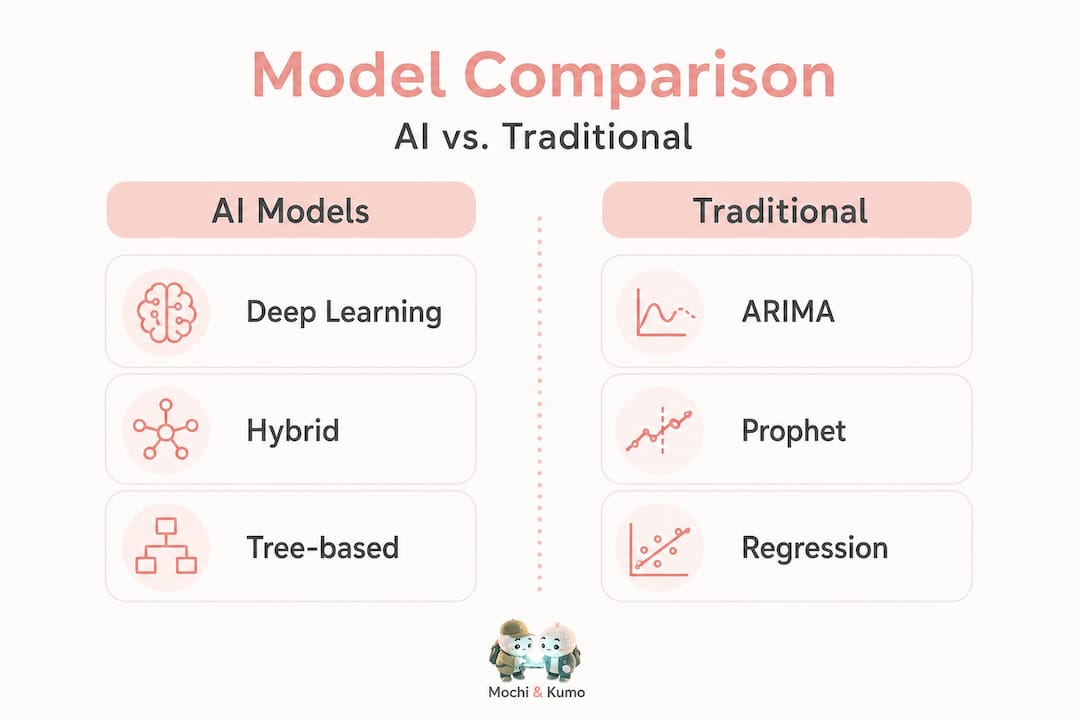
| Model type | Best suited for | Key strength | Main limitation |
|---|---|---|---|
| Classical (ARIMA, Prophet) | Regular, seasonal data with long history | Interpretable, fast to deploy | Assumes linearity; struggles with sudden changes |
| Tree-based (XGBoost, LightGBM) | Structured tabular data with engineered features | Robust, handles missing data well | Requires manual feature engineering |
| Deep learning (LSTM, Transformer) | Long sequences, complex non-linear patterns | Captures long-range dependencies | Needs large datasets; computationally intensive |
| Hybrid models | Varied real-world business data | Combines interpretability with accuracy | More complex to build and maintain |
For most business applications today, pure classical models leave performance on the table. Yet jumping straight to deep learning without sufficient data volume is equally problematic. The practical middle ground is the hybrid approach.
Pro Tip: Hybrid models are rapidly becoming the default in enterprise forecasting because they capture the explainability of classical methods while benefiting from the pattern-recognition power of machine learning. If your organisation is still running purely on ARIMA-style models, explore the trend forecasting process and consider a phased migration to hybrid pipelines.
Tree-based models like XGBoost deserve special mention for mid-sized businesses. They are computationally light, highly tolerant of messy or incomplete data, and can deliver strong results with relatively modest training sets. Pair them with well-engineered lag features (previous week's sales, rolling averages, seasonality flags) and they often outperform models that look far more sophisticated on paper.
Understanding these categories also helps you evaluate the AI opportunity models available in the market today. When a vendor claims their platform "uses AI," you now have the vocabulary to ask which type, and why.
How AI brings data together: sources, signals, and competitive advantage
Understanding the models is only half the story. Next, it is about where the data comes from and how bringing in more signals can set your business ahead of competitors who are still relying on internal sales data alone.
The real step-change in modern AI forecasting comes from data fusion, that is, the ability to combine heterogeneous data streams into a single coherent signal. AI incorporates diverse data sources via natural language processing (NLP) for sentiment analysis from social media and consumer reviews, IoT real-time device data, and macroeconomic indicators, improving predictions well beyond what historical sales records alone can achieve. NLP is particularly powerful because it can detect shifts in consumer language, product terminology, and sentiment weeks before those shifts appear in transaction data.
Consider the practical implications. A consumer goods company monitoring online discussions might detect a surge in negative sentiment around a packaging format months before returns spike. A logistics provider ingesting IoT telemetry from its fleet can predict maintenance demand before breakdowns occur. A financial analyst combining news sentiment with economic indicators can spot sector rotation earlier than peers relying purely on price history.

The table below summarises common non-traditional data sources and the sectors that gain the most from each:
| Data source | Type | Sectors benefiting most |
|---|---|---|
| Social media sentiment | Unstructured text | Retail, consumer brands, media |
| IoT sensor data | Real-time numerical | Manufacturing, logistics, energy |
| Economic indicators | Structured numerical | Finance, real estate, commodities |
| Online reviews and forums | Unstructured text | Technology, hospitality, healthcare |
| Satellite and geospatial imagery | Visual/spatial | Agriculture, retail footfall, mining |
Real-world AI trend examples show that businesses which layer even two or three of these non-traditional sources onto their existing models consistently produce sharper forecasts than those who do not. The barrier is rarely technical; it is usually organisational inertia.
Top three sources for actionable trend signals in 2026:
- Social media and forum data — consumer conversations often surface product demand shifts three to six weeks before they appear in sales data.
- Search query volume — rising search terms signal emerging consumer interest and can be tracked at near-zero cost via publicly available tools.
- Industry-specific IoT streams — real-time operational data provides leading indicators that lagging sales reports simply cannot replicate.
These industry signals are most powerful when they are monitored continuously rather than in periodic batch reviews. The competitive edge comes from being the first to act on a signal, not the first to notice it after everyone else already has.
Benchmarks, accuracy, and where AI still falls short
While richer data and smarter models offer rising promise, not every use case is covered and expectations must be grounded in evidence.
The headline numbers are genuinely impressive. Hybrid models reduce forecasting error by up to 92.9% compared to baseline statistical methods, and deep learning consistently delivers 14 to 50 percent accuracy improvements over traditional ARIMA models in domains like finance and demand forecasting. For a business running high-stakes inventory decisions or capital allocation cycles, those margins are commercially significant.
"Hybrid AI models combining statistical and machine learning approaches have demonstrated RMSE reductions of up to 92.9% against standard baselines, representing a step-change in what is achievable in applied forecasting."
However, the picture has important caveats. AI struggles significantly with limited historical data (such as forecasting demand for a new product category), structural breaks caused by sudden shocks like a pandemic or regulatory change, and highly volatile environments where the signal-to-noise ratio collapses. On complex, poorly defined events, AI large language models (LLMs) currently score a Brier score (a measure of forecast accuracy where lower is better) of 0.101 compared to 0.081 for expert human superforecasters. That gap matters.
For analysts seeking early market insights, the lesson is practical: use AI aggressively where you have rich, structured data and stable patterns; apply greater caution and human oversight in domains with sparse history or rapid structural change.
Checks and balances analysts must apply:
- Validate with holdout data — always test model performance on data the model has never seen before deployment.
- Monitor for data drift — the statistical properties of input data change over time; models trained on pre-2022 data may perform poorly on 2026 markets.
- Stress-test against known shocks — simulate how your model would have performed during a known disruption to understand its resilience.
- Document assumptions explicitly — every model rests on assumptions; make them visible so they can be challenged and updated.
- Pair with expert review cycles — schedule regular human reviews of model outputs, especially before major strategic decisions.
These disciplines are exactly what distinguishes organisations that gain competitive advantage from disruptive trends versus those that are blindsided by them.
Pro Tip: Avoid deploying any AI forecasting model as a true black box in a business-critical process. Even where model internals are complex, insist on explainability layers (SHAP values, feature importance scores) that let analysts understand which signals are driving the output.
Nuance and myth-busting: when to trust AI, traditional models, or people
Analysis means understanding not only what works best most of the time, but also what to do when the data or the stakes change.
The honest answer is that no single approach dominates across all conditions. AI excels in data-rich, stable scenarios but carries black-box risks and a strong dependency on data quality. Traditional statistical models offer interpretability and remain the right choice when data is limited, the audience requires explanation, or auditability is a regulatory requirement. Human forecasters, particularly experienced domain experts, routinely outperform both when the situation involves novel conditions, complex geopolitical dynamics, or thinly traded markets.
| Scenario | Best approach | Reason |
|---|---|---|
| High-volume, stable historical data | AI (deep learning/hybrid) | Pattern complexity exceeds human capacity |
| New product or market entry | Traditional + expert overlay | Insufficient data for training AI models |
| Regulatory or compliance context | Classical statistical | Interpretability and auditability required |
| Complex geopolitical or macro events | Human superforecasters | Contextual reasoning beats pattern recognition |
| Fast-moving consumer sentiment | AI with NLP integration | Speed and scale of signal processing |
LLMs represent a distinct and rapidly evolving category. They bring genuine value in summarising qualitative intelligence, identifying emerging trends from unstructured text, and generating scenario narratives. But they are not replacements for rigorous quantitative forecasting, at least not yet.
Signs you may be over-relying on automated predictions:
- Your team cannot explain why the model recommended a particular action.
- Forecast outputs are accepted without any sanity checking against market realities.
- Edge cases and structural breaks receive no special attention or human review.
- Model performance is evaluated only on average accuracy, ignoring tail risks.
- There is no process for incorporating new qualitative intelligence into model updates.
Each of these warning signs represents a real, recurring failure mode in organisations that move too quickly from "AI pilot" to "AI-dependent operation."
Why blending AI and human insight is the real frontier in trend prediction
The organisations consistently winning the competitive forecasting battle are not the ones with the most sophisticated models. They are the ones that have built a genuine capability to combine algorithmic output with structured human judgment, and know precisely when to trust which.
Here is a counter-intuitive insight: excessive faith in AI forecasting often reflects a deficit of analytical maturity, not an abundance of it. Teams that understand the limitations deeply are the ones most effective at extracting value. They treat AI outputs as strong prior evidence rather than settled conclusions, and they maintain the expert knowledge needed to challenge the model when something does not feel right.
Benchmarks from ForecastBench reveal that LLMs are approaching but not yet surpassing human superforecasters, with parity projected by late 2026. The near-term gain, rather than waiting for AI to catch up entirely, is in ensemble approaches that combine LLM-generated hypotheses with quantitative model outputs and expert review. Retrieval-augmented prompting, where models draw on curated, up-to-date knowledge bases, is already improving the quality of AI-assisted forecasts in structured business contexts.
The businesses seeing the greatest return from AI forecasting share a pattern: they have invested as much in the human-side of the process, in training analysts, building review cadences, and documenting decisions, as they have in the technology. AI does not replace practical AI trend examples of strong analytical thinking; it amplifies them. The competitive edge of 2026 will belong to teams that treat AI as an intelligence partner, not an autonomous oracle.
True intelligence augmentation means your analysts spend less time aggregating data and more time asking better questions. The machine handles volume and pattern recognition. The human handles context, judgement, and the kind of lateral thinking that no training set can yet encode.
Connect insights to action with OnTheRice
Translating forecasting theory into competitive moves requires more than good models. It requires a platform that continuously monitors markets, surfaces early signals, and helps you act before trends reach mainstream awareness.
OnTheRice is built precisely for this. Our AI-powered trend tools scan global data streams to rank and score emerging opportunities across sectors, giving your team a real-time view of what is gaining momentum. If you are exploring specific sectors or looking for structured competitive intelligence, the AI trend opportunities section provides ranked insights drawn from multiple AI engines. For teams focused on business-to-business markets, our B2B trend signals tools surface early-stage shifts before they reach the broader commercial press. Put the frameworks from this guide into practice with data that is already doing the heavy lifting for you.
Frequently asked questions
What kinds of business data does AI use to predict trends?
Modern AI uses everything from sales records to IoT streams and online reviews, combining structured and unstructured sources for more accurate forecasts. Social media sentiment, economic indicators, and search data are increasingly standard inputs.
How much more accurate is AI trend prediction versus traditional methods?
Benchmarks show AI delivers between 14% and 50% greater accuracy than traditional models like ARIMA, with hybrid approaches reducing error rates by as much as 92.9% in applied settings.
Are there scenarios where humans beat AI at forecasting?
Yes. Expert forecasters outperform AI on new, highly complex, or poorly defined events where historical patterns offer no reliable guide, scoring meaningfully better on probability calibration benchmarks.
What is the biggest risk of relying on AI-only trend prediction?
Blindly trusting AI models exposes businesses to black-box errors and unexpected structural shifts that the model was never trained to anticipate, with no human check to catch them in time.