

TL;DR:
- Most businesses fail to see measurable returns from following trends without strategy. Effective trend analysis involves systematic signal collection, multi-method techniques, and proactive positioning. Relying solely on AI without human judgment risks hype, herd behavior, and missed strategic nuances.
Most businesses believe chasing the latest trend is enough to stay competitive. It is not. A striking 95% of enterprises report no measurable return on their AI investments, which exposes just how costly trend-following without strategy can be. The real advantage goes to those who analyse signals before a trend peaks, position early, and build adaptive capacity that outlasts the hype. This article walks you through proven methodologies for trend analysis, practical techniques for signal interpretation, and how to translate all of it into a durable market position. If you want to stop reacting and start anticipating, read on.
Table of Contents
- Understanding trend analysis: methodologies and frameworks
- Core techniques for analysing trends
- From trend spotting to strategic positioning
- Pitfalls and paradoxes: hype, AI, and adaptive advantage
- Beyond the headlines: our take on sustainable trend adoption
- Explore actionable tools for trend-driven business growth
- Frequently asked questions
Key Takeaways
| Point | Details |
|---|---|
| Signal collection is vital | Gathering weak and strong market signals enables accurate trend analysis. |
| Combine analytics methods | Using statistical, AI, and qualitative techniques leads to actionable insights. |
| Avoid chasing hype | Focus on sustainable, human-centric strategies instead of technology fads. |
| Turn trends into actions | Strategic adaptation and cross-team collaboration drive market positioning. |
| Adaptivity beats replication | Nimble, sensing organisations outperform those simply copying trends. |
Understanding trend analysis: methodologies and frameworks
Trend analysis is not about reading headlines. It is a structured process of collecting signals from the market, interpreting what they mean, and deciding what action to take before your competitors do. Done well, it removes guesswork from strategic planning and replaces it with evidence.
The foundation is a systematic process. Trend forecasting frameworks typically follow five steps: signal collection, pattern recognition, relevance filtering, scenario modelling, and strategic response. Each step builds on the last. Skipping signal collection, for instance, means your pattern recognition has nothing reliable to work with.
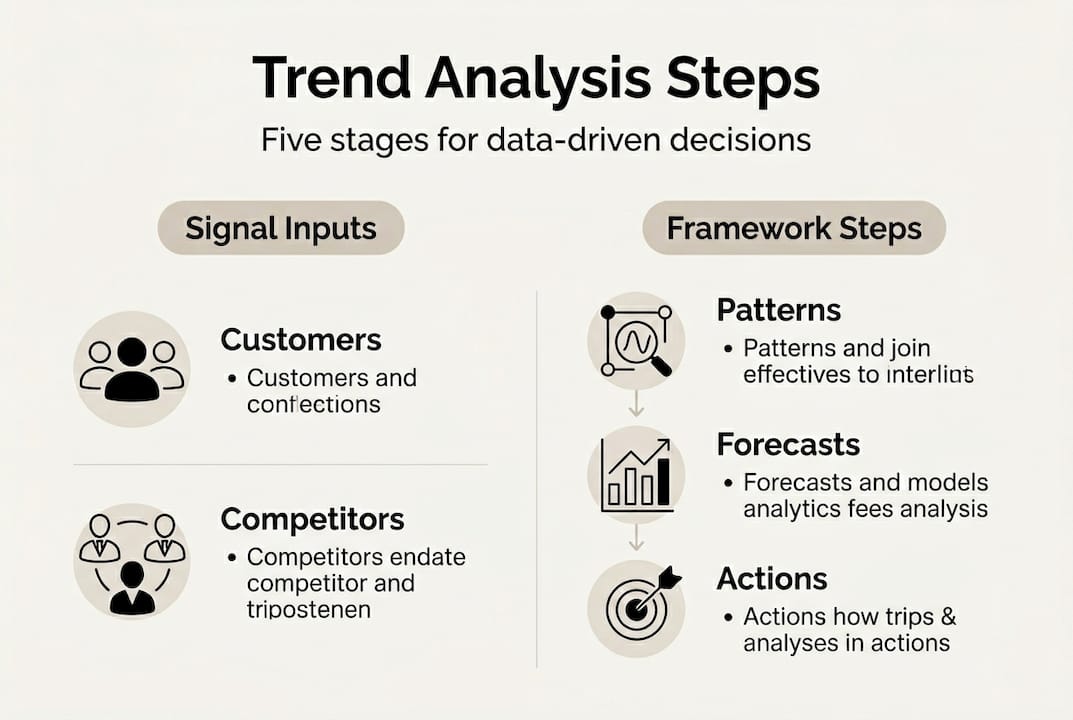
Where you collect signals matters enormously. Consider the three primary sources and what each reveals:
| Signal source | What it reveals | Typical lead time |
|---|---|---|
| Customers | Shifting needs and emerging frustrations | 3 to 6 months |
| Competitors | Strategic pivots and product bets | 1 to 3 months |
| Regulators | Future constraints and compliance pressures | 6 to 24 months |
Regulatory signals are chronically underused. Most businesses focus on competitors, but a pending regulation can reshape an entire category long before a competitor moves.
For deeper pattern work, trend analysis methodologies vary from qualitative horizon scanning to quantitative time series modelling. The most effective approaches combine both. Qualitative methods catch weak signals that data alone cannot yet quantify. Quantitative methods confirm whether a signal is growing or fading.
Key reasons signal collection matters:
- Early positioning: Signals caught 12 months out allow for considered strategy, not reactive pivots
- Resource allocation: Understanding which trends are accelerating helps you invest where it counts
- Risk reduction: Filtering noise from signal prevents costly bets on passing fads
- Cross-team alignment: Shared signal intelligence aligns sales, product, and leadership around the same future
To sharpen your signal reading, explore trend analysis techniques that combine multiple data sources for more accurate forecasting. The discipline is learnable. The competitive edge it delivers is real.
Core techniques for analysing trends
Frameworks tell you what steps to follow. Techniques tell you how to do the work. The distinction matters because choosing the wrong technique for your data type wastes time and produces misleading conclusions.
The most useful toolkit draws from several disciplines. Key techniques include statistical analytics, data mining, sentiment analysis, machine learning, benchmarking, surveys, MaxDiff, TURF, and conjoint analysis. That range might look overwhelming, but in practice you only need a few at any one time.
Here is how the most widely used techniques compare in practice:
| Technique | Best for | Data requirement |
|---|---|---|
| Time series analysis | Spotting directional momentum | Historical numeric data |
| Sentiment analysis | Reading market mood shifts | Social and review text |
| Machine learning | Pattern detection at scale | Large, varied datasets |
| Conjoint analysis | Understanding trade-off preferences | Survey responses |
| Benchmarking | Contextualising your position | Competitor or industry data |
The numbered steps for running a multi-method trend analysis:
- Start with quantitative data to identify statistical patterns across a defined time period
- Layer in sentiment analysis to understand the emotional context behind the numbers
- Use machine learning to surface non-obvious correlations that manual review would miss
- Validate findings with qualitative methods such as interviews or expert panels
- Benchmark results against industry data to assess relative momentum
Why does multi-method analysis matter? Because a single technique gives you a partial picture. Time series data might show a category growing, but sentiment analysis could reveal that growth is driven by complaints rather than enthusiasm. That distinction changes your strategic response entirely.
To stay ahead of current business trends, you need tools that process signals at speed and at scale. Platforms that use AI tools for trend monitoring do the heavy lifting on data aggregation, leaving you free to focus on interpretation and decision-making.
Pro Tip: Resist the urge to rely on a single technique. Combining sentiment signals with statistical trend lines consistently produces more actionable insight than either method alone. Blend your sources before drawing conclusions.
For teams exploring AI opportunities in trend analysis, the key is using AI as an amplifier of human judgement, not a replacement for it.
From trend spotting to strategic positioning
Spotting a trend is the easy part. Turning it into a competitive advantage requires deliberate strategy, cross-functional alignment, and the discipline to act before certainty arrives.

Proactive weak signal monitoring and cross-functional alignment are what separate businesses that capitalise on trends from those that merely observe them. A trend spotted only by the marketing team rarely reaches product or operations fast enough to matter.
Strategic positioning from trend analysis typically involves three moves:
- Scenario planning: Build two or three plausible futures based on different signal trajectories, then identify decisions that make sense across all of them
- No-regret actions: Invest in capabilities or assets that pay off regardless of which scenario unfolds
- Option creation: Make small, reversible bets that give you the right to move quickly if a trend accelerates
Scenario planning is where many businesses underinvest. They want certainty before committing, but Deloitte Human Capital Trends research consistently shows that leaders who act on probabilistic signals outperform those who wait for consensus.
"The businesses that win from trend analysis are not the ones with the most data. They are the ones who act on early signals while others are still debating whether the trend is real."
Pro Tip: Create a simple trend response matrix. Map each identified trend against two axes: probability of acceleration and impact on your core business. Focus your resources on high-probability, high-impact signals first.
For businesses monitoring B2B signal monitoring across supply chains and partner ecosystems, the same principle applies. Align your procurement, sales, and product teams around the same signal data so strategic moves happen in concert rather than in silos.
Avoid reactive pivots. The most damaging trend-related decisions we observe are businesses abandoning a working strategy to chase a trend that peaked six months earlier. Sustainable positioning is built on signals caught early, not headlines read late.
Pitfalls and paradoxes: hype, AI, and adaptive advantage
Not every trend deserves your attention. In fact, chasing the wrong ones can set you back further than ignoring trends altogether. The data here is sobering.
Deloitte found that 70% of leaders now prioritise speed in decision-making, yet AI-centric approaches are 1.6 times less likely to exceed ROI expectations than human-led adaptive strategies. Speed without direction is just expensive chaos.
The problem with AI-only trend strategies:
- AI tools identify patterns but cannot evaluate strategic fit with your specific context
- Reflexivity bubbles form when too many businesses chase the same AI-identified signal simultaneously
- 95% of enterprise AI investments fail to deliver measurable ROI, often because deployment outpaces understanding
- Human judgement remains the irreplaceable filter between signal and strategy
The AI campaign ROI tips that consistently work share one trait: they combine machine-generated signals with experienced human interpretation. Businesses that skip the human layer tend to act on noise rather than signal.
Reflexivity is a real risk. When every major player in a category uses the same AI tools to identify the same trends, they all move in the same direction at the same time. The trend becomes self-defeating. The businesses that benefit are the ones who used AI tools pitfalls awareness to stay one step removed from the herd.
Practical ways to avoid hype traps:
- Cross-reference AI-identified signals with qualitative research before committing resources
- Set a clear threshold for what constitutes a trend worth acting on versus monitoring
- Review your trend assumptions quarterly and retire those that have not gained traction
- Build adaptivity into your team structure so pivoting is low-cost, not disruptive
Adaptivity beats replication. Copying what competitors do with trends is a losing strategy because you will always be second. Building the internal capacity to sense, interpret, and respond faster than others is the real competitive moat.
Beyond the headlines: our take on sustainable trend adoption
Most trend advice you read follows the same pattern: here is a trend, here is why it matters, here is how to adopt it. That framing is backwards.
The businesses we see gaining lasting advantage are not the ones adopting the most trends. They are the ones who have built a continuous sensing capability and the organisational flexibility to act on what they find. Trend adoption is a symptom of good strategy, not the strategy itself.
Conventional wisdom overvalues future chasing. It creates a culture of anxiety where businesses are perpetually worried about missing the next wave. The more useful question is not "what is the next trend?" but "what do we need to be true about our market for our current strategy to hold?"
Invest in human capacity and rising tech signals literacy across your organisation. When your whole team can read and interpret signals, you stop relying on a single analyst or consultant and start building collective intelligence. That is a durable advantage that no trend can make obsolete.
Explore actionable tools for trend-driven business growth
Understanding trend analysis is one thing. Having the right intelligence infrastructure to act on it consistently is another.
OnTheRice.org gives business professionals and entrepreneurs access to AI-powered signal analysis across dozens of market categories. Whether you are tracking emerging markets analysis to find your next growth opportunity, refining your B2B signal strategy to stay ahead of partner and competitor moves, or using website traffic signals to validate market momentum before committing, the platform translates raw data into clear, ranked intelligence. Early signals. Real decisions. Competitive edge before the mainstream catches on.
Frequently asked questions
What is the first step to using trend analysis in business?
Signal collection from customers, competitors, and regulators is the foundational first step. Without reliable input signals, every subsequent stage of trend analysis produces unreliable output.
What techniques are best for identifying emerging trends?
Combining statistical analytics, sentiment analysis, and machine learning delivers the broadest and most accurate picture. Multi-method analysis blends quantitative momentum data with qualitative context, reducing the risk of acting on noise.
Why do many AI-driven business strategies fail to deliver ROI?
AI-only approaches lack the human adaptivity needed to filter signal from noise in context-specific situations. AI-centric strategies are 1.6 times less likely to exceed ROI expectations precisely because they undervalue human judgement in the interpretation layer.
How can trend analysis drive market positioning?
Proactive monitoring combined with cross-functional strategy alignment translates trend analysis into real positioning moves. Cross-functional alignment ensures that insights move from analyst to decision-maker to action without losing momentum or context.