
TL;DR:
- AI-driven market trend discovery offers over 95% backtested forecasting accuracy.
- Combining AI with human expertise provides the most effective approach for early trend detection.
- Regular, cross-validated reviews and real-time data sources are essential for actionable insights.
Trend detection is not guesswork, even though most businesses still treat it that way. The organisations that consistently move first are not clairvoyant; they have better intelligence systems. AI-driven market trend discovery has shifted the playing field entirely, with AI forecasting achieving over 95% backtested accuracy in leading benchmarks. This article breaks down exactly how that works, why it matters to analysts and business leaders right now, and what practical steps you can take to embed reliable early-signal detection into your decision-making process.
Table of Contents
- Why market trend discovery matters more than ever
- The process behind AI-driven market trend discovery
- AI vs. traditional methods: Finding the optimal blend
- Actionable strategies for market analysts and business leaders
- Why most market trend guides miss the mark
- Explore advanced trend discovery solutions
- Frequently asked questions
Key Takeaways
| Point | Details |
|---|---|
| Early insights drive advantage | AI-powered trend discovery lets businesses spot opportunities before competitors react. |
| Hybrid approach is best | Combining AI with human skills yields more accurate and actionable market analysis results. |
| Routine validation matters | Successful analysts validate findings across multiple sources and methods weekly. |
| Diverse data fuels reliability | Using social, CRM, sales, and industry data ensures AI analyses are comprehensive and robust. |
Why market trend discovery matters more than ever
Spotting a trend at its peak is already too late. By the time a shift shows up in a quarterly industry report, the fastest movers have already reallocated budget, repositioned product lines, and locked in supplier agreements. The competitive cost of being late is not just missed revenue; it is the compounding disadvantage of playing catch-up while others build scale.
The demand for better intelligence is reflected in the numbers. The business intelligence market is projected to reach $86.7 billion by 2030, growing at a 13.7% compound annual growth rate. That is not simply investment in faster spreadsheets. It signals a wholesale shift in how organisations approach strategic information.
"The question is no longer whether to invest in market intelligence. It is whether you can afford to fall behind the organisations that already have."
There are several core reasons why early trend discovery has become a strategic imperative rather than a nice-to-have:
- Revenue protection: Industries that shift quickly, such as retail, fintech, and health technology, punish companies that react slowly. Early signals allow you to protect margins before disruption erodes them.
- Competitive differentiation: Knowing what your competitors have not yet noticed is a genuine and measurable advantage, particularly in crowded markets.
- Capital allocation: Investors and leadership teams increasingly demand evidence-based forecasts. Trend intelligence makes it easier to justify investment decisions before consensus forms.
- Product and service development: Consumer preferences shift in patterns. Catching those patterns early gives product teams time to respond rather than scramble.
Following market intelligence trends in 2026 shows that the gap between early adopters and late movers has widened considerably as AI tools improve. Understanding how trends shape business decisions is no longer an abstract exercise; it is the difference between leading and lagging in your sector.
The process behind AI-driven market trend discovery
Understanding what happens under the hood makes the technology far less intimidating and far more actionable. AI trend discovery is not a single algorithm making a single prediction. It is a layered, multi-phase process that combines data breadth with statistical rigour.
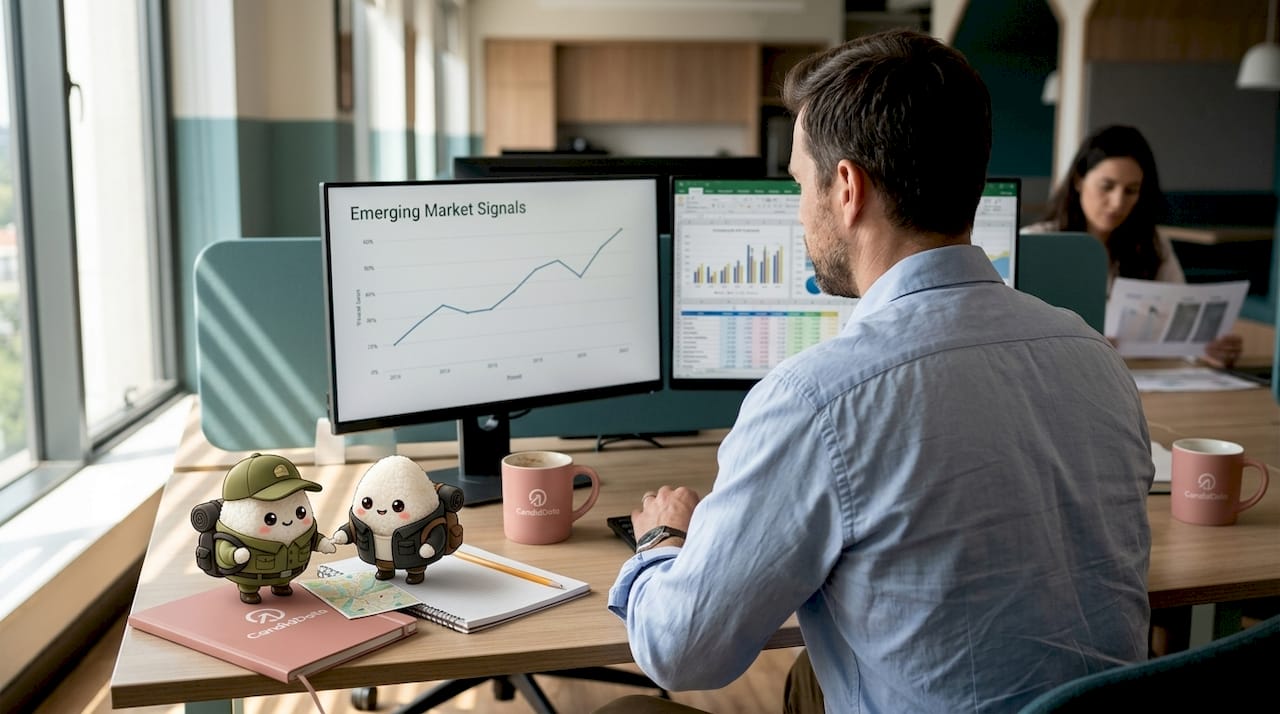
The quality of any trend model starts with its inputs. Key data sources used by leading AI platforms include social media APIs, CRM systems, sales data, industry reports, and ongoing competitor monitoring. The breadth of these sources is critical because no single channel tells the whole story. A spike in social sentiment combined with a rise in relevant job postings and a shift in search volume is far more meaningful than any single signal in isolation. Those social data signals are particularly valuable because they often move before formal reporting catches up.
Here is the typical sequence of an AI-driven trend discovery process:
- Data collection: Automated pipelines pull from dozens of sources simultaneously, including social platforms, news feeds, financial filings, patent databases, and consumer review networks.
- Data cleaning: Raw data is noisy. Algorithms remove duplicates, filter spam, normalise formats, and flag anomalies before any analysis begins.
- Feature engineering: This is where raw information is transformed into variables the model can learn from. Examples include sentiment scores, frequency rates, geographic spread, and rate-of-change metrics.
- Model training and application: Machine learning models, often a combination of natural language processing, time-series forecasting, and clustering algorithms, identify patterns and generate trend scores.
- Cross-referencing: Signals found in one data stream are checked against others to filter out noise and confirm genuine momentum.
- Validation and human review: Automated outputs are reviewed against known benchmarks and, in strong hybrid models, assessed by human analysts for contextual accuracy.
| Phase | Primary tool | Output |
|---|---|---|
| Data collection | API integrations | Raw multi-source dataset |
| Cleaning | Automated pipelines | Structured, usable data |
| Feature engineering | Statistical processing | Variables and scores |
| Model application | ML and NLP algorithms | Trend predictions |
| Validation | Cross-referencing and human review | Confidence-rated signals |
The dynamic market tools benefits become clear when you see this process run continuously rather than quarterly. Real-time processing means you are not waiting for a report to tell you what happened last month. You are seeing what is building right now. For actionable trend examples, this translates directly into product pivots, market entry decisions, and competitive responses made weeks or months ahead of the broader market.
Pro Tip: Do not evaluate an AI trend platform solely on its algorithm. Evaluate the breadth and freshness of its data sources. A brilliant model fed stale data will produce confidently wrong predictions.
AI vs. traditional methods: Finding the optimal blend
There is a temptation to frame this as AI versus human analysts. That framing is both inaccurate and counterproductive. The real question is how to combine the distinct strengths of each.
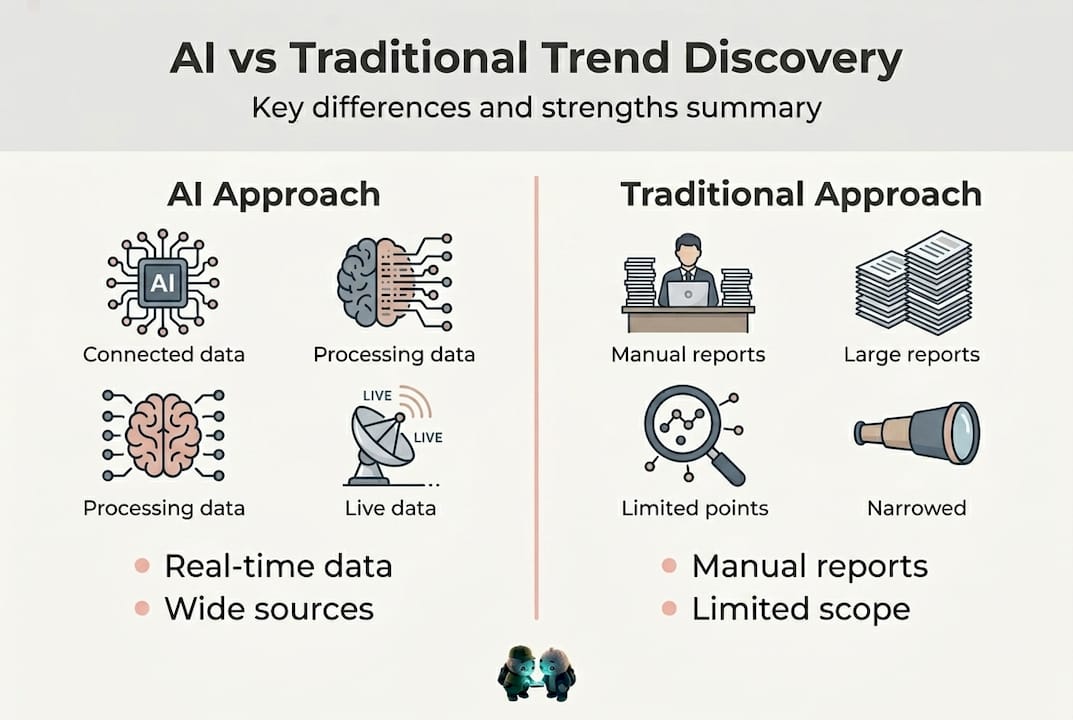
AI tools excel at scale, speed, and consistency. They can monitor thousands of data points simultaneously, flag emerging patterns in real time, and do so without fatigue or confirmation bias. Traditional methods, including expert interviews, ethnographic research, and strategic workshops, provide something AI still struggles to replicate: nuanced context. An algorithm can tell you that conversation around a particular ingredient in the food industry is rising sharply. A human analyst can tell you whether that rise reflects genuine consumer demand or a short-lived media cycle.
Research from Harvard Business Review confirms that the hybrid approach is now considered optimal: AI handles speed, scale, and real-time monitoring, while human expertise contributes primary research, contextual interpretation, and strategic validation.
| Capability | AI-driven approach | Traditional approach |
|---|---|---|
| Speed | Near real-time | Days to weeks |
| Data volume | Thousands of sources | Dozens at best |
| Contextual nuance | Limited | Strong |
| Cost at scale | Low | High |
| Bias management | Algorithmic bias risk | Human confirmation bias risk |
| Strategic interpretation | Weak | Strong |
This table makes clear that neither approach is categorically superior. The AI tools for trends available in 2026 are extraordinary at pattern recognition and continuous monitoring. But they still need informed humans to ask the right questions, interpret surprising outputs, and decide what to act on. Looking at disruptive trend examples from the past five years confirms that the companies that moved fastest and most successfully were those using AI as an amplifier of human judgement, not a replacement for it.
For teams building or upgrading their intelligence workflows, the trend discovery strategies outlined in leading frameworks consistently recommend starting with a clear decision question rather than a technology choice. Ask what decisions you need to make faster, then build your data and AI infrastructure around those specific needs.
Pro Tip: When evaluating a hybrid model for your organisation, map your existing human analyst time. You will likely find they spend 60 to 70 percent of their time on data gathering. AI can absorb that load and redirect your best people toward interpretation and strategy.
- Identify which decisions in your business are most time-sensitive
- Audit current data sources for gaps in real-time coverage
- Define what a "confirmed" trend signal means for your industry specifically
- Build a review cadence that matches your competitive environment, not a generic quarterly cycle
- Ensure your AI outputs are always reviewed against at least one qualitative source
Actionable strategies for market analysts and business leaders
Knowing that AI trend discovery works is one thing. Knowing how to embed it into your regular workflow is where most guides fall short. Here are the practical steps that separate organisations that extract competitive value from those that simply pay for a subscription they never fully use.
-
Establish weekly trend reviews: A weekly rhythm is the minimum frequency for meaningful trend monitoring in fast-moving industries. Monthly reviews are almost always retrospective rather than predictive. Set a fixed day and format, assign ownership, and treat it as a non-negotiable strategic ritual.
-
Cross-validate across multiple algorithms and sources: No single AI model has a monopoly on accuracy. The most robust signals are those that appear independently across multiple platforms and methodologies. If only one tool flags a trend, treat it as a hypothesis. When three independent sources corroborate it, treat it as actionable.
-
Prioritise leading indicators over lagging ones: Implementing weekly reviews and focusing on leading indicators such as job postings, patent filings, and sentiment shifts gives analysts a genuine time advantage over those relying on revenue data or published reports. Job postings, for instance, reliably signal where companies are investing before any product or announcement is public.
-
Use prescriptive AI for recommended actions: Most platforms offer descriptive analytics (what is happening) and predictive analytics (what will likely happen). Prescriptive AI goes a step further and recommends specific responses. If your platform offers this capability, use it. It converts intelligence into decision support, not just information.
-
Track sector-level momentum alongside firm-level signals: Firm-level data tells you about your competitors. Sector-level momentum tells you where the whole market is heading. Both layers are necessary for a complete picture.
-
Build a signal library: Document every trend signal you observe, whether it materialises or not. Over time, this creates a pattern library specific to your industry that improves your team's intuition and your AI model's calibration.
Understanding industry momentum tracking at a granular level separates analysts who advise confidently from those who hedge everything. Equally, acting on early advantage signals before they become consensus requires both the right tools and the organisational confidence to move before full certainty exists.
Pro Tip: Sentiment shifts in online communities often precede mainstream adoption by three to six months. Monitoring specialist forums, niche social groups, and professional networks gives you a genuine early-warning layer that broad social media monitoring frequently misses.
Why most market trend guides miss the mark
Most published guides on AI-driven trend discovery make the same mistake: they focus almost entirely on the technology and almost not at all on the organisational habits that make the technology work. They treat AI as a destination rather than a component of a broader intelligence system.
The reality, based on working across multiple industry contexts, is that the platforms rarely fail. The workflows around them almost always do. Teams adopt a tool, receive an initial briefing, generate a few reports, and then revert to their familiar quarterly cadence because nobody redesigned the decision-making process around the new capability. The AI runs in the background, generating insights that nobody acts on at speed.
There is also a persistent overconfidence in "black box" outputs. When an AI platform generates a trend score, analysts who do not understand the underlying methodology tend to either over-trust it or dismiss it entirely. Neither response is useful. The organisations extracting the most value from AI trend discovery are those that have invested in understanding what each score means, where it comes from, and what would cause it to be wrong.
Rigorous cross-validation is not a nice-to-have. It is the discipline that separates intelligence from noise. A signal confirmed across social data, job market shifts, search volume trends, and competitor behaviour carries a fundamentally different weight than a signal from a single source. That distinction should drive how urgently you respond and how much capital you allocate.
Understanding how trends shape business decisions in practice means building a culture where trend signals are reviewed critically, debated openly, and acted on decisively when the evidence warrants it. That culture does not emerge from installing software. It is built through leadership, process design, and a genuine commitment to speed as a competitive value.
Explore advanced trend discovery solutions
Staying ahead of your market requires more than monitoring. It requires the right intelligence infrastructure working continuously in the background.
OnTheRice is built precisely for this challenge. The platform uses multiple AI engines to scan global data sources, extract genuine momentum signals, and produce ranked, scored insights across sectors, so you see what is rising before your competitors do. You can explore AI market opportunities identified in real time, engage with the trend ranking engine to see which sectors are gaining momentum right now, and monitor live social trends signals for early-stage shifts across industries. Whether you are building a strategic intelligence function or accelerating an existing one, OnTheRice delivers the early signals that make the difference between leading and reacting.
Frequently asked questions
How can AI identify market trends earlier than traditional methods?
AI scans diverse, real-time sources and applies predictive models, spotting shifts before they appear in broad industry reports. Platforms drawing on social media APIs, CRM, and sales data consistently surface signals weeks ahead of consensus reporting.
What are the most reliable sources for market trend discovery?
Social media APIs, CRM systems, sales data, and industry reports are the top sources used by leading platforms. Leading AI tools combine these sources to cross-validate signals and reduce noise.
How accurate are AI market trend models?
Recent benchmarks show AI trend models can achieve over 95% backtested forecasting accuracy, though real-world performance depends heavily on data quality and model calibration.
Should human analysts still play a role in trend discovery?
Yes. Human analysts add crucial context, strategic nuance, and validation that AI cannot reliably replicate. The hybrid approach is considered optimal by leading research institutions, with AI handling scale and humans handling interpretation.