

TL;DR:
Industry momentum involves real-time signals indicating market acceleration before mainstream recognition.
Tracking momentum allows proactive resource allocation and faster market positioning.
Proper validation and balanced analysis prevent chasing noise and support sustainable strategic decisions.
Most organisations are making strategic decisions with yesterday’s map. They rely on quarterly reports, annual reviews, and historical benchmarks, all of which describe where a market was, not where it is heading. The problem is that by the time lagging data confirms a shift, competitors who were watching real-time signals have already moved. Industry momentum, the live accumulation of signals showing where a sector is accelerating or decelerating, is the intelligence layer that separates reactive businesses from proactive ones. This article explains what industry momentum is, why it matters, how to detect it early, and how to act on it without falling into common traps.
Table of Contents
-
The strategic advantage: How tracking momentum shapes business decisions
-
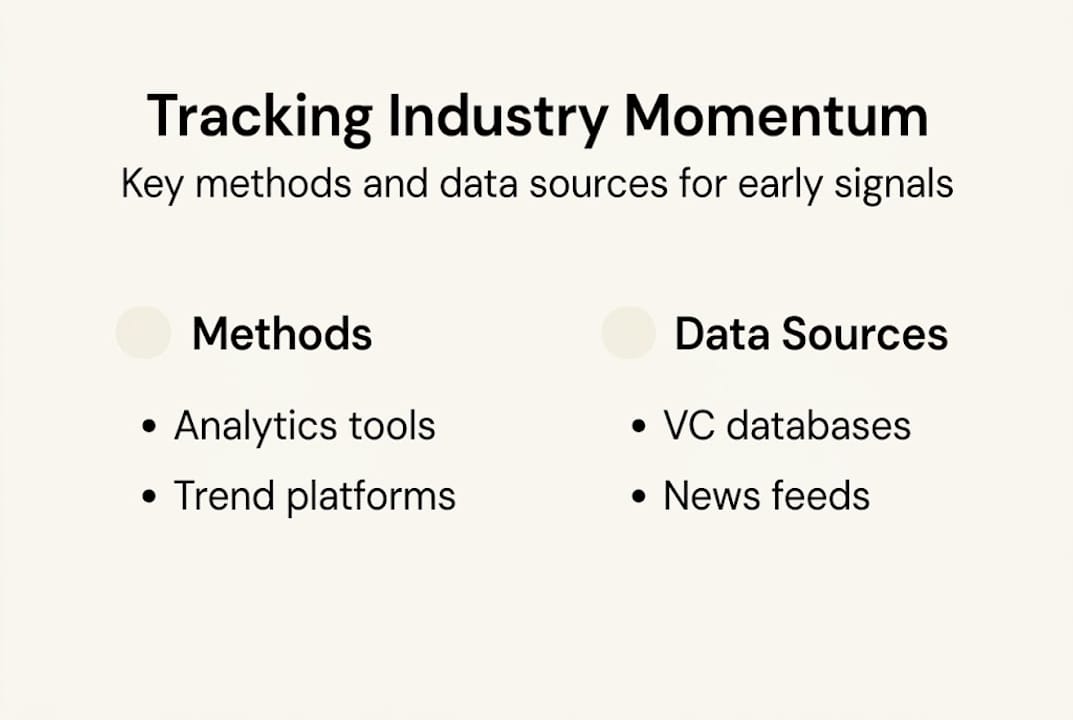
How to spot industry momentum early: Key methods and data sources
-
Turning industry momentum into action: Do’s, don’ts, and pitfalls
Key Takeaways
| Point | Details |
|---|---|
| Momentum signals lead action | Real-time industry momentum reveals upcoming shifts before traditional data sources. |
| Strategic tracking pays off | Using momentum tracking guides smarter, faster business decisions and better outcomes. |
| Balance speed with validation | Act quickly on momentum signals but always validate to avoid costly missteps. |
| Tools enable competitive edge | Integrated digital tools make it feasible for any business to track and utilise industry momentum effectively. |
What is industry momentum and why does it matter?
Industry momentum is not simply a trend. A trend is a pattern identified in retrospect. Momentum is the force behind movement, visible in real time through signals that precede mainstream recognition. Think of it as the difference between reading a newspaper and watching a live feed.
In practical terms, industry momentum shows up as:
-
Rising search volumes around a specific technology or product category
-
A sudden spike in venture capital flowing into a sector
-
Accelerated hiring activity in niche technical roles
-
Regulatory filings clustering around a new compliance area
-
Social media conversation shifting from curiosity to urgency
These signals, taken individually, may mean little. Taken together, they paint a picture of directional energy within a market. That is what momentum tracking captures.
The critical distinction between momentum and historic trend analysis is timing. Legacy data tells you what happened. Momentum tells you what is happening. For strategic decision-makers, that gap in time is where competitive advantage lives. Businesses that rely solely on annual reports or industry whitepapers are essentially navigating by looking in the rear-view mirror.
“Industry momentum predicts future market movements better than lagging indicators.”
This is why monitoring trends in real time has become a core competency for forward-thinking organisations. When you can see a sector gaining speed before the broader market notices, you have time to position, resource, and act with intention rather than urgency.
Consider the electric vehicle supply chain in 2020. Businesses tracking momentum signals, such as battery material procurement surges, government subsidy announcements, and hiring spikes at charging infrastructure firms, had 12 to 18 months of lead time over those waiting for analyst reports. That lead time translated directly into supplier agreements, talent acquisition, and market positioning.
Momentum is not about predicting the future with certainty. It is about reducing the lag between what is happening and what you know.
The strategic advantage: How tracking momentum shapes business decisions
Once you understand what industry momentum is, the next question is what it actually does for your business. The answer is that it transforms how you plan, allocate resources, and manage risk.
| Factor | Momentum trackers | Non-trackers |
|---|---|---|
| Speed to market | Early positioning, 6 to 18 months ahead | Reactive, often late |
| Resource allocation | Proactive, signal-driven | Retrospective, budget-cycle driven |
| Risk management | Anticipatory, with validation windows | Reactive, higher exposure |
| Growth rate | Consistently above sector average | Volatile, trend-dependent |
| Partnership decisions | Informed by industry partnerships data | Based on reputation alone |
The table above illustrates a pattern seen repeatedly across sectors. Businesses that invest in assessing industry momentum do not just grow faster. They grow smarter, with fewer costly pivots and more deliberate bets.
Take the fintech sector between 2022 and 2024. Firms tracking momentum signals around embedded finance, specifically API activity, partnership announcements, and regulatory sandbox approvals, moved early into product development. Those waiting for market research reports arrived to a crowded space with compressed margins.

Early adopters who track momentum outperform peers in growth, and the compounding effect of that advantage is significant over a three to five year horizon.
Momentum tracking also sharpens how you evaluate trend signal virality, helping you distinguish between a signal with staying power and one that will fade within weeks.
Pro Tip: Do not wait for perfect data before acting. Leading signals are, by definition, incomplete. The skill is in validating enough data points to justify a calculated move, not in waiting for certainty that arrives too late.
The strategic value is not just in spotting opportunities. It is equally powerful in avoiding missteps. When momentum signals in a sector start reversing, such as declining funding rounds, falling search interest, and talent exodus, that is a warning to pause or exit before the broader market confirms the downturn.
How to spot industry momentum early: Key methods and data sources
Detecting momentum before competitors requires a structured approach. Here are the core methods used by high-performing intelligence teams:
-
News and media monitoring: Track volume and sentiment shifts in trade publications and mainstream media. A sudden increase in coverage signals growing awareness.
-
Search trend analysis: Tools like Google Trends reveal rising query volumes before they reach saturation. A doubling of search interest in a niche topic over 30 days is a meaningful signal.
-
Funding and investment data: Venture capital and private equity flows are leading indicators. When capital clusters around a sector, momentum is building.
-
Hiring signal tracking: Job postings in specialised roles, particularly in engineering, regulatory, or product functions, indicate where companies are placing bets.
-
Social media velocity: Monitor not just volume but the speed of conversation growth. Rapid acceleration in a topic’s share of voice is a momentum marker.
-
Regulatory and filing activity: Patent filings, lobbying disclosures, and regulatory consultations often precede commercial momentum by 12 to 24 months.
Data analytics and trend platforms comprise over 60% of successful momentum tracking strategies, which is why choosing the right tools matters as much as the method.
| Data source | Momentum signal detected | Lead time |
|---|---|---|
| Venture capital databases | Sector investment surges | 6 to 18 months |
| Search analytics platforms | Rising consumer/B2B interest | 3 to 9 months |
| Job board aggregators | Talent demand shifts | 3 to 12 months |
| Social listening tools | Conversation velocity spikes | 1 to 6 months |
| Regulatory databases | Policy and compliance shifts | 12 to 24 months |
Tracking signals in emerging sectors requires combining multiple data sources rather than relying on any single feed. Monitoring momentum globally adds another dimension, since sectors often gain speed in one geography before spreading. Platforms offering AI-driven analysis can process this volume of cross-signal data far faster than manual research teams.
Turning industry momentum into action: Do’s, don’ts, and pitfalls
Detecting momentum is only half the work. Acting on it effectively requires discipline.
Best practices for acting on momentum:
-
Validate signals across at least three independent data sources before committing resources
-
Set clear thresholds: define what level of signal activity justifies a strategic response
-
Align momentum insights with existing business objectives, not as a separate initiative
-
Build a feedback loop: after acting, review whether the signal played out as expected
-
Use real-time B2B signals to cross-reference sector activity with commercial opportunity
-
Regularly review sector rankings to contextualise momentum within the broader competitive landscape
Common pitfalls to avoid:
-
Overreacting to noise: A single viral article is not momentum. Wait for signal convergence.
-
Neglecting cross-signal validation: One strong data point can mislead. Multiple weak signals pointing the same direction are more reliable.
-
Ignoring financial signals: Capital flows often confirm or contradict what other signals suggest.
-
Acting without a reversal plan: Momentum shifts. Build an exit or pivot condition into every momentum-driven decision.
Effective response to industry momentum increases market share by up to 15%, but only when action is disciplined and validated.
Pro Tip: Integrate momentum insights directly into your quarterly planning cycle. Treat them as a standing agenda item alongside financial performance, not as an occasional research exercise.
The closing loop matters enormously. Teams that review their momentum-driven decisions, whether they succeeded or failed, build institutional knowledge that sharpens future signal interpretation. Without that loop, you are simply reacting to data rather than learning from it.
Why the obsession with industry momentum can backfire
Here is the uncomfortable truth: momentum tracking, done poorly, creates exactly the problem it is meant to solve. When teams become obsessed with signals, they start chasing every spike, pivoting strategy on thin evidence, and burning resources on trends that evaporate within a quarter.
We have seen organisations redirect entire product roadmaps based on a three-week social media surge, only to find the signal was noise amplified by a single influencer campaign. That is not intelligence. That is reactive behaviour dressed up as strategy.
The discipline is in the interpretation, not the data volume. More signals do not automatically mean better decisions. The organisations that benefit most from momentum tracking are those with a clear framework for what constitutes an actionable signal versus background noise.
Balance is the operative word. Momentum insight should inform strategy, not replace it. If your business fundamentals do not support a move, no amount of positive signal data justifies the leap. For a grounded view of how to apply this balance, the industry analysis deep dive offers a structured framework worth reviewing.
Sustainable competitive advantage comes from consistent, measured responses to validated momentum, not from being first to react to every ripple in the data.
How OnTheRice helps you track, analyse, and act on momentum
Understanding industry momentum conceptually is one thing. Having the infrastructure to act on it is another entirely.

OnTheRice is built specifically for professionals who need to move from signal to strategy without delay. The platform’s AI engines continuously scan global data points, extracting meaningful signals from market noise and producing ranked, scored intelligence across sectors. Whether you are tracking B2B market shifts in real time or exploring the EmergingBrands accelerator to spot rising players before they reach mainstream awareness, OnTheRice gives you the speed and clarity that manual research simply cannot match. The platform is designed for decision-makers who treat early intelligence as a competitive asset, not an afterthought.
Frequently asked questions
What exactly is industry momentum?
Industry momentum refers to the aggregation of real-time signals showing the direction and speed of change in a sector before traditional data catches up. Unlike lagging indicators, momentum predicts movements before they become obvious to the broader market.
How do businesses track industry momentum effectively?
They use news analytics, funding signals, social and hiring data, and digital tools to detect and validate shifts early. Over 60% of successful momentum tracking strategies rely on dedicated data analytics and trend platforms.
Why is acting on industry momentum risky?
Reacting too quickly to early signals, without validation, can lead to wasted investment or chasing short-lived trends. Momentum obsession can trigger reactive over-investment when teams mistake noise for meaningful directional change.
Can small businesses benefit from tracking industry momentum?
Yes, smaller firms can use affordable digital tools to spot market shifts quickly and respond faster than larger competitors. Early adopters outperform peers in growth regardless of company size, making momentum tracking a high-return activity even with limited resources.