

TL;DR:
- Market intelligence must be continuous and real-time to remain effective in 2026.
- AI, machine learning, and NLP are essential tools for faster, more accurate data analysis.
- Leadership mindset and disciplined processes are critical for leveraging advanced market intelligence.
The market intelligence methods that served you well in 2023 are already obsolete. Signals move faster, data sources multiply daily, and the gap between early movers and late adopters widens with every quarter. Business leaders and investors who still rely on quarterly reports and static competitor benchmarks are, quite simply, flying blind. In 2026, the organisations that win are those that treat intelligence as a live, continuous function rather than a periodic exercise. This guide outlines the key emerging trends reshaping market intelligence, the technologies driving them, and the practical steps you can take to embed them into your strategy today.
Table of Contents
- Emerging technologies redefining market intelligence
- The role of data: Big data and analytics in actionable intelligence
- The rise of competitive and social signal analytics
- Practical strategies for future-proof market intelligence
- Why embracing market intelligence is now a leadership mindset
- Take your market intelligence further with OnTheRice
- Frequently asked questions
Key Takeaways
| Point | Details |
|---|---|
| AI and analytics dominate | Artificial intelligence and analytics now drive the speed and accuracy of market intelligence in 2026. |
| Data integration is essential | Harnessing diverse, real-time data streams is the foundation of actionable insight. |
| Competitive and social signals | Decoding competitive and social trend analytics yields a unique advantage. |
| Proactive, adaptive strategies | Organisations embracing future-proofed, agile intelligence outperform static approaches. |
Emerging technologies redefining market intelligence
The pace at which technology is transforming market intelligence is not gradual. It is exponential. Artificial intelligence, machine learning, and natural language processing (NLP) have moved from experimental tools to operational necessities, and the organisations still treating them as optional extras are already falling behind.
AI and machine learning now process millions of data points in the time it takes a human analyst to read a single report. NLP, which is the ability of machines to interpret and analyse human language, enables platforms to scan news feeds, earnings calls, regulatory filings, and social media simultaneously. AI-driven tools are now critical in uncovering market shifts faster than human analysts, making real-time intelligence a realistic expectation rather than a luxury.
Real-time sentiment tracking is another capability that has crossed into the mainstream. Prediction models that once required weeks of data preparation now operate on live feeds, flagging emerging risks and opportunities within hours. Cloud-based AI-driven intelligence platforms have made this scalable, allowing firms of varying sizes to access on-demand insights without building expensive internal infrastructure.
Here is a snapshot of how key technologies are changing the intelligence landscape:
| Technology | Traditional role | 2026 capability |
|---|---|---|
| Machine learning | Batch data processing | Real-time pattern detection |
| NLP | Document search | Live sentiment and intent analysis |
| Cloud platforms | Data storage | Scalable, on-demand intelligence |
| Predictive analytics | Historical reporting | Forward-looking scenario modelling |
The most effective intelligence teams are not replacing analysts with algorithms. They are combining both. Key capabilities to prioritise include:
- Real-time data ingestion from multiple structured and unstructured sources
- Automated anomaly detection to flag unusual market movements early
- Scenario modelling to stress-test strategic assumptions
- Cross-platform integration so intelligence flows into decision-making tools directly
Pro Tip: Never let AI operate in isolation. The most valuable outputs come when machine-generated signals are reviewed by analysts who understand the business context. Automation surfaces the signal; human judgement determines the response.
The role of data: Big data and analytics in actionable intelligence
Technology sets the stage, but data is the substance. The volume, velocity, and variety of data available to organisations in 2026 are unprecedented, and that creates both opportunity and risk. More data does not automatically mean better intelligence. The organisations winning are those that have built disciplined pipelines to turn raw inputs into decisions.

Big data integration is central to modern intelligence workflows, yet many firms still operate with fragmented data architectures that prevent a unified view. The gap between legacy and next-generation analytics is significant:
| Dimension | Legacy analytics | Next-generation analytics |
|---|---|---|
| Data sources | Internal databases | Multi-source, including alternative data |
| Update frequency | Weekly or monthly | Real-time or near-real-time |
| Analysis type | Descriptive (what happened) | Predictive and prescriptive |
| Accessibility | Specialist teams only | Cross-functional, self-serve dashboards |
Building a robust analytics pipeline does not require a complete overhaul overnight. A structured approach works far better:
- Audit existing data sources to identify gaps, redundancies, and quality issues
- Define the intelligence questions your organisation most needs answered
- Select ingestion tools that connect your priority data sources to a central platform
- Apply analytics layers including statistical modelling and machine learning where appropriate
- Create feedback loops so analysts can refine models based on real-world outcomes
Businesses using cloud intelligence opportunities and advanced market analytics are 2x more likely to anticipate sectoral shifts before their competitors act. That is not a marginal advantage. In capital-intensive sectors, being six weeks ahead of a trend shift can represent millions in avoided losses or captured upside.
The common pitfall is collecting data without a clear consumption strategy. Data warehouses full of unused information are a cost centre, not an asset. Every data source you add should map directly to a decision your leadership team actually makes.
The rise of competitive and social signal analytics
Data is only as powerful as the signals extracted from it, especially when competitor and social patterns are decoded. Competitive intelligence in 2026 is no longer about tracking a handful of direct rivals through occasional desk research. It is dynamic, multi-source, and granular enough to detect shifts in competitor positioning before those shifts become public knowledge.
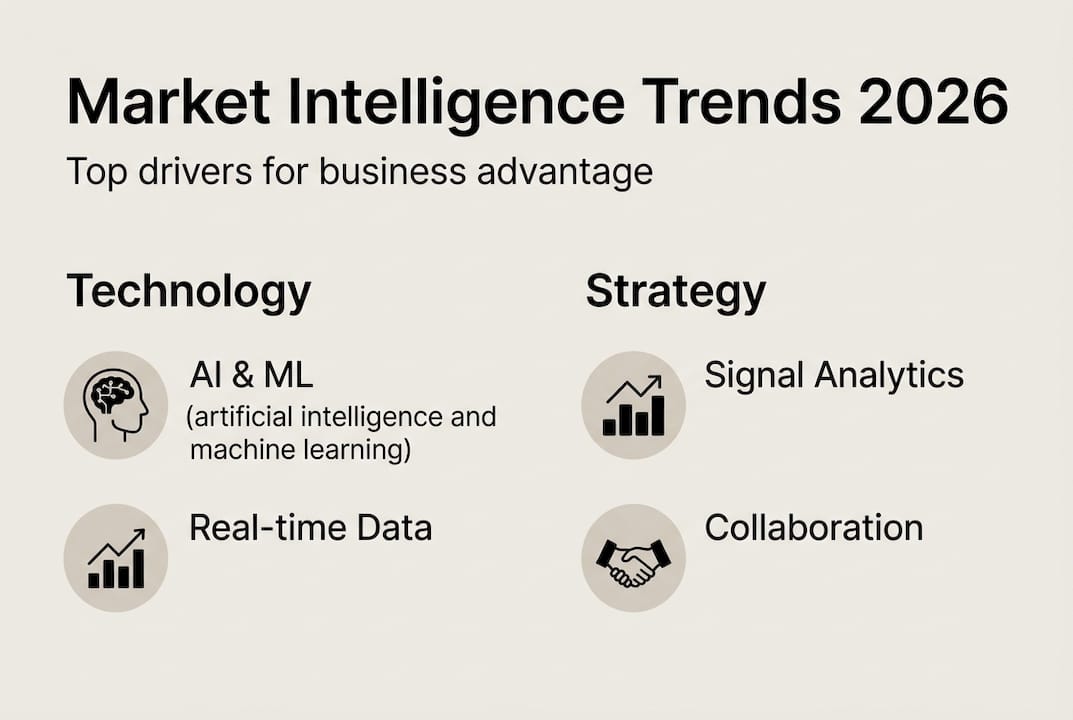
Social listening tools have matured considerably. They now go beyond brand mentions to analyse sentiment trajectories, identify emerging consumer concerns, and map the language competitors use in their communications. Tracking social sentiment offers unique predictive insight into market movements, often weeks before traditional indicators catch up.
Key capabilities that leading organisations are deploying include:
- Multi-channel social monitoring across platforms, forums, and review sites
- Competitor content and positioning analysis to detect strategic pivots early
- Alternative data integration, including job postings, patent filings, and supply chain signals
- Audience sentiment mapping to identify emerging demand shifts before they surface in sales data
"The next competitive advantage lies in decoding the right social signals, not just more data."
Layered signal analytics is the approach that separates sophisticated intelligence operations from basic monitoring. By combining public data with proprietary insights and alternative data sources, you build a picture that no single stream can provide alone. Platforms that support analysing social trends and competitive rankings analysis allow you to cross-reference signals and reduce false positives.
Pro Tip: Do not track everything. Define your signal priorities based on the decisions they inform. A well-curated set of 10 high-quality signals outperforms a noisy feed of 100 irrelevant ones every time.
Practical strategies for future-proof market intelligence
Now that you have seen the technologies, data workflows, and competitive techniques, it is time to turn those insights into concrete action. The organisations that benefit most from market intelligence are not necessarily those with the largest budgets. They are the ones with the most disciplined processes.
Start with an honest audit of where you stand today:
- Map your current intelligence sources and identify which are active versus dormant
- Assess the time lag between data collection and decision-making in your organisation
- Identify the decisions that most frequently suffer from insufficient intelligence
- Evaluate your team's capability to interpret and act on data-driven signals
- Pilot one new tool or data source before committing to full-scale integration
Organisations adopting adaptive intelligence strategies are measurably more resilient during market disruptions, recovering faster and capturing opportunities that less-prepared competitors miss. The evidence for investing in this capability is compelling: 74% of business leaders plan to increase their market intelligence investment before the end of 2026, recognising that the cost of inaction now outweighs the cost of adoption.
Cross-functional collaboration is a critical enabler that many organisations underestimate. Intelligence should not sit exclusively within a research or strategy team. When sales, product, finance, and marketing all contribute to and consume intelligence outputs, the quality of decisions improves across the board. Build shared dashboards, run regular cross-team intelligence briefings, and create clear ownership for acting on signals.
Pilot testing before full rollout is essential. New intelligence tools often require calibration to your specific sector and data environment. A focused pilot with clear success metrics tells you far more than any vendor demonstration.
Why embracing market intelligence is now a leadership mindset
Here is the uncomfortable truth that most market intelligence discussions avoid: the bottleneck is rarely the technology. It is leadership behaviour.
Organisations invest in sophisticated platforms, hire talented analysts, and build impressive dashboards. Then senior leaders continue to make decisions based on gut instinct, legacy assumptions, and the reports they have always trusted. The tools are present. The mindset is not.
Waiting for a polished quarterly report before acting is no longer a defensible approach. By the time that report lands, the signal has already moved. The leaders who will define their sectors in 2026 are those who engage directly with intelligence transformation outputs, ask sharper questions of their data, and treat uncertainty as something to navigate rather than avoid.
Market intelligence is not a research function delegated to a team. It is a competitive posture that starts at the top. The organisations that treat it as such are not just better informed. They are structurally faster, and in volatile markets, speed is the advantage that compounds.
Take your market intelligence further with OnTheRice
Staying ahead of market shifts requires more than awareness. It requires the right tools working continuously on your behalf. OnTheRice is built precisely for this moment, using multiple AI engines to scan global data, extract meaningful signals, and surface emerging trends before they reach mainstream visibility.
Whether you are tracking B2B intelligence solutions, monitoring live market trend signals across social and competitive channels, or exploring AI-driven market analysis tools to sharpen your strategy, OnTheRice provides the transparency and real-time depth that modern market intelligence demands. The platform is designed for professionals who cannot afford to be second. Explore what is rising before your competitors do.
Frequently asked questions
What is market intelligence and why does it matter in 2026?
Market intelligence involves gathering and analysing diverse data to guide business decisions. In 2026's fast-moving environment, intelligence speeds decision-making in volatile markets, making it essential for maintaining competitive positioning.
Which technology is most influential in shaping market intelligence in 2026?
Artificial intelligence and advanced analytics are leading the transformation, with AI integral to workflow automation enabling faster, more accurate signal detection than any manual process can achieve.
How can companies efficiently start using social signal analytics?
Begin with cloud-based social monitoring tools that track competitors and sentiment in real time. Social trend analytics improve competitive awareness most effectively when integrated directly with your core intelligence workflow.
Is big data adoption expensive or risky for smaller firms?
Cloud-driven tools have significantly lowered the barrier to entry. Cloud platforms lower costs for market intelligence, giving smaller firms scalable, pay-as-you-grow options that were previously unavailable.