

TL;DR:
- Industry signals are early indicators of market shifts, originating from various sources like technology and consumer trends.
- Spotting weak signals requires disciplined filtering, triangulation, and validation to avoid false positives.
- Embedding signal monitoring into organizational routines enables faster, proactive responses to emerging trends.
Most market analysts assume big trends declare themselves clearly before they must be acted on. They do not. The firms that consistently outperform their rivals are not necessarily smarter; they are earlier. They spot the faint tremors before the earthquake registers on anyone else's scale. This guide is built for analysts and strategists who want to move from reactive to predictive, covering what industry signals actually are, how to identify them reliably, and how to build the organisational habits that turn early detection into lasting competitive advantage.
Table of Contents
- What are industry signals: distinctions and origins
- How to spot weak signals: frameworks and common pitfalls
- Separating noise from actionable signal: practical tools and real-world examples
- From detection to strategy: turning early signals into results
- Why most organisations miss early industry signals (and how to do better))
- Drive your advantage with advanced signal tools
- Frequently asked questions
Key Takeaways
| Point | Details |
|---|---|
| Weak signals matter | Early, subtle trends often provide a competitive edge if recognised before going mainstream. |
| Frameworks beat instincts | Structured approaches help differentiate real signals from noise and prevent common errors. |
| Actionable insights | Piloting and institutionalising signal monitoring leads to resilience and strategic wins. |
| Guard against hype | Consistent validation and disconfirming evidence help avoid media-driven mistakes. |
What are industry signals: distinctions and origins
Having set the scene, let's ground the discussion by clarifying exactly what industry signals are and why they matter.
An industry signal is any piece of observable information that indicates a potential shift in a market, technology, regulation, or consumer behaviour. Not all signals carry equal weight, which is where the critical distinction between weak and strong signals comes in. Weak signals analysis describes weak signals as early, subtle indicators of emerging changes, trends, or disruptions that precede mainstream awareness, a concept first formalised in Igor Ansoff's 1975 strategic management work.
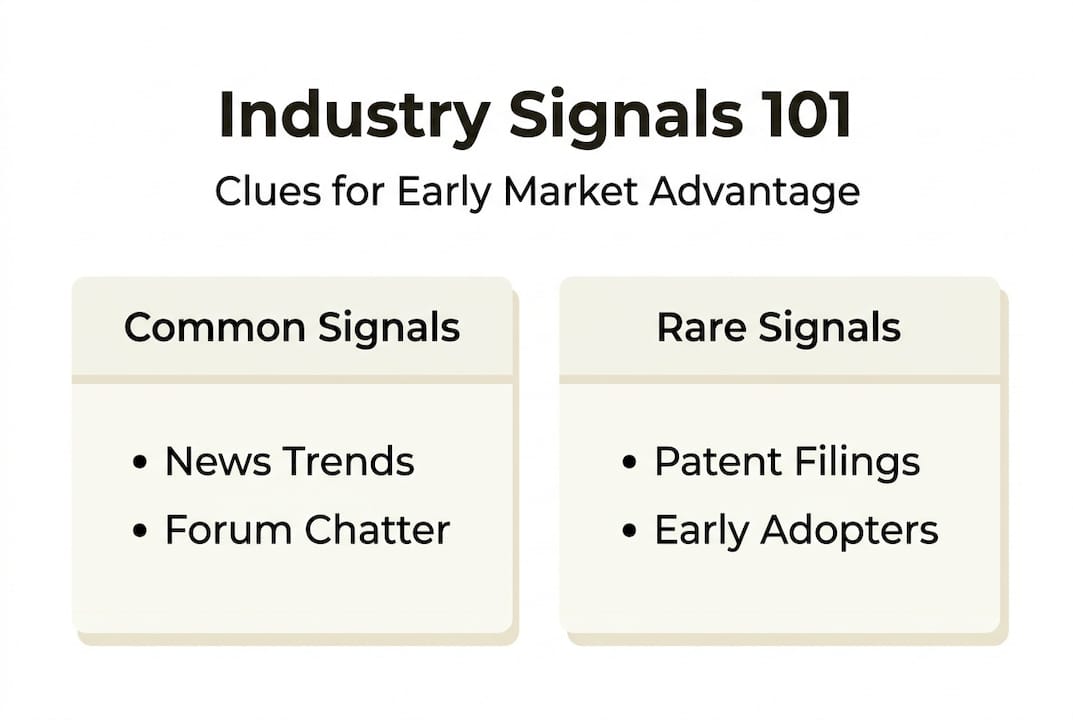
A strong signal is already widely acknowledged: a central bank raising interest rates, a competitor announcing a product launch, a headline regulation passing into law. These are confirmations of what many already suspect. Weak signals, by contrast, are the precursors: a niche academic paper, an unusual spike in a fringe online community, a quiet regulatory consultation with low public engagement. By the time a weak signal becomes a strong one, most of the strategic advantage has already been claimed.
Signals can originate across four broad categories:
- Market signals: unusual shifts in pricing, volume, or geography
- Technology signals: fringe patents, prototype demonstrations, niche developer communities
- Consumer signals: emerging vocabulary, behavioural micro-trends, spending shifts in subcultures
- Regulatory signals: consultation papers, parliamentary inquiries, think-tank policy proposals
Consider a quiet example: a government consultation paper on carbon border adjustments published eighteen months before becoming law. At the point of publication, few firms paid attention. Those who tracked social trend signals at the fringe of environmental policy discourse had already begun repositioning supply chains.
| Dimension | Weak signal | Strong signal |
|---|---|---|
| Definition | Faint, early indicator of change | Confirmed, widely recognised trend |
| Typical source | Fringe media, niche forums, academic papers | Mainstream press, official policy, major reports |
| Time to mainstream | Months to years | Already mainstream or imminent |
| Strategic value | Highest (first-mover advantage possible) | Lower (advantage largely competed away) |
"The future is already here — it is just not evenly distributed." This is precisely why weak signals matter: they are the uneven distribution you are looking for.
How to spot weak signals: frameworks and common pitfalls
Now that you understand the nature of industry signals and their types, it's essential to know how to spot them reliably.
Spotting weak signals requires a disciplined process, not just curiosity. A reliable scanning, filtering, and validation framework works in distinct steps:
- Scan broadly: Monitor sources beyond your sector's usual media diet. Include academic preprints, regulatory consultation portals, niche trade journals, and international equivalents of domestic trends.
- Filter by anomaly: Flag information that surprises you or contradicts existing assumptions. Consensus-aligned data rarely carries signal value.
- Cluster for pattern: Single data points are rarely meaningful. Look for independent sources surfacing similar themes within the same short window.
- Validate cross-sector: Check whether the observed pattern appears in adjacent industries. A trend visible in cryptocurrency signals often precedes broader global financial signals by a meaningful lead time.
- Stress-test the logic: Ask what would need to be true for this signal to be false. If you cannot construct a credible counter-argument, you may be falling victim to confirmation bias.
The pitfalls are numerous and often invisible until damage is done. False positives from media hype or viral events are among the most common traps; effective mitigation requires multi-week consistency checks, macro context validation, and careful attention to whether a signal is actually relevant to your specific sector. A viral consumer trend in retail carries far weaker signal value in the energy sector.

Confirmation bias is the most insidious trap of all. Analysts who have already formed a view will subconsciously weight evidence that supports it. Triangulation using disconfirming evidence is not a nice-to-have; it's the backbone of credible signal work.
Pro Tip: After forming an initial interpretation of a signal, actively seek out three pieces of evidence that would disprove it. If none exist, treat your interpretation with heightened scepticism rather than confidence.
Separating noise from actionable signal: practical tools and real-world examples
After identifying potential weak signals, the challenge becomes separating meaningful signals from distracting noise.
Every analyst faces the same tension: enormous volumes of incoming data, very few genuine signals. The tools and methods you use to triage this data determine whether you act early or waste effort on distractions.
Leading practical tools in 2026 include AI-driven monitoring platforms that scan thousands of sources simultaneously, pattern recognition dashboards that flag statistical anomalies, and trend aggregators that cluster thematically related signals across geographies. Platforms built around structured industry data methods help standardise how signals are categorised, making comparison across sectors more reliable.
When a high-impact candidate signal is identified, validating it through a pilot is the most practical next step. A structured pilot approach typically follows this sequence:
- Define scope: Isolate the signal's expected domain and timeframe.
- Assign a small team: Avoid large committees; agility matters more than consensus at this stage.
- Run a bounded test: Design a real-world or simulated scenario to observe whether the signal's implications hold.
- Measure against baseline: Compare outcomes to what would have occurred without acting on the signal.
- Document findings: Capture both what was confirmed and what was not, as AI opportunity signals environments evolve quickly.
| Symptom | Example | Next step |
|---|---|---|
| Noise | Single viral article on a new therapy | Monitor for recurrence over 4+ weeks |
| Possible signal | Multiple independent sources noting same regulatory shift | Triangulate and assign a tracker |
| Actionable signal | Cross-sector pattern confirmed by pilot data | Escalate to strategy team, act |
In medicine, a surge in clinician forum discussions about a specific off-label drug use preceded formal clinical trials by over a year in several documented cases. The analysts tracking health sector signals who noticed this pattern early were positioned to advise clients well before the mainstream coverage arrived. Analysts following international signal frameworks in finance have similarly reported lead times of six to twelve months before regulatory changes reached public awareness.
Pro Tip: Document your decision logic every time you pursue or dismiss a signal. Reviewing these records quarterly reveals your own systematic biases, which is far more valuable than any single correct call.
From detection to strategy: turning early signals into results
Knowing how to distinguish and act on signals is only half the battle; understanding how to integrate these practices into strategy closes the loop.
Detecting a signal without an organisational pathway to act on it is the equivalent of a smoke alarm with no evacuation plan. The signal itself creates no value; the institutional response does.
Piloting, as described in the previous section, is the entry point. But the deeper challenge is institutionalising the habit. Resilience in volatile markets depends on firms that act via pilots for high-impact signals and build ongoing capacity to repeat this cycle. The steps to embed this capability include:
- Appoint signal champions: Designate analysts in each major function whose role includes scanning and escalating signals. Without ownership, signals get noticed and then forgotten.
- Create feedback loops: When a tracked signal matures into a confirmed trend, conduct a retrospective. What was spotted early? What was missed? Why?
- Schedule quarterly reviews: Treat the signal backlog as a living document. Review what has strengthened, weakened, or been validated since the last cycle.
- Integrate into planning cycles: Signals should feed directly into annual strategy sessions, not remain in a separate research silo.
- Reward early and correct over late and obvious: Cultural incentives shape behaviour. If analysts are only recognised for confirming consensus views, weak signal work will atrophy.
Organisations that have embedded organisational signal monitoring into their strategic rhythms report measurably faster response times to market shifts, with some citing a 30 to 40 per cent reduction in the lag between trend emergence and strategic decision-making. Tracking emerging brands provides a parallel layer of intelligence: new entrants frequently behave as living signals of where an industry is heading before incumbents recognise the threat. Building cross-functional pilot teams accelerates the validation cycle significantly by reducing internal friction.
Why most organisations miss early industry signals (and how to do better)
Despite the frameworks, tools, and case studies available, the majority of organisations still act on industry signals too late. The reason is rarely a lack of data.
Most firms are structurally biased towards consensus. Presenting a weak, ambiguous signal to a leadership team conditioned to demand certainty before acting will almost always result in inaction. By the time the signal is strong enough to satisfy that demand for certainty, the competitive window has closed. The resilience built through early signal action only compounds over time for those who practise it consistently.
The teams that genuinely outperform on signal detection share a specific cultural trait: they are comfortable with being approximately right early, rather than precisely right late. They institutionalise doubt. They treat their own interpretations of social trend frameworks as hypotheses to be tested, not conclusions to be defended.
"In volatile markets, acting early on the right weak signals is the only sustainable edge."
This is not motivational rhetoric. It is a practical observation about where competitive differentiation actually lives in 2026.
Drive your advantage with advanced signal tools
If you are ready to put these ideas into practice and get ahead of emerging trends, technology can power your signal journey.
OnTheRice delivers AI-driven signal intelligence designed specifically for analysts and strategists who cannot afford to wait for consensus. The SignalsInternational suite scans global data in real time, surfacing cross-sector patterns before they reach mainstream awareness, while the B2BSignals platform focuses on business-to-business market dynamics with granular scoring and ranking tools.

Both platforms are built around the principle that transparency in signal methodology matters as much as the signal itself. If your team is serious about moving from reactive analysis to proactive strategy, OnTheRice gives you the infrastructure to make that shift permanent, not just occasional.
Frequently asked questions
What is a weak industry signal?
A weak industry signal is an early, often subtle sign that a new trend or disruption is emerging before it becomes widely recognised. Unlike strong signals, weak signals precede mainstream awareness by months or even years, making them the highest-value input for strategic planning.
How can I tell if a signal is real or just noise?
Check whether the signal persists across multiple weeks and appears in independent sources rather than a single outlet. Multi-week consistency and macro context checks are the most reliable filters against false positives from media hype.
What are common mistakes when acting on early industry signals?
Confirmation bias, overreacting to short-lived hype, and ignoring sector relevance are the most frequent errors. Triangulation and disconfirming evidence are your primary defences against all three.
Why should organisations institutionalise signal monitoring?
Embedding signal monitoring into regular strategy cycles creates organisational resilience and reduces response lag. Firms that act via pilots for high-impact signals consistently outperform those waiting for certainty before moving.