

TL;DR:
- Dynamic market tools adapt in real time, improving risk management and profitability.
- They can significantly increase revenue and profit through responsive pricing and risk strategies.
- Proper implementation and integration are essential to avoid automation risks and maximize benefits.
Fixed strategies feel safe. They are familiar, repeatable, and easy to defend in a boardroom. But markets don't wait for annual reviews or quarterly recalibrations. Volatility spikes overnight, pricing windows open and close within hours, and the professionals who act on live signals consistently outpace those relying on last quarter's assumptions. Dynamic market tools change the equation entirely, offering real-time adaptation that turns raw market noise into profitable intelligence. This guide covers the core mechanics, measurable outcomes, and best practices behind these tools so you can make faster, sharper, and more defensible decisions.
Table of Contents
- What are dynamic market tools and how do they work?
- The measurable benefits: Revenue, risk, and psychological advantage
- AI and machine learning: The next frontier in market adaptation
- Caveats, risks, and best practices in deploying dynamic market tools
- Our perspective: Why most decision-makers misuse dynamic market tools
- How OnTheRice empowers your dynamic market edge
- Frequently asked questions
Key Takeaways
| Point | Details |
|---|---|
| Faster market adaptation | Dynamic tools let you quickly adjust strategies as market data evolves, staying ahead of the curve. |
| Proven revenue and risk impact | Data shows dynamic pricing and hedging can significantly boost profits and protect against losses. |
| AI pushes performance | Machine learning and RL-based systems deliver optimal results especially in complex, changing markets. |
| Integration over isolation | Combining dynamic tools in a unified strategy beats using standalone solutions. |
What are dynamic market tools and how do they work?
Dynamic market tools are platforms, algorithms, and analytical frameworks designed to update continuously as market conditions shift. Unlike fixed tools that apply the same parameters regardless of context, dynamic solutions adjust in real time based on inputs like volatility, volume, and pricing signals.
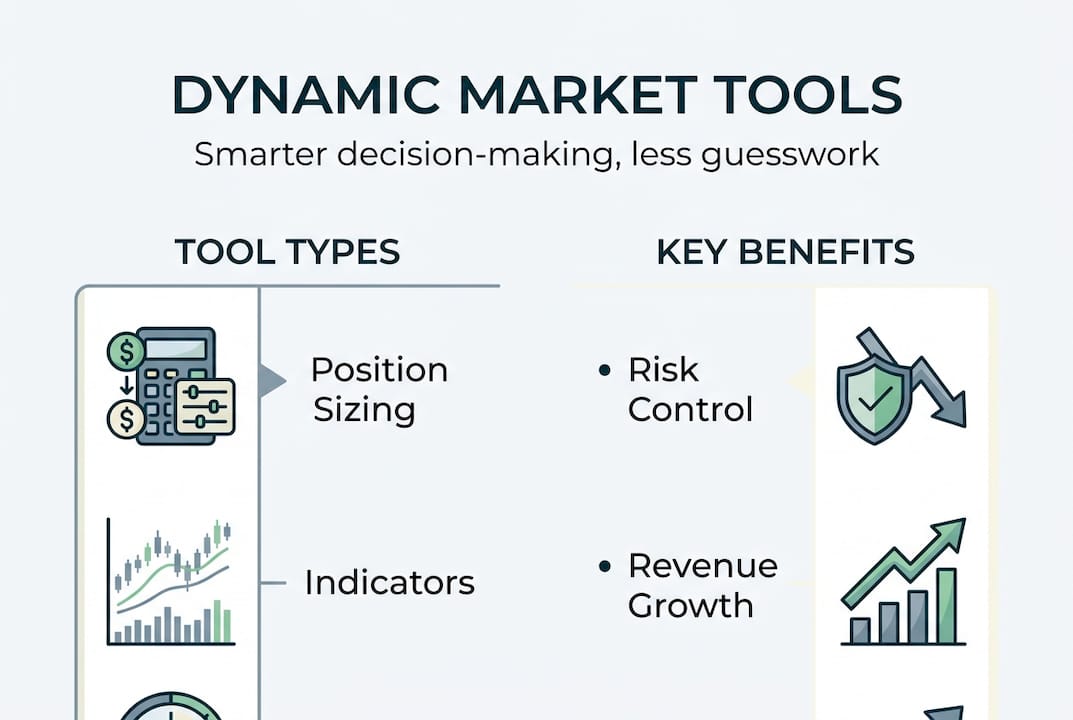
Dynamic trading methodologies cover a broad family of instruments: position sizing models, indicators such as the McGinley Dynamic, hedging strategies, and AI-driven analytics platforms. What unites them is their core capability to scale risk and recalibrate strategy based on account size and live conditions, rather than static rules set months ago.
The McGinley Dynamic indicator, for example, uses an automatic adjustment formula that minimises lag and whipsaws by adapting its smoothing factor to the speed of price movement. This is a meaningful edge over traditional moving averages, which apply a fixed smoothing regardless of whether markets are trending rapidly or ranging sideways.
Here is how dynamic and fixed tools compare directly:
| Feature | Dynamic tools | Fixed tools |
|---|---|---|
| Adaptation | Real-time, condition-based | Rule-based, static |
| Risk scaling | Adjusts to volatility and account size | Fixed parameters |
| Response to signals | Immediate recalibration | Manual override required |
| Outcome quality | Higher in volatile conditions | Reliable in stable conditions |
| Interpretability | Varies (AI tools can be opaque) | High |
The most effective dynamic tools draw on several mechanism types:
- Volatility bands and ATR (Average True Range): Automatically widen or tighten position sizing based on current market volatility.
- Algorithmic pricing engines: Adjust prices across product catalogues based on demand, competitor activity, and inventory levels.
- AI-driven analytics: Use reinforcement learning and pattern recognition to surface signals before they become consensus.
- Dynamic hedging: Shift options positions in real time to offset portfolio drawdowns.
If you want to see these tools in a live context, the AI powered market tools section on OnTheRice demonstrates how these signals are applied in practice. For those newer to the mechanics, trading strategies explained offers a structured starting point. AI software delivery approaches illustrate how such systems are built and deployed at scale.
The measurable benefits: Revenue, risk, and psychological advantage
Understanding the mechanics is vital, but the real measure of value lies in how dynamic tools affect bottom-line results and behaviour.
The financial evidence is striking. In apparel eCommerce, dynamic pricing produced a 31% revenue increase and a 39% profit increase across a global brand's catalogue. These aren't marginal gains. They reflect what happens when pricing responds to real demand rather than a spreadsheet updated once a month.
"Dynamic pricing increased orders by 17% and margin by 6% across 500 products, with A/B testing confirming optimised demand distribution in ticketing markets."
The compounding effect on capital is equally compelling. A portfolio applying 2% monthly dynamic risk scaling on a $10,000 base would grow to approximately $22,000 over five years without increasing absolute risk exposure. The table below illustrates the contrast:

| Metric | Dynamic approach | Fixed approach |
|---|---|---|
| Revenue uplift | Up to 31% | Baseline |
| Profit increase | Up to 39% | Baseline |
| Max drawdown control | Active, volatility-adjusted | Fixed stop-loss only |
| Order volume increase | Up to 17% | Minimal without repricing |
Beyond revenue, dynamic hedging with options provides a psychological benefit that experienced professionals value highly. Knowing that positions adjust automatically during downturns removes the paralysis that often leads to poor manual decisions under pressure. Discipline holds when the system holds.
For businesses wanting to track when competitor pricing begins to shift, detecting price shifts early is where a structural edge begins.
Pro Tip: When setting stop-loss triggers for dynamic strategies, link them to ATR multiples rather than fixed pip or percentage values. A 1.5x ATR stop adjusts automatically to volatility, reducing premature exits in choppy conditions without exposing you to outsized losses in trending markets.
Building investment discipline around these triggers, rather than emotional responses, is what separates consistent performers from reactive ones.
AI and machine learning: The next frontier in market adaptation
With traditional dynamic tools established, it is essential to examine how artificial intelligence is rapidly reshaping what is possible.
Reinforcement learning (RL) is a branch of machine learning where algorithms improve by interacting with their environment and receiving feedback signals. In market tools, this translates to systems that self-optimise pricing, inventory allocation, and risk management decisions without being explicitly programmed with fixed rules.
RL algorithms such as PPO and TD3 achieve up to 90% of optimal outcomes in dynamic pricing scenarios with medium to large datasets, outperforming traditional data-driven approaches. In data-scarce environments, classical dynamic programming remains competitive, but the advantage tilts decisively toward RL as data volume grows.
Real-world applications of AI in dynamic market tools include:
- Dynamic pricing at scale: AI reprices thousands of SKUs simultaneously, responding to competitor moves, demand signals, and margin targets.
- Inventory balancing: RL agents optimise stock levels by balancing holding costs against lost-sale risk in real time.
- Risk assessment: Machine learning models flag anomalous patterns in trading data before they escalate into losses.
- Ticketing and event demand: AI models redistribute demand across pricing tiers to maximise yield without triggering buyer resistance.
- Duopoly market pricing: AI tools outperform static models in competitive environments where two dominant players influence each other's moves constantly.
The challenge lies in interpretability. AI models, particularly deep RL systems, are often difficult to audit. You can observe what they decide, but not always why. This matters when explaining strategy to stakeholders or regulators. Exploring AI-driven insights through documented frameworks helps bridge that gap. For a broader view of where AI creates structural advantages, AI opportunities in markets provides relevant sector analysis.
For organisations evaluating build versus buy decisions on AI infrastructure, AI services for machine learning outlines the technical considerations involved.
Caveats, risks, and best practices in deploying dynamic market tools
The cutting edge brings new opportunities but also new risks and responsibilities requiring careful navigation.
The most common mistake professionals make is treating dynamic tools as set-and-forget systems. Automation reduces manual work, but it does not eliminate the need for human oversight. Drawdown brakes are essential: if losses exceed 15%, halting automated strategies to assess conditions is not a weakness but a discipline that preserves capital for the recovery phase.
Siloed tools fragment market views and cause professionals to miss causal relationships between signals. A pricing tool that doesn't communicate with your risk model is not truly dynamic. It is just faster at doing the wrong thing.
Here are five steps for implementing dynamic tools responsibly:
- Start small: Pilot in one product category or one market segment before scaling. Validate results with A/B testing before full deployment.
- Set explicit drawdown brakes: Define the threshold at which automation pauses, for example a 15% portfolio loss, and enforce it without exceptions.
- Ensure transparency: Document how tools make decisions. This protects you in regulatory reviews and builds internal trust.
- Audit regularly: Scheduled reviews of tool outputs catch drift before it becomes costly. Monthly is a practical minimum.
- Integrate platforms: Use unified systems wherever possible to maintain a consistent view of market causality across pricing, risk, and signals.
Pro Tip: Avoid running more than three or four separate dynamic tools in parallel without a unifying data layer. Fragmented signals create conflicting decisions and erode the very edge you are trying to build.
The diagnostic toolkit on OnTheRice can help you identify where current tools are creating blind spots. For benchmarking your strategy's performance against market signals, ranking strategies offers a structured comparison framework. Organisations looking to scale their infrastructure responsibly can explore scaling dynamic tech for technical guidance.
Our perspective: Why most decision-makers misuse dynamic market tools
Here is the uncomfortable reality. Most professionals adopt dynamic tools as add-ons to existing strategies rather than rebuilding their decision frameworks around them. They bolt a pricing algorithm onto a static commercial plan, or layer an AI signal feed on top of a process that still runs on quarterly reviews. Then they wonder why the results don't match the case studies.
The tools are not the problem. The integration is.
The real competitive edge comes from treating dynamic signals as primary inputs into strategy, not supplementary noise. That means connecting trading discipline with live data in a feedback loop, rather than reviewing dashboards after decisions have already been made.
We consistently observe that professionals who review their tool outputs weekly, enforce risk protocols without exception, and resist the temptation to constantly switch to newer instruments significantly outperform those chasing every new AI release. Consistency in applying dynamic strategies beats chasing the latest tool every time.
Understanding where AI market opportunities genuinely exist, rather than where marketing says they do, is the filter that separates disciplined operators from expensive early adopters.
How OnTheRice empowers your dynamic market edge
OnTheRice is built for professionals who need more than dashboards. The platform's AI engines scan global data continuously, surfacing ranked signals and emerging trends before they reach mainstream awareness.

Whether you're building a pricing strategy, assessing competitive positioning, or seeking early signals in a new sector, explore AI market tools on the platform to see what your competitors are likely missing. For organisations operating in B2B environments, access B2B market signals provides a dedicated intelligence layer designed around business-to-business market dynamics. The goal is straightforward: give you the signal before it becomes consensus.
Frequently asked questions
What is the main benefit of using dynamic market tools?
Dynamic market tools enable rapid adaptation to market changes, letting you manage risk and seize profit opportunities far more efficiently than static strategies permit.
How much can dynamic pricing increase profits?
Case studies show dynamic pricing can boost revenue by 31% and profit by 39% in sectors such as apparel eCommerce, with A/B testing confirming the reliability of these outcomes.
Are dynamic tools only for large companies?
No. Dynamic market tools range from simple indicators suitable for individual traders to advanced RL platforms used by global firms, with meaningful solutions at every scale.
What are the risks of using dynamic market tools?
Common risks include automation errors, loss of interpretability in AI systems, fragmentation from siloed tools, and potential customer backlash when dynamic pricing lacks transparency.