
TL;DR:
- Structured trend forecasting processes increase accuracy and organizational adaptability.
- Combining diverse data sources and advanced techniques enhances signal detection and timing.
- Continuous, disciplined forecasting helps companies stay ahead of market shifts.
Rapid industry shifts are forcing business leaders and market analysts to make high-stakes decisions with incomplete information. When you misread a trend or act too early, you waste capital. Act too late, and competitors already own the space. The difference between those two outcomes often comes down to one thing: whether you use a structured trend forecasting process or rely on instinct and noise. This guide walks you through the core frameworks, tools, advanced techniques, and practical wisdom you need to forecast with genuine confidence and turn market signals into strategic moves that actually hold up.
Table of Contents
- Understanding the fundamentals of trend forecasting
- Key frameworks and steps in the forecasting process
- Tools and data sources for effective forecasting
- Advanced techniques: Signal detection, inflection analysis, and hypothesis testing
- Why conventional trend forecasting falls short—and what actually works
- Take your forecasting to the next level
- Frequently asked questions
Key Takeaways
| Point | Details |
|---|---|
| Structured forecasting | Using multi-step frameworks boosts accuracy and adaptability in uncertain markets. |
| Data aggregation | Combining analytical, observational, and economic sources delivers reliable predictions. |
| Advanced techniques | Expert signal detection and timing at inflection points prevent wasted resources. |
| AI enhancements | Integrating AI tools can improve forecasting precision by up to 50%. |
Understanding the fundamentals of trend forecasting
Trend forecasting is the systematic process of identifying, analysing, and projecting market shifts before they reach mainstream awareness. It is not about predicting the future with certainty. It is about increasing the probability that your strategic decisions align with where the market is genuinely heading. For business professionals and analysts, the distinction matters enormously. A well-executed forecast narrows the range of plausible futures you need to prepare for, reducing both risk and the cost of strategic pivots.
What separates effective forecasting from guesswork is structure. Trend forecasting processes typically involve structured, multi-step frameworks combining data collection, signal detection, analysis, and strategic mapping. Without that structure, even experienced analysts fall into confirmation bias, over-weighting recent events and dismissing early signals that contradict their existing views. The result is a forecast that feels confident but performs poorly when tested against real outcomes.
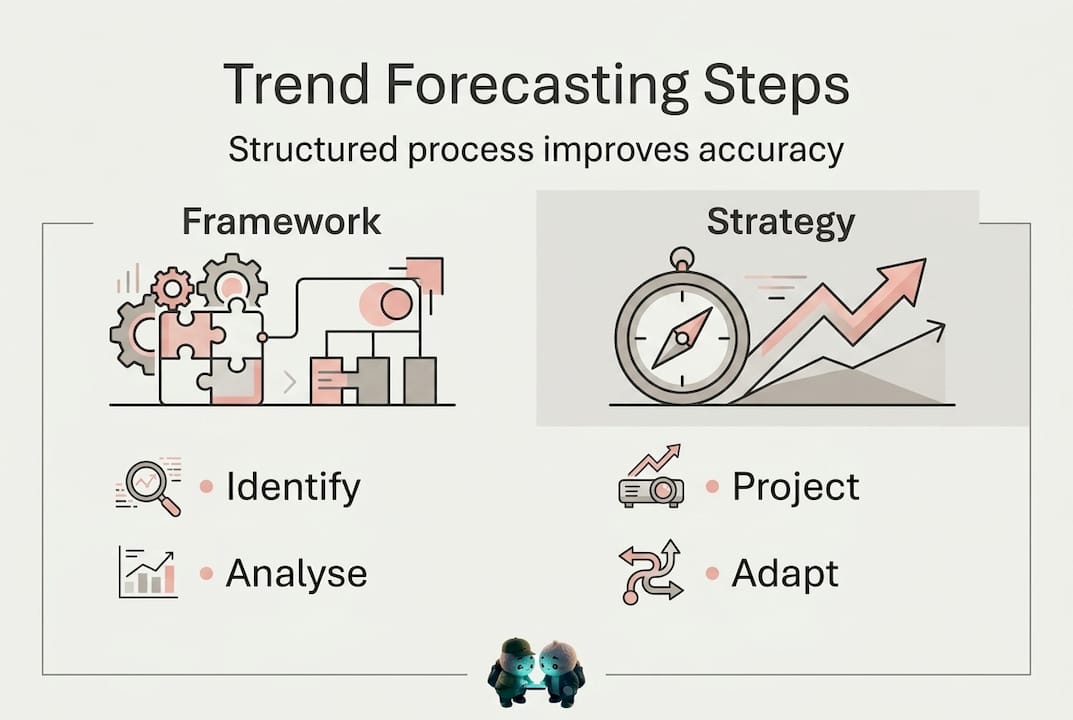
The empirical case for structure is compelling. Organisations using structured foresight show measurably higher adaptability according to Gartner benchmarks, while AI-assisted forecasting improves accuracy by up to 50% compared to manual approaches. These are not marginal gains. In competitive markets, a 10% improvement in directional accuracy can translate into significantly better resource allocation and faster time to market.
Building a structured process also creates institutional knowledge. Each forecast cycle teaches your team which signals carry weight in your sector and which ones dissolve into noise. Over time, your predictive accuracy compounds, and your ability to recognise inflection points sharpens considerably.
The core benefits of a structured approach include:
- Consistency: The same methodology applied across cycles produces comparable, benchmarkable results.
- Speed: Teams with defined processes move from raw data to actionable insight faster than those starting from scratch each time.
- Credibility: Structured outputs are easier to present to boards and investment committees, which matters when you need buy-in for bold strategic moves.
- Adaptability: Frameworks force you to revisit assumptions regularly, making your organisation more responsive to sudden market changes.
A structured approach is also the foundation of the strategic business edge that separates category leaders from reactive followers. You can find business growth examples across sectors where firms that invested in foresight outperformed peers who relied on reactive decision-making.

Key frameworks and steps in the forecasting process
Once you have grasped the basics, you need to choose a forecasting approach suited to your sector and the time horizons you care about. Different industries use different frameworks, and applying the wrong one can produce misleading outputs even from high-quality data.
The business trend forecasting framework typically follows five core steps:
- Define the scope and question. Clarify what strategic decision the forecast will inform. Vague briefs produce vague forecasts.
- Collect and filter data. Gather inputs from primary research, competitor intelligence, economic indicators, and consumer behaviour data.
- Detect signals and patterns. Separate meaningful signals from background noise using statistical filters and qualitative review.
- Analyse and model. Apply quantitative and scenario-based modelling to project how identified signals might evolve.
- Map to strategy. Translate findings into specific strategic options, resource implications, and timing recommendations.
The fashion industry uses a parallel but distinct approach. Fashion trend forecasting uses a 4-step process: aggregate data from diverse sources, identify influences across social, economic, and technological dimensions, gather predictions using specialist tools and expertise, then report findings with visuals and concrete recommendations. While the steps differ in specifics, the underlying logic is identical: structured data aggregation followed by disciplined interpretation and clear output.
| Framework | Primary sectors | Time horizon | Key strength |
|---|---|---|---|
| 5-step business framework | Finance, technology, FMCG | 12 to 36 months | Strategic depth and resource planning |
| 4-step fashion forecasting | Fashion, retail, consumer goods | 6 to 18 months | Visual trend mapping and trend speed |
| Horizon scanning | Government, infrastructure | 3 to 10 years | Long-range scenario building |
| Agile trend sprints | Tech startups, media | 1 to 6 months | Fast iteration and signal testing |
The table above highlights that framework selection is not a one-size-fits-all decision. A fintech firm planning its product roadmap for the next two years needs a different process than a luxury fashion brand preparing its next seasonal collection. Understanding disruptive trend examples across sectors will help you calibrate which framework suits your competitive context.
Pro Tip: If your market moves in cycles shorter than 12 months, combine the agile sprint approach with the business framework's strategic mapping step. This gives you the speed to act on short-term signals without losing sight of the broader directional picture. You can explore structured trend forecasting best practices that apply across multiple sectors and cycle speeds.
Tools and data sources for effective forecasting
With a framework chosen, you need robust tools and relevant data to support the process. The quality of your forecast is ultimately bounded by the quality of your inputs. Many organisations invest heavily in analytical sophistication but underinvest in data breadth, which creates blind spots that no amount of modelling can fix.
Effective forecasting draws on four primary categories of data:
- Analytical data: Web traffic patterns, search volume trends, app usage metrics, and transactional data that reveal shifts in consumer behaviour at scale.
- Observational data: Social media conversations, forum discussions, cultural commentary, and influencer activity that surface emerging sentiment before it shows up in hard metrics.
- Competitor intelligence: Product launches, patent filings, hiring patterns, and pricing movements that indicate where established and emerging players are placing their bets.
- Economic and regulatory data: Macroeconomic indicators, central bank signals, trade data, and regulatory changes that shape the environment in which trends either accelerate or stall.
Aggregating these sources is where most teams struggle. Data aggregation from diverse sources is a foundational step in any serious forecasting process, and it requires both technological infrastructure and disciplined curation to work well.
| Tool category | Examples | Primary use |
|---|---|---|
| AI signal platforms | OnTheRice, TrendWatching AI | Real-time trend scoring and ranking |
| Social listening tools | Brandwatch, Sprinklr | Sentiment and cultural signal detection |
| Economic dashboards | OECD Data, Bloomberg Terminal | Macro and sectoral trend tracking |
| Search analytics | Google Trends, SEMrush | Consumer interest and demand signals |
| Scenario modelling software | Palantir, Quantexa | Probabilistic future-state modelling |
Staying current with market intelligence trends is essential because the tool landscape evolves rapidly. Platforms that were cutting-edge three years ago may now lag behind newer AI-driven alternatives that process far greater data volumes in real time. Monitoring social trend signals through dedicated platforms, rather than manual social media scanning, dramatically improves both the speed and reliability of your observational data layer.
Pro Tip: One of the most common data blind spots is over-reliance on your own sector's data feeds. Trends frequently originate in adjacent industries before migrating into your market. A pharmaceutical company that monitors consumer wellness behaviour on social platforms will often spot health trend shifts months before they show up in clinical or market research data.
Advanced techniques: Signal detection, inflection analysis, and hypothesis testing
To boost accuracy further, take your forecasting beyond the basics with advanced signal and validation methods. Most organisations that use structured frameworks still stop short of these techniques, which is precisely why mastering them creates genuine competitive separation.
Weak signal detection is the practice of identifying early-stage trend indicators before they reach measurable scale. The challenge is that weak signals are, by definition, surrounded by noise. Three filters help distinguish genuine signals from coincidental data spikes:
- Convergence: A signal gains credibility when it appears independently across multiple unrelated data sources. A single social media spike means little. The same pattern appearing simultaneously in search data, patent filings, and academic publications is worth investigating seriously.
- Persistence: Genuine trend signals tend to resurface consistently over time rather than appearing once and fading. Tracking signal recurrence over several data collection cycles separates durable trends from short-lived anomalies.
- Amplification: Real trends tend to grow in intensity and geographic spread over successive measurement periods. If a signal is neither growing nor spreading, its strategic relevance is limited regardless of its initial strength.
Weak signals via convergence, persistence, and amplification filters represent the expert-level approach that distinguishes professional forecasters from those who rely on surface-level trend reports. Applying these filters consistently requires discipline but pays dividends in forecast reliability.
Inflection point timing is equally critical. An inflection point is the moment when a trend transitions from early adoption to mainstream acceleration. Acting before this point often means investing in infrastructure and capability that sits idle. Acting after it means competing in a crowded market at a cost disadvantage. The goal is to time resource allocation so that your organisation is positioned precisely as the curve steepens.
"Timing actions at inflection points allows organisations to avoid early resource waste while still capturing the strategic upside of emerging trends before they become mainstream." The Trend Forecasting Framework
Stakeholder impact mapping adds another layer of rigour. Once a trend signal clears your detection filters, map which internal and external stakeholders it affects and how. A supply chain disruption trend may look like a logistics issue on the surface but carries profound implications for procurement, product design, and customer experience teams. Mapping these impacts early ensures your organisation responds holistically rather than in silos.
Hypothesis testing closes the loop. For each trend hypothesis your framework generates, define what observable evidence would confirm or disconfirm it within a specific timeframe. This transforms forecasting from an opinion-forming exercise into a falsifiable analytical process. Teams that practise this rigorously become significantly better calibrated over successive cycles. You can explore identifying industry signals to understand how professional signal detection works in practice, and review AI forecasting tools that can automate much of the convergence and persistence tracking described above. For sector-specific applications, crypto signal detection offers a useful case study in applying these techniques within a highly volatile, fast-moving market.
Why conventional trend forecasting falls short—and what actually works
Most businesses approach trend forecasting as a periodic activity rather than a continuous discipline. They commission a market research report once a year, discuss it at a strategy offsite, and then return to running the business until the next cycle. That approach was always fragile. In 2026, it is genuinely dangerous.
The core problem is that ad hoc forecasting captures the market as it was when the research was conducted, not as it is becoming. By the time a trend reaches a formal research report, early movers have frequently already positioned themselves. The opportunity you are reading about is often the opportunity you have already missed.
What genuinely works is treating forecasting as an operational process rather than a strategic event. Organisations that build strategic edge into their day-to-day decision-making treat signal detection as a continuous function, not a quarterly deliverable. They allocate dedicated analytical resource to monitoring weak signals, run regular hypothesis review sessions, and maintain living scenario maps rather than static strategy documents.
The business growth insights from organisations that have made this transition consistently point to the same practical lesson: the value of a forecasting framework is not in the framework itself. It is in the discipline of applying it consistently, especially when the signals are ambiguous and the temptation to wait for certainty is strongest.
Take your forecasting to the next level
If you are ready to move from theory to practise, OnTheRice.org gives you the real-time intelligence infrastructure to make that transition immediately.
Our AI engines continuously scan global data points, score emerging signals across dozens of sectors, and surface what is gaining momentum before it reaches mainstream awareness. Whether you are tracking AI forecasting opportunities in your sector, monitoring B2B signals for competitive positioning, or staying ahead of social trends analysis that inform your marketing strategy, OnTheRice provides the structured, transparent signal scoring your forecasting process needs to function at its best.
Frequently asked questions
What is the main advantage of using a structured trend forecasting process?
Structured processes improve accuracy and adaptability by removing the confirmation bias inherent in ad hoc approaches. Organisations using structured foresight show measurably higher adaptability, and AI-assisted forecasting can improve prediction accuracy by up to 50%.
Which data sources are most reliable for trend forecasting?
The most reliable forecasts draw on a combination of analytical, observational, competitor, and economic data. Aggregating data from diverse sources ensures that no single feed creates a structural blind spot in your analysis.
How can businesses avoid mistakes in trend forecasting?
Apply empirical frameworks consistently and time resource allocation to inflection points rather than early signal detection. Timing actions at inflection points prevents organisations from committing capital before a trend achieves genuine market momentum.
How does AI impact trend forecasting accuracy?
AI forecasting improves prediction accuracy by up to 50%, according to IBM benchmarks. AI-assisted forecasting processes larger data volumes with greater consistency than manual analysis, reducing the impact of human cognitive bias on forecast outputs.