

TL;DR:
- Nearly half of startups fail due to building products nobody wanted, caused by lack of market signals.
- Early insights provide businesses with a competitive advantage by detecting trends before they become obvious.
- Effective use of AI, human judgment, and disciplined processes enables organizations to turn signals into sustained success.
Nearly half of all startups collapse because they built something nobody wanted. 42% cite no market need as their primary cause of failure, and the uncomfortable truth is that most of those founders were not short of data. They were short of the right signals, read at the right time. Early insights are not a luxury reserved for large enterprises with sprawling research teams. They are the difference between leading a market and scrambling to catch up. This guide breaks down what early insights actually are, how to find them, where they fail, and how to build a system that keeps you ahead consistently.
Table of Contents
- The strategic value of early insights
- How to discover early insights: Tools and frameworks
- Risks and myths: When early isn't always better
- Turning insights into sustained business advantage
- Why most businesses still miss early signals (and how you can outpace them))
- Ready to act? Transform early signals into your next success
- Frequently asked questions
Key Takeaways
| Point | Details |
|---|---|
| Early insights boost competitiveness | Spotting trends before others leads to superior decisions, innovation, and efficiency for your business. |
| Method matters more than speed | It’s interpretation, not just rapid action, that makes early insights valuable. |
| Technology aids, but doesn’t replace, expert judgement | AI accelerates discovery but must be balanced with human experience and validation. |
| Risks exist for the unprepared | Acting early without organisational readiness can backfire—timing and alignment matter. |
The strategic value of early insights
An early insight is a meaningful signal extracted from noisy, real-world data before that signal becomes obvious to your competitors. Think of it as the difference between spotting a weather pattern forming offshore versus reacting to a storm already at your door. Businesses that act on early insights gain measurable advantages in decision-making speed, innovation capacity, and operational efficiency.
Consider what this looks like across industries. A retail chain that identifies a shift in consumer sentiment six weeks before a seasonal peak can adjust its stock levels, pricing, and marketing spend in time to capitalise. A manufacturing firm that detects a raw material shortage signal early can lock in supplier contracts before prices spike. A startup that spots an underserved segment through B2BSignals business insights can validate its product direction before burning through its runway.
The business case is not theoretical. Real-time intelligence has been used to identify productivity drops in operations before they cascade into costly delays, and to build investor pitch narratives grounded in verifiable market momentum rather than gut instinct. That kind of evidence wins funding rounds.
"The organisations that win are not necessarily the ones with the most data. They are the ones who extract meaning from it faster than anyone else."
Here are the core business areas that benefit most from early insights:
- Product development: Spot demand before it peaks and build ahead of the curve
- Sales and marketing: Target emerging customer segments with precision
- Supply chain: Anticipate disruptions and lock in favourable terms early
- Investment decisions: Validate market momentum before committing capital
- Talent acquisition: Identify skills shortages before they become expensive
- Risk management: Detect regulatory or reputational shifts before they escalate
Exploring EmergingBrands case studies reveals a consistent pattern: the businesses that outperform peers are not always the most innovative in product terms. They are the most responsive to signals that others dismiss as noise.
How to discover early insights: Tools and frameworks
Understanding the impact is one thing. Learning how to act is another. There are two broad approaches to gathering early insights: top-down and grassroots.
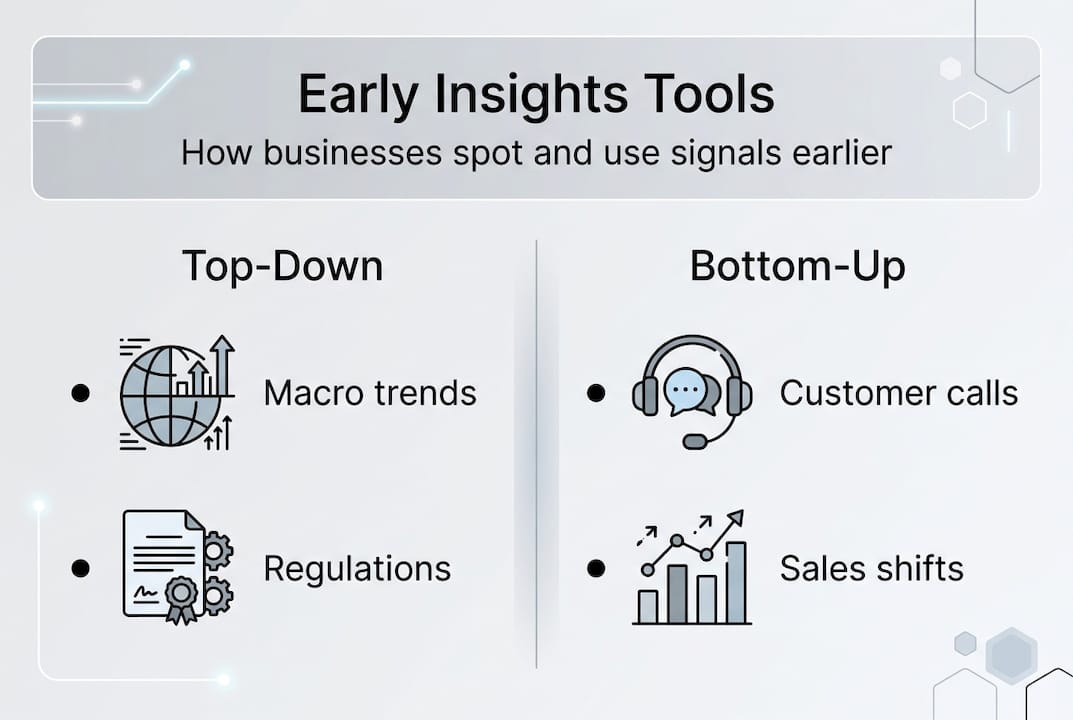
A top-down approach starts with macro signals, think global trade data, regulatory announcements, or macroeconomic indicators, and works inward to identify sector-specific implications. A grassroots approach starts at the micro level, monitoring social platforms, niche forums, customer support tickets, and sales team feedback, then aggregates upward to find patterns.
Both matter. Neither alone is sufficient.
Here is a comparison of the most common methods:
| Method | Data source | Speed | Accuracy | Best for |
|---|---|---|---|---|
| Market research | Surveys, interviews | Slow | High | Validating hypotheses |
| Trend analysis | Search, social, media | Medium | Medium | Spotting emerging themes |
| Competitive intelligence | Competitor activity | Medium | Medium | Benchmarking positioning |
| Demand sensing | Sales, POS, logistics | Fast | High | Supply chain and retail |
P&G's use of demand sensing is a well-documented example. By integrating real-time point-of-sale data with supply chain signals, they achieved 30 to 40% forecast accuracy improvements and a 15% inventory reduction, releasing working capital that could be redeployed elsewhere.
To run your own early insight project, follow this sequence:
- Define the decision you need to make. Insights without a decision context are just noise.
- Map your signal sources. Identify which data streams are most likely to carry early indicators relevant to that decision.
- Set detection thresholds. Decide what level of signal strength warrants action versus further monitoring.
- Apply AI tools for acceleration. Use AI tools for signals to scan at scale, but do not skip human review.
- Validate with sales intelligence. Cross-reference AI findings against what your frontline sales team is actually hearing.
- Act and measure. Commit to a response and track the outcome to improve your model.
AI accelerates detection, but human judgement is what separates a genuine signal from a statistical artefact. Running business diagnostics alongside AI outputs adds the contextual layer that pure automation misses. The goal is not to monitor more. It is to act faster on what genuinely matters.
Pro Tip: Prioritise signals that are directly linked to sales behaviour or purchasing decisions. Volume of monitoring is a vanity metric. Actionable, revenue-connected signals are the ones worth building systems around.
Risks and myths: When early isn't always better
With methods in hand, it is important to recognise that not all early moves guarantee success. The idea that being first always wins is one of the most persistent and damaging myths in business strategy.
Early mover advantage is conditional on ecosystem readiness, the type of innovation involved, and your organisation's internal capacity to execute. A firm that rushes into a market before the infrastructure, regulation, or customer behaviour has matured can spend enormous resources educating a market that ultimately rewards a later, better-positioned entrant.
Here is how the outcomes compare:
| Scenario | Early mover | Late mover |
|---|---|---|
| Mature, stable market | Disadvantage (entrenched competition) | Advantage (learn from errors) |
| Emerging, fast-moving market | Advantage (brand recognition) | Risk (miss the window) |
| Regulated industry | High risk (compliance uncertainty) | Lower risk (rules established) |
| Technology-dependent product | Risk (immature infrastructure) | Advantage (proven stack) |
There are also serious risks in over-relying on unvalidated AI or social signals. Algorithms can amplify fringe sentiment, mistake viral noise for structural demand, or reflect the biases embedded in their training data. Prioritising interpretation over monitoring, and validating generative AI outputs with proprietary data and expert judgement, is what separates genuine intelligence from expensive distraction.
Common myths worth challenging:
- Myth: More data always means better decisions. Reality: Uninterpreted data creates paralysis, not clarity.
- Myth: AI signals are objective. Reality: They reflect the biases of their training sets and data sources.
- Myth: Speed is the only advantage. Reality: Timing matters more than pace. Acting at the right moment beats acting first.
- Myth: Early insights are only for large firms. Reality: Small teams with focused signal sources often outperform large, slow-moving research departments.
Exploring AI opportunities and reviewing AI whitepapers on signal validation can help your team build a more rigorous approach to separating genuine trends from noise.
Turning insights into sustained business advantage
Knowing the risks, successful businesses do not just spot trends. They build repeatable systems for acting on them. The difference between a one-off win and sustained advantage is process.
Here is a practical three-step process for converting signals into action:
- Signal to hypothesis. When a signal crosses your detection threshold, frame it as a testable business hypothesis. "If this trend continues for four more weeks, our Q3 demand for product X will increase by 15%." Specificity forces rigour.
- Hypothesis to pilot. Run a small, fast, measurable test. Adjust pricing in one region. Launch a targeted campaign to one segment. Shift one supplier relationship. Keep it contained so you can learn quickly.
- Pilot to scale. If the pilot confirms the hypothesis, scale with confidence. If it does not, feed the learning back into your signal model and refine your thresholds.
The empirical benchmarks from real deployments are striking. A fashion retailer using real-time demand signals saw fast-picking improve by 35% and on-time delivery rise by 25%. Turning Point, a research-led organisation, achieved a 93% reduction in research costs by integrating AI-driven signal detection into its workflow.

These are not outliers. They are the result of disciplined application of insight systems. EmergingBrands lessons consistently show that the firms achieving these results share one trait: they treat insight as an operational function, not a periodic exercise.
Pro Tip: Measure the business impact of every insight acted upon. Track revenue influenced, costs avoided, or time saved. This creates accountability and helps you identify which signal sources are genuinely predictive versus which ones just feel important.
The Discovery platform approach, scanning global data points and generating ranked signals by sector, is exactly the kind of continuous intelligence loop that sustains advantage over time.
Why most businesses still miss early signals (and how you can outpace them)
Here is the uncomfortable reality: most organisations are not short of signals. They are drowning in them. The failure is not in detection. It is in interpretation.
Building a culture that values interpretation is genuinely rare. It requires cross-functional trust, where sales teams share what they are hearing, analysts translate that into structured hypotheses, and leadership acts on incomplete information with appropriate speed. Most firms optimise for certainty and end up acting too late.
The outliers who consistently outperform share a specific discipline. They prioritise interpretation over monitoring, integrate sales intelligence directly into their signal review process, and validate every AI-driven finding with expert human judgement before committing resources.
You do not need a large team to start. Begin with smart AI tools that surface ranked signals, assign one person per signal to own the interpretation, and build a weekly rhythm of hypothesis review. The advantage compounds quickly when interpretation becomes a habit rather than an event.
Ready to act? Transform early signals into your next success
The gap between knowing a trend exists and acting on it profitably is where most businesses lose ground. OnTheRice closes that gap.
The SignalsInternational data platform scans global markets in real time, surfacing ranked signals before they reach mainstream awareness. For business-to-business professionals, B2BSignals for business delivers sector-specific intelligence tailored to commercial decision-making. And if you are tracking emerging brands and category shifts, EmergingBrands for trends gives you the early read your competitors are missing. Start with the platform most relevant to your industry and build your insight advantage from there.
Frequently asked questions
What is an early insight in business?
An early insight is a signal or data trend identified before it becomes widely recognised or acted on in the market. Early insights drive better decision-making, innovation, and competitive advantage when applied with the right context.
Are early insights always accurate predictors of market shifts?
Not all early signals lead to success. Early mover advantage is conditional on organisational readiness, ecosystem maturity, and how well the insight is interpreted and applied.
How can technology improve the collection of early business signals?
AI and real-time analytics accelerate signal detection at scale, but AI findings require validation from proprietary data and expert judgement to avoid bias and misinterpretation.
What are examples of companies using early insights profitably?
P&G improved forecast accuracy by 30 to 40% through demand sensing, while startups using structured insight processes identified market fit opportunities that would otherwise have been missed entirely.