
TL;DR:
- Effective trend opportunity scanning is a disciplined, cyclical process involving signal detection, validation, and prioritization to stay ahead of competitors. It requires structured tools, regular cadences, cross-lane convergence, and formal scoring to identify high-impact opportunities reliably. Embedding this system into organizational routines transforms insights into a competitive advantage and future growth.
The trend opportunity scanning process is the structured method by which businesses identify, evaluate, and act on emerging market signals before rivals do. Treated as a formal operating system rather than a casual activity, it enables strategists to anticipate demand 6–12 months ahead of competitors and convert raw signals into validated growth opportunities. Frameworks from RapidKnowHow, signal-tracking systems described by Ayush Poddar, and AI visibility tools like UltraScout all point to the same conclusion: the strategists who win are those who scan with discipline, score with rigour, and act with speed.
What is the trend opportunity scanning process?
Environmental scanning, the recognised industry term for this practice, is the systematic collection and interpretation of signals from markets, customers, competitors, and technology. The trend opportunity scanning process is its applied, opportunity-focused variant. Where traditional environmental scanning monitors broadly, this process filters aggressively for signals that indicate near-term commercial potential.

The output is not a report. It is a prioritised backlog of opportunities, each scored against measurable criteria, ready for validation or pilot. Structuring trend opportunities around clear commercial outcomes separates this process from the vague "trend watching" that most organisations mistake for strategy.
Three named entities define the current state of the art. UltraScout provides AI visibility auditing to detect cross-platform signal strength. RapidKnowHow publishes scoring matrices and breakthrough formulas for opportunity evaluation. Ayush Poddar's three-phase system, covering Signal, Validation, and Monetisation, offers the clearest operational blueprint available for business professionals in 2026.
What tools and practices enable effective scanning?
Successful business opportunity scanning depends on two things: the right tools and a non-negotiable cadence. Neither works without the other.
Build your scanning infrastructure first
The foundational layer consists of four data source categories:
- AI trend detection tools such as UltraScout for visibility auditing and Ontherice for real-time market signal scoring across sectors
- Behavioural signal trackers monitoring job post keywords, tool spend changes, and support ticket volume
- Competitor and customer monitoring covering enterprise procurement signals, partnership announcements, and pricing shifts
- Market radar inputs including regulatory filings, infrastructure investment data, and patent activity
Market scanning functions as an early warning system with four distinct parts: rival watching, customer signal watching, industry trend watching, and technology impact checking. Each part feeds a different layer of your opportunity backlog.
Establish a scanning cadence and backlog system
Recurring 30–60 minute weekly scanning sessions, combined with monthly deep reviews, separate strategists who act from those who accumulate noise. The weekly session is for signal capture. The monthly session is for scoring, pruning, and prioritisation.
Every signal captured should be tagged immediately by buyer type, workflow affected, supporting metric, and evidence category. This tagging system converts raw observations into backlog items that your team can act on without re-researching from scratch.
Pro Tip: Set a hard rule that no signal enters your backlog without at least one demand proxy attached. A signal with no measurable demand indicator is an opinion, not intelligence.
How do you execute the three core scanning phases?
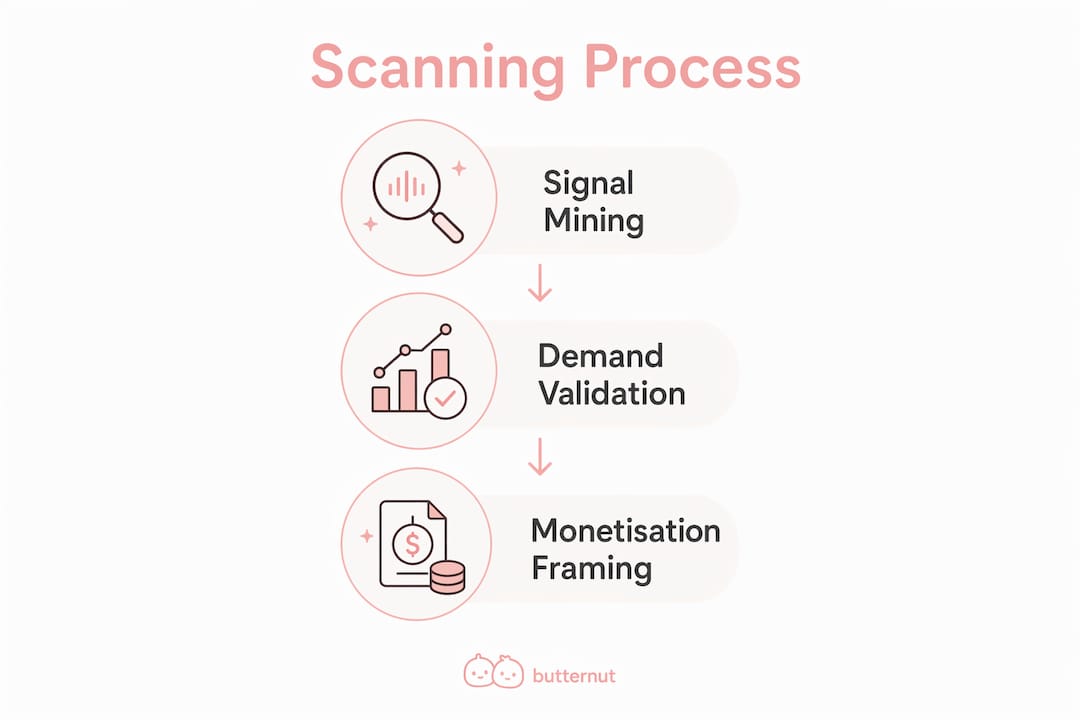
The three-phase model is the operational backbone of any credible scanning process. Each phase has a distinct purpose and a distinct failure mode.
Phase 1: signal mining
Signal mining means tracking early indicators across multiple data lanes simultaneously. The three primary lanes are:
- Customer conversation signals such as repeated support queries, feature requests, and language shifts in sales calls
- Enterprise activity signals including procurement changes, hiring patterns, and partnership announcements from large organisations
- Infrastructure pressure signals covering regulatory changes, supply chain disruptions, and capital flows into adjacent sectors
Multi-lane signal tracking across these three categories is the only reliable method for filtering high-value opportunities from noise. A signal appearing in one lane is a data point. A signal appearing in all three is a priority.
Phase 2: demand validation
Validation converts a signal into evidence of real commercial demand. The tools for this phase are specific.
| Validation Method | What It Measures | Reliability |
|---|---|---|
| Job post keyword tracking | Employer investment in a capability | High |
| Tool spend change data | Actual budget allocation shifts | High |
| Search trend velocity | Rate of public interest growth | Medium |
| Social sentiment volume | General awareness level | Low |
Demand proxies such as job post keywords, tool spend changes, and support ticket volume are more reliable than social sentiment, which is volatile and misleading. Social chatter tells you what people are talking about. Demand proxies tell you what they are paying for.
Phase 3: monetisation framing
Monetisation framing means building a narrative around the validated opportunity before committing resources. This involves three steps: identifying the ideal customer profile most affected by the trend, sizing the addressable wedge within that profile, and designing a pilot experiment with a clear success metric.
Pro Tip: Before any pilot, write a one-paragraph "opportunity brief" that states the signal, the demand evidence, the target buyer, and the proposed test. If you cannot write it in one paragraph, the opportunity is not yet validated.
What pitfalls should strategists expect?
The most common failure in emerging trends evaluation is not a lack of data. It is a lack of discipline in how data is interpreted and acted upon.
"The strategist who monitors social sentiment as a primary signal is optimising for awareness, not demand. Awareness does not pay invoices."
Four pitfalls account for the majority of scanning failures:
- Over-reliance on public chatter. Social media volume reflects what is trending in conversation, not what is gaining commercial traction. Behavioural change tracking, not sentiment analysis, identifies high-priority opportunities.
- Inconsistent cadence. A scanning session skipped for two weeks means signals missed at their most actionable point. Cadence is the process. Without it, you have a tool list, not a system.
- Single-lane signal reliance. Acting on a signal from one data lane without cross-referencing others produces false positives. Convergence across customer, enterprise, and infrastructure lanes is the validation threshold.
- No documentation standard. Signals captured informally, in emails or meeting notes, are lost within days. A tagged backlog is the only format that survives organisational memory.
Strategists should plan for a 4–8 week response timeline after initial signals appear in high-fidelity AI visibility data. That window is tight. It requires a backlog that is already populated and scored, not one being built from scratch when urgency arrives.
How do you score and prioritise opportunities?
Scoring is where most organisations lose competitive advantage. They identify signals correctly and then stall on prioritisation because they have no agreed evaluation framework.
Apply a structured scoring matrix
RapidKnowHow's research recommends focusing on opportunities scoring above 30 on a 1–40 matrix that evaluates market size, technology leverage, capital inflow, and speed of adoption. The breakthrough formula is: Competitive Advantage multiplied by the square of the System Multiplier. This is not abstract. It forces you to quantify your differentiation before committing resources.
| Scoring Dimension | What to Measure | Weight |
|---|---|---|
| Market size | Total addressable spend in the segment | High |
| Capital inflow | Venture and enterprise investment activity | High |
| Speed of adoption | Rate of behaviour change in target buyers | Medium |
| Technology leverage | Degree to which AI or automation amplifies the opportunity | Medium |
| Deployment friction | Barriers to entry and implementation complexity | Low |
Size the wedge, not the market
Success in opportunity capture is less about being first and more about correctly sizing the wedge. A wedge is the smallest urgent, addressable, and budget-ready niche within a larger trend. Targeting the full market is a strategy for large incumbents. Targeting the wedge is a strategy for everyone else.
Operational metrics for wedge sizing include urgency (how acutely does the buyer feel the problem today), budget ownership (does the buyer control the spend decision), and deployment friction (how many steps between purchase and value realisation). Score each on a simple 1–5 scale and multiply. Opportunities scoring above 50 on this combined metric warrant a 30-day sprint.
A 30-day strategic sprint with real customers is the minimum viable validation for any scored opportunity. It tests willingness to pay, not just willingness to engage. Those are different things, and confusing them is expensive.
Pro Tip: Run your wedge sizing exercise with a sceptic in the room. The person most likely to find the flaw in your opportunity brief is more valuable than the person most enthusiastic about the trend.
You can explore how AI predicts trends to understand how automated signal detection accelerates the scoring phase significantly.
Key takeaways
The trend opportunity scanning process delivers competitive advantage only when it operates as a disciplined, cadence-driven system with clear scoring criteria and documented signal backlogs.
| Point | Details |
|---|---|
| Treat scanning as a system | Run weekly 30–60 minute sessions and monthly deep reviews, not ad-hoc searches. |
| Track signals across three lanes | Customer, enterprise, and infrastructure signals must converge before you act. |
| Use demand proxies, not sentiment | Job post data and tool spend changes outperform social sentiment as leading indicators. |
| Score every opportunity formally | Apply a 1–40 matrix covering market size, capital inflow, and adoption speed before committing. |
| Validate with a 30-day sprint | Test willingness to pay with real customers before scaling any identified opportunity. |
Why scanning must become an operating cadence
I have watched capable strategy teams spend months building elaborate trend reports that nobody acts on. The problem is almost never the quality of the analysis. It is the absence of a repeatable operating cadence that connects signal capture to decision-making.
The shift that changes everything is treating the scanning process the way a finance team treats month-end close. It happens on a schedule. It has an owner. It produces a documented output. When that discipline is in place, the quality of the signals almost becomes secondary, because the system processes them consistently rather than selectively.
What I find most underestimated is multi-lane convergence. Strategists who track only one data source, typically market research reports or industry news, are operating with a significant blind spot. The signals that matter most appear first in customer behaviour and enterprise procurement, not in published analysis. By the time a trend appears in a research report, the wedge has usually been claimed.
The other lesson I would press on any strategist is this: scoring is not bureaucracy. It is the mechanism that stops you from pursuing the loudest trend rather than the most profitable one. The emerging trend scouting discipline that separates high-performing strategy teams from the rest is not better data. It is better filtering.
Embed your scanning outputs directly into your quarterly strategic reviews. Tag your backlog items to specific business objectives. Make the connection between signal and strategy visible to everyone in the room. That is when scanning stops being a research activity and starts being a competitive weapon.
— Aidil
Discover trends before your competitors do
Ontherice is built for exactly the kind of structured, signal-driven scanning this article describes. The platform's AI engines scan global data points in real time, extract meaningful signals from noise, and produce scored rankings across sectors before trends reach mainstream awareness.
If you are ready to move from manual scanning to an AI-powered process, the AIOpportunities platform gives you scored trend opportunities with the transparency to understand why each signal ranks where it does. For the strategic frameworks and scoring methodologies that underpin the process, the Ontherice Whitepaper provides the depth your planning sessions need. Start with the signals. Build the system around them.
FAQ
What is the trend opportunity scanning process?
The trend opportunity scanning process is a structured, three-phase system covering signal detection, demand validation, and monetisation that enables businesses to identify and act on emerging market opportunities 6–12 months ahead of competitors.
How often should you run a trend scanning session?
Weekly 30–60 minute sessions for signal capture, combined with monthly deep reviews for scoring and prioritisation, is the recommended cadence for consistent opportunity detection.
What scoring threshold indicates a breakthrough opportunity?
Opportunities scoring above 30 on a 1–40 evaluation matrix covering market size, technology leverage, capital inflow, and adoption speed are classified as breakthrough candidates worth pursuing.
Why are demand proxies better than social sentiment for trend detection?
Demand proxies such as job post keywords and tool spend changes reflect actual budget decisions, whereas social sentiment reflects conversation volume, which is volatile and does not reliably predict commercial traction.
How long should a trend opportunity validation sprint last?
A 30-day strategic sprint with real customers is the minimum viable test for any scored opportunity, as it measures willingness to pay rather than willingness to engage, which are distinct and often misaligned signals.