

TL;DR:
- Most businesses recognize trend signals but fail to structure them into actionable strategies or investments. Applying frameworks like McKinsey's Three Horizons and AI-driven scanning helps organizations turn early signals into growth opportunities. Regular, disciplined evaluation, experimentation, and integration into strategic pipelines are essential for gaining and maintaining competitive advantage through trend management.
Most businesses don't fail to spot trends. They fail to do anything structured with them. A signal surfaces, someone flags it in a meeting, it gets added to a "things to watch" list, and then nothing happens. Knowing how to structure trend opportunities is the difference between an organisation that turns early signals into revenue and one that watches competitors capitalise on the same information six months later. This guide walks you through the frameworks, AI-driven scanning methods, and decision tools that convert raw trend data into actionable growth pipelines.
Table of Contents
- Understanding the framework for structuring trend opportunities
- Preparing to identify trend opportunities using AI-driven weak signal scanning
- Executing structured evaluation and experimentation of trend opportunities
- Verifying and integrating trend insights into strategic growth pipelines
- Rethinking trend opportunity management for AI-powered strategic advantage
- Leveraging OnTheRice solutions to accelerate trend opportunity success
- Frequently asked questions
Key Takeaways
| Point | Details |
|---|---|
| Use a structured innovation model | Apply frameworks like McKinsey’s Three Horizons to balance current and future growth initiatives effectively. |
| Scan broadly for weak signals | Monitor multiple zones including regulatory and fringe communities, applying filters to identify true trends early. |
| Test with small reversible bets | Convert signals into falsifiable claims and run bounded experiments to manage risk and learn quickly. |
| Integrate with scenario planning | Use scenario frameworks to adapt strategies quarterly and prepare for multiple future market conditions. |
| Leverage AI with expert oversight | Combine AI-driven insights with human judgement and technical strategists to maximise trend spotting success. |
Understanding the framework for structuring trend opportunities
Having introduced the challenge, we now explore the essential frameworks that organise trend opportunities effectively.
The single most useful mental model for structuring trend opportunities is McKinsey's Three Horizons of Growth. It organises innovation into three distinct layers: Horizon 1 covers your current core business, Horizon 2 addresses emerging ventures requiring investment now, and Horizon 3 captures visionary bets on future markets. Each horizon demands different management postures, budgets, and timelines.
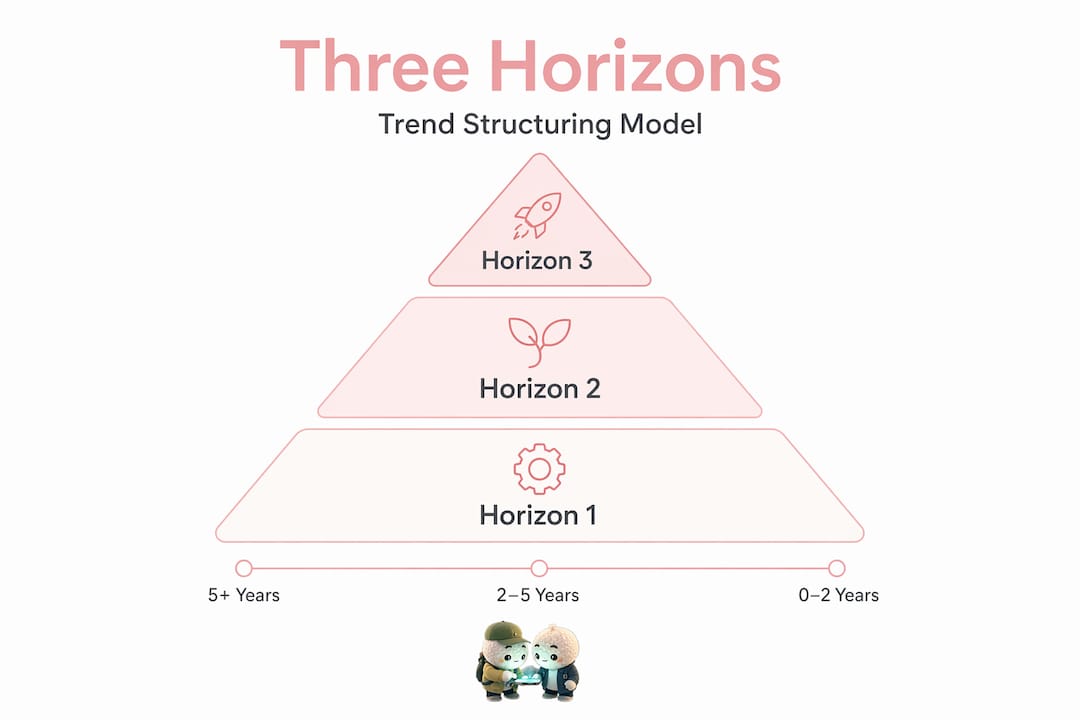
What most strategists miss is that industry pace affects horizon timelines dramatically. In traditional manufacturing, Horizon 3 might span a decade. In enterprise software, the same horizon can collapse to 18 months. If your organisation is applying a retail-industry rhythm to a tech-adjacent market, you are already behind.
The model also forces you to invest simultaneously across all three layers rather than sequentially. Waiting until Horizon 1 matures before funding Horizon 2 is how market leaders get blindsided. Sound trend forecasting for business advantage depends on holding all three horizons in view at once.
| Characteristic | Horizon 1 | Horizon 2 | Horizon 3 |
|---|---|---|---|
| Time frame | 0 to 2 years | 2 to 5 years | 5 or more years |
| Goal | Defend and extend core | Build emerging ventures | Seed future options |
| Risk level | Low | Medium | High |
| Resource priority | High allocation | Moderate allocation | Small bets |
| Management focus | Efficiency and margins | Growth and learning | Exploration |
| Metrics | Revenue, profit | Adoption, pipeline | Signal strength |
Understanding which horizon a trend belongs to determines how urgently you act, how much you invest, and who in your organisation owns it. To master the trend forecasting process, you need this categorisation before anything else.
Preparing to identify trend opportunities using AI-driven weak signal scanning
With a grasp on foundational frameworks, next is preparing to spot trend signals supported by AI-driven scanning techniques.
A weak signal is a faint, early indicator that a shift may be underway. The problem is that most of these signals arrive buried in noise. The SUCCESS 5-Step Trend Forecasting Framework addresses this directly by scanning five distinct zones where meaningful signals tend to emerge first:
- Regulatory environments: Policy consultations, legislative proposals, and enforcement shifts often precede market changes by 12 to 24 months
- Academic and research outputs: Pre-publication data, grant allocations, and conference themes signal where scientific and commercial attention is moving
- Startup activity: Funding rounds, patent filings, and new company formations in a space indicate where practitioners see near-term opportunity
- Fringe communities: Early adopters, hobbyists, and niche forums often normalise behaviours years before mainstream markets acknowledge them
- Adjacent technologies: Tools and platforms built for one sector frequently migrate and disrupt others unexpectedly
Once signals are collected, professional futurists recommend filtering using three criteria: convergence (is the signal appearing across multiple independent sources?), persistence (has it recurred over several months?), and amplification (is it growing in volume or intensity?). A signal that meets all three is worth serious attention. One that meets only one is noise.
AI makes this scanning manageable at scale. Platforms that identify signals for smarter decisions can monitor thousands of data sources simultaneously, flagging patterns a human analyst would take weeks to surface. The human role shifts from collection to interpretation, which is precisely where strategic judgement adds the most value.

Pro Tip: Build a weekly 30-minute signal review into your team's calendar. Assign one person to aggregate AI-flagged signals across your five zones, apply the three filters, and present a shortlist of three to five candidates. A consistent trend spotting workflow beats sporadic deep dives every time.
Executing structured evaluation and experimentation of trend opportunities
Having prepared to spot signals, we now focus on how to systematically evaluate and experiment with trend opportunities.
Spotting a signal is not the same as understanding its commercial potential. Logan Reed's SIGNAL-PROOF-BET framework provides a disciplined path from observation to action. The process works as follows:
- Convert the signal into a falsifiable claim. Not "AI in logistics is interesting" but "AI-driven route optimisation will reduce last-mile delivery costs by 15% for mid-market carriers within 24 months." Specificity forces honest evaluation.
- Identify the proof points that would confirm or deny the claim. What evidence would you need to see? Pilot data, competitor moves, customer willingness to pay?
- Place a small, reversible bet. Run a 90-day pilot with a defined budget ceiling, clear learning goals, and a pre-agreed kill criterion.
- Track leading metrics, not lagging ones. Engagement rates, prototype adoption, and early customer feedback tell you where the opportunity is going before revenue data exists.
- Make a structured decision to ignore, watch, test further, or commit based on what the experiment returns.
The bounded nature of trend experiments is what makes this practical. Without explicit limits, trend pilots absorb resources indefinitely without producing decisions.
To prioritise which signals deserve experimentation, use a two-axis matrix plotting durability (how long will this trend persist?) against asymmetry (how large is the upside relative to the cost of testing?).
| Quadrant | Durability | Asymmetry | Recommended action |
|---|---|---|---|
| High durability, high asymmetry | Strong | Large upside | Commit: allocate significant resources |
| High durability, low asymmetry | Strong | Limited upside | Watch: monitor for changing conditions |
| Low durability, high asymmetry | Weak | Large upside | Test: run a fast, bounded experiment |
| Low durability, low asymmetry | Weak | Limited upside | Ignore: deprioritise entirely |
Pro Tip: Before launching any trend experiment, write a single-page brief that states the hypothesis, the budget ceiling, the leading metric target, and the exact condition that triggers a stop. Share it with your AI predicts trends guide process so that AI-generated data feeds directly into your evaluation criteria rather than sitting in a separate report.
Verifying and integrating trend insights into strategic growth pipelines
With trends evaluated and tested, the next step is integrating them into strategic growth plans and verifying their impact.
A verified trend insight that sits outside your strategic planning cycle is worthless. Integration requires connecting what you have learned from experimentation directly into Horizon 2 and Horizon 3 pipeline management.
- Run quarterly scenario planning sessions. The SUCCESS framework advises quarterly scenario refresh with "no-regret moves" (actions beneficial across most futures) and trigger points (specific conditions that accelerate or pause investment).
- Map verified trends to horizons. A trend that passed experimentation and shows clear durability belongs in Horizon 2 planning. A speculative but high-asymmetry signal with early proof belongs in Horizon 3 as an option to seed.
- Prune regularly. Most organisations accumulate innovation projects without removing them. A bloated pipeline dilutes focus and burns capacity. Review and retire underperforming initiatives quarterly.
- Maintain balance deliberately. McKinsey practitioners recommend balancing horizons and seeding multiple options rather than concentrating bets. The goal is a portfolio with coverage, not a lottery ticket.
| Pipeline stage | Horizon | Review cadence | Exit condition |
|---|---|---|---|
| Emerging signals | Horizon 3 | Monthly | Promote or archive after 3 months |
| Active experiments | Horizon 2/3 boundary | Bi-weekly | Kill criteria met or results confirm |
| Validated ventures | Horizon 2 | Quarterly | Scale or divest |
| Core growth | Horizon 1 | Monthly | Optimise or sunset |
Feeding emerging trends into actionable growth pipelines requires this kind of structured discipline. Without it, trends become talking points rather than revenue contributors. Understanding how trends shape business decisions at the structural level is what separates organisations that grow from those that merely observe.
Rethinking trend opportunity management for AI-powered strategic advantage
Here is the uncomfortable truth most trend guides skip: AI does not make strategy easier. It makes the wrong parts faster, which can create the illusion of progress while the genuinely hard decisions remain unresolved.
BCG's research on AI in corporate strategy shows that AI enhances market intelligence functions significantly but that complex judgement tasks still require technical strategists and redesigned workflows. Scanning and signal collection, which historically consumed 30 to 40% of a strategist's time, are now largely automatable. The bottleneck has shifted to interpretation, prioritisation, and commitment.
What this means in practice is that your strategy team's job description needs rewriting. The most valuable skill is no longer the ability to gather and synthesise market data. It is the ability to design AI workflows with clear escalation criteria, supervise model outputs for blind spots, and make contextual decisions that no model will make correctly without human input.
Organisations that flatten their strategy hierarchies and embed AI tools directly into decision-making cycles gain speed. Those that use AI as a reporting layer feeding upward into traditional management structures simply add a faster-moving inbox to a slow-moving process.
The other risk worth naming is monoculture. When multiple organisations use similar AI platforms scanning similar data sources, everyone surfaces the same signals at roughly the same time. The competitive advantage comes not from the signal but from the speed and quality of your response. Building competitive advantage from disruptive trends increasingly depends on your execution infrastructure, not your information access.
Invest in hybrid teams where AI proficiency and deep domain expertise sit in the same person or pair of people. The analyst who understands the model's limitations and the market's nuances simultaneously will consistently outperform either a pure data scientist or a pure industry veteran working alone.
Leveraging OnTheRice solutions to accelerate trend opportunity success
Applying the frameworks in this guide requires more than a spreadsheet and a newsletter subscription. You need real-time signal data, structured scoring, and an environment where AI scanning and human judgement work together efficiently.

OnTheRice is built specifically for this. The AI-driven trend opportunity tools within the platform allow you to place and track small bets against emerging signals with data continuously refreshed across global markets. If you need aggregated weak signal intelligence filtered to your sector, the business signal intelligence platform does the convergence, persistence, and amplification filtering for you automatically. And for monitoring where innovation is moving at the market level, the emerging brands and market insights dashboard surfaces which players are gaining momentum before mainstream coverage catches up. The tools are designed to sit inside your existing planning cycle, not replace it.
Frequently asked questions
What is the best way to identify weak signals in trend forecasting?
The most reliable approach involves scanning regulatory, academic, startup, fringe community, and adjacent technology zones, then applying the filters of convergence, persistence, and amplification. The SUCCESS framework's five-zone scan distinguishes meaningful signals from background noise with consistent accuracy.
How does the Three Horizons model help balance innovation efforts?
It separates innovation into current core business, emerging ventures, and future bets, allowing distinct resource allocation and management focus at each stage. McKinsey's Three Horizons framework ensures short-term efficiency does not crowd out long-term growth investment.
What is the SIGNAL-PROOF-BET framework?
It is a structured process that converts weak signals into specific, falsifiable claims, then runs small and reversible experiments to test them before committing significant resources. Logan Reed's framework makes trend experimentation decision-linked rather than open-ended.
How often should scenario planning be revisited when managing trends?
Quarterly reviews are the recommended cadence, allowing strategies to incorporate new evidence as signals evolve. The SUCCESS quarterly scenario refresh approach also sets trigger points so that rapid shifts prompt immediate reassessment rather than waiting for the next scheduled review.