

TL;DR:
- Building a systematic process transforms competitive signals into strategic decisions quickly.
- Effective CI requires clear objectives, appropriate tools, structured workflows, and human interpretation.
- Combining automation with cross-functional insights and creative analysis leads to better market foresight.
Blockbuster had the data. In 2004, internal reports flagged a scrappy DVD-by-mail service called Netflix as a growing threat, yet leadership dismissed the signal and stayed the course. Within six years, Blockbuster filed for bankruptcy whilst Netflix became a household name worth billions. The lesson is not that Blockbuster lacked information; it is that they lacked a systematic process for translating competitive signals into decisive action. This guide walks you through every stage of building that process: clarifying objectives, selecting tools, structuring workflows, interpreting outputs, and turning market intelligence into measurable strategic gains.
Table of Contents
- Identifying your monitoring objectives and requirements
- Choosing the right tools for comprehensive trend detection
- Implementing systematic monitoring workflows
- Interpreting results and adjusting strategies
- What most professionals miss about competitive trend monitoring
- Take your competitive monitoring to the next level
- Frequently asked questions
Key Takeaways
| Point | Details |
|---|---|
| Clarify objectives | Start by defining what you want to achieve with your trend monitoring efforts for targeted results. |
| Use diverse tools | Combining multiple CI platforms ensures you catch competitor movements across channels. |
| Automate routines | Automating data collection and alerting saves time and ensures timely insights. |
| Interpret and act | Regularly analyse gathered intelligence, adapt your strategies, and measure impact for ongoing competitive advantage. |
Identifying your monitoring objectives and requirements
With the stakes established, let's start by clarifying exactly what you're looking to achieve and which aspects of competitors you want to monitor.
Before you spend a single hour gathering data, you need to know what you're looking for. Competitive intelligence (CI) without clear objectives produces noise, not insight. Most organisations fall into the trap of monitoring everything and acting on nothing. The first discipline of effective CI is ruthless prioritisation.
Start by anchoring your objectives to genuine business decisions. Are you trying to defend a pricing position? Are you watching for a competitor's product launch that could cannibalise your pipeline? Are you tracking market share shifts in a specific region? Each of these questions requires a different set of metrics, sources, and reporting cadences.
Common monitoring objectives fall into several distinct categories:
- Pricing intelligence: tracking competitor price changes, discount strategies, and bundle offers in near real-time
- Product and feature launches: monitoring release notes, app store updates, press releases, and patent filings
- Market share and share of voice: measuring organic search visibility, social engagement, and media mentions relative to competitors
- Talent and hiring signals: analysing job postings to infer strategic intent, such as a competitor suddenly hiring a large data science team
- Partnership and M&A activity: watching for press announcements, regulatory filings, and investor relations updates
Once you have identified your objectives, choose metrics that align with your sector. A SaaS business might prioritise keyword rankings and feature parity, whilst a retailer focuses on price benchmarking and promotional cadence. The right market intelligence trends for your industry will shape every subsequent decision in your monitoring programme.
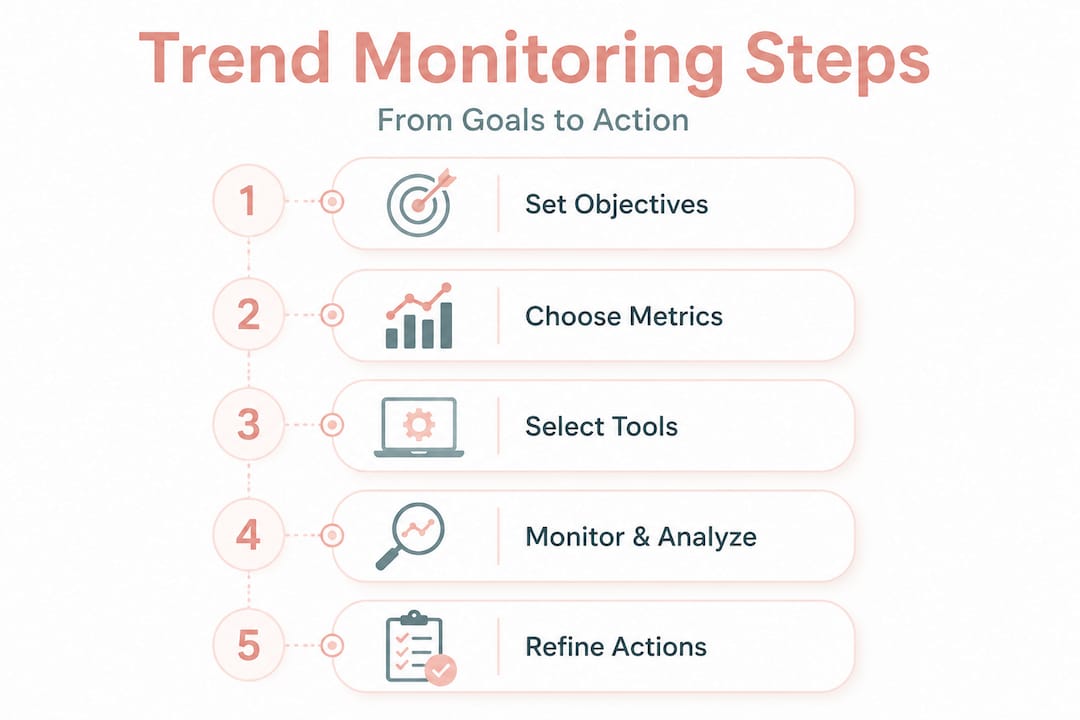
The business case for this discipline is compelling. AI-driven CI correlates with 18-22% higher profitability in tech and retail sectors, and empirical benchmarks show Walmart achieving a 9-12% sales uplift via algorithmic tracking, Target recording 145% e-commerce growth, and Toyota reducing costs by 25% through systematic benchmarking. These are not theoretical outcomes; they are the result of structured, repeatable monitoring processes.
| Business objective | Key metric to track | Recommended frequency |
|---|---|---|
| Pricing defence | Competitor price index | Daily or weekly |
| Product positioning | Feature parity score | Monthly |
| Market share | Share of organic search | Monthly |
| Talent intelligence | Job posting volume | Weekly |
| Partnership activity | Press and filing mentions | Weekly |
The table above is a starting framework. Refine it as your understanding of the competitive landscape deepens.
Choosing the right tools for comprehensive trend detection
Once objectives are set, the next step is ensuring you have the right tools for the job.
The market for CI tools has matured significantly. You no longer need a dedicated analyst team to track competitors effectively; the right technology stack can automate most of the heavy lifting. The challenge is selecting tools that complement each other rather than creating redundancy or gaps.
Ahrefs and Semrush cover SEO, backlinks, and keywords exceptionally well, whilst dedicated CI platforms handle web page change detection, pricing crawls, and product catalogue monitoring. Social listening tools such as Brandwatch surface sentiment and emerging narratives, and specialist platforms like PredictLeads track job postings and technology adoption signals. No single tool covers everything, which is why integration matters as much as individual capability.
Here is how leading tool categories compare:
| Tool category | Strengths | Limitations | Best for |
|---|---|---|---|
| SEO platforms (Ahrefs, Semrush) | Keyword gaps, backlink analysis, content performance | Limited to search signals | Content and demand gen teams |
| Web change detection | Monitors competitor pages for updates | Can generate false positives | Product and pricing teams |
| Social listening (Brandwatch) | Sentiment, brand mentions, narrative tracking | Volume and cost can be high | Marketing and comms teams |
| Job and tech tracking (PredictLeads) | Strategic intent inference | Lags behind actual decisions | Strategy and BD teams |
| AI signal platforms | Cross-market trend detection, early signals | Requires interpretation skill | Strategy, analysts, executives |
The most capable organisations combine at least three of these categories into a unified dashboard or reporting layer. This is where AI-powered CI tools deliver genuine leverage: they aggregate signals across disparate sources and surface patterns that manual review would miss entirely.
Key criteria for selecting tools:
- Coverage: does the tool monitor the channels where your competitors are most active?
- Freshness: how often is data updated, and does that cadence match your decision-making speed?
- Signal-to-noise ratio: does the platform surface actionable insights or dump raw data on you?
- Integration: can it feed into your existing BI tools, dashboards, or CRM?
- Scalability: will it grow with your monitoring needs without exponential cost increases?
Pro Tip: Before committing to an annual subscription, map each tool to a specific business decision. If you cannot name the decision a tool informs, you do not need it yet. This discipline keeps your stack lean and your team focused. Exploring AI opportunities in CI can also reveal where automation can replace manual research entirely.
Implementing systematic monitoring workflows
Having selected your tools, it is time to put them to work with structured monitoring routines.

A monitoring strategy without a workflow is just a collection of subscriptions. The real competitive edge comes from consistency: knowing what you are collecting, when you are reviewing it, who is responsible for acting on it, and how findings get distributed across your organisation. Treat your CI workflow like a business process, not a research project.
Here is a practical workflow for most organisations:
- Define your monitoring universe. List all direct and indirect competitors, as well as adjacent players who could enter your space. Include at least five direct competitors and two potential disruptors.
- Configure tool alerts and crawls. Set up automated alerts for price changes, new content publication, social spikes, and job postings. Segment alerts by priority so your inbox is not flooded with low-signal noise.
- Schedule regular data pulls. Daily automated reports for pricing and social; weekly pulls for SEO rankings and product changes; monthly deep dives for market share and strategic summaries.
- Assign ownership. Each monitoring stream should have a named owner. Pricing alerts go to the commercial team; product changes go to product management; talent signals go to strategy. Diffuse ownership means no one acts.
- Create a central intelligence repository. Store findings in a shared location with consistent tagging so patterns can be spotted across time. A simple spreadsheet works; a dedicated wiki or Notion database works better.
- Review and synthesise weekly. A 30-minute weekly review meeting where owners share flagged signals is more valuable than any monthly report. Speed of synthesis determines speed of response.
- Distribute actionable briefs. Translate intelligence into short, opinionated briefs for decision-makers. Not raw data. Not 20-slide decks. A one-page summary with a recommended action is what leaders actually use.
Common pitfalls to avoid:
- Monitoring too many competitors at once. Focus narrows insight; breadth dilutes it.
- Neglecting indirect threats. The most dangerous competitors are often those you are not yet watching.
- Storing data without synthesis. Raw data accumulates; intelligence requires human judgement applied to it.
- Ignoring weak signals. Small, early movements often predict large shifts. Build a habit of flagging anomalies, even when you cannot yet explain them.
Pro Tip: Use traffic monitoring strategies to identify sudden shifts in competitor web traffic, which often precede a product launch or marketing campaign by several weeks. Pair this with dynamic market tools to validate whether a traffic spike reflects a paid push or organic momentum. The distinction changes your strategic response entirely.
Research confirms that AI-driven CI delivers measurable profitability gains, with Walmart's algorithmic tracking generating a 9-12% sales uplift. These results are only achievable when the workflow is automated, consistent, and connected to decision-making rather than sitting in a folder no one opens.
Interpreting results and adjusting strategies
All monitoring efforts come down to the quality of insights and the actions you take based on them.
Data collection is the easy part. Interpretation is where most CI programmes falter. Analysts often present a competitor's activity without context, leaving decision-makers unsure whether to respond aggressively, cautiously, or not at all. Effective interpretation requires combining multiple data sources, applying sector knowledge, and asking the right questions.
When reviewing gathered intelligence, work through the following analytical steps:
- Contextualise the signal. Is a competitor's price drop a strategic move or a clearance of excess stock? Is a surge in job postings evidence of expansion or a response to churn? Context changes the implication entirely.
- Cross-reference sources. A single signal is a data point. The same signal appearing across SEO, social, hiring, and pricing data simultaneously is a trend worth acting on.
- Assess competitive intent. Ask whether the competitor's move is offensive (taking market share) or defensive (protecting margin). Your response strategy differs substantially based on that distinction.
- Model the impact. Quantify the potential effect on your own business. If a competitor drops pricing by 15%, what percentage of your customer base is at risk? What is the revenue exposure?
- Determine your response. Not every competitor move requires a reaction. Decide whether to match, counter, ignore, or accelerate based on strategic priority and resource availability.
"The firms that outperform their peers in competitive intelligence are not those with the most data. They are those with the clearest process for turning signals into decisions within days, not quarters."
The business impact of strong interpretation is well documented. Target achieved 145% e-commerce growth by reading retail behaviour signals and investing ahead of demand. Toyota achieved a 25% cost reduction by applying competitive benchmarking to supply chain decisions rather than waiting for market pressure to force change.
| Intelligence signal | Possible interpretation | Recommended action |
|---|---|---|
| Competitor price drop of 10%+ | Margin pressure or market share grab | Conduct customer risk analysis; consider selective matching |
| Sudden hiring spike in engineering | Major product development underway | Accelerate own product roadmap review |
| Significant drop in SEO rankings | Strategic content pivot or technical issues | Identify keyword gaps and exploit them |
| Negative social sentiment spike | PR crisis or product failure | Analyse root cause; consider targeted outreach |
Accessing structured B2B competitive signals can significantly speed up the interpretation phase by providing pre-analysed intelligence that highlights what is genuinely significant versus what is background noise.
What most professionals miss about competitive trend monitoring
The uncomfortable truth about CI programmes is that most of them monitor competently but interpret poorly. Organisations invest in tools, configure dashboards, and generate weekly reports. Yet when a genuine competitive threat emerges, they are still caught off guard. Why? Because they confuse data volume with intelligence quality.
Algorithmic trend detection is powerful, but it is inherently backward-looking. It identifies patterns in historical behaviour. The signals that precede truly disruptive moves often appear as weak, scattered, and easy to dismiss. The professionals who catch them earliest are not those with the best tools; they are those who combine tool outputs with deep sector intuition and cross-functional conversation.
Consider the role of your sales team. They hear directly from prospects about competitor conversations. That information rarely makes it into a CI dashboard. Your customer success colleagues know when retention is fragile and what competitors are being mentioned. Your procurement team hears supplier gossip about who is scaling production. None of this data appears in Ahrefs or Brandwatch. Yet it is often the most actionable intelligence your organisation possesses.
The best CI programmes we have seen build formal mechanisms for capturing these human signals: a monthly cross-team briefing, a shared Slack channel for competitive observations, a simple form where anyone in the business can log a competitor mention. This human layer, combined with structured tool outputs, creates a genuinely robust picture of market dynamics. Explore deeper market intelligence insights to understand how leading organisations are structuring this hybrid approach in 2026.
The final element most professionals overlook is creative interpretation. The data rarely speaks for itself. Someone needs to synthesise signals into a coherent narrative, challenge assumptions, and propose bold responses. That is a creative act, not an analytical one. The organisations that treat CI as purely a data exercise will always be one step behind those that treat it as a strategic discipline.
Take your competitive monitoring to the next level
Competitive intelligence is only as powerful as the platform behind it. If your current toolset is generating reports but not surfacing genuine early signals, there is a structural gap in your monitoring approach.
OnTheRice is built specifically to close that gap. The platform uses multiple AI engines to scan global data points, extract meaningful signals from noise, and produce real-time rankings across sectors before trends reach mainstream awareness. For analysts and strategists who need to act ahead of the curve, the B2BSignals platform delivers structured competitive intelligence tailored to business-to-business markets. The AIOpportunities hub surfaces emerging AI-driven shifts that competitors may already be capitalising on. And the RankingHistory tool lets you trace momentum over time to distinguish lasting trends from short-lived spikes. Start exploring today and monitor the signals that matter before your competitors do.
Frequently asked questions
What is the most important metric to track for competitive trend monitoring?
Choose metrics based on your business objectives, but market share, pricing changes, and product launches are the most common starting points. Research shows AI-driven CI correlates with 18-22% higher profitability, meaning the right metric choices compound over time.
How often should I update my competitive monitoring routines?
Most businesses benefit from weekly or monthly reviews, but high-growth sectors may require daily automated checks to catch rapid pricing or product movements.
Are there affordable tools for small businesses?
Yes, platforms like Ahrefs, Semrush, and Brandwatch offer scalable plans suitable for small teams, with entry-level tiers that cover the most critical monitoring categories without enterprise-level costs.
How do I avoid information overload when monitoring?
Set clear objectives upfront, focus on a shortlist of priority metrics, and configure automated reports to flag only significant changes rather than delivering raw data feeds to your inbox.
What impact can effective trend monitoring have on business outcomes?
Studies show AI-driven monitoring delivers up to 18-22% higher profitability, alongside specific gains such as Walmart's 9-12% sales uplift, Target's 145% e-commerce growth, and Toyota's 25% cost reduction through systematic benchmarking.