

TL;DR:
- Acting on emerging signals three months ahead allows brands to reshape markets rather than just compete within them. Most organizations rely on slow, ad hoc methods, but AI-driven workflows like the Discovery Loop enable rapid, deliberate trend detection and strategic action. Continuous review and human validation are essential to sustain accuracy and harness the true strategic value of trend insights.
Brands that act on emerging signals three months ahead of competitors don't just win market share, they redefine it. Yet most organisations still rely on quarterly reports, gut instinct, and ad hoc monitoring, which means by the time an insight reaches a boardroom, the opportunity has already peaked. Target's Trend Brain AI compresses the design cycle from months to weeks by pulling signals from social data, catwalk coverage, and purchase behaviour simultaneously. This article delivers the complete blueprint for building a trend spotting workflow that is fast, repeatable, and genuinely difficult for competitors to replicate.
Table of Contents
- What is a modern trend spotting workflow?
- Key requirements and essential tools
- Step-by-step: Building your trend spotting workflow
- Verification: Monitoring results and avoiding common pitfalls
- Why most trend spotting advice misses the mark, and what actually works
- Next steps: Unlocking trend workflow power with OnTheRice
- Frequently asked questions
Key Takeaways
| Point | Details |
|---|---|
| AI-human synergy | Combining AI speed with human validation delivers the most reliable trend insights. |
| Workflow matters | A deliberate, repeatable approach to trend spotting outperforms ad hoc scouting. |
| Speed advantage | AI-driven workflows can compress trend identification and response time from months to weeks. |
| Bias reduction | Regular review processes and diverse data sources help mitigate both human and AI biases. |
What is a modern trend spotting workflow?
Now that you've seen why reactive trend spotting falls short, let's define the modern workflow that solves these core pain points.
A trend spotting workflow is a repeatable, structured sequence of steps that moves raw signals from discovery through to strategic action. The critical word here is repeatable. Ad hoc scanning, even by seasoned analysts, introduces inconsistency, confirmation bias, and blind spots that compound over time. A workflow removes personal whim from the equation and replaces it with deliberate process.
The contrast between manual and modern approaches is stark. Traditional methods rely heavily on periodic industry reports, conference attendance, and analyst networks. These inputs are valuable but slow. By the time a report is written, peer-reviewed, and published, the underlying signal may have already moved from weak to mainstream. A modern AI-enhanced workflow ingests data continuously, scores signals against objective criteria, and surfaces only what matters most for your strategic horizon.
Multi-horizon thinking is one of the most underused frameworks in trend analysis. It organises your attention across three windows:
- H1 (0 to 2 years): Near-term trends requiring immediate commercial response
- H2 (2 to 5 years): Emerging shifts where early positioning creates advantage
- H3 (5 or more years): Weak signals and nascent patterns worth monitoring without over-committing resources
Most teams neglect H3 entirely, which is where the most disruptive opportunities originate. Expert nuances on deliberate spotting confirm that structured, deliberate workflows reduce bias compared to ad hoc scanning and that human validation remains critical even when AI accelerates detection.
The most effective evidence-based structure in circulation today is the Discovery Loop. Developed for analysts who need speed without sacrificing rigour, the Discovery Loop workflow operates on a 10-minute daily cycle across five phases:
| Phase | Action | Output |
|---|---|---|
| Collect | Aggregate signals from curated sources | Raw signal list |
| Score | Apply 7-factor TrendScore (0 to 35) | Ranked signals |
| Triage | Categorise as yes, park, or ignore | Prioritised shortlist |
| Act | Place a small, low-risk bet | Committed experiment |
| Review | Evaluate outcomes and refine scoring | Improved future accuracy |
The seven scoring factors include velocity, acceleration, convergence, intent, credibility, engagement, and spread. Together they prevent analysts from chasing noise while ensuring genuine momentum isn't missed.
Pro Tip: Set a hard limit of five signals per daily triage session. Attempting to process more than this breaks focus and lowers the quality of every decision you make.
For practical examples of how AI surfaces these signals in real sectors, the AI trend examples resource is worth reviewing alongside this workflow framework.
Key requirements and essential tools
Understanding the workflow is only effective if you have the right set of tools and prerequisites. Here's what you'll need to get started seamlessly.
Building an effective trend spotting operation requires three categories of input: data feeds, AI platforms, and human skill sets. Neglect any one of these and the entire process becomes unreliable.
On the data side, the most robust workflows draw from a deliberately diverse pool. Relying on a single source type, such as social media alone, creates a skewed picture. The Claude Trend Analyst playbook demonstrates a well-rounded approach: it combines weak signal detection from industry reports and academic papers, patent filings, funding announcements, and social engagement data. It then layers in pattern detection, scenario planning with assigned probabilities, S-curve analysis to gauge adoption stage, and structured foresight briefs. This combination is far more predictive than any single data type.
Essential data feeds and platforms:
- Industry and trade publications with RSS or API access for auto-aggregation
- Patent databases (especially early-stage filings, not just granted patents)
- Investment and funding signals from platforms tracking seed and Series A activity
- Social listening tools covering niche communities, not just mainstream platforms
- Academic preprint servers for scientific and technology trend detection
- Search trend data reflecting changing consumer intent over time
Human skill sets matter just as much. Pattern recognition, the ability to connect disparate signals into a coherent narrative, and strategic analysis, the judgement to assess whether a trend fits your specific market context, cannot be automated. AI accelerates and scales detection. Humans determine relevance.
| Task | Recommended tool type | Human input required |
|---|---|---|
| Signal capture | Auto-aggregation and RSS readers | Low: curate source list quarterly |
| AI-assisted scoring | LLM-based analyst platforms | Medium: validate scoring calibration |
| Triage and fit assessment | Internal team session or async review | High: strategic context judgement |
| Scenario planning | S-curve and foresight frameworks | High: probability assignment and narrative |
| Ongoing review | Dashboard and reporting tools | Medium: interpret outcome patterns |
For teams beginning this process, AI-driven trend discovery provides a clear entry point, while a curated overview of AI tools for trend spotting gives you a practical starting point for platform selection.
Pro Tip: Rotate your data sources every quarter. Sources that produce strong signals in one period often become echo chambers as analysts collectively converge on them. Fresh inputs prevent tunnel vision.
Quick setup checklist:
- At least five distinct data source categories feeding into one aggregation point
- An AI-assisted scoring layer with configurable weighting
- A defined triage protocol with clear decision rules
- At least one human analyst with foresight or scenario planning experience
- A weekly or biweekly review cycle with documented outcomes
Step-by-step: Building your trend spotting workflow
With your toolkit assembled, here is how to construct and sustain a trend spotting workflow that actually delivers results.
Step 1: Signal collection
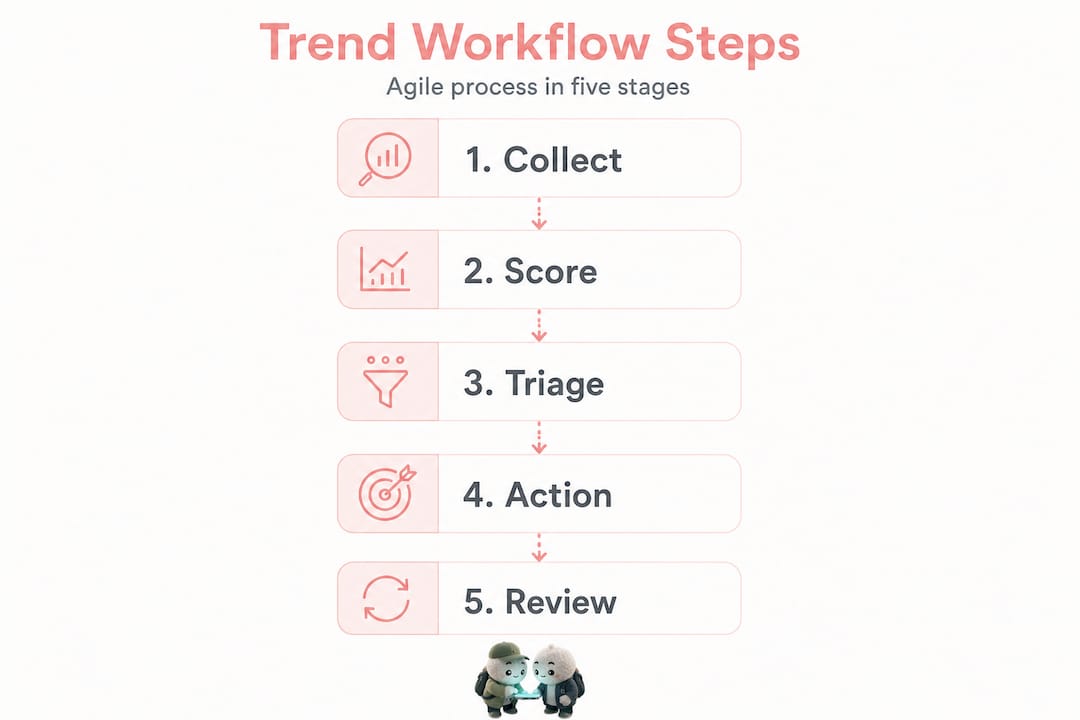
Begin by mapping every relevant source category for your market. Do not attempt to monitor everything manually. Use auto-aggregation tools to pull from your curated source list into a single inbox. Set keyword filters broadly at this stage. You want to cast a wide net during collection, because premature filtering here is where many teams lose their best early signals. For detailed guidance on source selection, industry signal identification covers sector-specific approaches worth adapting.

Step 2: Scoring and prioritisation
Apply a structured scoring model to every signal that passes your initial filter. The Discovery Loop's TrendScore methodology scores signals across seven dimensions on a 0 to 35 scale. Signals scoring above 20 typically warrant active monitoring. Those above 28 justify immediate strategic discussion. AI can assist enormously here by calculating velocity (how fast mentions are growing) and convergence (whether multiple independent source types are picking up the same signal), but a human analyst should review the top-scored signals daily.
Step 3: Triage for strategic fit
Not every high-scoring signal is relevant to your business. This is the step where human judgement is non-negotiable. For each prioritised signal, make one of three decisions: yes (act now or immediately deepen research), park (revisit in 30 to 90 days), or ignore (outside strategic scope). The discipline here is avoiding the temptation to park everything. If your park list grows beyond 20 signals without action, your triage process has broken down.
Step 4: Action through small bets
The principle of the small bet is central to agile strategy. Rather than waiting until a trend is fully validated before committing resources, you make a proportionate, reversible investment that generates real-world learning. Target's Trend Brain AI exemplifies this at scale, compressing the design cycle so that the company can test trend-responsive products in weeks rather than months. Your small bets might be a pilot product line, a content experiment, a partnership conversation, or a focused market research sprint.
Step 5: Review and refine
This step is where most workflows fail. Teams complete the first four steps adequately, then skip the review because it feels administrative. In reality, it is the engine of continuous improvement. Document what you acted on, what happened, and how that outcome should recalibrate your scoring weights. For a structured approach to this process, trend forecasting steps provides a useful complement to the cycle described here.
| Step | Responsible actor | Key tool | Time investment |
|---|---|---|---|
| Signal collection | Automated plus analyst | Aggregation platform | 5 minutes daily |
| Scoring | AI-assisted plus analyst review | Scoring model | 10 to 15 minutes daily |
| Triage | Strategy lead | Decision framework | 20 minutes weekly |
| Small bet action | Cross-functional team | Project or pilot tool | Variable |
| Review | Analyst plus strategy lead | Dashboard and notes | 30 minutes weekly |
Pro Tip: Keep a "signal graveyard," a running log of signals you ignored or parked. Review it monthly. You will occasionally find that something you dismissed early became significant, and that pattern tells you exactly where your scoring model needs recalibration.
Verification: Monitoring results and avoiding common pitfalls
A robust workflow doesn't end with execution. Here's how top performers check and sharpen their process over time.
Knowing whether your workflow is actually working requires tracking a small set of precise metrics. Vanity metrics like "number of trends monitored" mean nothing. What matters is lead time reduction (how many weeks earlier are you detecting trends than your nearest competitor?), trend success rate (what proportion of signals you acted on delivered measurable business value?), and decision speed (how quickly does a validated signal translate into committed action?).
Key metrics to track:
- Lead time reduction: Compare your detection date against when the trend appeared in mainstream press or competitor actions
- Trend success rate: Track the ratio of acted signals to positive outcomes over rolling 90-day periods
- Decision speed: Measure average days from signal intake to strategic decision
- Signal-to-noise ratio: Monitor how often your triage produces actionable signals versus irrelevant ones
The most common mistakes analysts make in this phase are confirmation bias (favouring signals that confirm existing strategy), over-trusting AI outputs without human validation, and ignoring scenario planning. As human-AI hybrid research consistently demonstrates, AI accelerates detection and analysis, but humans must validate and contextualise every output before it drives strategic decisions.
"Trend spotting without structured verification is just expensive rumour-mongering. The workflow is only as valuable as the learning loop that corrects it."
Target's AI approach highlights that competitive advantage through early detection is real but requires hybrid oversight. Removing human judgement from the loop to save time is precisely how organisations end up chasing AI-generated noise.
Pro Tip: Schedule a quarterly "workflow autopsy." Set aside two hours to review your signal graveyard, your outcome log, and your scoring calibration together. This single ritual will improve your workflow more than any new tool you could add.
For structured guidance on sustaining long-term signal quality, competitive trend monitoring covers the operational practices that keep workflows sharp beyond the initial setup phase.
Why most trend spotting advice misses the mark, and what actually works
The mainstream guidance on trend spotting tends to focus on tools. Add this platform, integrate that data source, automate your reporting. It is well-intentioned but fundamentally incomplete. Having observed many organisations attempt to implement AI-driven workflows, the pattern is clear: those that treat technology as a substitute for analytical discipline consistently underperform those that treat it as an amplifier of existing rigour.
Consider what happens when purely automated monitoring misses a key inflection point. Algorithms optimised for engagement metrics will surface high-volume, fast-moving signals. But some of the most strategically important trends grow quietly in niche communities, professional forums, or patent filings long before they register on any engagement metric. A purely automated system, trained on historical patterns, will systematically underweight exactly these signals. This is not a flaw that better AI will fix. It is a structural limitation of optimising for what is measurable rather than what is meaningful.
The genuine differentiator is a learning-focused review culture. Teams that treat every workflow outcome, whether a successful bet or a missed signal, as a data point for improving their process get dramatically better over time. Those that treat their workflow as a finished product stagnate. Human-AI hybrid frameworks are explicit on this: the human role is not to rubber-stamp AI outputs but to actively contextualise, challenge, and refine them.
The strategic value of trends is only realised when the organisation builds the internal capacity to act on signals with conviction. That conviction comes from a track record of deliberate practice, not from deploying the most sophisticated tool on the market.
Build the habit before you build the technology stack. Start with a simple scoring system and a weekly review. Let the complexity grow in proportion to the team's analytical maturity.
Next steps: Unlocking trend workflow power with OnTheRice
Applying this guidance is even easier with platforms designed for agile trend discovery. Here's how OnTheRice closes the loop.
OnTheRice is built specifically for analysts and strategists who need to move faster than their market. The platform's AI engines continuously scan global data to surface ranked, scored signals before they reach mainstream awareness, doing the signal collection and initial scoring work that typically consumes the most analyst time.
Whether you are tracking B2B trend signals across industries, monitoring global trend signals across international markets, or exploring AI-powered opportunities in emerging technology sectors, OnTheRice provides the structured intelligence layer that transforms a good workflow into a genuinely competitive advantage. The platform's transparent ranking system means you always understand why a signal is surfacing, not just that it is surfacing. Start with one market segment, run it alongside your existing process for 30 days, and measure your lead time reduction. The results tend to speak clearly.
Frequently asked questions
How can AI help reduce bias in trend spotting?
AI identifies weak signals efficiently across vast data volumes, but human-AI hybrid oversight is essential for contextualising patterns and preventing algorithmic bias from reinforcing existing assumptions.
What data sources are most effective for trend detection?
Diverse sources including industry reports, patent filings, investment data, and social signals produce the most robust picture, as the Claude Trend Analyst playbook demonstrates through its multi-source weak signal detection approach.
How quickly can an AI-driven workflow accelerate trend spotting?
Workflow automation can reduce detection-to-action cycles from months to weeks, mirroring how Target's Trend Brain AI compressed its design cycle by processing signals from multiple real-time data sources simultaneously.
What is the key to making trend spotting workflows sustainable?
Consistent review and learning cycles blending automated and human-led analysis ensure ongoing accuracy, as the structured Discovery Loop workflow demonstrates through its daily act-and-review cadence.