

TL;DR:
- Organizations often fail to capitalize on signals because they lack a structured process for turning early indicators into action. Effective trend scouting requires clear scoping, multi-source signal collection, rigorous filtering, and embedding insights into strategic decision-making. Automating this process with tools like OnTheRice's AI-driven platform enhances speed and reliability, enabling faster adaptation and competitive advantage.
Blockbuster dismissed streaming as a niche curiosity. Kodak invented the digital camera, then buried it. Nokia's engineers reportedly demonstrated smartphone prototypes years before the iPhone launched, yet leadership shelved the concept. Each story follows the same painful pattern: organisations with enormous resources and talented teams failed not because they lacked intelligence, but because they lacked a structured process for turning early signals into decisive action. This guide gives you that process, walking through every stage from scoping your scouting effort to embedding insights into board-level governance, so you spend less time reacting and more time leading.
Table of Contents
- Laying the groundwork: defining your scope and approach
- Signal collection: where and how to find emerging trends
- Filtering, analysis and validation: turning signals into insight
- Embedding findings into decision-making and action
- Expert validation: the role of panels and Delphi methods
- Why the best scouts prioritise capacity over certainty
- Turn insight into action with OnTheRice
- Frequently asked questions
Key Takeaways
| Point | Details |
|---|---|
| Start with scope clarity | Explicitly define your scouting objectives and macro drivers before collecting any signals. |
| Multiple sources matter | Rely on several types of data and perspectives to minimise the risk of missing or misreading signals. |
| Validation prevents mistakes | Validate findings with independent indicators to avoid false positives and wasted resources. |
| Integrate into governance | Ensure insights power action by linking trend scouting to strategy and risk management cycles. |
| Continuous improvement wins | Treat scouting as an ongoing, institutional discipline rather than a one-off task. |
Laying the groundwork: defining your scope and approach
Before you scan a single data source, you must answer a harder question: why are you scouting? The answer shapes everything. A business scouting for innovation opportunities needs a fundamentally different focus than one mapping existential risks or exploring adjacent markets. Without a clear purpose, your scouting effort will produce a pile of interesting-but-useless observations.
Effective trend scouting combines horizon scanning with explicit scoping, multi-source signal collection, triage scoring, mixed-method analysis, and stress-testing. Skipping the scoping step is the single most common reason scouting programmes stall within six months.
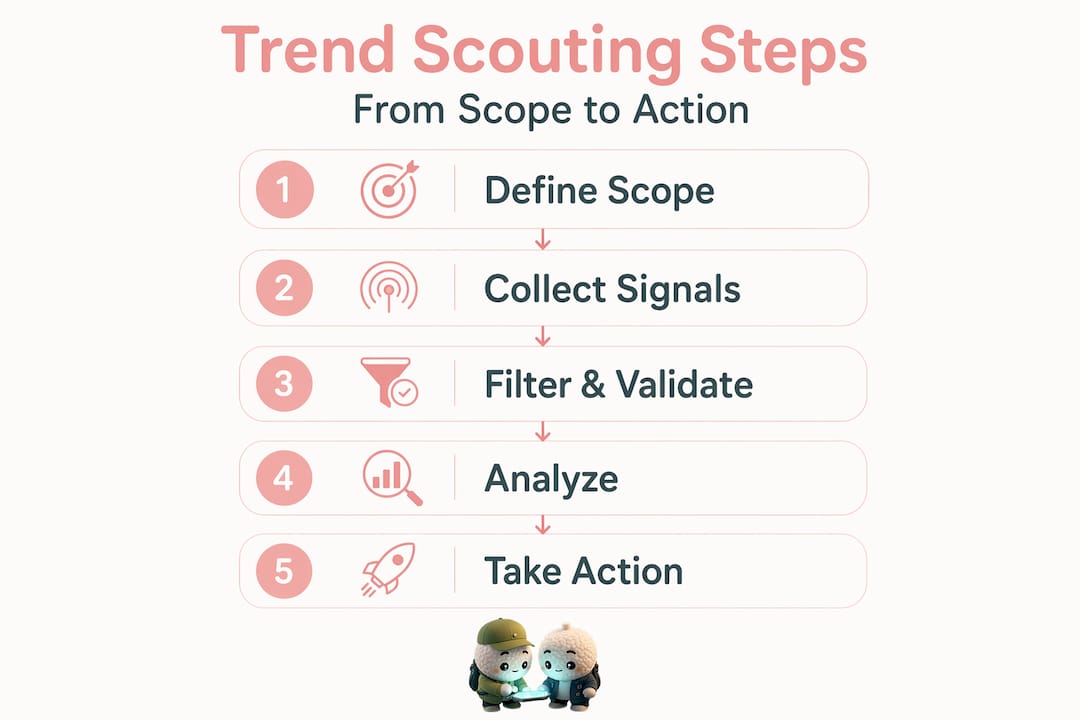
The STEEP or STEPLE framework gives you a disciplined lens for covering the external environment. It stands for Social, Technological, Economic, Environmental, Political, Legal and Ethical forces. Macro-environment driver coverage using STEEP or STEPLE ensures you capture the external forces that shape customer behaviour and market dynamics, rather than fixating narrowly on your own category.
Steps to determine scope and prioritise drivers:
- Define the business objective (innovation, risk, market expansion, regulatory readiness)
- Set your time horizon: near-term (0 to 2 years), medium-term (2 to 5 years), or long-horizon (5 to 10+ years)
- Select two or three STEEP/STEPLE domains most material to your sector
- Identify existing assumptions that your scouting should challenge
- Agree on stakeholders who need to act on the findings
- Schedule a first iteration review before the scan even concludes
Choosing the right framework sets the ambition level from the start. The table below compares three common options.
| Framework | Scope | Primary focus | Key advantage |
|---|---|---|---|
| STEEP/STEPLE | External macro environment | Broad driver coverage | Prevents blind spots across dimensions |
| Porter's Five Forces | Industry structure | Competitive dynamics | Sharp on near-term competitive threats |
| Scenario Planning | Multiple futures | Strategic uncertainty | Stress-tests strategy against discontinuity |
Pro Tip: Keep your scoping iterative. Revisit your chosen domains and time horizon every quarter because new signals often reveal that you defined the scope too narrowly or too broadly at the outset. Learning to identify trend signals reliably depends on continually refining where you look.
Signal collection: where and how to find emerging trends
Once the scouting territory is defined, systematic signal collection begins. Most organisations default to industry reports and conference decks. These are useful but insufficient. The most valuable signals tend to arrive from sources that mainstream analysts have not yet reached, which is precisely why unconventional sourcing is where the genuine competitive edge with trends is found.

Effective scouting demands multi-source signal collection because any single channel introduces systematic bias. A social media monitor misses lab-stage innovations. A patent database misses cultural shifts. Building source diversity into the process reduces the risk of converging on popular but misleading narratives.
Key signal sources, in priority order:
- Primary research: customer ethnography, observational fieldwork, and interviews with early adopters who are already living the trend
- Social and news media monitoring: tracking volume, sentiment shifts, and unexpected cross-category conversations
- Patent and investment databases: early filings and funding rounds frequently precede public product launches by two to four years
- Expert interviews: practitioners, academics, and regulators who sit at the edge of your domain
- Field observation: visiting markets, trade shows, and geographies where the trend is further along its maturity curve
A critical nuance, often underestimated: as Deloitte's 2026 Technology Signals notes, some signals are significant but sit adjacent to your core themes, and some mature while others fade entirely. Strong scouts build sensing capacity rather than committing too early to a single prediction.
| Source type | Reach | Reliability | Best use case |
|---|---|---|---|
| Industry analyst reports | Wide | High for established trends | Confirming signals, not discovering them |
| Patent databases | Specialist | High for technology signals | Early-stage technology mapping |
| Social listening tools | Very wide | Moderate | Detecting cultural and consumer shifts |
| Fringe communities and forums | Narrow | Variable | Breakthrough signals before mainstream awareness |
| Regulatory consultation documents | Narrow | High | Anticipating compliance-driven disruption |
Pro Tip: Cross-check every promising signal against at least three independent sources. A signal that only appears in one channel is a hypothesis. A signal appearing in a patent database, an investor thesis, and a fringe community forum at the same time is a very different conversation. See strategies for spotting opportunities for practical examples of multi-source triangulation in action.
Building competitive trend monitoring into your weekly rhythm, rather than running it as an annual project, is what separates organisations that spot shifts early from those that read about them in the news.
Filtering, analysis and validation: turning signals into insight
Aggregating signals without a rigorous filtering process produces an overwhelming catalogue of "interesting things." The real work, and the real value, lies in ruthless triage and multi-method analysis.
Triaging signals: four criteria to apply immediately:
- Novelty: Is this genuinely new, or is it a repackaged version of something already well-documented?
- Impact: If it matures, does it fundamentally alter costs, customer behaviour, regulation, or competitive structure in your market?
- Uncertainty: How wide is the confidence interval? High uncertainty does not disqualify a signal; it changes how you respond to it.
- Relevance: Does it connect directly or adjacently to your strategic priorities as defined during scoping?
Once triaged, signals enter a mixed-method assessment phase. Quantitative methods, such as trend curve analysis and keyword growth tracking, show you the rate of change. Qualitative methods, such as expert judgement and ethnographic interviews, explain the why beneath the data. Neither alone is sufficient. A step-by-step trend forecasting process consistently outperforms intuition-only approaches because it forces teams to surface assumptions explicitly.
"Stress-testing is not about being pessimistic. It is about ensuring that a signal genuinely survives scrutiny before you bet resources on it. The question is not 'could this happen?' but 'what independent indicators would confirm that it is already happening?'"
Validation requires independent indicators such as investment flows, regulatory moves, or supply-chain shifts rather than relying on a single data stream. For instance, if you are tracking a signal around regenerative agriculture, you should look simultaneously at venture capital flowing into soil science start-ups, shifts in government subsidy policy, consumer purchasing data for sustainably labelled products, and commodity price movements. Any one of these alone is fragile. All four pointing in the same direction is compelling.
Pro Tip: The conversations that most reliably surface early-stage signals are with outliers: the researcher whose work is two years ahead of commercial adoption, the frontline buyer who is already workarounding an industry problem, or the regulator who is drafting policy that the market has not yet seen. Mainstream data almost always lags these conversations by twelve to twenty-four months.
Mastering the trend forecasting process means knowing when to escalate a signal even before full validation, because some windows close quickly. Leveraging early insights effectively is as much about timing and organisational courage as it is about analytical rigour.
Embedding findings into decision-making and action
A validated insight that sits in a PDF shared once with a strategy team is almost worthless. The final test of any scouting effort is whether it changes something: a budget allocation, a partnership decision, a product roadmap, a risk register. Without deliberate embedding, scouting becomes expensive theatre.
Steps for packaging and sharing trend insights for action:
- Translate insights into business implications, not just trend descriptions (e.g., "this technology will commoditise our current premium service within three years")
- Build a living trend radar using ring models such as Hold, Assess, Trial, and Adopt to reflect maturity and urgency
- Create tiered briefing formats: an executive one-pager, a mid-level working brief, and a detailed appendix for analysts
- Define escalation paths so that a fast-moving signal can trigger a board discussion without waiting for the next quarterly review
- Connect insights directly to existing risk registers and strategic plans so they update governance documents, not just slide decks
- Schedule mandatory feedback loops: after six months, revisit each validated signal and record whether it matured, faded, or evolved
Strategic foresight frameworks emphasise converting early-stage signals into structured intelligence for board-level decisions, rather than treating foresight as ad-hoc horizon scanning. Organisations that institutionalise this conversion consistently respond to market shifts faster than competitors who rely on periodic, one-off studies.
Treat scouting outputs as inputs to governance and risk processes with clear escalation and feedback, so that early signals become an advantage rather than a filing exercise. The best-performing organisations build their trend radar reviews directly into existing governance cycles, rather than running them as separate innovation initiatives that leadership sees as optional.
Expert validation: the role of panels and Delphi methods
When data is sparse, when a signal sits at the intersection of several disciplines, or when the stakes are high enough that a wrong call carries real cost, expert panels become essential. The Delphi method is one of the most robust tools available for exactly these conditions.
Expert-judgement methods like Delphi validate and forecast emerging trends when uncertainty is high and data is sparse, using structured, iterative questionnaires with controlled feedback. The process works because it prevents the loud voice in the room from dominating, while still converging on a defensible consensus over multiple rounds.
Steps of a Delphi study:
- Selection: Identify eight to fifteen subject-matter experts across diverse but relevant disciplines, including at least two dissenters
- Round one: Distribute open-ended questionnaires asking each expert to independently assess the likelihood and impact of specific trend statements
- Statistical synthesis: Aggregate responses into median scores and interquartile ranges to reveal where consensus exists and where it does not
- Controlled feedback: Share anonymised group results with all participants, highlighting areas of disagreement without attributing views to individuals
- Round two or three: Invite each expert to revise their position in light of the group synthesis, again anonymously
- Final report: Document the converged assessments and the residual areas of meaningful disagreement, which are themselves strategically important
"Anonymity is not a procedural nicety in Delphi. It is the mechanism that makes the process work. When experts cannot see who holds which view, they evaluate the argument rather than the authority of the person making it."
Delphi's anonymity and iterative rounds specifically reduce peer pressure and groupthink while still converging on probabilities and assessments. This is particularly important when a trend is generating social buzz but the empirical foundations are still uncertain, because social momentum can make weak signals appear stronger than they actually are.
Pro Tip: Combine qualitative outputs (expert narrative, dissenting views) with quantitative outputs (probability scores, confidence intervals) when presenting Delphi findings to a board. Executives need a number to act on and a story to trust.
Why the best scouts prioritise capacity over certainty
Here is an uncomfortable truth that most trend scouting guides will not tell you: no methodology, however rigorous, produces reliably correct predictions about specific future events. The organisations that consistently outperform their peers are not better at predicting; they are better at sensing, adapting, and learning in shorter cycles.
The greatest risk is not missing a single trend. It is building an entire scouting programme around the assumption that the goal is to be right. That framing drives teams towards overconfident commitments and discourages the iterative revision that actually generates long-term foresight capability.
As Deloitte's signals research illustrates, strong scouts build sensing and evaluation capacity rather than over-committing to prediction certainty. This is a structural argument: organisations need scouting as an ongoing muscle, not a project. The moment you treat a trend study as "complete," you have already started falling behind.
Building continuous scouting advantage means embedding trend conversations into regular team meetings, not just dedicated foresight workshops. When a product manager in a weekly stand-up mentions that three customers asked about the same unexpected use case last week, that is a signal. When a finance director flags an anomaly in a competitor's capex pattern, that is a signal. The organisations that capture those moments and feed them back into a structured process compound their advantage quarter after quarter.
Pro Tip: Embed a standing five-minute "weak signals" segment into your monthly leadership meetings. Ask each function to flag one unexpected observation from the past four weeks. Over time, the pattern of anomalies becomes one of your most valuable early-warning datasets.
Turn insight into action with OnTheRice
You have the framework. Now the question is scale. Manually monitoring dozens of signal sources, running triage across thousands of data points, and maintaining a live trend radar is resource-intensive even for well-staffed strategy teams.
OnTheRice was built specifically to automate the most labour-intensive parts of this process. The B2BSignals platform continuously scans global data streams and surfaces ranked signals before they reach mainstream awareness, giving your team the validated intelligence it needs without the manual overhead. Explore the full suite of AI-powered trend tools to see how automated scoring and radar mapping integrate directly with your existing strategy workflows. If you are operating in fast-moving sectors, the crypto trend signals module shows how real-time signal intelligence translates into decision-ready insight at speed.
Frequently asked questions
How often should you update your trend scouting process?
You should revisit trend scans and update your process at least quarterly to capture new signals, because the external environment shifts continuously and annual cycles leave you perpetually behind.
What's the best way to avoid false positives when scouting trends?
Validate every signal against independent indicators such as investment flows, regulatory changes, and supply-chain shifts, rather than relying on a single data stream, which dramatically reduces the rate of false positives.
When is it necessary to use expert panels like Delphi?
Use Delphi panels when data is sparse or uncertainty is high, as the iterative, anonymous feedback structure helps converge on reliable forecasts without groupthink distorting the output.
How do you ensure trend scouting influences real business action?
Build findings into decision dashboards and risk governance processes with clear escalation paths, so validated signals trigger concrete decisions rather than accumulating in unread reports.