
TL;DR:
- Companies that systematically track industry trends grow revenue faster than those that ignore them.
- Understanding and acting on technological, consumer, and regulatory shifts give businesses a competitive edge.
- Effective trend analysis involves regular scanning, filtering relevance, testing hypotheses, and strategic application.
Most business leaders think of industry trends as background noise, something to glance at in a quarterly newsletter and then forget. That assumption is quietly expensive. Companies that consistently track and act on emerging shifts grow revenues 2.5 times faster than those that do not. This article breaks down exactly what industry trends are, why they matter more than most strategists admit, and how you can build a systematic approach to spotting them before your competitors do.
Table of Contents
- Understanding industry trends and their impact
- Why following industry trends is critical for competitive advantage
- How to track and interpret industry trends effectively
- Practical strategies for applying industry trends to your business
- What most strategists overlook in trend-following
- Equip your business with cutting-edge trend intelligence
- Frequently asked questions
Key Takeaways
| Point | Details |
|---|---|
| Early trend adoption | Identifying and acting on industry trends early gives your business a lead over competitors. |
| Strategic advantage | Using trend insights in planning helps position your business for future success. |
| Risk awareness | Balancing trend-following with sound decision-making prevents costly missteps. |
| Practical frameworks | Structured approaches for trend monitoring make implementation actionable and measurable. |
| Leveraging technology | Digital tools enable faster, smarter trend identification and strategic application. |
Understanding industry trends and their impact
An industry trend is a sustained directional shift in how a market operates, buys, or innovates. It is not a spike in social media chatter. It is not a viral product moment. It is a structural change that reshapes buyer behaviour, supply chains, competitive dynamics, or regulatory frameworks over months or years.
The distinction between a trend and a fad matters enormously here. A fad is short-lived, driven by novelty, and collapses as quickly as it rises. A genuine trend has compounding momentum. It feeds on itself because it reflects deeper changes in technology, demographics, or regulation. For example, the shift toward cloud-based software was not a fad. It was a decade-long structural movement that permanently altered how businesses purchase and deploy technology.
Trends typically form through three overlapping forces:
- Technological advancement: New capabilities create new possibilities. Generative AI, for instance, is restructuring roles and workflows across industries simultaneously.
- Consumer behaviour shifts: Changing preferences, values, or purchasing habits force markets to adapt or become obsolete.
- Regulatory change: Government policy can create or destroy entire market categories, as seen with data privacy legislation reshaping digital advertising.
The cost of missing these signals is concrete. Businesses that fail to monitor industry trends risk losing market relevance before they realise it. Blockbuster ignored the streaming trend. Kodak dismissed digital photography. Both had the data and the resources to pivot. They chose not to.
| Trend category | Example | Business impact |
|---|---|---|
| Technology | Generative AI adoption | Workforce restructuring, product reinvention |
| Consumer behaviour | Sustainability preference | New procurement criteria, brand repositioning |
| Regulatory | Data privacy laws | Compliance cost, ad targeting disruption |
| Economic | Supply chain localisation | Procurement strategy overhaul |
According to recent research on SaaS product trends, over 60% of technology product failures in 2025 were linked to misalignment with market momentum rather than poor execution. That is a striking figure. It tells you that strategy divorced from trend intelligence is a bet against the market itself.
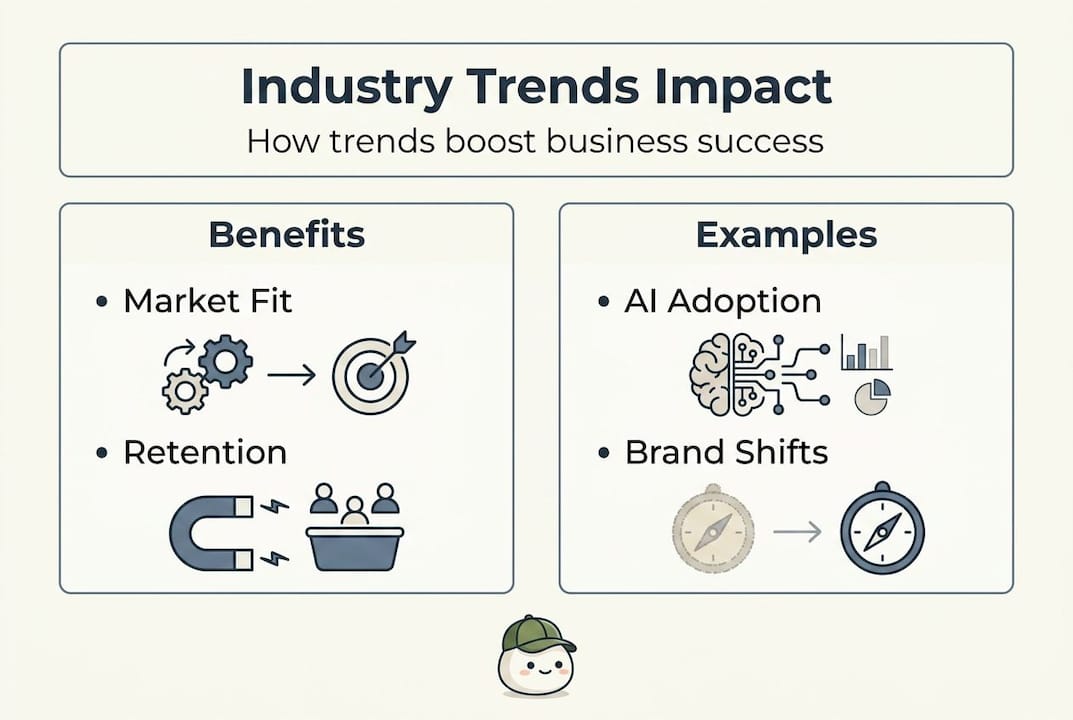
Businesses following current trends consistently outperform peers on product-market fit, customer retention, and investor confidence.
Why following industry trends is critical for competitive advantage
With a solid grasp on what trends are, the next step is understanding why actively following them is vital for maintaining your competitive position.
Consider two companies operating in the same sector. One builds a quarterly trend review into its strategic planning cycle. The other relies on gut instinct and legacy assumptions. Within 18 months, the gap between them in new customer acquisition, product relevance, and operational efficiency becomes measurable. Within three years, it can become irreversible.

| Factor | Companies tracking trends | Companies ignoring trends |
|---|---|---|
| New product success rate | Higher alignment with demand | Frequent mismatches |
| Revenue growth | Proactive positioning | Reactive cost-cutting |
| Talent attraction | Forward-thinking culture | Perceived stagnation |
| Investor confidence | Data-backed roadmap | Uncertain trajectory |
Real examples reinforce this. Netflix monitored shifts in emerging brand strategies in entertainment consumption and doubled down on original content precisely when traditional broadcasters were defending legacy models. Shopify identified the small-business e-commerce wave early and built its entire platform around enabling it, while incumbents debated whether the trend was sustainable.
Insights from MVP trend analysis suggest that companies integrating trend analysis into product planning reduce time-to-market by up to 30%, a direct commercial advantage.
Here is a practical numbered process for incorporating trend analysis into your business planning:
- Designate a trend owner. Someone in leadership must be accountable for monitoring and synthesising trend signals on a regular cadence.
- Establish a scanning rhythm. Monthly scans for micro signals, quarterly reviews for macro patterns.
- Filter by relevance. Not every trend applies to your market. Score each against your strategic priorities.
- Test before committing. Run small pilots informed by trend data before major investment decisions.
- Measure and iterate. Track whether trend-aligned initiatives outperform your baseline.
Pro Tip: Watch for three early warning signs that your industry is shifting: your most loyal customers start asking questions you cannot answer, new entrants are growing faster than your category average, and trade press begins using terminology that is unfamiliar to your team. When all three appear together, act quickly.
How to track and interpret industry trends effectively
Knowing why trend-following matters, professionals must master the process of tracking and making sense of relevant shifts.
The most reliable sources for trend intelligence are layered. No single channel gives you the full picture. Build a scanning stack from multiple inputs:
- Industry reports: Gartner, McKinsey, Forrester, and sector-specific research bodies publish rigorous analyses updated regularly.
- Patent databases: Patent filings reveal where R&D investment is flowing before products reach market.
- Earnings calls: Listed companies telegraph strategic priorities and market concerns to investors every quarter.
- Regulatory pipelines: Government consultation documents signal upcoming rule changes months before they are enacted.
- Social trends tools: Platforms aggregating social signals can surface consumer sentiment shifts in near real-time.
- Startup funding rounds: Where venture capital flows, market opportunity often follows.
"Trend analysis is not about predicting the future with certainty. It is about reducing the probability of being blindsided." This principle, widely held among leading strategists, underscores why innovation monitoring is increasingly a board-level priority rather than a marketing function.
When evaluating whether a trend is worth pursuing, apply a simple four-part framework. First, assess magnitude: how large is the potential market shift? Second, evaluate velocity: how quickly is adoption accelerating? Third, consider relevance: does this trend intersect with your core customer base or value proposition? Fourth, measure durability: is there structural evidence that this shift will persist beyond 24 months?
Pro Tip: The most common mistake in trend interpretation is confusing correlation with causation. A spike in interest around a topic does not mean adoption is accelerating in your specific market. Always cross-reference social signals with purchasing data, hiring trends, and investment flows before concluding that a trend is actionable for your business.
Practical strategies for applying industry trends to your business
Armed with trend intelligence, business leaders need practical approaches for turning those insights into action.
Identifying a trend is only half the job. The harder part is integrating it into operations, product development, and go-to-market strategy without disrupting existing momentum. Here is a step-by-step process:
- Map the trend to a business unit. Each relevant trend should be assigned to a specific team or function that owns the response.
- Set a decision timeline. Define when you will decide to act, pilot, or dismiss based on incoming evidence.
- Allocate exploratory budget. Ring-fence a small percentage of your innovation budget for trend-led experiments.
- Build cross-functional input. Sales, product, operations, and finance all see trends differently. Combine their perspectives before committing.
- Establish success metrics upfront. Agree on what a positive outcome looks like before the pilot begins.
Common business actions driven by trend intelligence include:
- Repositioning existing products for emerging customer segments
- Forming partnerships with startups operating at the trend frontier
- Upskilling teams in areas where demand is outpacing current capability
- Adjusting pricing models to reflect shifting value expectations
- Accelerating product release strategies to align with demand windows
In the technology sector, companies that embraced large language model integration in 2024 are now reporting measurable productivity gains in customer service and content operations. In retail, businesses that acted on the resale and circular economy trend early have built entirely new revenue streams. These are not coincidences. They are the result of systematic trend application.
Once you adopt a trend-informed initiative, monitor its impact using a simple framework: track adoption rate internally, measure customer response within 60 days, and benchmark against sector peers quarterly. Explore AI application opportunities to see where intelligent automation is creating leverage across business functions right now.
What most strategists overlook in trend-following
Here is the uncomfortable truth: most businesses that commit to trend-following eventually overcorrect. They become so attuned to external signals that they start chasing every movement, abandoning proven strengths in pursuit of the next emerging opportunity. That is not strategy. That is anxiety dressed up as agility.
The most damaging trend missteps we observe are not cases of ignorance. They are cases of misapplication. A retailer pivots entirely to direct-to-consumer because the trend data supports it, without accounting for the logistics infrastructure that pivot requires. A software firm rushes an AI-powered feature to market because the category is hot, but ships a product that does not actually solve a customer problem.
The real discipline in trend-following is knowing when not to act. Strong trend intelligence, like what you find through trend discovery insights, should sharpen your decision criteria, not replace them. Apply this test before committing: does this trend align with your existing competitive advantage, or does it require you to become a fundamentally different business? If it is the latter, the risk calculus changes significantly.
Balance is the mark of a mature strategist. Use trends to inform and adjust, not to rebuild from scratch every 18 months.
Equip your business with cutting-edge trend intelligence
Understanding trends is one thing. Having a system that surfaces them reliably, scores them for relevance, and delivers them before your competitors see them is another entirely.
OnTheRice is built precisely for this. Our AI engines scan global data continuously, extracting meaningful signals from noisy markets so you do not have to. Whether you are tracking AI application solutions reshaping your sector, monitoring B2B trend signals across your supply chain, or following social trend tracking to catch consumer shifts early, our platform delivers ranked, scored intelligence in real time. Stop reacting. Start anticipating.
Frequently asked questions
What are the best sources for reliable industry trend information?
Industry reports from firms such as Gartner and McKinsey, specialised intelligence platforms, and peer-reviewed research provide the most dependable foundation for trend-driven business decisions.
How often should businesses update their strategy based on new trends?
Strategies should be reviewed on a quarterly basis, with targeted adjustments made whenever significant trend shifts or new data emerge between review cycles.
Can following industry trends ever hurt a business?
Yes. Misinterpreting signals or pursuing trends without validating their relevance to your specific market can result in costly pivots, wasted investment, and loss of strategic focus.
What tools can help automate trend monitoring for strategists?
Platforms such as OnTheRice's SignalsSocialTrends provide automated signal analysis and timely intelligence alerts tailored for business professionals who cannot afford to miss a shift.
How can SMEs leverage industry trends compared to large corporations?
SMEs gain the most advantage by focusing on niche-specific, high-impact trends where they can move quickly, while larger organisations typically benefit from investing in broader trend analytics and long-range forecasting capabilities.