
TL;DR:
- Actionable foresight anticipates multiple futures and guides strategic decisions before uncertainty becomes risk. It connects scenario planning and signal scanning directly to leadership choices, enhancing organizational agility. Embedding continuous sensing and clear decision triggers ensures foresight actively shapes ongoing strategy rather than remaining a theoretical exercise.
Actionable foresight is the structured practice of anticipating multiple plausible futures and translating those scenarios into concrete strategic decisions before uncertainty hardens into risk. Unlike traditional forecasting, which projects a single most-likely outcome, strategic foresight accepts that the future is genuinely uncertain and builds decision-making capacity across several possible trajectories. A Harvard Business Review 2026 study of 500 companies found a significant spike in market uncertainty discussions during earnings calls, confirming that volatility is now a baseline condition rather than an exception. Foresight is not prediction. As Bluemorrow foresight experts put it, it is a governance tool that helps organisations make confident decisions under uncertainty. This guide to actionable foresight covers the core methods, organisational conditions, step-by-step execution, and the pitfalls that most teams never see coming.
What is a guide to actionable foresight, and why does it matter?
Actionable foresight differs from generic trend analysis in one critical way: every output must connect to a decision. Scenario narratives, horizon scans, and signal reports only have value when they change what a leadership team does next. Foresight must influence strategic decisions or install clear triggers for action, otherwise it is an expensive intellectual exercise.

The purpose of market foresight is to expand the range of futures a team considers, then narrow that range into specific options the organisation can act on. This prevents the common trap of planning for one future while being blindsided by another. BCG research from 2025 confirms that companies detecting weak signals early gain competitive advantage by stretching their perspectives and challenging embedded assumptions before conditions shift.
Strategic foresight, as a recognised discipline, draws on frameworks developed by institutions including the Institute for the Future, the World Economic Forum, and academic researchers such as Rohrbeck and Kum. These frameworks share a common structure: scan the environment, build scenarios, identify options, and monitor indicators. The guide to integrating market foresight into your organisation follows that same logic, adapted for practical use.
Core methods for implementing actionable foresight
Five techniques form the backbone of any credible foresight practice. Each serves a distinct purpose, and the most effective teams use them in combination rather than in isolation.
Horizon scanning is the systematic search for weak signals: early, ambiguous indicators that a significant change may be forming. Scanning covers technology, regulation, social behaviour, economics, and geopolitics. The goal is not to find certainties but to surface surprises before they become obvious.
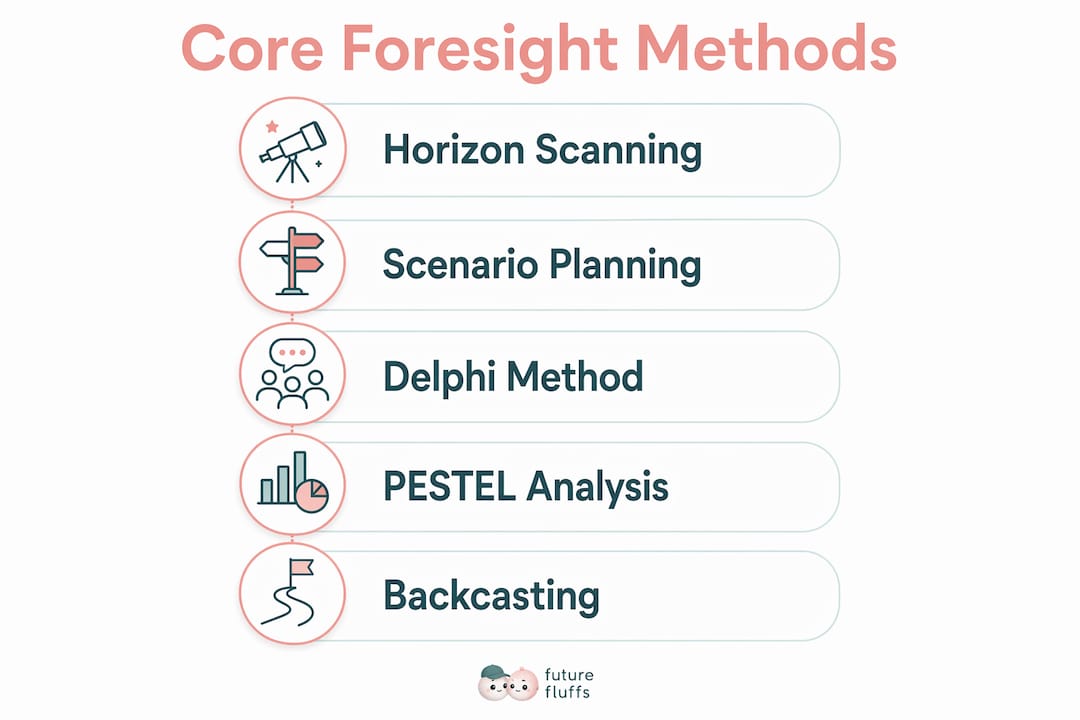
Scenario planning takes the signals gathered and constructs three to five plausible but distinct futures. Each scenario represents a coherent world, not a best-case or worst-case projection. Scenario planning for leaders works best when the scenarios are built around two or three critical uncertainties that genuinely drive divergent outcomes.
The Delphi method is a structured consultation process that aggregates expert judgement through iterative rounds of anonymous questioning. It is particularly useful in data-scarce domains where quantitative models cannot resolve disagreement. Each round refines the group's collective view until a working consensus emerges.
PESTEL analysis provides a structured framework for environmental scanning across Political, Economic, Social, Technological, Environmental, and Legal dimensions. It is most useful as an input to scenario construction rather than as a standalone output.
Backcasting reverses the usual planning direction. You define a desired future state, then work backwards to identify the decisions and milestones needed to reach it. This technique is especially powerful for long-horizon planning in sectors such as energy, infrastructure, and healthcare.
The Institute for the Future found that iterative scenario planning with defined leadership questions compresses strategy cycle time by 30–40% compared to ad hoc foresight methods. That efficiency gain comes from focus: when the foresight question is sharp, the process moves faster and produces more usable outputs.
Pro Tip: Never run these methods sequentially as a one-off project. The most effective foresight teams treat them as a continuous, overlapping cycle that feeds directly into quarterly strategy reviews.
What organisational conditions make foresight work?
The right methods fail without the right conditions. Most foresight efforts stall not because the analysis is poor but because the organisation has not created the structures needed to act on it.
The World Economic Forum found that future-ready organisations embed foresight in their planning cycles, which enhances agility and enables proactive shaping of market narratives. Embedding means foresight outputs appear on leadership agendas, not just in strategy documents filed away after an offsite.
Four conditions are non-negotiable for effective foresight:
- Decision anchoring. Every foresight exercise must be tied to a specific, near-term decision. "What should we do about our supply chain over the next 18 months?" is a workable anchor. "What will the world look like in 2035?" is not.
- Clear ownership. One senior leader must own the foresight process and be accountable for acting on its outputs. Shared ownership produces inaction.
- Governance cadence. Foresight reviews should occur on a fixed schedule, quarterly at minimum, so that monitoring and updating become routine rather than reactive.
- Continuous sensing infrastructure. Teams need systems, whether curated news feeds, AI-powered signal platforms, or structured analyst briefings, to maintain awareness between formal review cycles.
Common organisational challenges include leadership scepticism, resource constraints, and the tendency to treat foresight as a one-off project. The most effective counter is to start with a pilot exercise tied to a decision that genuinely matters to the leadership team. Success on a real problem builds credibility faster than any methodology presentation.
How to deploy actionable foresight: a step-by-step process
A practical action plan for market foresight follows six steps. Each step builds on the previous one, and skipping any of them weakens the final output.
-
Define a sharp foresight question. The question must link directly to a pending strategic decision. Specificity is everything. "Should we enter the South-East Asian market in the next 24 months, and under what conditions?" is a question that foresight can answer. Vague questions produce vague scenarios.
-
Gather and curate signal inputs. Collect signals from external sources (regulatory changes, technology developments, competitor moves, social trends) and internal sources (customer feedback, sales data, operational stress points). Mix quantitative data with qualitative intelligence. Early industry signals are often qualitative long before they appear in datasets.
-
Construct scenarios with cross-functional teams. Build three to four distinct scenarios using the signals gathered. Each scenario should be internally consistent and genuinely different from the others. Cross-functional participation is not optional: finance, operations, marketing, and product teams each see different signals and challenge different assumptions.
-
Pressure-test pending decisions against each scenario. Take the decision identified in step one and ask: "How does this decision perform in each scenario?" A decision that works well across all scenarios is a no-regret move. A decision that only works in one scenario requires either hedging or a clear trigger for when to commit.
-
Generate strategic options that preserve flexibility. A 2018 study by Rohrbeck and Kum, cited in 2026, found that fewer than one in three foresight processes explicitly identify strategic options that maintain organisational flexibility across multiple futures. Options such as phased investment, modular contracts, or reversible partnerships give organisations room to adapt as conditions evolve.
-
Assign monitoring indicators and establish trigger-action protocols. For each scenario, identify two or three observable indicators that would signal the environment is moving in that direction. Assign a named owner to monitor each indicator. Define in advance what action the organisation will take when a trigger threshold is crossed. Clear trigger mechanisms are what separate foresight from wishful thinking.
Pro Tip: Keep scenario documents to two pages maximum. A scenario that requires a lengthy report to explain will never be used in a leadership meeting.
Common pitfalls in actionable foresight and how to avoid them
Most foresight programmes underperform for predictable reasons. Recognising these patterns early saves significant time and credibility.
"Most foresight efforts fail to affect leadership decisions because outputs are too lengthy and not decision-focused. Briefings with clear options and explicit assumptions are consistently more effective than comprehensive reports." — Infomineo practitioner research
The most damaging pitfalls are:
- Scanning without a decision focus. Teams that scan broadly without anchoring to a specific question produce interesting observations that nobody acts on. Every scanning effort should feed a defined foresight question.
- Scenarios disconnected from near-term options. Scenarios set 10 or 20 years out rarely influence decisions made this quarter. Effective scenarios are set at a horizon that matches the decision's time frame.
- No ownership of outcomes. When everyone is responsible for acting on foresight, nobody is. Assign a named owner to each strategic option and each monitoring indicator.
- Overwhelming leaders with lengthy reports. A 60-page foresight report will not be read before a board meeting. A two-page briefing with three options, each with explicit assumptions and a recommended trigger, will be.
- Skipping strategic option mapping. Scenarios without options leave leaders knowing more about the future but no better equipped to act. Options are the product. Scenarios are the process.
- No trigger-action protocols. Without pre-agreed triggers, organisations wait for certainty before acting. By the time certainty arrives, the window for advantage has closed.
How to integrate foresight into ongoing strategy and decision-making
Foresight becomes genuinely powerful when it is embedded as a continuous practice rather than a periodic project. The role of market foresight in an organisation is not to predict the future once a year but to maintain the capacity to adapt as conditions evolve.
Practical integration requires four commitments:
- Link foresight cycles to existing planning rhythms. Foresight reviews should feed directly into annual strategy planning, quarterly business reviews, and risk management processes. Standalone foresight programmes that operate outside these rhythms rarely influence decisions.
- Use AI-powered tools to automate signal sensing. BCG research confirms that AI-powered analytics combined with scenario development provide deeper insights and help challenge cognitive biases. Platforms that triage signals automatically reduce the manual burden on analysts and surface patterns that human scanning misses. Ontherice uses multiple AI engines to scan global data points and produce real-time trend signals, which makes it a practical tool for continuous sensing between formal foresight cycles.
- Design foresight workshops for decision commitment, not alignment. A workshop that ends with "we are all aligned on the scenarios" has produced nothing. A workshop that ends with "we have agreed to do X if indicator Y crosses threshold Z" has produced a decision.
- Build feedback loops to revisit assumptions. Assumptions embedded in scenarios become outdated. Schedule quarterly reviews to check whether the signals are tracking as expected and update options accordingly.
Pro Tip: Treat emerging trend scouting as a standing agenda item in leadership meetings, not a separate workstream. Five minutes of signal review per meeting builds foresight muscle faster than any annual offsite.
Key takeaways
Actionable foresight works when every scenario, signal, and option connects directly to a decision a leadership team is prepared to make.
| Point | Details |
|---|---|
| Define a sharp question | Anchor every foresight exercise to a specific, near-term strategic decision. |
| Use five core methods | Combine horizon scanning, scenario planning, Delphi, PESTEL, and backcasting as an iterative cycle. |
| Build strategic options | Fewer than one in three foresight processes identify flexibility-preserving options; make this non-negotiable. |
| Establish trigger protocols | Assign named owners to monitoring indicators and pre-agree the action each trigger will prompt. |
| Embed in planning rhythms | Link foresight reviews to quarterly strategy cycles to maintain relevance and drive consistent action. |
Why most foresight programmes miss the point entirely
I have seen foresight done well and done badly, and the difference is almost never the quality of the analysis. The teams that produce the most sophisticated scenarios are often the ones whose work sits unread on a shared drive. The teams that produce the most impact are the ones who walk into a leadership meeting with a single page: three options, two assumptions per option, and a clear trigger for each.
The uncomfortable truth about strategic foresight is that it is not primarily an analytical discipline. It is a political one. Getting leadership to act on foresight outputs requires understanding what decisions are actually live, who owns them, and what format those decision-makers will engage with. A beautifully constructed scenario set that does not match the format, timing, or decision horizon of the leadership team is worthless.
My strongest advice for anyone building a foresight capability is to start with a pilot that has genuine stakes. Do not run a practice exercise on a hypothetical question. Find a real decision that is coming up in the next six months, build a foresight process around it, and deliver a two-page briefing to the person who owns that decision. If the briefing changes what they do, you have proof of concept. If it does not, you have a learning that no methodology presentation could have given you.
Foresight is not a project. It is a capability. And like any capability, it compounds over time when practised consistently and honestly.
— Aidil
Ontherice: AI-powered sensing for your foresight practice
Foresight without continuous signal sensing is a one-off exercise. Ontherice provides AI-driven market intelligence that scans global data points in real time, surfaces emerging trends before they reach mainstream awareness, and produces ranked signals across sectors.
For analysts and strategists building a foresight practice, Ontherice offers the sensing layer that most organisations lack between formal review cycles. The platform's AI opportunity signals identify which markets and categories are gaining momentum, giving your team the early inputs needed to construct credible scenarios and monitor trigger indicators. You can also explore the social trend signals feed to track shifts in consumer behaviour before they appear in quarterly data. Ontherice turns continuous sensing from a resource-intensive manual task into a structured, repeatable process.
FAQ
What is actionable foresight?
Actionable foresight is the structured practice of anticipating multiple plausible futures and translating those scenarios into concrete strategic decisions. It differs from forecasting by accepting genuine uncertainty rather than projecting a single most-likely outcome.
What is the purpose of market foresight?
The purpose of market foresight is to expand the range of futures a team considers, then identify strategic options that preserve flexibility across those futures. It enables organisations to act before uncertainty becomes risk.
What are the most effective strategic foresight techniques?
The five core techniques are horizon scanning, scenario planning, the Delphi method, PESTEL analysis, and backcasting. The Institute for the Future found that iterative scenario planning with defined leadership questions compresses strategy cycle time by 30–40%.
Why do foresight programmes fail to influence decisions?
Most foresight efforts fail because outputs are too lengthy and not connected to near-term decisions. Practitioner research confirms that concise briefings with clear options and explicit assumptions are consistently more effective than comprehensive reports.
How do you integrate foresight into an ongoing strategy process?
Link foresight review cycles directly to quarterly strategy planning and risk management processes. Use AI-powered sensing tools to maintain continuous signal monitoring between formal reviews, and design workshops to produce decision commitments rather than alignment on scenarios.