
TL;DR:
- Scenario planning involves creating multiple plausible futures to enhance organizational resilience and decision-making. It replaces traditional forecasting by developing a portfolio of narratives to prepare for volatile and uncertain environments. Regular updates, shared language, and integration with trend monitoring turn scenario thinking into an active, strategic governance tool.
Scenario planning is the strategic discipline of constructing multiple plausible futures and preparing adaptive responses to each, rather than committing resources to a single predicted outcome. Where traditional forecasting asks "what will happen?", scenario planning asks "what could happen, and are we ready?" The shift matters enormously. Multi-scenario frameworks evaluate the intersection of technological progress, corporate megatrends, and geopolitical shifts to support resilient decision-making. Boards at major financial institutions and technology firms now treat this practice as a governance imperative, not an optional analytical exercise. The organisations that thrive through disruption are those that have already rehearsed it.
Why scenario planning is essential: beyond traditional forecasting
Traditional forecasting assumes the future is a linear extension of the past. That assumption breaks down the moment a market faces what researchers describe as S-Curve disruptions: non-linear shocks such as energy price collapses, geopolitical realignments, or sudden technological upheavals that render historical trend lines useless. A single-point forecast in these conditions is not a plan. It is a bet.
Multi-scenario planning emerged as a direct response to this fragility. Rather than producing one "most likely" number, it generates a portfolio of plausible futures and tests strategy against each. The classic four-quadrant structure illustrates this well. Consider four scenarios for a technology business entering a new market:
- Fast win: rapid adoption, favourable regulation, strong early revenue
- Slow win: adoption takes hold but over a longer horizon, requiring sustained investment
- Fast loss: swift rejection due to competitive or regulatory headwinds
- Slow loss: gradual erosion of position through incremental competitor gains
Each scenario demands a different strategic posture. Planning across all four prevents the catastrophic mistake of optimising entirely for the fast win while leaving the organisation defenceless against the others.
The importance of scenario planning also lies in what it prevents. Organisations that rely on a single forecast tend to over-invest in one direction, creating brittle strategies that shift from efficiency to resilience only after a crisis forces their hand. Multi-scenario planning builds that resilience before the shock arrives.

Pro Tip: When building your first scenario set, resist the urge to create one optimistic, one pessimistic, and one "base case." This structure unconsciously anchors teams to the middle scenario. Instead, build scenarios around genuinely different structural assumptions about your market.
What are the main benefits of scenario planning for decision-making?
The benefits of scenario planning extend well beyond risk mitigation. At its most powerful, the practice reshapes how an organisation thinks, communicates, and decides.
-
Reveals strategic asymmetries. Scenario planning uncovers exposures and resilience that traditional risk assessments miss entirely. Organisations routinely discover they are far more vulnerable to certain changes than they assumed, and far more resilient to others they feared. This asymmetric insight is the kind that redirects capital allocation and governance priorities.
-
Builds a shared language. When leadership teams work through scenarios together, they develop a common vocabulary for uncertainty. Scenario narratives as shared language reduce cognitive bias and improve the board-level defensibility of complex decisions. A CFO and a Chief Risk Officer who have stress-tested the same four futures will argue less and decide faster.
-
Enables faster pivots. Scenario planning is not about predicting the exact future. It is about creating a portfolio of contingent strategies that allow the organisation to move quickly when a specific future begins to materialise. The pivot is faster because the plan already exists.
-
Improves governance and stakeholder confidence. Boards increasingly demand better decision-making under uncertainty rather than static dashboards. Multi-scenario planning as governance embeds risk into key forums, supporting informed trade-offs across credit, liquidity, operations, and technology. Decisions become defensible because they were tested against multiple futures, not just the comfortable one.
-
Uncovers cascading risk interactions. Scenario planning aids organisations in understanding how risks interact and cascade rather than treating each threat as an isolated event. A supply chain disruption that coincides with a currency shock and a regulatory change is not three separate risks. It is one compounded scenario that requires a coordinated response.
"The real value of scenario planning lies in preparation, adaptable strategies, and shared mental models, not in crystal-ball predictions." — MIT Sloan Management Review
This reframing is the core of the practice. Leaders who approach scenario planning as a prediction exercise will always be disappointed. Leaders who approach it as a preparation exercise will find it transforms their strategic confidence.
How does scenario planning compare with forecasting and trend monitoring?
Scenario planning and forecasting are complementary, not competing. The distinction is in their purpose and output.
| Dimension | Forecasting | Scenario planning |
|---|---|---|
| Primary question | What will happen? | What could happen? |
| Output | A single quantitative prediction | Multiple plausible narrative futures |
| Strength | Precision in stable conditions | Resilience in volatile conditions |
| Weakness | Brittle under non-linear disruption | Requires qualitative judgement and facilitation |
| Best used for | Budgeting, short-term resource allocation | Strategic direction, governance, risk stress-testing |
Forecasting excels when conditions are relatively stable and historical data is a reliable guide. Scenario planning takes over when the environment is genuinely uncertain and the range of plausible outcomes is wide. The most capable organisations use both: forecasting to manage operations and scenario planning to govern strategy.
The integration with trend scouting and monitoring is where scenario planning gains its early-warning capability. Long-term scenarios must be supported by ongoing environmental scanning, enabling early recognition of weak signals before they become full disruptions. A geopolitical tension that appears as a minor news item today may be the central driver of your "fast loss" scenario within 18 months. Monitoring systems that surface these signals give scenario teams the raw material to update their assumptions continuously.
MIT Sloan Management Review identifies adaptive management and learning culture as the connective tissue that translates high-level scenarios into practical, agile business management. Without this culture, even the most sophisticated scenario work becomes static paperwork reviewed once a year and forgotten. The disruptive trend examples that reshape industries rarely announce themselves clearly. They require an organisation trained to notice and respond.
Pro Tip: Assign a named owner to each scenario within your leadership team. When that person spots a signal suggesting their scenario is materialising, they have both the authority and the responsibility to escalate immediately. This converts scenario planning from an annual exercise into a live operational tool.
What practical steps should leaders take to implement scenario planning?
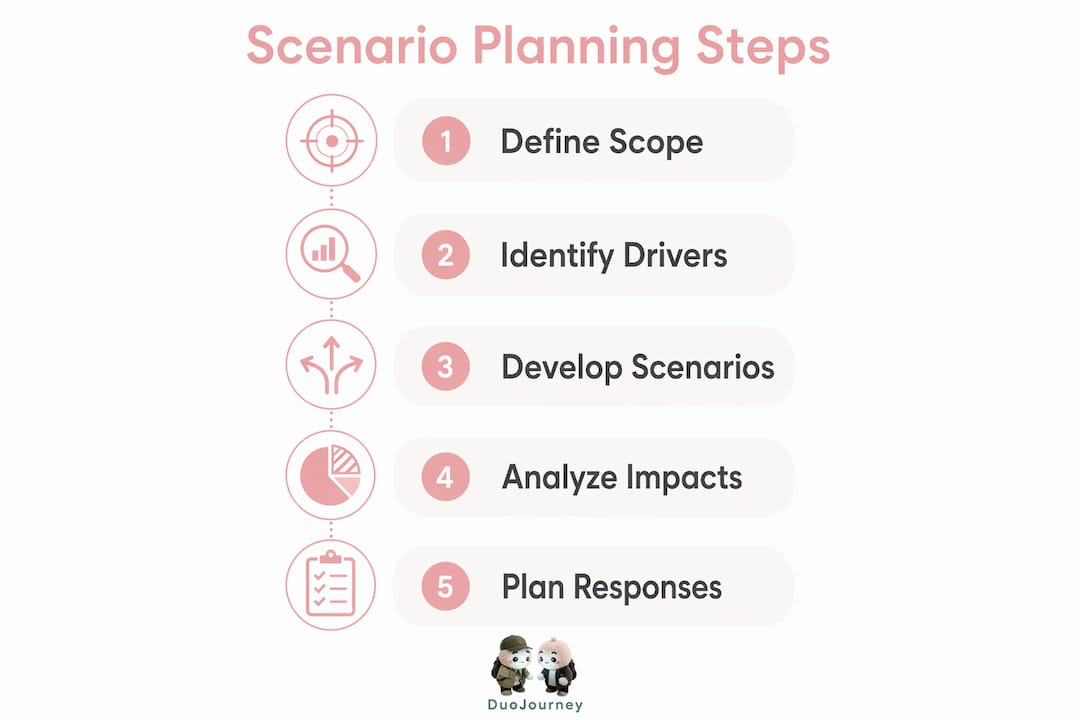
Effective implementation follows a clear sequence, but the sequence is less important than the discipline of repeating it regularly.
-
Define your planning horizon. Short-horizon scenarios (12 to 24 months) suit operational stress-testing. Long-horizon scenarios (three to ten years) suit strategic positioning and capital allocation. Most organisations benefit from running both simultaneously, with different teams and different levels of granularity.
-
Identify the critical uncertainties. These are the two or three factors whose outcomes are both highly uncertain and highly consequential for your strategy. Technology adoption rates, regulatory direction, and geopolitical stability are common candidates. The intersection of two critical uncertainties typically generates your four-quadrant scenario structure.
-
Develop rich scenario narratives. Each scenario should be a coherent story, not a spreadsheet column. It should describe the world your organisation inhabits, the competitive dynamics, the customer behaviour, and the resource environment. Narratives are more memorable and more useful in board discussions than numerical projections alone.
-
Link scenarios directly to decisions. For each scenario, identify the strategic moves that would be required. Which investments make sense across all four futures? Which are scenario-specific bets? This analysis reveals your "no-regret" moves and your contingent options.
-
Update scenarios continuously. Scenario planning must be integrated with external monitoring and adaptive management to avoid becoming static. Assign a quarterly review cadence. When weak signals suggest a scenario is gaining probability, update the narrative and re-examine the linked decisions.
-
Embed scenarios in governance. Boards want scenario planning as a governance muscle, not a once-a-year event. Present scenario updates at board meetings alongside financial results. This normalises uncertainty as a governance topic rather than treating it as an exceptional crisis.
The impact of scenario planning on business is most visible in organisations that treat it as a living practice rather than a project. Leaders who shift from a "just-in-time" efficiency mindset to a "just-in-case" resilience mindset report faster decision cycles, fewer strategic surprises, and greater board confidence in management's judgement.
Key takeaways
Scenario planning delivers strategic advantage because it replaces single-point predictions with a portfolio of prepared responses, enabling faster decisions and greater organisational resilience under genuine uncertainty.
| Point | Details |
|---|---|
| Prediction versus preparation | Scenario planning builds readiness for multiple futures rather than betting on one outcome. |
| Governance imperative | Boards now expect multi-scenario frameworks as a core risk and strategy tool, not an optional exercise. |
| Asymmetric insight | Scenarios reveal unexpected vulnerabilities and resilience that traditional risk assessments consistently miss. |
| Integration is critical | Scenario planning only delivers value when combined with ongoing trend monitoring, adaptive management, and a learning culture. |
| Continuous practice | Quarterly updates and named scenario owners convert scenario planning from an annual report into a live decision tool. |
The governance muscle most leaders are still underusing
I have watched organisations invest considerable time in building scenario frameworks and then file the outputs in a shared drive until the next annual strategy retreat. That is not scenario planning. That is scenario theatre.
The organisations I find most impressive are those that have made scenario thinking genuinely habitual. Their leadership teams do not wait for a crisis to ask "what if?" They ask it every quarter, every time a significant decision lands on the table. The scenarios are not polished documents. They are working tools, annotated and updated as the environment shifts.
The most common error I see is treating scenario planning as a prediction competition. Teams argue about which scenario is most likely rather than preparing for all of them. This misses the point entirely. The value is not in guessing correctly. The value is in the preparation that happens when you take each scenario seriously on its own terms.
A second error is building scenarios in isolation from the people who will act on them. If the scenario narratives live only with the strategy team, they will never change the behaviour of the operations director or the sales leader. The shared language benefit only materialises when the scenarios are genuinely shared. That requires facilitation, repetition, and leadership commitment that most organisations underestimate.
Scenario planning is also one of the few strategic tools that improves with scale. The more people in an organisation who understand the scenarios, the more early-warning signals get noticed and escalated. That collective vigilance is worth more than any single analyst's forecast.
— Aidil
How Ontherice supports your scenario planning capability
Scenario planning depends on the quality of signals you feed into it. Weak or delayed intelligence produces scenarios that are already outdated before the ink dries. Ontherice is built precisely to solve this problem. The platform's AI engines scan global data continuously, surfacing emerging market signals before they reach mainstream awareness. For leaders building or refreshing scenario frameworks, this means your critical uncertainties are grounded in real-time evidence rather than last quarter's reports. The Rankings Generator Engine adds competitive context, showing which sectors and players are gaining momentum across the scenarios you are stress-testing. Explore Ontherice to bring live intelligence into your planning process.
FAQ
What is scenario planning in business strategy?
Scenario planning is a structured method for developing multiple plausible futures and preparing strategic responses to each. It replaces single-point forecasting with a portfolio of contingent strategies that allow faster pivots when conditions change.
How does scenario planning differ from traditional forecasting?
Forecasting produces a single quantitative prediction based on historical trends, while scenario planning generates several narrative futures based on critical uncertainties. Forecasting suits stable conditions; scenario planning suits volatile or structurally uncertain environments.
Why use scenario analysis for governance and risk management?
Multi-scenario planning embeds risk into board-level forums, supporting defensible trade-offs across credit, liquidity, and operations. It converts uncertainty from a threat into a structured governance conversation.
How often should organisations update their scenarios?
Scenarios should be reviewed at least quarterly and updated whenever monitoring surfaces a significant weak signal. Scenario planning must integrate with ongoing environmental scanning to remain relevant rather than becoming static annual paperwork.
What are the most common scenario planning methods?
The most widely used approaches include the four-quadrant model built around two critical uncertainties, the "Four Worlds" framework, and multi-scenario portfolio planning. Each method structures plausible futures differently but shares the core principle of preparing for several outcomes rather than predicting one.