
TL;DR:
- Most organizations are shifting from pilot projects to large-scale, measurable AI deployments that drive real business value. Success depends on operational discipline, including clear measurement, workflow integration, and governance before deployment. Infrastructure, regulation, and disciplined management of agentic AI are critical for competitive advantage in 2026.
The experimental phase of artificial intelligence is over. Two-thirds of organisations now report measurable gains from their AI initiatives, which signals a decisive shift: competitive advantage in 2026 belongs not to those who explore AI, but to those who deploy it with discipline and measure its impact rigorously. If your organisation is still debating which model to use rather than how to integrate AI into workflows at scale, you are already falling behind. This guide cuts through the noise to give you the clearest, most actionable picture of what matters this year.
Table of Contents
- AI at scale: Moving from pilot to measurable business impact
- Infrastructure, compute, and the economics of AI in 2026
- Agentic AI: Deployment discipline and operational consequences
- AI regulation, compliance, and governance in 2026
- What most strategy guides miss about AI trends in 2026
- Leverage the tools and insights to win with AI in 2026
- Frequently asked questions
Key Takeaways
| Point | Details |
|---|---|
| Scaling is the new norm | Measurable, large-scale AI deployments now define leadership and outpace pilot-only strategies. |
| Infrastructure drives value | Massive investment in compute and data centres enables those with scale to capture and defend margins. |
| Governance over glamour | Deployment discipline and compliance matter more than model types for sustainable success. |
| Regulation is here | Major markets enforce new rules, and compliance is non-negotiable for ongoing access and growth. |
AI at scale: Moving from pilot to measurable business impact
For the past several years, "running a pilot" was a perfectly acceptable answer when the board asked about AI strategy. That window has firmly closed. In 2026, enterprise AI success is shifting from isolated experiments to measurable activation at scale, and the organisations that are still cycling through proof-of-concept projects are not standing still. They are actively losing ground to competitors who have moved into production.
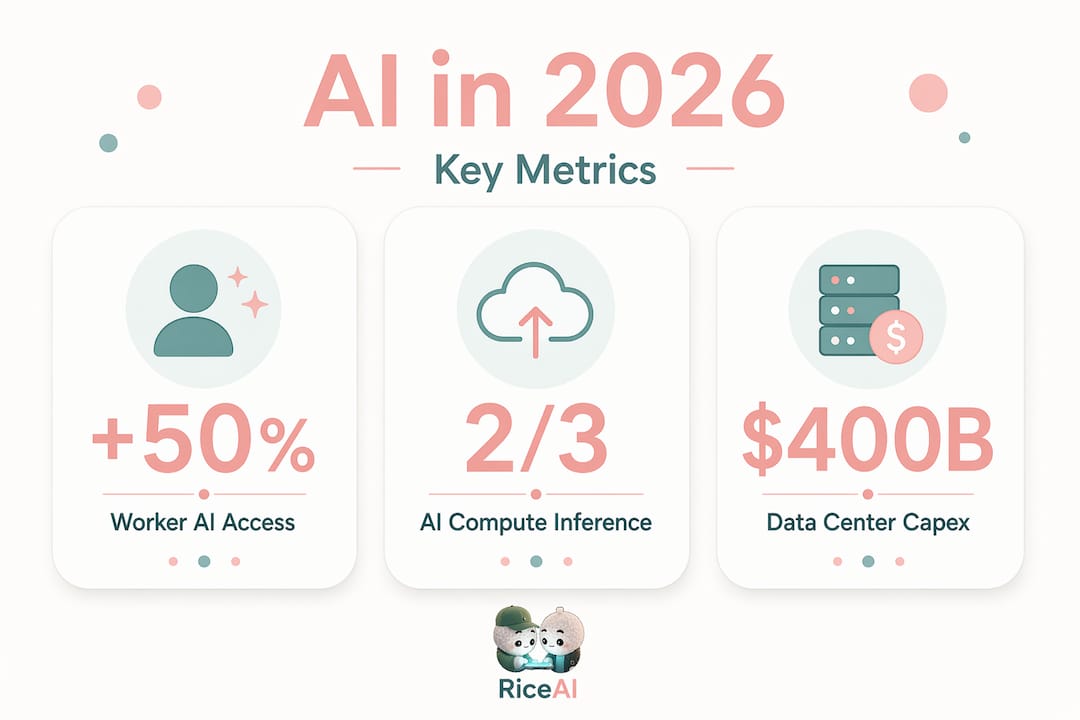
The numbers are instructive. Worker access to AI tools has increased by 50% year on year, which reflects a genuine democratisation of capability across business functions. Finance teams are using AI for anomaly detection. Marketing departments are deploying it for personalised content generation. Supply chain managers are using it for demand forecasting. This is no longer the territory of specialist data science teams working in isolation.
| Metric | 2023 | 2025 | 2026 (Forecast) |
|---|---|---|---|
| Organisations reporting measurable AI gains | ~35% | ~55% | ~66% |
| Worker access to AI tools (year-on-year growth) | Baseline | +30% | +50% |
| Firms with AI in full production | ~20% | ~40% | ~60% |
| Organisations increasing AI budget | ~45% | ~60% | ~72% |
The key distinction between organisations gaining margin and those stuck in pilot purgatory comes down to three operational choices:
- Measurement frameworks: You cannot scale what you cannot measure. High-performing adopters define success metrics before deployment, not after.
- Workflow integration: AI tools bolted on to existing processes deliver a fraction of the value of AI embedded directly into core workflows and decision loops.
- Deployment governance: Who owns the model in production? Who monitors its outputs? These questions must be answered before launch, not during a crisis.
"The organisations expanding margins in 2026 are not necessarily using better models. They are deploying with more rigour, measuring with more precision, and integrating with more intentionality."
If you are looking for AI trend examples from sectors that have already crossed this threshold, the patterns are consistent: retail, financial services, and logistics lead because they invested in integration infrastructure, not just in model licences. Understanding AI-driven trend discovery mechanisms can help you spot which adjacent sectors are approaching the same tipping point before your competitors do.
Pro Tip: Before purchasing any new AI capability, map it to a specific business process with defined KPIs. If you cannot articulate the expected impact in measurable terms within 90 days of deployment, the investment is premature.
The biggest mistake leaders make is conflating model sophistication with business value. A well-integrated, well-measured deployment of a mid-tier model will consistently outperform a poorly governed deployment of a frontier model. This is the central discipline of 2026.
Infrastructure, compute, and the economics of AI in 2026
With the deployment imperative established, the next question is whether your infrastructure can actually support the ambitions you are setting. The answer, for most organisations, requires honest reassessment.

Inference workloads now represent two-thirds of all AI compute, up from roughly a third in 2023. This matters because inference (running models in production) is structurally different from training. It is continuous, latency-sensitive, and scales with your user base. Every time a customer interacts with your AI-powered product, compute is consumed. This is not a one-time capital cost. It is an ongoing operational expenditure.
Globally, AI data centre capex is forecast at $400 to $450 billion in 2026, with chips representing the largest single line item. Semiconductor supply chains remain tight, and lead times for specialised AI accelerators stretch into the months, not weeks. For organisations planning new deployments, this has direct procurement implications.
From an investor perspective, the dominant institutional theme is infrastructure and compute buildout, combined with a sharp focus on which beneficiaries and adopters are actually capturing value. Strong AI adopters are showing cash-flow margin expansion at roughly twice the global average. This is not coincidental. It reflects the compounding advantage of having scalable infrastructure in place when others are still negotiating cloud contracts.
Here is a practical prioritisation framework for business leaders:
- Audit your current compute footprint. Understand exactly what proportion of your AI workload is training versus inference, and ensure your contracts are structured accordingly.
- Negotiate for scalability, not just capacity. Static infrastructure contracts are a liability in a market where inference demands can spike unpredictably.
- Assess power and cooling costs honestly. These are frequently underestimated and can erode the margin gains AI is supposed to deliver.
- Consider sovereign and self-sufficiency strategies. Geopolitical uncertainty is reshaping how organisations think about where their compute lives and who controls it.
- Benchmark against sector peers. Understanding where you sit relative to competitors on infrastructure maturity is now a strategic intelligence task, not just an IT exercise.
| Infrastructure factor | Low maturity | High maturity |
|---|---|---|
| Compute model | Ad hoc cloud | Dedicated, scalable contracts |
| Inference cost visibility | Minimal | Real-time dashboards |
| Power/cooling planning | Reactive | Proactive, built into TCO |
| Sovereign strategy | None | Active policy |
| Vendor lock-in risk | High | Managed and diversified |
Pro Tip: When evaluating infrastructure partners, ask specifically about inference pricing at scale, not just training costs. Vendors who cannot give you clear inference cost projections at 10x your current volume are not ready to be strategic partners.
For those tracking disruptive trend examples across sectors, infrastructure maturity is emerging as a key differentiator. Organisations with a market intelligence edge are already identifying which infrastructure plays will compound in value through 2027 and beyond.
Agentic AI: Deployment discipline and operational consequences
If infrastructure is the foundation, agentic AI is the most consequential new structure being built on it. And it demands your full attention.
Agentic AI refers to systems where multiple semi-autonomous agents are linked together to manage complex, multi-step tasks over extended periods with minimal human input at each stage. Think of it as AI that does not just answer questions but takes actions, coordinates with other systems, and pursues goals across time. An agentic system might receive a brief, conduct research, draft a document, review it against company policy, and submit it for approval, all without a human touching it until the final step.
Agentic AI is moving from capability to operational consequence in 2026. The distinction matters enormously. Capability is what a system can do in a demo. Operational consequence is what it actually does in your environment, under your governance structures, interacting with your data and your customers.
The shift has also reached software development. Agentic coding is changing development workflows, moving from coding as a series of isolated tasks to orchestrating agents over longer development spans. Entire application modules can now be constructed with minimal direct human coding. This dramatically compresses development timelines but creates new security and quality-assurance responsibilities.
The risks of poor agentic deployment are serious and specific:
- Lack of meaningful oversight: Agents making consequential decisions without adequate human review points creates liability exposure.
- Security vulnerabilities: Agentic systems with broad permissions are high-value targets; a compromised agent can traverse your entire data environment.
- Operational failures at scale: Errors that would be contained in a human workflow can propagate rapidly through an agentic system before anyone notices.
- Accountability gaps: When something goes wrong, who is responsible? If this is not defined before deployment, the answer will be determined by a regulator or a court.
- Data exfiltration risks: Agents that access sensitive data as part of legitimate tasks can inadvertently or maliciously expose that data if boundaries are not precisely defined.
"In 2026, deployment discipline is not a best practice for agentic AI. It is the primary determinant of whether these systems create value or create crisis."
Understanding the AI operational impact of agentic systems requires treating governance as a product requirement, not an afterthought. Every agentic deployment should have explicit permission boundaries, audit logging, human review checkpoints, and a documented incident response protocol before it goes anywhere near a production environment.
AI regulation, compliance, and governance in 2026
Alongside agentic AI's rise, the regulatory environment has matured considerably. For any organisation operating AI systems in Europe or serving European customers, this is no longer a future consideration. It is a present obligation.
The EU AI Act is the most consequential piece of AI legislation currently in force. It creates enforceable obligations for organisations deploying high-risk AI systems, with consequences ranging from mandatory corrective action to market withdrawal. The critical compliance deadline is 2 August 2026 for many of the Act's remaining provisions. Organisations that have not yet assessed their AI systems against the Act's risk classification framework should treat this as a board-level emergency.
Compliance-by-design for agentic and generative AI systems:
- Classify your AI systems by risk level under the EU AI Act framework. High-risk categories include systems used in employment, credit, education, and critical infrastructure.
- Conduct a conformity assessment for high-risk systems, documenting technical specifications, training data provenance, and performance metrics.
- Implement human oversight mechanisms that are genuine, not cosmetic. Regulators are specifically examining whether oversight processes are meaningful.
- Establish a transparency register so that affected individuals can understand when and how AI systems are making decisions about them.
- Appoint a designated compliance owner with direct board access and the authority to halt deployments that fail to meet regulatory standards.
Regulatory deadlines are now a decisive go/no-go factor for AI investment decisions in 2026. Any deployment timeline that does not account for EU AI Act compliance is incomplete.
Beyond the EU, regulators are increasingly focused on agentic AI risks including dark patterns, the erosion of consumer agency, and the risk of agentic collusion where AI systems acting on behalf of competing businesses inadvertently or deliberately coordinate in ways that harm market competition. The Competition and Markets Authority has flagged this as a priority concern, and enforcement action is expected as agentic deployments scale.
For investors, regulatory risk is now a material factor in AI valuations. Companies that can demonstrate compliance readiness are commanding a measurable premium. Those that cannot are facing not just fines but the possibility of being excluded from some of the world's largest markets.
What most strategy guides miss about AI trends in 2026
Here is the uncomfortable observation: most AI strategy guides published this year are still spending the majority of their analysis on model comparisons and capability benchmarks. Which model scores highest on reasoning tasks? Which performs best on coding evaluations? These are genuinely interesting questions, but they are almost entirely irrelevant to competitive advantage in 2026.
The organisations pulling ahead are not winning because they chose a better model. They are winning because they built operational systems around AI that are disciplined, measured, and integrated into the actual work the business does every day.
The consistent pattern across every credible source is movement from pilots to activation at scale, with measurement, deployment discipline, and workflow integration treated as decisive factors. Not model selection. The businesses that will dominate AI-driven markets in 2028 are building the operational muscle right now.
"AI competitive advantage in 2026 is not a technology problem. It is an organisational discipline problem. The winners have stopped asking 'which AI?' and started asking 'how do we govern, measure, and integrate this into everything we do?'"
This means that your AI strategy needs to be embedded in your operating model, not presented as a separate technology initiative. It needs to live in HR processes, in customer service workflows, in financial modelling, in supply chain decisions. When AI becomes part of your organisation's muscle memory rather than a feature on a roadmap, that is when compounding advantage begins.
Pro Tip: Run a quarterly AI deployment audit. Score each deployment against a simple framework: Is it measured? Is it integrated? Is it governed? Any deployment that cannot answer yes to all three should be paused or restructured before resources are added.
For actionable growth examples from organisations that have made this transition successfully, the case studies are illuminating. The common thread is always the same: governance and measurement came first, scale came second.
Leverage the tools and insights to win with AI in 2026
The frameworks outlined in this guide are only as powerful as the intelligence feeding them. Knowing which trends are accelerating, which sectors are at inflection points, and where deployment discipline is already delivering outsized returns requires more than periodic reports.

OnTheRice.org is built precisely for this moment. Its AI engines scan global data continuously, extract meaningful signals from noisy markets, and surface ranked, scored insights for professionals who need to act before trends reach mainstream awareness. Whether you are benchmarking your AI deployment strategy against sector leaders, identifying AI trend opportunities before they become obvious, or evaluating which top AI tools are gaining genuine traction, the platform gives you the early intelligence that turns strategy from reactive to predictive. In 2026, the competitive edge belongs to those who see clearly before the crowd catches up.
Frequently asked questions
What is the biggest shift in AI adoption for 2026?
AI adoption is moving decisively from experimental pilots to at-scale, measurable deployments with real business impact. 66% of organisations now report measurable gains as deployments scale, marking the end of the pilot era.
How important is infrastructure investment for AI progress?
Infrastructure and compute investment is now a primary competitive differentiator, dominating costs and determining which firms can sustain and scale AI at pace. AI data centre capex is set to reach $400 to $450 billion in 2026, with chips representing the single largest cost component.
What is the EU AI Act and why is it significant in 2026?
The EU AI Act is an enforceable regulatory framework imposing structured obligations on organisations deploying high-risk AI systems in European markets. The August 2026 compliance deadline means non-compliant organisations risk both fines and market withdrawal.
How is agentic AI changing business workflows?
Agentic AI enables linked systems to operate over extended periods, building software and making multi-step decisions with minimal human input at each stage. However, agentic systems creating complete applications with minimal oversight still require robust governance, security boundaries, and defined accountability frameworks to operate safely at scale.