

TL;DR:
- Technical SEO remains crucial, with HTTPS, canonical tags, and schema enhancing AI and traditional search.
- Managing AI crawlers through robots.txt and llms.txt is vital to control content access and citations.
- Content that truly helps users, demonstrates authority, and cites sources sustains long-term visibility.
The assumption that artificial intelligence will simply swallow SEO whole is one of the most persistent misconceptions circulating in digital marketing right now. The reality is far more nuanced. HTTPS adoption has crossed 91% across the web, canonical tag usage sits above 67%, and FAQ schema is growing specifically because AI systems need structured data to extract brand information accurately. The fundamentals are not fading; they are becoming more consequential. This article cuts through the noise to show SEO strategists exactly what has changed, what has stayed the same, and where to focus energy for meaningful organic growth in 2026.
Table of Contents
- Why technical SEO matters more than ever
- How AI and GEO are reshaping search results
- The enduring power of helpful content
- Emerging best practices for future-proof SEO
- What most SEO guides get wrong about trends in 2026
- Boost your SEO strategy with AI-powered solutions
- Frequently asked questions
Key Takeaways
| Point | Details |
|---|---|
| Technical SEO adoption | More than 90% of top sites now have strong technical foundations such as HTTPS and canonical tags. |
| AI & GEO integration | AI-powered search and content sourcing can boost visibility, but do not eliminate need for classic SEO. |
| Content quality rules | Helpful, original, well-structured content is still the surest route to organic growth in 2026. |
| Crawlers & policy files | New protocols like llms.txt allow precise management of AI and GEO bots for better control. |
| Frameworks beat gimmicks | The best SEO results combine technical basics, adaptive AI strategies, and genuine user focus. |
Why technical SEO matters more than ever
If you expected technical SEO to become less relevant as AI-driven search expanded, the numbers tell a different story. The web is actually getting cleaner and better structured. HTTPS adoption above 91% is not just a security milestone; it is a signal that even mid-tier websites understand baseline trust requirements. Canonical tags, now used by more than two thirds of tracked domains, resolve duplicate content issues that once silently eroded ranking potential.
What makes this particularly interesting for SEO strategists is that structured data, especially FAQ schema, is now doing double duty. It supports traditional search engine result page (SERP) features and simultaneously feeds AI systems that extract authoritative answers. When an AI tool cites a brand, it is frequently pulling from structured, well-tagged content. Ignoring schema is no longer just a missed opportunity for rich snippets; it is a missed opportunity to appear in AI-generated summaries that reach enormous audiences.
Here are the technical foundations you cannot afford to skip in 2026:
- HTTPS: Non-negotiable. Sites without it are penalised in trust signals by both Google and AI crawlers.
- Canonical tags: Essential for signalling your preferred page version and consolidating link equity across similar URLs.
- FAQ schema: Growing rapidly as a mechanism for AI extraction; mark up genuine questions your audience asks.
- Core Web Vitals: Page experience signals remain active ranking factors; slow, unstable pages lose ground regardless of content quality.
- XML sitemaps and robots.txt: Now more critical than ever as AI crawlers join the mix (more on this shortly).
Staying current with technical SEO trends requires ongoing attention, not a one-time audit. The landscape shifts as new schema types emerge and search engine guidelines are updated.
Pro Tip: Schedule a technical audit every quarter rather than annually. AI crawlers, new schema formats, and updated Google guidance can create silent gaps in visibility between major site reviews. Tools that surface market intelligence trends can help you spot shifts before they erode traffic.
How AI and GEO are reshaping search results
Technical foundations keep your site eligible. But understanding how AI is actively changing who crawls your site, and how your content surfaces in results, is where 2026 strategy diverges from prior years.
Generative Engine Optimisation (GEO) is the practice of making content legible and citable by AI systems such as ChatGPT, Perplexity, and Gemini, in addition to traditional search engines. It is not a replacement for SEO. It is an additional layer that SEO professionals now need to manage consciously.

The AI crawler picture has become genuinely complex. AI crawler blocks are rising sharply, with gptbot restrictions up approximately 55% and claudebot blocks having roughly doubled across tracked domains. Site owners are actively making choices about which AI systems may access their content, using robots.txt directives and a newly emerging file format called llms.txt. The llms.txt file functions similarly to robots.txt but is specifically designed to communicate content policies to large language models (LLMs), specifying which pages or sections may be used for training or citation purposes.
| AI crawler | Estimated block rate increase (2024 to 2026) | Primary control mechanism |
|---|---|---|
| GPTBot (OpenAI) | +55% | robots.txt, llms.txt |
| ClaudeBot (Anthropic) | ~100% (doubled) | robots.txt, llms.txt |
| GoogleBot (search) | Largely unblocked | robots.txt |
| BingBot (Microsoft) | Largely unblocked | robots.txt |
Here are the practical steps for managing AI crawlers intelligently in 2026:
- Audit your current robots.txt file. Identify which AI crawlers you are currently allowing or blocking, and assess whether this matches your content monetisation strategy.
- Create an llms.txt file. Even a basic version signals that you are actively managing AI access, which builds trust with both crawler operators and your audience.
- Decide on a content access policy. Some organisations block AI training access but allow AI citation access. These distinctions now need to be explicit.
- Monitor AI citation appearances. Use search and brand monitoring tools to track where AI systems reference your content, and optimise accordingly.
- Balance GEO tactics with traditional SEO. High-intent keyword targeting still drives the bulk of convertible traffic.
"Traditional SEO remains the dominant traffic source despite growing GEO adoption — building for AI citation without sustaining core organic rankings is a strategic error most brands cannot afford."
Opportunities in AI-influenced search are real and growing. But the brands winning in 2026 are those using AI ranking intelligence tools to understand both channels simultaneously, rather than abandoning one for the other. For a closer look at AI crawler management approaches, the options are becoming more varied and controllable than many SEO teams realise.
As noted in current SEO trend analysis, the industry is evolving towards a dual optimisation model: traditional search and AI/GEO systems working in parallel. Both require attention; neither can be ignored.
The enduring power of helpful content
Strip away every new protocol, every schema update, and every AI crawler consideration, and one truth holds firm: content that genuinely helps a real person with a real question is what earns long-term visibility. Google's helpful content guidance has not softened; if anything, it has become more consequential as the volume of AI-generated noise flooding the web increases.
Here is why this matters more than ever. AI systems that generate summaries and citations are drawing from content that demonstrates expertise, authority, and trustworthiness. Thin content, over-optimised keyword stuffing, and low-effort AI-generated articles are filtered out quickly, both by Google's ranking systems and by the citation logic of tools like Perplexity and ChatGPT. Bad content will not survive in either ecosystem.
| Attribute | High-quality, helpful content | Low-value AI-generated spam |
|---|---|---|
| Authorship | Clear expert or brand voice | Generic, no discernible perspective |
| Sources | Cited, verifiable, current | Absent or fabricated |
| User intent | Directly addressed | Loosely matched |
| Structure | Logical, scannable, layered | Flat, repetitive |
| AI citation potential | High | Near zero |
| Long-term ranking stability | Strong | Volatile, often penalised |
Signs that your content is genuinely AI-friendly (in the positive sense, meaning favoured by AI citation systems) include the following:
- Clear authorship and brand attribution: AI systems favour content they can attribute to a credible source.
- Structured answers: FAQ sections, numbered steps, and defined terms all make content easier for AI to extract and cite accurately.
- Cited sources within your content: Paradoxically, linking to credible external sources makes your own content more trustworthy to AI systems assessing quality.
- Original data or unique insights: Synthesised views that add something new are cited far more frequently than rehashed generic information.
- Consistent topical depth: Content clusters around a theme signal authority to both Google and AI tools.
SEO tools built for 2026 can help you audit existing content against these criteria systematically. Combining content quality assessment with actionable trends for growth gives teams a clear prioritisation framework rather than an endless to-do list.
Pro Tip: Avoid the emerging spam tactics that are already drawing Google penalties in 2026. Parasite SEO, which involves publishing low-quality content on high-authority third-party sites to borrow their ranking power, and review ransom, which involves pressuring businesses for favourable reviews, are both on Google's active watch list. The risk-to-reward ratio is appalling. Build your authority on your own domain with real content.
Emerging best practices for future-proof SEO
Knowing what matters is one thing. Having an operational framework to act on it is where most SEO strategies fall short. Here is a structured sequence for aligning your approach with 2026 realities.
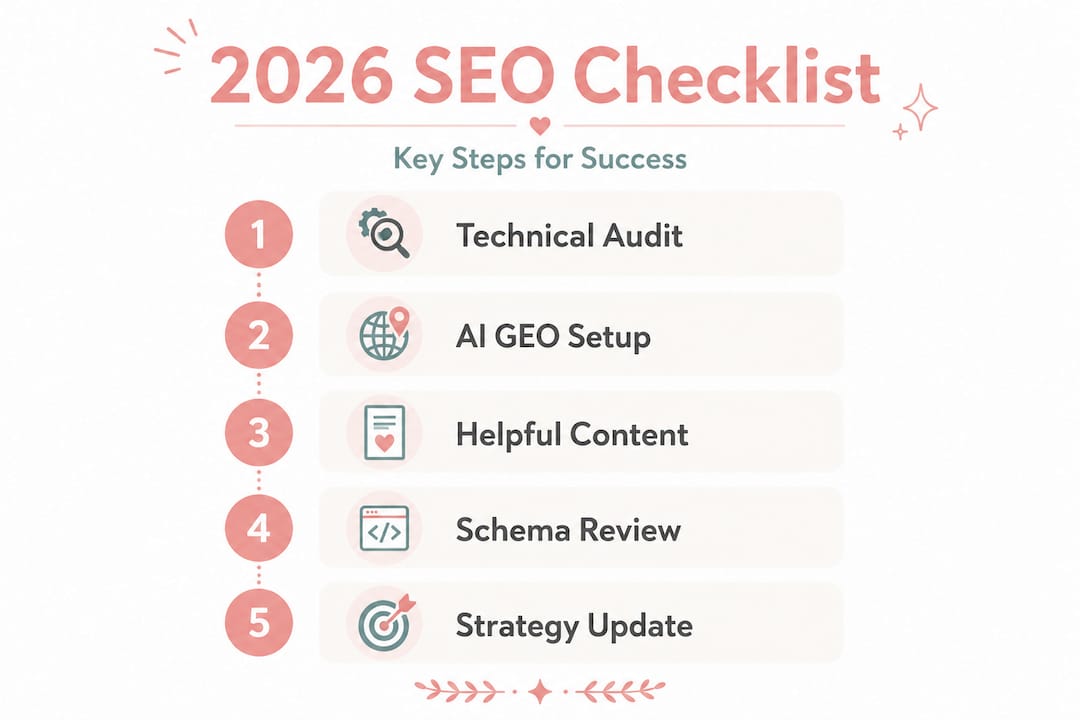
Action steps for 2026 SEO alignment:
- Conduct a full technical audit, covering HTTPS status, canonical implementation, Core Web Vitals scores, and structured data coverage. Fix what is broken before adding new content.
- Implement or update your schema markup. FAQ schema growth for AI extraction is documented and measurable; product markup and how-to schema are similarly valuable for appropriate content types.
- Establish an AI crawler policy using robots.txt and llms.txt. Make a conscious decision rather than leaving it to default.
- Map your content against user intent, not just keywords. Identify where your content genuinely resolves a question versus where it is padding volume.
- Build content clusters around your core topics, with a strong pillar page and supporting articles that link intelligently to one another.
- Monitor GEO citation appearances monthly. Track where AI tools reference your brand and whether the citations are accurate and positive.
- Review and update your schema formats quarterly. Standards evolve, and outdated markup can actively confuse crawlers.
Common pitfalls that undermine even well-intentioned SEO strategies in 2026:
- Ignoring schema entirely: Even basic structured data is now table stakes; the absence of it is a competitive disadvantage.
- Poor AI crawler management: Blocking all AI crawlers without strategy can eliminate valuable citation opportunities.
- Weak or absent citations within content: Content that does not cite sources is treated with less trust by both Google and AI systems.
- Treating GEO as separate from SEO: The most successful teams integrate both into a single workflow.
- Chasing algorithm updates reactively: Brands that build for users rather than for the latest update consistently outperform reactive competitors over time.
The content categorisation tool at OnTheRice helps map your existing assets against current demand signals. Pairing this with B2B SEO signal tracking gives you a clear picture of where your industry is moving before competitors catch on.
Pro Tip: Set a recurring calendar reminder each quarter specifically for schema review. New formats such as event schema updates, speakable schema for voice search, and evolving FAQ guidelines are regularly adjusted. A schema that was correct twelve months ago may no longer reflect current best practice.
What most SEO guides get wrong about trends in 2026
Most coverage of 2026 SEO trends falls into a predictable trap: it frames AI as the enemy of organic search, creating urgency around abandoning fundamentals in favour of the next shiny GEO tactic. This framing is not just wrong; it actively harms the strategies of professionals who follow it.
The more productive framing is this: AI will not kill SEO. Poor strategy and poor content will. This distinction matters enormously. Teams that respond to AI disruption by accelerating their output of thin, automated content are not adapting; they are accelerating their own decline. The platforms penalising that content, both Google and AI citation systems, are becoming better at identifying and filtering it every month.
What actually wins over time is consistent application of a solid framework: strong technical foundations that make your site crawlable and trustworthy; content that genuinely serves a human need; and intelligent adaptation to new protocols like llms.txt and GEO without losing sight of the user at the centre of the strategy. This is not exciting advice. It is, however, the advice that produces durable results.
The brands we see outperforming their sectors are not the ones chasing trend cycles. They are the ones that built reliable infrastructure early, produced content with genuine depth, and then layered AI-aware tactics on top of that solid base. Agility matters, but only if you have something worth being agile with.
Studying actionable business trends across sectors reveals the same pattern repeatedly: frameworks outperform hacks, and compound investment in fundamentals outperforms trend-chasing by a substantial margin over a 24-month horizon. The professionals who will lead in 2026 are those treating AI as an additional distribution and optimisation layer, not as a reason to abandon what already works.
Boost your SEO strategy with AI-powered solutions
The landscape described throughout this article requires tools that can keep pace with both traditional SEO signals and emerging AI-driven changes simultaneously.

OnTheRice is built precisely for this moment. The platform's AI engines continuously scan market signals across sectors, giving SEO and digital marketing professionals early visibility into shifts before they become mainstream. You can discover AI SEO opportunities as they emerge, rather than reacting after competitors have already moved. Whether your priority is to grow your organic traffic through smarter content and technical decisions or to automate rankings tracking across multiple channels, OnTheRice provides the real-time intelligence layer that manual monitoring simply cannot replicate. Stay ahead, not behind.
Frequently asked questions
How does llms.txt affect my SEO strategy in 2026?
The llms.txt file gives you direct control over which large language models can access and use your content, letting you manage AI citation risk and opportunity simultaneously without disrupting traditional search crawling.
Is Google still prioritising technical SEO in 2026?
Yes. HTTPS, canonical tags, and schema remain active ranking and trust signals; a technically sound site is the prerequisite for any content or GEO strategy to function effectively.
Can AI-generated content rank highly in 2026?
Genuinely helpful AI-assisted content can rank, but low-value mass-produced AI output is actively filtered by Google's systems and ignored by AI citation platforms alike.
How do I protect my site from AI spam tactics?
Steer clear of parasite SEO and review ransom tactics entirely; these attract penalties and erode brand trust in ways that take considerable time and resource to reverse.
What's the quickest technical SEO win for 2026?
Verifying full HTTPS implementation across every page of your site remains one of the fastest trust and credibility improvements available, with measurable ranking and user confidence benefits.