

TL;DR:
- Generative AI adoption has rapidly surpassed 29% worldwide, signaling a global structural shift.
- The key trends now focus on AI engagement, infrastructure, and data governance frameworks.
- Deep institutional question-asking and data literacy are crucial for sustained competitive advantage.
Most business leaders assume they have a reasonably accurate picture of where the world stands digitally. They are wrong by a significant margin. Generative AI users have already crossed 2.42 billion globally in early 2026, representing 29.2% of the world's population and more than doubling year-over-year. That is not incremental growth. That is a structural rupture. This article breaks down what global data trends actually mean in 2026, which frameworks are separating winners from laggards, and how to translate signals into strategic decisions before your competitors even notice the shift.
Table of Contents
- Defining global data trends: what's new, what matters
- A snapshot of 2026: key metrics and trajectories
- Emerging frameworks: making sense of rapid change
- Monetising data trends: competitive advantage and skill gaps
- What most strategy guides miss about global data trends
- Unlock global data insights for your organisation
- Frequently asked questions
Key Takeaways
| Point | Details |
|---|---|
| AI adoption accelerating | Nearly a third of the global population now uses generative AI, doubling every year. |
| Skill gaps shape advantage | AI and data literacy are make-or-break factors for business competitiveness. |
| Smart frameworks matter | Universal semantic layers and AI governance are redefining data strategy foundations. |
| Context outpaces copying | Adapting data trends with agility and insight delivers more value than simply following competitors. |
Defining global data trends: what's new, what matters
With the stage set, let us clarify what the explosion of data and usage means for today's business landscape.
For years, "global data trends" was shorthand for internet penetration rates and social media follower counts. That framing is now dangerously outdated. The current landscape spans AI engagement depth, mobile-first infrastructure dominance, and the rise of semantic AI systems that are reshaping how organisations make sense of their information assets. Executives who still evaluate data trends through a 2019 lens are navigating 2026 with an obsolete map.
What actually defines a meaningful data trend today? Three dimensions matter:
- Scale and penetration: Is this adoption broad enough to shift market behaviour, or is it still a niche signal?
- Velocity: How quickly is the trend accelerating? Doubling in a year, as AI engagement has done, demands immediate attention.
- Infrastructure dependency: Does the trend require new underlying systems, or can existing workflows absorb it?
Consider the current baseline. Internet and social media figures illustrate the breadth of the digital shift: 6.12 billion internet users (73.8% penetration), 5.79 billion social media users (69.9%), and 5.83 billion mobile users (70.4%). These numbers tell you that mobile-first and always-connected assumptions are now safe design principles globally, not regional exceptions. Tracking digital adoption metrics helps you move beyond raw numbers to understand what these populations are actually doing with connectivity.
Key insight: The most strategically valuable data trends in 2026 are not about whether people are online. They are about how people are interacting with AI, what decisions they delegate to it, and which organisations are building the infrastructure to capture that behaviour at scale.
The consequences for global strategy are direct. A business that treats AI engagement as a secondary metric will systematically underestimate competitor capabilities, miss pricing signals, and fail to anticipate demand shifts in AI-adjacent product categories. Global data trends are no longer background context. They are the competitive terrain itself.
A snapshot of 2026: key metrics and trajectories
Now that we know what to look for, let us quantify the current landscape and its steep upward momentum.
Numbers without context are noise. Numbers placed in trajectory reveal direction. The table below organises the most critical digital metrics from the 2026 mid-year data, showing both absolute scale and what that scale implies for strategy.
| Metric | 2026 figure | Global penetration | YoY direction |
|---|---|---|---|
| Internet users | 6.12 billion | 73.8% | Steady growth |
| Social media users | 5.79 billion | 69.9% | Maturing |
| Mobile connections | 5.83 billion | 70.4% | Near saturation |
| Generative AI users | 2.42 billion | 29.2% | Rapid acceleration |
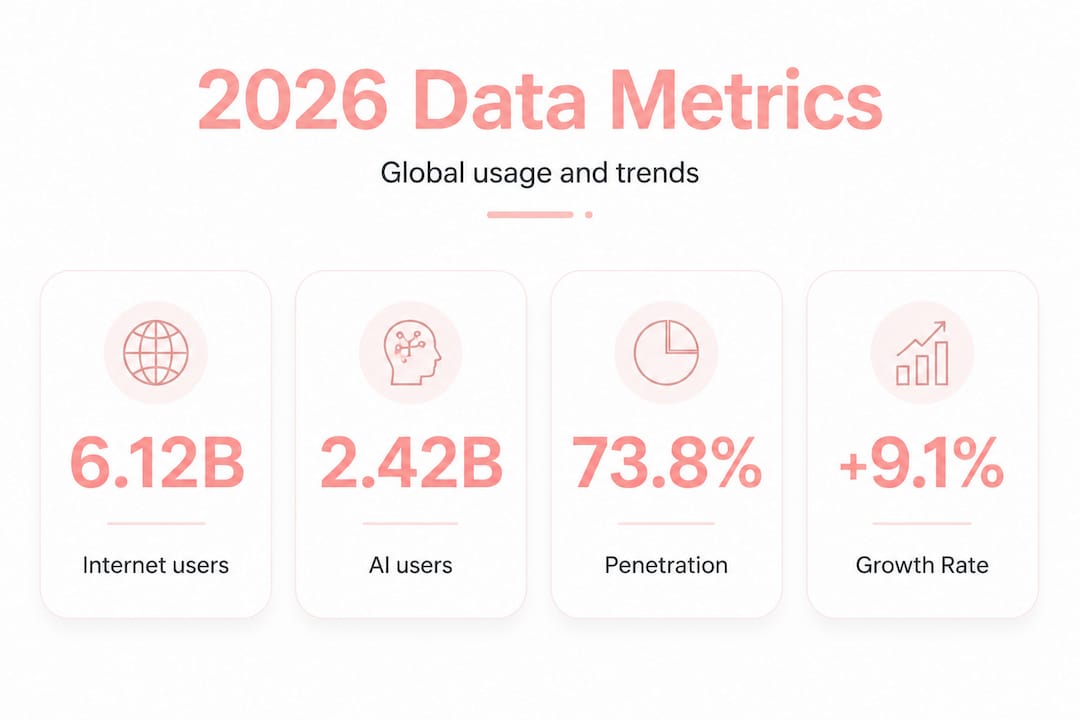
The generative AI figure is the outlier that demands your attention. Every other metric reflects a maturing digital world approaching saturation. AI engagement is the outlier climbing fast. AI adoption has surged to encompass nearly a third of the global population, having more than doubled year-over-year. This is not adoption creep. This is exponential uptake entering its steep phase.
What this means in practice: When nearly 30% of the world is actively engaging with generative AI tools, the baseline expectation for product intelligence, customer service responsiveness, and content personalisation shifts industry-wide. Firms that assume "AI is still emerging" are operating under a false premise. It has emerged. The question is now about depth of integration and competitive differentiation.
From a revenue standpoint, AI workforce readiness is directly tied to how quickly organisations can capture the value embedded in these trends. Companies that have invested early in AI-literate teams are already pulling ahead on implementation speed, data quality, and model governance. The gap between early movers and late adopters is widening every quarter, not narrowing.

Strategically, the takeaway from this snapshot is simple but easily missed: the window for treating AI as optional is closing. The firms benchmarking against these figures now will set the competitive floor for their sectors by 2027.
Emerging frameworks: making sense of rapid change
With metrics in hand, let us shift to the strategies top organisations are deploying to adapt and thrive.
Data without structure is expensive chaos. The frameworks emerging in 2026 are specifically designed to address the governance, accuracy, and coordination challenges that arise when AI systems operate at scale across complex organisations. Two developments stand out as genuinely transformative.
First, universal semantic layers. Think of a semantic layer as a shared vocabulary sitting between your raw data and your AI models. It ensures that when an AI agent in your marketing department asks about "revenue," it is using the same definition as the AI agent in your finance function. Without this, multi-agent AI systems produce contradictory outputs and erode trust in data quickly. Gartner predicts that by 2030, universal semantic layers will be critical infrastructure for AI accuracy and multi-agent alignment, with 50% of organisations using AI agents specifically for governance enforcement.
Second, AI-driven governance agents. These are automated systems that monitor data pipelines, flag inconsistencies, enforce policies, and generate audit trails without requiring constant human intervention. They are not a replacement for human oversight. They are the scaffolding that makes human oversight scalable.
Comparing legacy and emerging data frameworks:
| Dimension | Legacy approach | Emerging framework |
|---|---|---|
| Data definitions | Manual, siloed per team | Universal semantic layer |
| Governance | Human-reviewed periodically | AI agents, continuous enforcement |
| Accuracy checks | Batch audits | Real-time anomaly detection |
| Speed to insight | Days to weeks | Hours to minutes |
| Risk management | Reactive | Predictive and automated |
Transitioning to these frameworks is not a single project. It is a phased organisational shift. Here is a practical sequence for moving from legacy data workflows to modern infrastructure:
- Audit your current data definitions across all major functions. Identify where the same term means different things in different teams.
- Pilot a semantic layer on one high-stakes data domain, such as customer lifetime value or product margin, before rolling out broadly.
- Deploy AI governance agents in monitoring roles first, with human sign-off on enforcement actions, then progressively automate low-risk decisions.
- Measure consistency improvements at each stage. Track the reduction in data reconciliation time as your key performance indicator.
- Train your analysts to work with AI-augmented governance rather than around it. Resistance here is the most common implementation failure point.
Pro Tip: The biggest risk in deploying AI agents for governance is "ungoverned deployment" of the governance tools themselves. Before going live, document precisely what decisions each AI agent is authorised to make, and build in a human escalation path for edge cases. Organisations that skip this step often discover data policy violations created by the very tools designed to prevent them.
Explore AI tools for business to understand which platforms are already integrating semantic layers natively. Staying ahead means understanding market intelligence trends well enough to evaluate these tools against your specific strategic context, not just their feature lists.
Monetising data trends: competitive advantage and skill gaps
Having explained the frameworks, it is time to focus on what makes the difference between growth leaders and laggards.
Understanding data trends is one thing. Converting them into revenue is another. The organisations capturing the most value from the 2026 data landscape share a common pattern: they treat data capability as a product, not just a support function. They build internal systems that generate proprietary insight, then use that insight to move faster on pricing, product development, and market entry than competitors relying on public data alone.
Where is the value actually being captured right now? Three areas stand out:
- Predictive demand modelling: Firms using AI to synthesise social signals, purchasing behaviour, and macroeconomic indicators are forecasting demand with significantly higher accuracy than traditional statistical models.
- Dynamic pricing intelligence: Real-time data feeds combined with AI pricing agents allow for granular, market-responsive pricing that static quarterly reviews simply cannot match.
- Competitive signal detection: Organisations scanning competitor activity, regulatory changes, and consumer sentiment at scale are making strategic pivots months ahead of publicly available intelligence.
The commercial case for urgency is clear. AI-related sectors delivered 11% annual revenue growth and a 29% annual rise in market capitalisation from 2022 to 2025. Those are not projections. That is the demonstrated return on early commitment to AI-adjacent capability building.
Reality check: Most organisations are not failing because they lack access to data. They are failing because they lack the human capacity to act on it effectively. The bottleneck is not data volume. It is analytical fluency.
The skill gap is the central obstacle. AI proficiency testing is projected to feature in 75% of hiring processes by 2027, signalling that the market is already adjusting to this reality. Organisations that wait to build AI literacy in their workforce will find themselves competing for a shrinking pool of qualified candidates against firms that started building internal capability two years earlier.
Pro Tip: Rather than hiring externally for every AI skill gap, identify your two or three most analytically capable current employees and fund intensive AI training for them immediately. Internal advocates who understand your data environment will outperform external hires who need six months to understand the business context.
Leverage dynamic market tools to prioritise which capability gaps to close first based on your specific sector's momentum. Studying actionable trend examples from organisations in adjacent industries can also surface non-obvious opportunities before they show up in your direct competitive set.
What most strategy guides miss about global data trends
With the tactical and technical sides covered, it is worth stepping back for a critical look at what actually delivers long-term advantage.
Most published guides on global data trends make the same mistake. They equate adoption with advantage. They present a list of metrics, recommend a set of tools, and imply that following the checklist delivers competitive edge. It does not. The firms consistently generating strategic value from data are not the ones with the most sophisticated tools. They are the ones with the deepest institutional habit of asking better questions.
Here is the uncomfortable truth: copying a competitor's data framework is the fastest way to ensure permanent second-place status. Frameworks are visible. They can be replicated. What cannot be replicated quickly is the judgement your team develops through sustained engagement with your specific data environment, your particular customers, and your unique competitive landscape.
The real differentiator is contextual agility. That means the capacity to recognise when a global signal is relevant to your business before the consensus acknowledges it, and to act before the window narrows. That capacity does not come from dashboards. It comes from data literacy distributed across decision-makers, not concentrated in a central analytics team.
We have observed, working across market intelligence contexts, that organisations which outperform over multiple cycles share one behavioural trait: they treat anomalies as hypotheses rather than noise. When a signal appears in their data that contradicts their current model, they investigate rather than dismiss. That discipline, compounded over time, is what produces genuine foresight rather than reactive scrambling.
The second blind spot in most strategy guides is the conflation of data volume with data quality. In 2026, data volume is not a competitive advantage. Nearly every large organisation has access to more data than it can sensibly process. The advantage lies in signal quality, which is determined by how well your data governance, semantic layers, and analytical frameworks filter meaningful patterns from the noise. Exploring disruptive trend examples reveals that the firms making non-obvious strategic moves are almost always working from cleaner, better-contextualised data rather than more data.
Build the culture first. The tools will follow naturally.
Unlock global data insights for your organisation
Equipped with new understanding and strategies, here is how you can act on global data trends with confidence.
OnTheRice.org is built precisely for the challenge this article describes. When global data is moving at the speed shown in the 2026 figures, you need a platform that continuously scans multiple data streams, extracts meaningful signals, and ranks them by momentum before they reach mainstream visibility. That is not a spreadsheet task. That is an AI task.

Whether you are mapping AI opportunity analysis for your sector or building a broader picture through global data intelligence, the platform gives you ranked, scored, and contextualised trend insights in real time. The analytical frameworks covered in this article are embedded in the engine. You get the output without rebuilding the infrastructure from scratch. Start exploring the signals that matter to your sector before your competitors do.
Frequently asked questions
What is the most significant global data trend in 2026?
The surge in generative AI users is the standout shift, with 2.42 billion active users globally representing nearly a third of the world's population and having more than doubled year-over-year. No other digital metric is moving at this velocity.
How are companies overcoming AI skill gaps?
Forward-looking organisations are embedding AI proficiency assessments directly into recruitment pipelines, with 75% of hiring processes projected to test AI skills by 2027, while simultaneously investing in upskilling existing analytical staff rather than relying solely on external hires.
Why are universal semantic layers important now?
As multi-agent AI systems multiply across organisations, shared data definitions become essential to prevent contradictory outputs and governance failures. Universal semantic layers are moving from optional architecture decisions to core infrastructure requirements by 2030.
What is the economic impact of AI-related industries?
The commercial case is well-established: AI-related sectors generated 11% annual revenue growth and a remarkable 29% annual market capitalisation increase from 2022 through 2025, outpacing virtually every other industry category over the same period.