
TL;DR:
- Trend stacking involves layering multiple, non-correlated signals to improve decision accuracy across finance, trading, and market intelligence. It enhances diversification, trade reliability, and early trend detection by combining distinct indicators and data sources, supported by advanced scoring tools and technology platforms.
Trend stacking is the practice of layering distinct trend signals or exposures to improve decision accuracy and performance across finance, trading, and market intelligence. The term covers three recognised disciplines: return stacking in investment portfolios, probability stacking in technical analysis, and signal stacking in market intelligence. Each method applies the same core logic. Layering complementary, non-correlated inputs produces a stronger, more reliable picture than any single indicator can deliver. For business professionals and market analysts, understanding this concept is the difference between reacting to trends and anticipating them.
What is return stacking and how does it improve portfolio performance?
Return stacking is defined as overlaying uncorrelated, alpha-generating sleeves on a core long-only portfolio using derivatives, without selling the underlying holdings. A traditional 60/40 portfolio holds equities and bonds. A return-stacked version adds a managed futures or trend-following overlay on top, funded through derivatives rather than by liquidating core positions.

The practical effect is meaningful. Managed futures strategies target absolute returns regardless of equity market direction. Adding them as an overlay improves diversification without reducing exposure to the original portfolio's growth engine. Return-stacked products such as RSST carry an expense ratio of approximately 0.99%, which reflects the operational cost of running derivatives alongside core holdings.
That operational cost points to a real challenge. Return stacking requires active margin management and dedicated liquidity buffers to handle variation margin during volatile periods. Derivatives overlays must be funded independently of core holdings. Failing to maintain those buffers risks forced liquidation of the very assets the strategy is designed to protect.
Successful return stacking also demands what practitioners call intelligent leverage. This means setting explicit leverage and volatility rules before deploying the overlay, not after a drawdown. The goal is diversification over added risk, not amplification of it.
Pro Tip: Run scenario stress tests across at least three market regimes, including a sharp equity sell-off, a rising rate environment, and a low-volatility grind, before committing to any derivatives overlay. Volatility budgeting at the portfolio level prevents the overlay from consuming more risk budget than intended.
| Metric | Traditional 60/40 portfolio | Return-stacked portfolio |
|---|---|---|
| Core holdings | Equities and bonds | Equities and bonds |
| Additional sleeve | None | Managed futures or trend-following overlay |
| Diversification source | Asset class mix | Asset class mix plus uncorrelated alpha |
| Funding mechanism | Direct allocation | Derivatives overlay |
| Operational complexity | Low | High: margin and liquidity management required |
How does probability stacking improve technical trading decisions?
Probability stacking is defined as layering complementary technical indicators across multiple timeframes to increase the reliability of any single trade setup. The method works because each indicator measures a different aspect of market behaviour. Combining them produces a consensus rather than a single, fallible signal.
A well-constructed probability stack covers three distinct market dimensions:
- Trend direction: A moving average or exponential moving average (EMA) slope confirms whether price is trending up or down on the higher timeframe.
- Momentum: MACD readings confirm whether momentum supports the direction the moving average suggests.
- Order flow and value: VWAP confirms intraday price acceptance around fair value, filtering out weak pullbacks that look like entries but are not.
Professional methods extend this further. A triple-check filter combining EMA slope, price action confirmations, and ADX readings above 25 identifies high-probability setups with measurable criteria. An ADX reading above 25 signals a trending market rather than a ranging one. That distinction matters because trend-following indicators produce false signals in ranging conditions.
The most common mistake in probability stacking is adding more indicators rather than better ones. Overcomplicating indicator stacks reduces effectiveness. A simpler stack of three or four reliable indicators outperforms a complex one by reducing analysis paralysis during volatile markets. Each indicator must cover a distinct market aspect. Selecting non-redundant indicators that cover trend, momentum, and volume forms a consensus rather than clutter.
Pro Tip: Build a decision tree based on market regime before selecting your indicator stack. In a trending regime, weight moving averages and MACD. In a breakout regime, weight volume and price action. In a ranging market, reduce position size or stand aside entirely.
What is signal stacking in market intelligence?
Signal stacking is defined as validating an emerging trend by identifying the convergence of multiple early signals across different platforms and data sources. Traditional viral indicators, such as a spike in social media mentions, capture a trend after it has already reached mass awareness. Signal stacking captures it months earlier.
The method relies on four key signals working in combination:
- Persistent search curiosity: Sustained growth in search volume over weeks or months, not a single spike. This reflects genuine, growing interest rather than a news cycle.
- Parallel creator experimentation: Multiple independent creators across different platforms testing the same concept simultaneously. This signals organic adoption rather than coordinated promotion.
- Community signal density: Rising discussion volume within niche communities such as Reddit forums, Discord servers, or specialist publications. Dense community engagement precedes mainstream awareness.
- Early commercial activity: The appearance of early-stage products, services, or funding activity around a concept. Early commercial traction is a more reliable predictor of lasting trends than transient social media spikes.
The logic behind this approach is straightforward. A single signal can be noise. Four signals converging simultaneously is a pattern. Signal stacking detects opportunities months before they spike in mainstream visibility. That timing advantage translates directly into lower competition, stronger narrative positioning, and higher long-term leverage for any business or analyst acting on the intelligence early. Platforms that aggregate these signals across global data points, such as Ontherice, are built specifically to surface this kind of convergence before it becomes obvious.
Pro Tip: When using signal stacking for market intelligence, weight early commercial activity and community signal density above social media volume. Viral attention fades. Commercial traction and community depth do not.
What are the benefits and challenges of trend stacking?
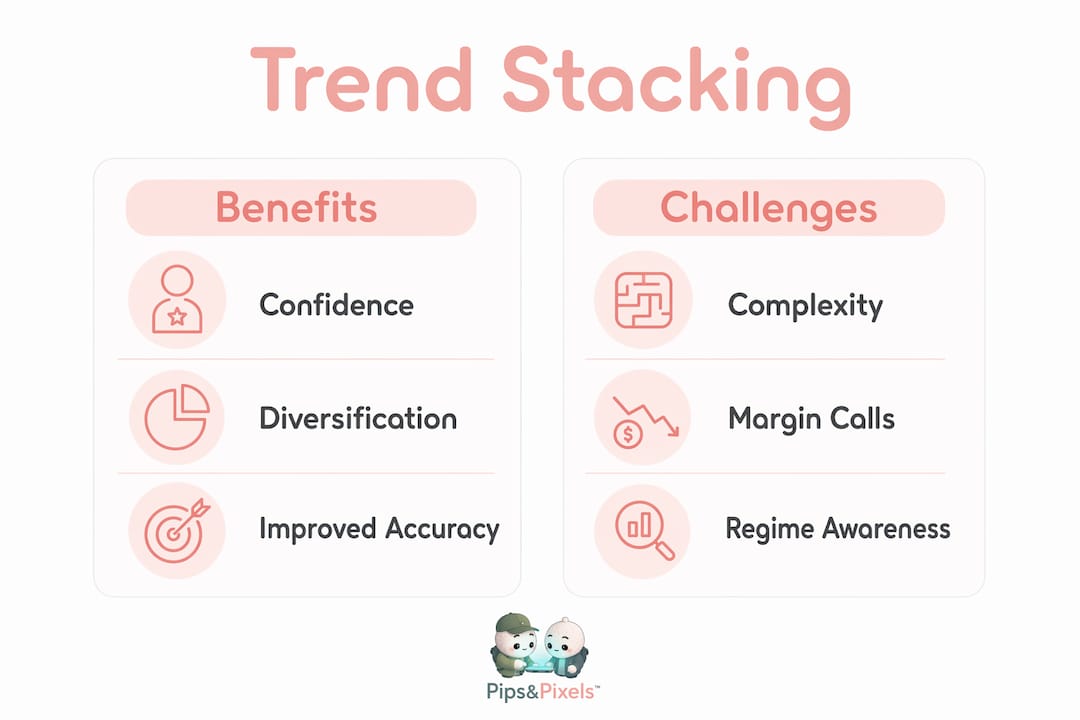
The primary benefit of trend stacking across all three disciplines is improved confidence in any decision. A single indicator or signal can mislead. Multiple non-correlated inputs converging on the same conclusion reduce that risk substantially. For business analysts, this translates into better-timed decisions and reduced exposure to false positives.
Scoring models formalise this benefit. Professional stacking employs scoring models that assign points for trend, momentum, and relative strength. The clarity and repeatability of rules consistently outperform indicator complexity. Removing emotion from the decision process is the core value of any well-constructed stacking model.
The challenges differ by discipline. Return stacking introduces operational complexity: margin calls, liquidity management, and leverage budgeting all require active oversight. Probability stacking risks indicator redundancy when analysts select indicators that measure the same thing in different ways. Signal stacking faces the challenge of distinguishing sustained momentum from viral noise. Persistent search curiosity and community signal density are prioritised over explosive initial attention precisely because viral spikes are unreliable.
| Type | Key benefits | Key challenges |
|---|---|---|
| Return stacking | Diversification without selling core holdings | Margin management, liquidity buffers, leverage rules |
| Probability stacking | Higher trade setup reliability, reduced false signals | Indicator redundancy, analysis paralysis |
| Signal stacking | Early trend detection, months ahead of mainstream | Distinguishing sustained momentum from viral noise |
How to apply trend stacking strategies in practice
Applying trend stacking effectively starts with selecting inputs that are genuinely non-correlated. Whether you are building an indicator stack for trading or a signal stack for market intelligence, the same rule applies: each layer must measure something the others do not.
A practical implementation follows these steps:
- Define your objective. Clarify whether you are managing portfolio risk, identifying trade setups, or detecting emerging market trends. The objective determines which type of stacking is relevant.
- Select complementary inputs. For probability stacking, choose indicators covering trend direction, momentum, and order flow. For signal stacking, monitor search data, creator activity, community forums, and commercial signals simultaneously.
- Assign a scoring model. Allocate points to each input based on its signal strength. A trend confirmed by three of four indicators scores higher than one confirmed by two. Act on high-scoring setups only.
- Set risk parameters before deploying. For return stacking, define leverage limits and liquidity buffers in advance. For trading, define maximum position size per setup quality tier.
- Review and adjust by market regime. Indicator stacks that work in trending markets underperform in ranging ones. Build regime detection into your review process and adjust weightings accordingly.
Pro Tip: Use technology platforms that aggregate and score signals automatically. Ontherice's AI-driven tools scan global data points and produce ranked, scored outputs for emerging trend scouting, removing the manual aggregation step that most analysts underestimate in time cost.
Key takeaways
Trend stacking works because layering non-correlated signals, whether in portfolios, trading setups, or market intelligence, produces more reliable decisions than any single input can deliver.
| Point | Details |
|---|---|
| Core definition | Trend stacking layers distinct, non-correlated signals or exposures to improve decision accuracy. |
| Return stacking | Derivatives overlays add uncorrelated alpha to core portfolios without selling base holdings. |
| Probability stacking | Combining moving averages, MACD, and VWAP across timeframes increases trade setup reliability. |
| Signal stacking | Convergence of search curiosity, creator activity, community density, and commercial traction detects trends early. |
| Scoring models | Assigning points to each signal layer removes emotional bias and improves decision repeatability. |
Why trend stacking is harder than it looks
I have watched analysts build elaborate stacking systems and still make poor decisions. The reason is almost always the same. They confuse complexity with rigour. Adding a fifth indicator or a sixth signal does not make the stack stronger. It makes it noisier.
The discipline that separates effective stacking from expensive experimentation is regime awareness. A probability stack built for trending markets will produce false signals in a ranging one. A signal stack calibrated for consumer markets will miss the nuances of B2B adoption curves. The stack itself is not the edge. Knowing when to trust it is.
Technology has changed the calculus here. Platforms that aggregate and score signals in real time remove the cognitive load that used to make stacking impractical for most analysts. The question is no longer whether you can build a stack. It is whether you have the discipline to act on it consistently and the tools to maintain it without manual overhead.
The future of trend stacking sits at the intersection of data convergence and decision frameworks. Analysts who combine structured scoring models with real-time signal aggregation will consistently outpace those relying on intuition or single-source data. That gap is widening, not narrowing.
— Aidil
Ontherice: AI-driven trend stacking for market analysts
Ontherice is built for exactly the kind of multi-signal analysis this article describes. Its AI engines scan global data points, extract meaningful signals, and produce ranked, scored outputs across diverse markets.

Analysts can access AI-driven opportunities that surface trend convergence before it reaches mainstream awareness, and explore a full suite of analytical tools covering indicator libraries, signal aggregation, and real-time scoring. The platform's ranking engine assigns scores to stacked signals, giving you a clear, repeatable basis for decisions rather than a list of raw data points to interpret manually. For professionals who need to act early and act with confidence, Ontherice delivers the infrastructure that makes trend stacking practical at scale.
FAQ
What does trend stacking mean in simple terms?
Trend stacking means layering multiple distinct signals or exposures to confirm a trend rather than relying on a single indicator. The approach applies across investment portfolios, technical trading, and market intelligence.
What is the difference between return stacking and probability stacking?
Return stacking adds uncorrelated investment sleeves, such as managed futures, on top of a core portfolio using derivatives. Probability stacking layers complementary technical indicators like moving averages, MACD, and VWAP to improve trade setup reliability.
How many indicators should a probability stack include?
A stack of three to four non-redundant indicators outperforms more complex configurations. Each indicator must cover a distinct market dimension: trend direction, momentum, and order flow or volume.
How early does signal stacking detect trends?
Signal stacking detects emerging trends months before they spike in mainstream visibility by identifying convergence across search data, creator activity, community forums, and early commercial activity simultaneously.
Is trend stacking suitable for non-financial applications?
Signal stacking applies directly to product innovation, marketing intelligence, and competitive analysis. Any domain where early trend detection creates a timing advantage benefits from the convergence-based approach that signal stacking provides.