
TL;DR:
- Strategic trend timing involves early detection and action on market signals to gain a competitive advantage, requiring continuous analysis. Validating signals through multiple data sources and credible drivers prevents mistaking noise for genuine trends, essential for effective timing. Treating trend timing as an ongoing governance loop with structured decision rules and reviews enhances accuracy amid economic uncertainties.
Strategic trend timing is the systematic process of detecting and acting on market signals early enough to gain a measurable competitive advantage over rivals who wait for trends to become obvious. The formal discipline behind this practice is known as strategic foresight, and mastering it requires more than intuition. This guide to strategic trend timing walks you through the core signals to identify, the frameworks and tools that structure your decisions, a step-by-step execution process, and the most costly mistakes to avoid. You will leave with a repeatable method grounded in 2026 research from BCG, Investopedia, and the World Economic Forum.
What is strategic trend timing and why does it matter?
Strategic trend timing is defined as the deliberate alignment of decision-making with the earliest credible evidence that a market shift is underway, rather than waiting for consensus confirmation. The distinction matters enormously. By the time a trend appears in mainstream reporting, the window for competitive positioning has often already closed.

BCG's strategic foresight research describes the most effective approach as a dynamic iterative process that combines rigorous data analysis with "what if?" explorations to detect early signals before they alter industry trajectories. This means your timing process cannot be a once-a-year exercise. It must function as a continuous loop that updates your mid- to long-term strategy in real time.
The payoff is asymmetric. Organisations that act on weak signals before competitors do not merely gain a head start. They shape the conditions under which latecomers must compete. Ontherice is built on precisely this principle, using AI engines to surface signals across global markets before they reach mainstream awareness.
How do you identify genuine trend signals and filter out noise?
The most reliable framework for separating real trends from noise examines three variables: direction, duration, and credible drivers. If you cannot identify a plausible driver behind an observed movement, the signal is almost certainly noise.
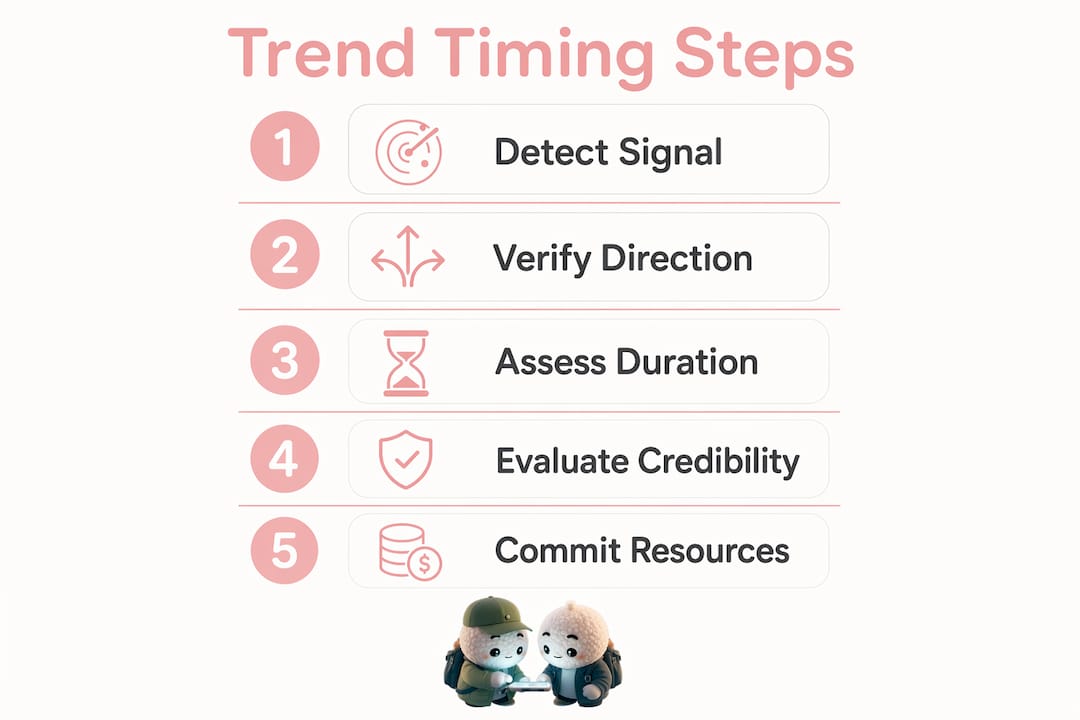
Blogarama's anatomy of a trend formalises this as an anti-noise test. Direction asks whether the movement is consistently upward, downward, or rotational. Duration requires you to apply context-appropriate thresholds: a shift in daily web traffic needs at least 30 to 90 days of observation before it qualifies as a trend, whereas a weekly sales metric requires 12 to 26 weeks. Credible drivers include identifiable forces such as demographic shifts, regulatory change, or technology adoption curves.
Differentiating a trend from a fad or a one-off event is where most strategists make their first error. A fad produces a sharp spike without a structural driver. An event produces a temporary distortion. A genuine trend shows a sustained directional movement with at least one verifiable driver that has not yet peaked. Combining multiple data streams with varying timeliness and reliability, then cross-validating the drivers, is what separates signal intelligence from guesswork.
- Direction: Confirm the movement is consistent across at least two independent data sources before treating it as directional.
- Duration: Apply time thresholds appropriate to your metric cadence. Do not use monthly data to justify a conclusion that requires quarterly evidence.
- Drivers: Name the specific force behind the movement. Demographics, regulation, technology, and macroeconomic shifts are the four most common credible drivers.
- Multi-source validation: BCG advocates evaluating broader indirect and higher-order effects to reduce false positives when confirming a trend's actionability.
Pro Tip: Build a simple driver log alongside your trend tracking sheet. For each signal you observe, write one sentence naming the specific driver. If you cannot write that sentence, treat the signal as unconfirmed noise until you can.
Which tools and frameworks structure effective market trend timing?
The most practical way to operationalise timing decisions is through a repeatable analysis loop. Scoop Analytics defines this loop as seven sequential steps: define the metric, select the time window, normalise the data, visualise the output, segment by driver, quantify the movement, make a decision, and track outcomes. The feedback from step seven feeds directly back into step one, making the process self-correcting over time.
BCG's strategic foresight toolkit adds three decision rules that translate quantitative findings into resource commitments: go, probe, or wait. "Go" applies when multiple metrics confirm a trend with sufficient velocity. "Probe" applies when signals are present but drivers are not yet validated. "Wait" applies when the evidence is directional but duration thresholds have not been met. These rules prevent gut-based commitments and create a defensible audit trail for every timing decision.
| Framework | Best use case | Key output |
|---|---|---|
| Scoop Analytics loop | Recurring metric review cycles | Structured decision with outcome tracking |
| BCG go/probe/wait rules | Resource commitment decisions | Threshold-based action classification |
| Market shift scoring model | Launch and entry timing | Composite score across demand and readiness |
| Investopedia trend confirmation | Financial and demand signals | Moving average and momentum validation |
Quantitative methods worth embedding into your process include rolling averages to smooth short-term volatility, moving medians to reduce the influence of outliers, seasonality checks to separate cyclical patterns from genuine directional shifts, and velocity metrics to measure how quickly a trend is accelerating. L'Oréal's TrendSpotter platform demonstrates what continuous sensing looks like at scale. It aggregates thousands of online sources to predict trends six to eighteen months ahead of traditional planning cycles, expanding the decision window considerably.
Pro Tip: Apply a seasonality check before committing to any trend classification. A signal that appears every Q4 is a cycle, not a trend. Removing seasonal effects from your data before analysis prevents one of the most common misclassifications in market timing.
How to execute a step-by-step strategic trend timing process
A structured execution sequence converts signal detection into decisions you can act on with confidence. The following five steps reflect best practices drawn from BCG, Scoop Analytics, and the market shift scoring literature.
-
Identify and confirm trend signals using multiple corroborative data points. A single data source is never sufficient. You need at least two independent streams pointing in the same direction before treating a signal as confirmed. Cross-reference search volume data, sales figures, social listening outputs, and sector-specific indices simultaneously. The cross-sector trend mapping approach is particularly useful here, as it surfaces convergence across industries that single-sector analysis would miss.
-
Align your timing window with your metric cadence. Scoop Analytics is explicit on this point: daily metrics require 30 to 90 days of observation, weekly metrics require 12 to 26 weeks. Misaligning these windows is one of the most common sources of premature or inaccurate conclusions. Set your observation period before you begin collecting data, not after you have seen results you want to act on.
-
Operationalise decision rules with thresholds and assign ownership. Translate your quantitative findings into a scoring regime that classifies market phases as noise, directional movement, or regime change. The market shift framework uses composite scores across demand strength and operational readiness to produce go, probe, or wait outputs. Assign a named owner to each metric so accountability is clear when thresholds are crossed.
-
Make repeatable decisions: investigate, adjust, monitor, or escalate. Once thresholds are crossed, the decision rule should trigger a predefined response, not an ad hoc discussion. Investopedia's trend trading methodology stresses that confirmation via moving averages and momentum indicators reduces the risk of acting on a false signal. The same discipline applies to strategic timing: wait for confirmation, then act with conviction.
-
Track outcomes and refine your timing accuracy over time. Every timing decision produces data about whether your thresholds were calibrated correctly. Effective teams treat this as a governance loop with post-action reviews to assess whether the timing was correct and why. This is what separates organisations that improve their timing accuracy from those that repeat the same miscalibrations year after year.
Pro Tip: Schedule a post-action review within 90 days of every major timing decision. Record whether the signal confirmed, the driver held, and the threshold was appropriate. Three cycles of this practice will sharpen your calibration more than any theoretical framework.
What are the most common mistakes in trend timing and how do you avoid them?
Even experienced strategists fall into predictable traps when timing market trends. Recognising these patterns is the first step to avoiding them.
- Mixing incompatible time horizons. Using monthly data to justify a quarterly decision is the single most common calibration error. Align your observation window to your metric cadence before drawing any conclusions.
- Overreacting to a single signal. One data point, however striking, does not confirm a trend. Require at least two independent corroborating sources before moving from "probe" to "go."
- Premature commitment without driver validation. Acting before you can name the specific force driving a signal is the fastest route to a costly mistiming. If the driver is unclear, the correct response is to investigate, not to commit.
- Ignoring macroeconomic uncertainty. The WEF's 2026 Chief Economists' Outlook links weaker global growth and elevated volatility directly to shifting trend adoption rates. External shocks can compress or extend the timing window for any given trend, and your framework must account for this.
- Failing to embed contingency planning. BCG's Alan Iny argues that embedding risk sensing, scenario planning, and war games into strategy provides an uncertainty advantage by enabling repeated early-warning action. Timing decisions made without contingency plans are fragile.
- Confusing patience with inaction. Waiting for confirmation is disciplined. Waiting indefinitely because the signal is uncomfortable is avoidance. Set a predefined review date for every "wait" classification so that inaction has a deadline.
Key takeaways
Effective strategic trend timing requires a repeatable, multi-signal loop that aligns observation windows with metric cadence, validates credible drivers, and translates findings into threshold-based decision rules.
| Point | Details |
|---|---|
| Define direction, duration, and drivers | Confirm all three before classifying any signal as a genuine trend rather than noise. |
| Align windows to metric cadence | Daily metrics need 30 to 90 days; weekly metrics need 12 to 26 weeks of observation. |
| Use go/probe/wait decision rules | Translate quantitative scores into predefined actions to remove gut-based commitments. |
| Embed contingency planning | Risk sensing and scenario planning extend your early-warning window under uncertainty. |
| Review outcomes systematically | Post-action reviews after every major timing decision sharpen future calibration. |
Why timing is a loop, not a moment
The most persistent misconception I encounter among strategists is that trend timing is a discrete event. You spot a signal, you act, and the job is done. That framing is wrong, and it is expensive.
What I have found consistently is that the organisations with the sharpest timing advantage treat the entire process as a governance loop. They define thresholds before they see data. They assign ownership before a signal appears. They schedule reviews before they make decisions. The discipline is structural, not reactive.
The combination of qualitative foresight and quantitative validation is where most teams underinvest. Scenario planning and war games feel soft compared to rolling averages and velocity metrics, but BCG's research on uncertainty advantage makes clear that the two approaches are complementary, not competing. The qualitative work surfaces the drivers you have not yet measured. The quantitative work tells you when those drivers have reached threshold.
My honest recommendation is to start smaller than you think you need to. Build the loop for one metric, one market, one quarter. Run the post-action review. Adjust the thresholds. Then expand. Organisations that try to instrument everything at once almost always revert to gut instinct within six months because the system becomes too complex to maintain. One well-calibrated loop beats five poorly maintained ones every time.
— Aidil
Discover Ontherice's signal detection tools for strategists
Ontherice is built for strategists who want to act on trends before they become obvious. The platform's AI engines scan global data points continuously, extracting meaningful signals from noisy markets and producing real-time rankings across sectors.

For professionals working across international markets, SignalsInternational provides advanced signal detection that surfaces cross-border trend movements early. The GeneralSignals tool covers broad market signals for teams monitoring multiple sectors simultaneously. Both tools are designed to extend your early decision window, giving you the calibrated lead time that separates well-timed moves from reactive ones. Explore the full suite at Ontherice and put a structured timing process behind your next strategic decision.
FAQ
What is strategic trend timing?
Strategic trend timing is the process of detecting and acting on market signals early, using validated data and credible drivers rather than waiting for mainstream confirmation. It is the applied practice within the broader discipline of strategic foresight.
How do you distinguish a trend from noise?
A genuine trend shows consistent direction, meets duration thresholds appropriate to the metric cadence, and has at least one identifiable driver such as demographic change or regulation. If no driver can be named, the signal is most likely noise.
How long should you observe a signal before acting?
Scoop Analytics recommends 30 to 90 days for daily metrics and 12 to 26 weeks for weekly metrics before drawing conclusions. Acting before these thresholds are met significantly increases the risk of mistiming.
What is the go/probe/wait framework?
The go/probe/wait framework translates quantitative trend scores into three predefined responses: commit resources when multiple signals confirm, investigate further when drivers are unvalidated, or hold position until duration thresholds are met.
How does macroeconomic uncertainty affect trend timing?
The WEF's 2026 Chief Economists' Outlook confirms that weaker global growth and elevated volatility shift trend adoption rates unpredictably. Strategists must build contingency scenarios into their timing frameworks to account for external shocks that compress or extend the window for action.