

TL;DR:
- Most businesses often detect trends too late, after the damage is already in motion. Understanding the full trend lifecycle helps companies make strategic decisions about timing, resource allocation, and risk management. Digital acceleration has shortened trend durations from years to weeks, requiring organizations to adopt real-time signals and modular strategies to stay ahead.
Most businesses discover a trend the same way they discover a slow puncture: by the time they feel it, the damage is already done. Defining trend lifecycle is not just an academic exercise. It is the difference between entering a market at the right moment and spending resources on a wave that has already broken. With trend saturation happening in days rather than months, the old practice of watching a trend from the sidelines before committing is no longer a safe default. Understanding the full arc of how trends develop, peak, and dissolve is now a core analytical competency.
Table of Contents
- Key takeaways
- Defining trend lifecycle: the foundation
- Phases of the trend lifecycle
- Digital acceleration and its effect on trend speed
- Practical applications of trend lifecycle analysis
- Comparing lifecycle models across industries
- My view: why the model is always one cycle behind
- How Ontherice helps you stay ahead of the cycle
- FAQ
Key takeaways
| Point | Details |
|---|---|
| Trends are not fads | True trends change behaviour permanently; fads spike and vanish without leaving structural change. |
| Four phases define the arc | Every trend moves through Emerge, Peak, Decline, and Integration, each demanding a different strategic posture. |
| Digital speed changes everything | Social media and algorithms compress lifecycle duration, sometimes from years to weeks. |
| Peak entry is the riskiest move | Scaling spend at peak without retention metrics drives up acquisition costs and increases backlash exposure. |
| Separate sensing from doing | Organisations that split trend identification from strategic execution avoid burnout and make sharper decisions. |
Defining trend lifecycle: the foundation
The trend lifecycle describes the complete arc of a trend from its earliest signal to its eventual absorption into the mainstream or disappearance from it. Trend lifecycle analysis provides the framework for mapping that arc and understanding what behaviours, risks, and opportunities appear at each stage.
The single most dangerous misconception in this space is that trends and fads are interchangeable. They are not. A fad generates excitement and then evaporates without changing the underlying structure of how people behave or make decisions. A true trend shifts practice. It alters what people expect, what they buy, and how organisations respond. The distinction is not cosmetic; misclassifying a fad as a trend has sent entire product roadmaps and campaign budgets in the wrong direction.
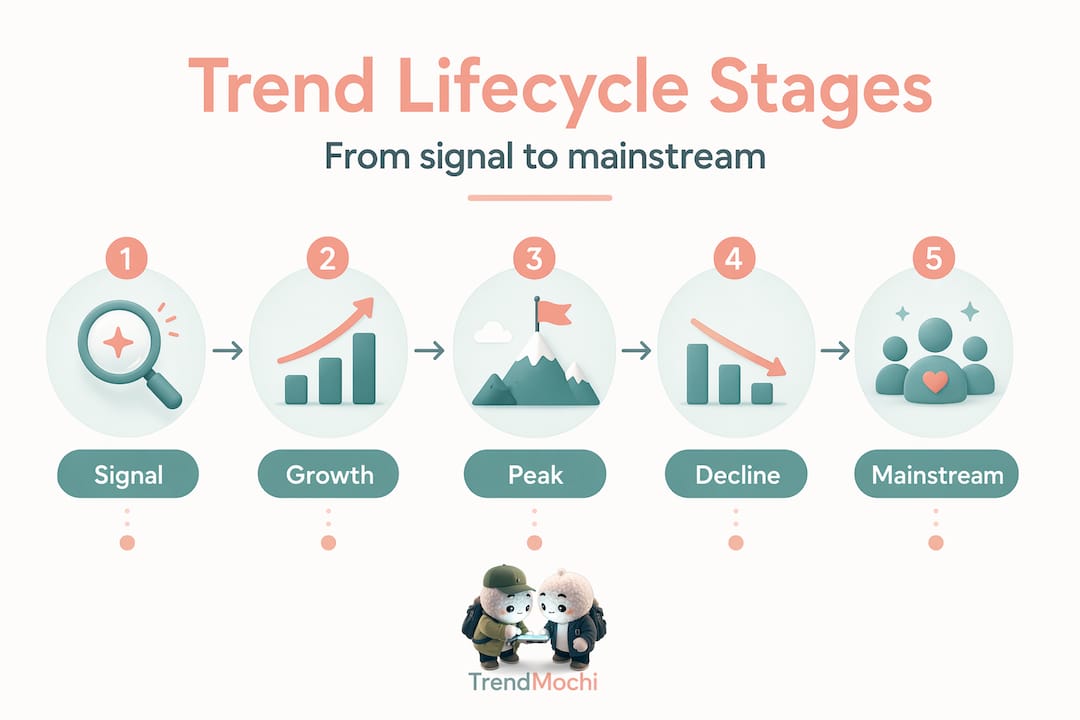
The standard model, now widely accepted across industries, identifies four primary lifecycle phases: Emerge, Peak, Decline, and Impact or Integration. Some analysts use a five-stage model that inserts a distinct Growth phase between Emerge and Peak, which is particularly useful in technology sectors where acceleration from inception to mass adoption can be measured with precision. Both models share the same core logic. The differences lie in granularity and application.
Understanding trend lifecycle delivers clear strategic value across several dimensions:
- Timing: Knowing which phase a trend occupies tells you whether to invest, wait, or exit.
- Resource allocation: Early-phase trends reward exploratory investment; peak-phase trends require retention discipline.
- Risk calibration: Decline-phase trends trap reactive businesses that mistake falling prices for opportunity.
- Communication: Lifecycle position should inform messaging, not just product decisions.
Phases of the trend lifecycle
Each phase of the trend lifecycle has its own behavioural fingerprints. Recognising them quickly is the core skill in how to identify trends before they become obvious to everyone.
-
Emerge (Inception): The signal exists but is weak and noisy. Early adopters and specialists are the primary audience. Volume data is sparse, but qualitative signals from niche communities, research publications, and forward-thinking operators are present. This is where the real edge lives.
-
Growth (Rise): Momentum builds. Search volumes climb, media coverage increases, and competitors begin to notice. Consumer interest widens beyond the early adopter segment. This is typically the most profitable entry window for businesses with agile development pipelines.
-
Peak (Maturity): The trend reaches maximum visibility. Everyone is talking about it. Scaling spend without establishing retention at this stage leads to the highest customer acquisition costs and leaves brands exposed to rapid sentiment reversal.
-
Decline: Novelty fades. The early adopters have moved on. Mainstream adoption may still be growing numerically, but the trend's cultural energy is depleted. Businesses that entered late are now competing on price alone.
-
Integration or Obsolescence: Either the trend becomes a durable feature of market behaviour, absorbed into standard practice, or it disappears without a trace. True trends reach integration. Fads reach obsolescence.
The table below illustrates typical phase durations across three contrasting sectors, based on current industry observations.
| Sector | Emerge to growth | Growth to peak | Peak to decline |
|---|---|---|---|
| Food and restaurant | Days to weeks | 1 to 3 months | 1 to 4 weeks |
| Technology products | 3 to 12 months | 6 to 18 months | 6 to 24 months |
| Fashion and apparel | Weeks to months | 3 to 6 months | 1 to 3 months |
The food sector figures are striking. 84% of food industry experts report that trend cycles now last within three months, with 36% saying some last as little as one month. That is not a cycle; it is a sprint.
Digital acceleration and its effect on trend speed
The relationship between digital infrastructure and trend duration is now structural, not circumstantial. Algorithms reward novelty over durability, meaning platforms actively surface new content to replace whatever is currently trending, regardless of whether audiences are finished with it.
The result is a compression effect that no sector is immune to. A product format, a creative approach, or a market positioning can move from unknown to saturated in days or hours when algorithmic amplification and near-instant copying combine. This is not hyperbole; it is the structural reality of near-zero distribution costs in a networked environment.
| Factor | Pre-digital era | Digital era |
|---|---|---|
| Time from niche to mainstream | Years | Weeks or days |
| Primary distribution channel | Physical retail, broadcast | Social platforms, search algorithms |
| Copying cost for competitors | High | Near zero |
| Trend saturation speed | Gradual | Abrupt |
| Consumer attention span for trends | Sustained | Fragmentary |
The strategic risk that emerges from this compression is what analysts have begun calling organisational thrashing. When copying costs approach zero and distribution is near-instant, businesses react to every new signal by overhauling messaging, pivoting priorities, and redirecting teams. The constant churn burns resources without building anything durable.
Pro Tip: Separate your trend sensing function from your trend execution function. The team that monitors emerging signals should not be the same team responsible for implementation. Conflating the two creates pressure to act on every observation, which is precisely how organisations get trapped chasing transient signals.
Practical applications of trend lifecycle analysis
The importance of trend lifecycle thinking lies not in the model itself but in how it changes decisions. Here is where understanding trend lifecycle becomes practical rather than theoretical.
The 4D Trend Filter framework offers a structured approach: Define the trend precisely, Diagnose its position in the lifecycle, Decide on a strategic posture, and Design the response with pre-planned exit criteria. The exit criteria element is consistently underused. Businesses plan their entry but not their extraction, which is why so many get caught in decline phases they saw coming.
Aligning business posture with lifecycle phase is the clearest application:
- Emerge phase: Invest in sensing tools and small-scale pilots. Commit budget to learning, not scaling.
- Growth phase: Accelerate. This is the window where speed genuinely matters and where market share is established.
- Peak phase: Shift focus from acquisition to retention. Measure lifetime value, not just new customer numbers.
- Decline phase: Plan the exit or pivot. Reusable assets and modular architecture reduce the cost of transition.
- Integration phase: Codify what worked. The durable behaviours from a mature trend become the baseline for the next cycle.
The product launch timing problem is the most common operational failure in this space. Companies feel perpetually behind because their development timelines are built for trend cycles that no longer exist. The fix is not to develop faster in a vacuum but to build modular components that can be reconfigured rapidly when the signal changes.
Pro Tip: Build reusable assets as a deliberate policy. If your trend response requires a complete rebuild each time, your cost-per-cycle is too high. Modular creative, reusable content frameworks, and adaptable campaign structures let you move at signal speed without starting from zero.
Competitive trend monitoring becomes significantly more useful when anchored to lifecycle position. A competitor entering a trend at peak is not a threat; it is confirmation that the cycle is ending.
Comparing lifecycle models across industries
The four-stage and five-stage lifecycle models are not interchangeable across all contexts. The choice of model should reflect the pace and structure of the industry being analysed.
| Model | Best suited to | Key advantage | Limitation |
|---|---|---|---|
| Four-stage (Emerge, Peak, Decline, Integration) | Broad strategic planning | Simple and applicable across sectors | Misses granularity in rapid growth phase |
| Five-stage (adds Growth between Emerge and Peak) | Technology and digital markets | Captures acceleration and adoption curves | Requires more precise data to implement |
| Fashion-specific spiral model | Apparel and consumer trends | Accounts for cyclical revival of styles | Poorly suited to non-cyclical industries |
The fashion sector illustrates why model selection matters. Lasting styles retain relevance despite accelerating cycles because they function across contexts and adapt to shifting tastes. A simple four-stage model applied to fashion would misclassify a durable style as a fading trend. The same problem appears in technology, where foundational platforms are sometimes mistaken for trend cycles simply because their growth velocity resembles one.
The driver type of a trend also shapes its lifecycle. Trends driven by technology enablement tend to have longer growth phases and more gradual declines. Trends driven by cultural moment, a viral post, a celebrity adoption, or a news event, compress fast and decay fast. Knowing the driver is part of trend lifecycle analysis, not an afterthought to it.
My view: why the model is always one cycle behind
I have watched businesses invest heavily in lifecycle frameworks and still get timing wrong. The reason is usually the same. They treat the model as a prediction tool when it is actually a diagnostic one.
In my experience, the biggest value of understanding trend lifecycle is not in forecasting the next big thing. It is in refusing to mistake a fad for a structural shift. I have seen teams spend months building capability around a signal that, had they applied even a basic lifecycle filter, they would have recognised as a peak-phase noise spike.
What I have found actually works is disciplined optionality. You do not need to bet on the right trend early. You need to be positioned to move quickly when the signal clarifies, and to exit cleanly when the data turns. That requires modular infrastructure, pre-defined decision triggers, and a team culture that treats lifecycle data as a live instrument rather than a historical report. Strategic advantage in shorter cycles comes from this kind of structural readiness, not from being the first to notice.
The uncomfortable reality is that the pace of change now exceeds the update frequency of most strategic planning cycles. If your lifecycle model is refreshed quarterly, it is already trailing the market. Real-time signal tracking is not a luxury for trend-sensitive sectors. It is the minimum viable approach.
— Aidil
How Ontherice helps you stay ahead of the cycle
Most trend monitoring tools tell you what was popular last week. Ontherice is built to surface what is gaining momentum before it registers on conventional radar.
Ontherice uses multiple AI engines to scan global data points and extract early signals from market noise, giving analysts and business professionals a structured view of where trends are in their lifecycle right now. The platform's B2B signal tracking is designed specifically for the kind of cross-sector intelligence that makes lifecycle analysis actionable rather than theoretical. For teams that need to move from sensing to strategy without losing time, the AI trend tools on the platform allow live querying of trend signals across industries. Whether you are diagnosing an emerging opportunity or evaluating whether a competitor's recent pivot signals peak or growth, Ontherice gives you the data infrastructure to make that call with confidence.
FAQ
What is trend lifecycle analysis?
Trend lifecycle analysis is the process of identifying which phase of development a trend currently occupies, from early emergence through growth, peak, decline, and integration, in order to inform strategic timing and resource allocation.
How long does a typical trend lifecycle last?
Duration varies significantly by sector. In food and restaurant markets, cycles can last as little as one month. In technology, lifecycles often span one to three years, depending on the nature of the underlying driver.
What is the difference between a trend and a fad?
A trend changes behaviour and becomes integrated into standard practice over time. A fad generates temporary excitement without altering how people fundamentally operate or make decisions.
Why is entering a trend at peak so risky?
At the peak phase, customer acquisition costs are at their highest and sentiment can reverse quickly. Scaling spend without retention metrics in place at this stage leaves businesses exposed to backlash and margin compression.
How do digital platforms affect trend lifecycles?
Algorithms prioritise novelty and enable near-instant distribution, which compresses the time between a trend's emergence and its saturation. What once took years can now move through the full lifecycle in weeks.