
TL;DR:
- Trend curation involves the deliberate selection and contextualisation of emerging signals before they reach saturation, providing businesses with a strategic advantage.
- It relies on unique data sourcing, analytical framing, audience-specific optimisation, and timeliness while integrating AI discovery with human interpretation.
Most people conflate trend curation with trend following. They assume it means tracking what is already popular, then relaying it to an audience. That is not trend curation. It is noise redistribution. What is trend curation, properly understood, is the disciplined practice of selecting, contextualising, and organising emerging signals before they reach saturation point, giving businesses the window they need to act first. For market analysts and business professionals, getting this distinction right is not academic. It determines whether your intelligence function is genuinely useful or simply reactive.
Table of Contents
- Understanding trend curation: definition and scope
- The role of AI and human insight in modern trend curation
- Distinguishing trend curation from similar concepts and measuring its impact
- Applying signal stacking for early trend detection and strategic advantage
- Implementing effective trend curation strategies in your organisation
- Rethinking trend curation: the curator's unseen power
- Explore curated signals tools to boost your strategic insight
- Frequently asked questions
Key Takeaways
| Point | Details |
|---|---|
| Trend curation defined | It is a strategic process combining technology, data, and human insight to select and contextualise emerging trends. |
| AI-human synergy | AI handles discovery by filtering noise; humans add context and trust, making insights reliable and relevant. |
| Signal stacking advantage | Identifying multiple converging trend signals early leads to stronger market positioning and timing. |
| Quality over quantity | Effective curation requires adding unique analysis, not just reposting links or copying trends. |
| Practical application | Implement trend curation by auditing sources, configuring AI filters, and distributing via trusted channels. |
Understanding trend curation: definition and scope
The term "trend curation" gets used loosely, so let us anchor it properly. At its core, the trend curation definition centres on deliberate selection and contextualisation. You are not aggregating everything that looks interesting. You are making editorial judgements about which signals matter, why they matter now, and what they mean for a specific audience or market.
In programmatic advertising, where curation has become a formal discipline, the IAB Tech Lab defines curation as the selection and organisation of inventory using technology and data to create optimised packages, delivering 20 to 30 per cent performance gains. That framing holds true beyond advertising. Replace "inventory" with "market signals" and the logic is identical: curated data, properly organised and filtered, outperforms raw data every time.
What separates genuine trend curation from surface-level trend following comes down to a few non-negotiable elements:
- Unique data sourcing: You need signals from places your competitors are not yet watching, whether that is niche forums, patent filings, or early-stage creator communities.
- Analytical framing: Every curated signal needs context. What category does it belong to? What does its current trajectory suggest about the next 90 days?
- Optimisation for a specific audience: A curated insight for a consumer goods buyer differs fundamentally from the same signal framed for a venture capital analyst.
- Timeliness: Curation that arrives after a trend peaks is not intelligence. It is a post-mortem.
Understanding how trends shape business decisions helps clarify why this rigour matters. The difference between acting on a curated insight at week two versus week ten of a trend's lifecycle can be the difference between market leadership and catch-up.
The role of AI and human insight in modern trend curation
The mechanics of how to curate trends have shifted dramatically in the past three years. AI now handles the volume problem. Humans handle the meaning problem. Neither works without the other.

In 2026, AI handles discovery using semantic agents rather than keyword matching, allowing systems to identify conceptually related signals even when the language varies. A semantic agent can connect a spike in "bioreactor home kits" searches to conversations about DIY fermentation on specialist forums and a cluster of new patents, without any of those sources using identical terminology.
Here is where the human layer becomes critical. Raw AI output, without interpretative judgement, produces what practitioners sometimes call "link dumps": long lists of loosely connected content that looks like intelligence but reads like a sitemap. The curator's job is to:
- Determine why a cluster of signals is appearing now
- Assess whether momentum is genuine or manufactured (astroturfing is more common than most analysts account for)
- Add the "so what" layer that transforms a signal into a decision prompt
- Filter out recency bias, where recent signals are overweighted simply because they are new
The comparison below illustrates the distinct contributions of AI and human curation in practice:
| Curation task | AI contribution | Human contribution |
|---|---|---|
| Signal discovery | Scans millions of sources semantically | Defines which sources are worth scanning |
| Noise filtering | Removes irrelevant content at volume | Catches false positives with domain knowledge |
| Contextualisation | Clusters related signals | Explains implications for a specific market |
| Trend validation | Tracks signal frequency over time | Judges credibility and source quality |
| Distribution | Automates formatting and scheduling | Selects channels and frames the narrative |
Pro Tip: When building a curation workflow, assign AI the discovery and filtering tasks first, then introduce human review at the contextualisation stage. Reversing this order wastes your analysts' time on tasks machines handle better.
Understanding how AI predicts trends gives you the technical foundation to design this division of labour intelligently rather than defaulting to whichever tool is easiest to access.
Distinguishing trend curation from similar concepts and measuring its impact
The importance of trend curation becomes clearer when you contrast it with concepts it is frequently confused with. Trendjacking is the most common conflation. Trendjacking involves participating in viral social media trends with brand-specific content, while trend curation focuses on selection and contextual insight. One is a marketing tactic. The other is an intelligence function.
Trendjacking asks: "How do we insert our brand into what is already viral?" Trend curation asks: "What is becoming significant, and what does that mean for our positioning over the next quarter?" These are fundamentally different questions with fundamentally different time horizons.
To avoid the most common mistakes in trend curation, watch for the following pitfalls:
- Blind sharing: Passing on a signal without adding original analysis. This trains your audience to go elsewhere for interpretation.
- Recency bias: Treating the newest data as the most important. Older, persistent signals often carry more weight than a sudden spike.
- Volume over value: Publishing 20 curated signals when five would have been sufficient. Quality always wins.
- Ignoring source credibility: Not all signals are equal. A trend appearing in a respected trade publication carries different weight than the same trend on a general news aggregator.
- Chasing virality: Curating based on social media volume rather than genuine market momentum. Virality and significance are not the same thing.
The metrics that matter for assessing curation quality are not clicks or shares. They are:
- Audience trust scores: Do your subscribers act on your curated insights?
- Lead time accuracy: How consistently do your curated trends precede mainstream coverage?
- Engagement depth: Are readers spending time with the analysis, or skimming headlines?
Pro Tip: Track how often your curated insights appear in decisions your stakeholders make. That is the real return on investment of a strong strategic edge of trends function.
Applying signal stacking for early trend detection and strategic advantage
Signal stacking is the advanced technique that separates serious trend curators from content aggregators. The concept is straightforward, but the execution requires discipline. Early trends rarely announce themselves with a single, obvious signal. They accumulate across multiple weak sources before they converge into something unmistakable.
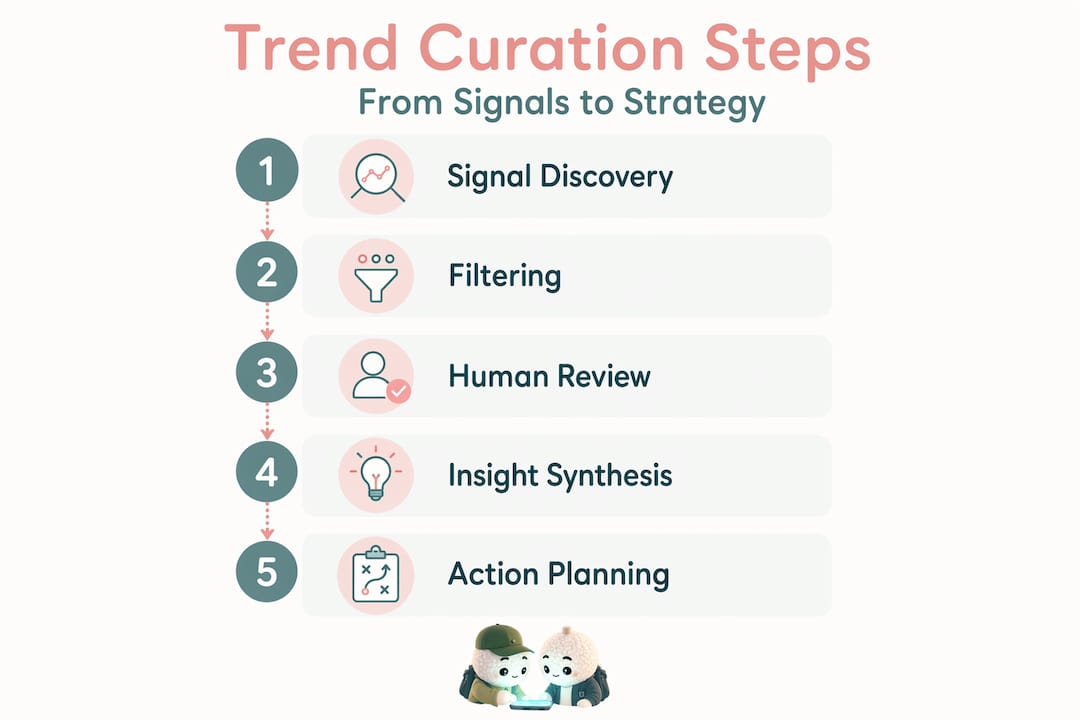
Signal stacking requires 3 to 4 converging signals across search, community, creators, and commerce before acting, enabling early market entry 4 to 6 weeks ahead of viral spikes. That is a material advantage. At week two of a trend's arc, competition for attention and positioning is negligible. By week eight, you are in a crowded room.
The four signal categories worth monitoring in parallel are:
- Search curiosity: Persistent, growing search volume around a specific query, particularly in long-tail variations that indicate genuine learning intent rather than casual browsing.
- Community conversation: Specialist forums, Discord servers, subreddits, and LinkedIn groups where practitioners discuss emerging ideas before they reach trade press.
- Creator experimentation: When independent content creators begin testing content around a theme, that is often six to eight weeks ahead of brand adoption.
- Early commercial activity: New product listings, crowdfunding campaigns, or niche retailer activity signal that demand is crossing from aspiration into transaction.
| Signal type | Detection method | Lead time before mainstream |
|---|---|---|
| Search curiosity | Long-tail keyword monitoring | 6 to 10 weeks |
| Community conversation | Forum and group listening tools | 4 to 8 weeks |
| Creator experimentation | Content analytics on emerging accounts | 4 to 6 weeks |
| Early commercial activity | Marketplace and patent monitoring | 2 to 6 weeks |
Understanding industry trend analysis techniques will help you build the monitoring infrastructure to detect these signals systematically rather than opportunistically.
Pro Tip: When two or more signal types converge on the same theme within a short window, treat it as a confirmed early trend worth acting on. One signal is interesting. Three signals is intelligence.
Implementing effective trend curation strategies in your organisation
Knowing what trend curation is and knowing how to embed it into your organisation are two different things. The examples of trend curation that actually move the needle share a common architecture: clear source criteria, structured AI filtering, mandatory human commentary, and disciplined distribution.
The benefits of trend curation materialise when AI filters are combined with human oversight to audit sources, add insightful commentary, and distribute content via trusted channels to build authority and engagement. Here is how to build that in practice:
- Audit your current sources. List every feed, newsletter, and platform your team currently monitors. Remove anything that primarily aggregates rather than analyses. You want primary sources and specialist publications, not second-hand summaries.
- Define your semantic filters. Work with your AI tooling to build filters around the conceptual territory relevant to your market, not just product-level keywords. A consumer health brand, for instance, should monitor signals around behaviour change, not just supplement ingredient searches.
- Create a "bridge commentary" standard. Every curated signal your team publishes should include at minimum two to three sentences explaining why it matters to your specific audience right now. This is the layer that transforms curation into intelligence.
- Choose distribution channels deliberately. A specialised internal newsletter reaches decision-makers more effectively than a broad social media post. Niche outperforms mass for curated intelligence.
- Build a review cadence. Weekly signal reviews, monthly trend reports, and quarterly strategic briefings create a rhythm that keeps curation connected to planning cycles rather than floating as a disconnected content function.
Pro Tip: Assign one person or team the explicit role of "trend curator" with defined KPIs around lead time accuracy and stakeholder utility. Without ownership, curation drifts into aggregation. Pairing this role with trend forecasting steps turns individual signals into coherent forward-looking narratives.
Rethinking trend curation: the curator's unseen power
Here is the view that most articles on this topic will not give you: trend curation is one of the most undervalued sources of market power available to a business analyst today, precisely because it looks simple from the outside.
The common mistake is treating curation as packaging. You find interesting signals, you put them in a document, you circulate it. Done. But true curation demands unique data, robust connections, and optimisation. Mere packaging is not enough to unlock performance gains. The IAB Tech Lab's position on advertising curation applies directly to market intelligence: without the analytical rigour, you are producing noise with good formatting.
The curator who adds genuine interpretative value becomes something the organisation cannot function without. They are not just passing on what others have noticed. They are shaping the questions the business asks before decisions get made. That is influence, not administration.
What tends to happen without this rigour is equally instructive. Teams end up reacting to trends that competitors spotted weeks earlier. Budgets get allocated to categories that are already saturating. Product roadmaps get built around signals that were loud rather than meaningful. The absence of good curation is not neutral. It actively distorts decision-making.
The AI and human curation balance question is often framed as efficiency versus quality. The smarter framing is this: AI gives you scale, humans give you credibility. Together, they give you the kind of curated intelligence that positions you ahead of the market rather than inside it.
Explore curated signals tools to boost your strategic insight
If you have reached this point and are thinking about how to build a real curation capability rather than just a better reading list, the tools you use matter as much as the process.
OnTheRice offers a suite of AI-powered products built specifically for this challenge. B2BSignals delivers actionable market intelligence for business-to-business professionals, surfacing early signals before they reach mainstream visibility. For a broader view across international markets, SignalsInternational provides curated trend data across geographies and sectors. If your focus is identifying emerging players before they become dominant, EmergingBrands monitors the brand landscape for early-stage momentum. Each product blends AI-driven discovery with structured curation logic, giving you the lead time that reactive intelligence simply cannot offer.
Frequently asked questions
What is trend curation in business?
Trend curation in business is the process of selecting, organising, and contextualising emerging signals and data to produce actionable insights for strategic decision-making, going well beyond simple aggregation or trend monitoring by adding interpretative rigour to raw information. The IAB Tech Lab defines curation as the selection and organisation of inventory using technology and data to create optimised packages that deliver measurable performance gains.
How does AI enhance trend curation in 2026?
AI improves trend curation by filtering large volumes of noisy data through semantic understanding, freeing analysts to focus on adding the contextual interpretation that turns signals into decisions. AI handles discovery via semantic agents, allowing curators to provide context and build trust rather than spending time on manual source hunting.
What is signal stacking and why is it important?
Signal stacking is the practice of identifying multiple converging weak signals across search, community, creator, and commercial channels to detect trends early before they reach mainstream saturation. Signal stacking requires 3 to 4 converging signals before acting, enabling market entry 4 to 6 weeks ahead of viral trend peaks.
How is trend curation different from trendjacking?
Trend curation is a strategic intelligence process focused on early signal detection and contextual analysis, whereas trendjacking is a short-term tactic for inserting a brand into already-viral social media moments. Trendjacking centres on real-time viral trends with brand-specific spins, which is distinct from the broader, forward-looking process of strategic trend curation.