
Trend breakout alerts are AI-generated notifications that flag accelerating, cross-source signals of an emerging market trend, before it shows up on a competitor's radar. They matter because the value isn't in the notification itself. It's in the extra decision-making time it buys you. A good alert gives you days or weeks to validate a hypothesis while everyone else is still reading last month's report.
TL;DR:
- Cross-source signals need to converge across multiple independent data streams to reliably indicate genuine market trend breakouts.
- The alert system combines anomaly detection, regime classification, and NLP models, attaching provenance metadata for transparency and trust.
- Verify alerts through source diversity, confidence scores, and independent corroboration before acting on them.
- Use alerts as hypotheses for decision-making, applying a staged process with quick screening, evidence gathering, and small-scale testing.
- Alerts are most valuable in scenarios like early M&A scouting, product timing, investment testing, and supplier disruption detection.
Table of Contents
- What is an AI trend breakout alert?
- How are breakout alerts generated? Data and models explained
- How do you know if a breakout alert is trustworthy?
- Turning an alert into a decision: a workflow that works
- Where breakout alerts change real decisions
- What breakout alerts can't tell you
- How I use breakout alerts in practice
- Getting started with Ontherice's alert system
- Sources
What is an AI trend breakout alert?
A "breakout" here has nothing to do with a stock chart punching through a resistance line. It means a measurable acceleration in attention or signal strength across multiple independent sources at once. Think a spike in patent filings, a surge in job postings for a niche skill, and a jump in social mentions, all converging within the same short window on the same underlying theme.
This article is deliberately not about technical trading breakout alerts, the kind that fire when a share price crosses a trendline. That's a different discipline built on price and volume data. Cross-sector trend breakout alerts work on a wider canvas: markets, products, technologies, hiring patterns, regulatory chatter, even crypto and local deal flow.
Breadth is what makes these alerts useful rather than noisy. A single spike in one data source is often coincidence, a viral post, a seasonal blip, a one-off news cycle. When three or four unrelated sources start moving together, the odds that you're looking at a genuine shift rather than random static improve considerably. That confirmation across sources is also what extends your lead time. You're not catching the trend as it peaks. You're catching it while the pieces are still assembling.
How are breakout alerts generated? Data and models explained
Alert engines pull from a wide spread of public data, then run several types of models against it in parallel. No single feed is trustworthy on its own, so the inputs typically include:
- News and press coverage volume and sentiment shifts
- Social and forum discussion velocity across platforms
- Patent filing activity by sector or technology cluster
- Job posting trends for emerging roles and skills
- Developer activity, including GitHub repository growth
- Product launch announcements and retail listing changes
- Search volume and query pattern shifts
On the model side, AI systems detect cross-source statistical shifts and narrative changes before they become obvious using a handful of complementary techniques. Anomaly detection flags data points that deviate sharply from historical baselines, a method detailed in the trend following strategy: a rules-first playbook explaining why detecting the right market regime matters. Regime and regression detection classifies whether a market or sector has shifted into a genuinely different state, rather than just wobbling around its usual pattern, a distinction that regime-aware analysis argues is more reliable than reading raw indicators in isolation. NLP models track how the language used to describe a topic changes, which often precedes measurable activity by weeks.
None of these run in isolation. Ensemble confirmation cross-checks outputs from several models against several data sources before an alert ever reaches a user, and the strongest platforms attach provenance metadata to each one, showing exactly which sources tripped the signal and how confident the system is in the result.
How do you know if a breakout alert is trustworthy?
Not every alert deserves your attention, and the fastest way to waste a strategy team's time is chasing every notification as if it were gospel. Ask any provider for three numbers before you trust their output: historical precision (how often past alerts in this category proved correct), recall (how many real breakouts they actually caught), and time-to-confirmation (how long it typically takes for a flagged signal to either strengthen or fade).
Once an alert lands, run it through a fast triage:
- Check source diversity. Is this one loud source or four quiet ones agreeing?
- Compare against the confidence score and ask what threshold triggered it.
- Search for independent corroboration outside the platform itself.
- Map it against your own sector knowledge. Does it contradict something you already know to be true?
- Set a short-term recheck to see if the signal is strengthening or decaying.
Pro Tip: Treat the confidence score as a filter, not a verdict. Set your own internal threshold, say, only escalating alerts above a certain confidence tier, and staged-test anything below it before committing resources.
Watch for red flags too. A signal built from a single data source, one that correlates suspiciously well with an outcome you already wanted to be true, or one that can't explain why it fired, is a candidate for overfitting rather than insight.
Turning an alert into a decision: a workflow that works
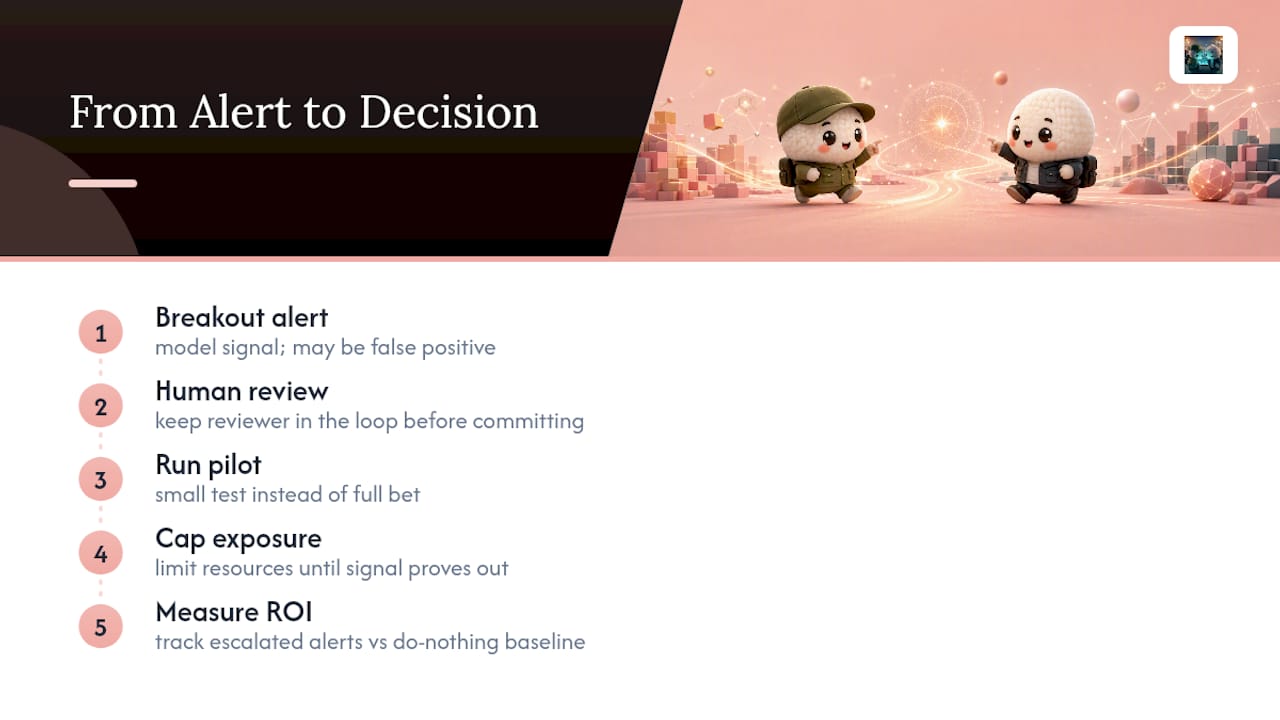
An alert is a hypothesis, not an answer. Predictions carry ex ante value in guiding decisions and ex post value when reality diverges from the forecast, which means the gap between what an alert predicted and what actually happened is itself useful information worth recording.
A workable triage flow looks like this:
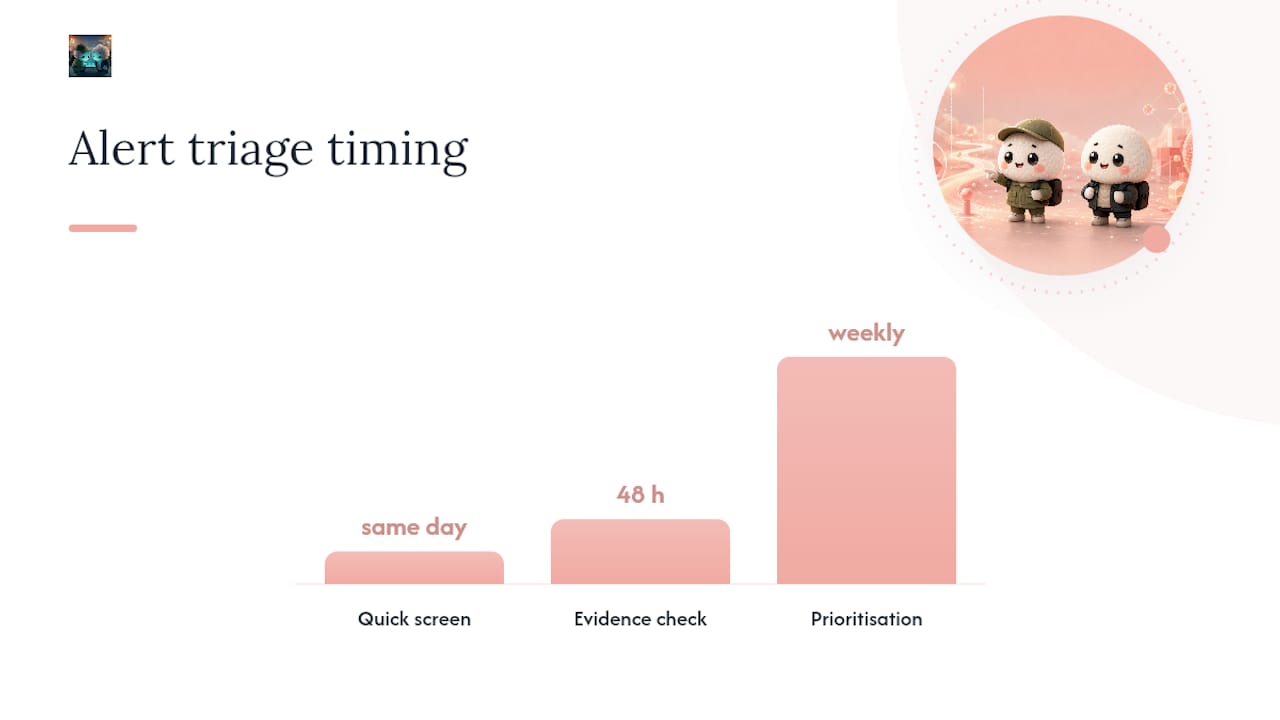
- Quick screen (same day): an analyst checks source count and confidence score.
- Evidence check (48 hours): pull supporting data, sector context, and any contradicting signals.
- Prioritisation (weekly review): rank against current strategic priorities, not in isolation.
- Pilot or test: assign a small budget, a watchlist slot, or a scoping call, never a full commitment on day one.
A strategy lead typically owns the weekly prioritisation call, while a junior analyst or research associate handles the first two steps within a day or two. Outcomes should feed back into the system: log which alerts led to a pilot, a watchlist addition, or a pass, so thresholds can be recalibrated over time rather than left static.
Where breakout alerts change real decisions
Cross-sector alerts earn their keep in a handful of recurring scenarios.
- M&A scouting: a sudden cluster of patent filings and hiring activity in a niche subsector flags an acquisition target before it appears on a banker's shortlist, feeding directly into predicting how markets will react to a deal before it's announced.
- Product ideation and go-to-market timing: a spike in developer repository activity around a specific framework signals demand months before mainstream adoption, a pattern covered in detail in Ontherice's playbook on acting on GitHub trend signals.
- Investment scouting: a cluster of search volume, job postings and social chatter around an emerging material or process gives a portfolio manager grounds to open a small position and test the thesis rather than wait for consensus.
- Supplier disruption monitoring: an early cluster of regulatory and social signals around a raw material warns procurement teams before a shortage becomes public news.
What breakout alerts can't tell you
No alert engine eliminates uncertainty, and treating one as a guarantee is the fastest way to lose money on a false signal. Models are inherently backward-looking. They learn from historical patterns, which means genuinely novel events, a regulatory shock, a black-swan disruption, can slip past even a well-tuned system. False positives are a permanent feature of the category, not a bug to be fully engineered away.
The sensible response is operational, not technical. Keep a human reviewer in the loop before any significant commitment, run pilots instead of full bets, and cap resource exposure until a signal proves out. Decision-grade market intelligence depends on trusted data, human validation and explainability, not on raw model output alone. Ask any provider how their data is sourced and how alerts are scored, then measure ROI by tracking how many escalated alerts led to a decision that outperformed a do-nothing baseline.
How I use breakout alerts in practice
Alerts carry their provenance: which sources tripped them, what confidence score they earned, and often include a live AI query option so users can interrogate the reasoning behind the score rather than take it on faith. One pattern we see repeatedly is an unnamed cluster of hiring and search-volume signals in an adjacent sector triggering a watchlist add, then a small pilot, weeks before the trend became visible in mainstream coverage. If you want the mechanics behind how this actually gets built, our guide on how AI predicts trends for business advantage and our note on why trend detection works best as a pipeline, not a single tool are good starting points.
— Aidil
Getting started with Ontherice's alert system
This approach is the practical alternative to waiting for a quarterly report to tell you what already happened. Market research often arrives too late to act on; these alerts surface cross-sector signals while they're still forming, complete with transparent scoring and live AI you can question directly about why a signal fired.
Getting your first alert running takes three steps. First, build a watchlist around the sectors or technologies you track. Second, set your confidence threshold so you only see alerts worth a second look. Third, run your first 72 hour triage using the checklist above and log the outcome. Free tier access covers the core scanning and scoring; additional access unlocks deeper signal feeds and premium queries when you're ready to go further. Head to AIOpportunities to set up your first watchlist and see a live breakout alert in action.
Sources
- Predictions, market reactions and acquisition decision making (INFORMS, 2025)
- How AI detects market trends before humans: the 3 mechanisms explained (2026) - NEXTAPP ZONE