
TL;DR:
- Effective trend leadership hinges on designing systems, routines, and cultures that automate forward-thinking behavior. Building a live trend radar, fostering continuous development, and embedding weekly routines enable organizations to anticipate and act on emerging signals. Most failures stem from poor design, not intelligence, emphasizing the importance of behavioral environment and deliberate weekly practices.
Trend leadership strategies are deliberate design choices that enable organisations to anticipate, shape, and capitalise on emerging market shifts before competitors act. The distinction between reacting to trends and leading them is not a matter of resources or luck. It is a matter of architecture. Leaders who understand leadership as a design choice build systems, routines, and cultures that make forward-thinking behaviour the default. According to ATD's 2026 research, nearly 79% of organisations that train employees at all levels report measurable improvements in organisational culture. That figure signals that trend leadership development is no longer a senior-executive privilege. It is an organisation-wide discipline.

How to design trend leadership strategies: core components
Designing effective leadership strategies for trend anticipation begins with five foundational elements. Without these in place, any trend-spotting effort becomes episodic rather than systemic.
- A culture of continuous development. ATD's 2026 data shows 44% of organisations have increased their emphasis on workforce upskilling compared to 2025. Culture is not a byproduct of strategy. It is the substrate on which strategy runs.
- Dedicated weekly scanning time. Blocking 30 to 60 minutes weekly for structured trend review prevents information overload and builds the discipline that separates reactive managers from visionary leaders.
- A trend radar tool. A trend radar is a living document that categorises signals by urgency and impact. Gartner, ThoughtWorks, and internal strategy teams all use radar formats to prioritise where attention and investment should flow.
- Human-centred leadership skills. The Centre for Creative Leadership notes that AI integration is still treated as a technical rather than a leadership challenge by most organisations. Leaders who develop empathy, ethical reasoning, and communication skills alongside technical literacy hold a structural advantage.
- Cross-sector networks. Diverse external perspectives prevent the echo-chamber effect. Peer groups, industry consortia, and cross-functional internal forums all serve as early-warning systems for signals your own sector may be slow to notice.
Pro Tip: When building your prerequisite stack, prioritise communication skills first. The ATD 2026 data shows 93% of C-suite executives rank communication as the most critical leadership skill. A trend insight that cannot be communicated clearly will not drive action.
How do you build a trend radar that actually works?
A trend radar works only when it is treated as a living operational document, not a quarterly report filed and forgotten. The structure matters as much as the content.
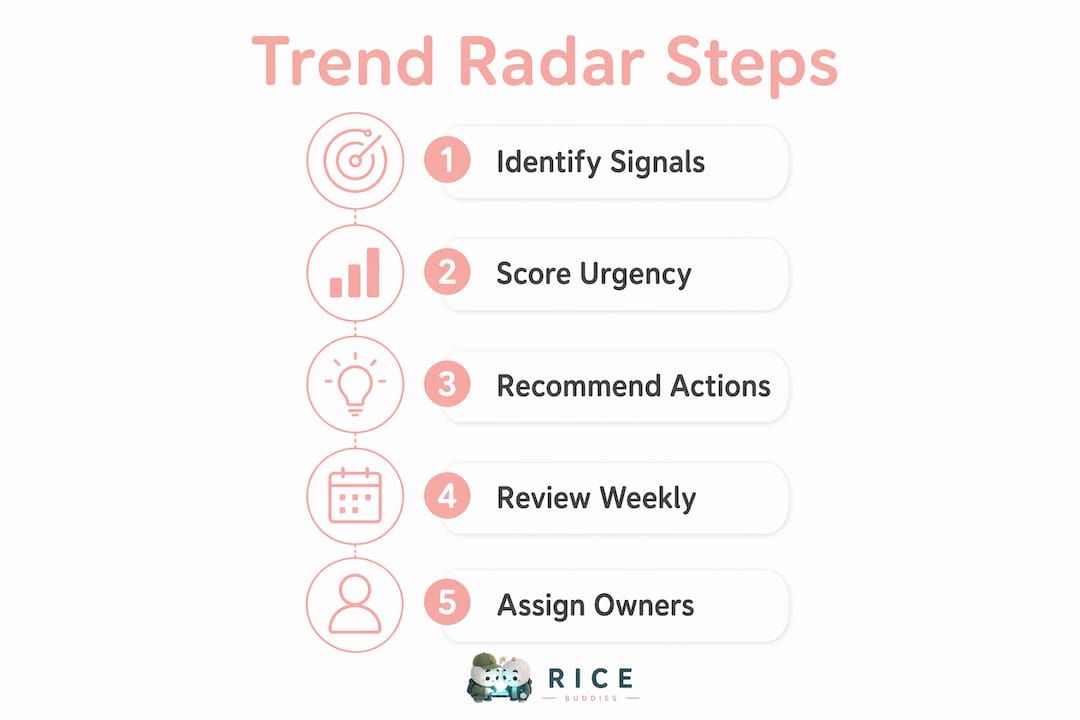
- Set up a shared, editable document. Use tools like Notion, Confluence, or a dedicated spreadsheet that your team can update in real time. The radar must be accessible to the people who will act on it.
- Define your signal sources. Monitor analyst reports from firms such as McKinsey Global Institute and Forrester, sector-specific publications, competitor press releases, customer feedback channels, and patent filings. Each source type surfaces a different layer of the trend picture.
- Categorise by urgency and impact. Score each signal on a 1 to 5 scale for both dimensions. A signal scoring 5 on urgency and 4 on impact demands immediate scenario planning. A signal scoring 2 on urgency and 5 on impact belongs in your emerging trends watch list.
- Assign ownership. Trend radars must connect each signal to a named owner and a testable hypothesis. Without ownership, signals accumulate without generating decisions.
- Integrate AI summarisation tools. Platforms that aggregate and distil trend intelligence reduce the cognitive load of scanning. The goal is signal clarity, not signal volume.
| Signal category | Urgency score | Recommended action |
|---|---|---|
| Short-term trend (0 to 12 months) | 4 to 5 | Assign owner, begin scenario planning immediately |
| Emerging trend (1 to 3 years) | 2 to 3 | Monitor weekly, prepare pilot hypothesis |
| Long-term structural shift (3+ years) | 1 to 2 | Track quarterly, build into strategic planning cycle |
Pro Tip: Avoid the common trap of building a radar with 40 signals and reviewing none of them deeply. Limit your active radar to 10 to 15 signals at any one time. Depth of analysis on fewer signals consistently outperforms breadth on many. For a structured approach to prioritising trend signals, the Ontherice blog offers a practical framework worth bookmarking.
What weekly routines embed trend leadership in decision-making?
Strategies for leading trends do not survive on good intentions. They survive on weekly habits that connect signal to decision to action. The following routine is designed for leaders who want to operationalise trend leadership without adding unsustainable workload.
- Block a strategic learning session. Reserve 30 to 60 minutes each week for reading from three to five trusted sources. Rotate between analyst reports, a sector-specific newsletter, and one source from outside your industry entirely.
- Run a brief scenario planning exercise. Take one signal from your radar and write two plausible futures: one where the trend accelerates, one where it stalls. Identify what your organisation would do differently in each case. This takes 15 minutes and builds strategic flexibility over time.
- Launch a small-scale pilot. Acting early on soft trends through pilots and micro-campaigns allows leaders to influence market direction rather than react once a trend is entrenched. A pilot does not require a large budget. It requires a clear hypothesis, a defined timeframe, and a measurable outcome.
- Collect frontline signals. Your customer-facing teams, sales representatives, and support staff encounter early-stage trend signals daily. Build a simple weekly feedback loop, a short form or a standing five-minute slot in team meetings, to surface what they are observing.
- Empower teams with autonomy within defined guardrails so they can act on signals without waiting for approval chains.
- Use rapid feedback loops to iterate pilots within two to four weeks rather than running extended programmes that outlive the trend.
- Connect every pilot outcome back to the trend radar so the organisation learns collectively, not just individually.
The trend spotting workflow described by Ontherice provides a useful template for embedding these routines into agile team structures, particularly for organisations that are still building their strategic cadence.
What mistakes undermine trend leadership strategies?
Most trend leadership efforts fail not because of poor intelligence but because of poor design. The following pitfalls are the most common and the most costly.
- Episodic training and one-off reviews. A single annual trend workshop does not build trend leadership capability. It builds familiarity with a slide deck. Sustained capability requires recurring practice, not periodic exposure.
- The library report mentality. Compiling a comprehensive trend report and distributing it widely is not trend leadership. It is trend documentation. The difference is that trend leadership connects insights to owners, decisions, and testable actions.
- Treating trends as purely intellectual forecasts. Successful trend leadership demands shifting from motivation-based influence to designing environments that naturally elicit desired behaviours through context. Trends are behaviour-driven phenomena. Leaders who understand this design for behaviour change, not just awareness.
- Paralysis by analysis. Waiting for indisputable evidence before acting on a trend is a strategy for finishing second. Soft trends can be influenced early through micro-campaigns and pilot tests. By the time a trend is obvious to everyone, the window for shaping it has closed.
- Ignoring the judo principle. Behaviour-driven leadership uses context design to make desired behaviour the easiest choice. Leaders who rely on constant management effort to drive trend adoption will exhaust themselves and their teams.
"The most dangerous trend leadership mistake is not missing a trend. It is seeing it clearly and designing no mechanism to act on it."
Key takeaways
Designing trend leadership strategies requires a behaviour-driven architecture of weekly routines, living trend radars, and human-centred skills that make forward-thinking the default rather than the exception.
| Point | Details |
|---|---|
| Leadership is a design choice | Build systems and routines that make trend-aware behaviour the default, not a periodic effort. |
| Trend radars must be living documents | Assign ownership and testable hypotheses to each signal, reviewed weekly not quarterly. |
| Act early on soft trends | Small pilots and micro-campaigns allow leaders to shape trends before they become entrenched. |
| Communication is the critical skill | 93% of C-suite leaders rank communication above all others for effective trend leadership. |
| Avoid episodic approaches | Sustained trend leadership requires recurring practice embedded in weekly operational cycles. |
Why most leaders design trend strategies backwards
I have spent considerable time working with organisations that invest heavily in trend intelligence and almost nothing in the design of how that intelligence gets used. The pattern is consistent. A leadership team commissions a detailed trend report, circulates it before a strategy offsite, discusses it for half a day, and then returns to business as usual. Six months later, a competitor has moved on one of the signals the report identified. The intelligence was not the problem. The architecture was.
What I have come to believe, and what the research consistently supports, is that human and machine collaboration in trend leadership is still being treated as a technical problem by most organisations. That framing is wrong. The real challenge is behavioural. How do you design an environment where your team naturally surfaces signals, tests hypotheses, and iterates without waiting for permission?
The leaders I have seen do this well share one habit: they treat their weekly calendar as a design artefact. Every recurring meeting, every information source, every feedback mechanism is a deliberate choice about what behaviour they want to make easy. That is the judo principle in practice. You do not push people towards trend leadership. You build the path so that trend leadership is simply the way work gets done. For leaders building this capability, the strategic trend exploration resources on the Ontherice blog offer a grounded starting point.
— Aidil
Start spotting trends before your competitors do
Designing and implementing trend leadership strategies requires the right intelligence infrastructure, not just the right intentions. Ontherice is built precisely for this. The platform uses multiple AI engines to scan global data points, extract meaningful signals, and surface what is gaining momentum before it reaches mainstream awareness.
For leaders building a trend radar, the AIOpportunities tool identifies AI-driven market opportunities with real-time scoring, giving your strategy a data foundation that manual scanning cannot match. The AiTools directory aggregates and categorises AI-powered resources relevant to trend intelligence, saving your team the hours typically spent on source discovery. If competitive positioning is your focus, the EmergingBrands tracker provides rankings on brands gaining momentum across sectors. These tools do not replace strategic judgement. They give it sharper raw material.
FAQ
What is a trend leadership strategy?
A trend leadership strategy is a deliberate design framework that enables an organisation to anticipate, monitor, and act on emerging market signals before they become mainstream. It combines structured scanning routines, behaviour-driven leadership principles, and pilot-based execution to create competitive advantage.
How often should leaders review their trend radar?
Leaders should review their trend radar weekly for 30 to 60 minutes, with each signal connected to a named owner and a testable hypothesis. Quarterly reviews alone are insufficient for maintaining the tactical discipline that trend leadership requires.
What is the biggest mistake in trend leadership design?
The most common mistake is treating trend intelligence as a reporting exercise rather than an operational one. Trend radars that lack ownership, hypotheses, and weekly integration become static documents that generate no decisions and no competitive advantage.
How do human skills fit into AI-driven trend leadership?
Future-ready leaders must orchestrate human and machine collaboration responsibly, developing empathy, ethical reasoning, and communication skills that AI cannot replicate. Organisations that treat AI adoption as purely technical consistently underperform those that treat it as a leadership design challenge.
How can small organisations implement trend leadership without large budgets?
Small organisations can implement trend leadership through low-cost weekly routines: a 30-minute scanning block, a shared trend radar in a free tool like Notion, and small pilots with defined hypotheses and two-week feedback cycles. The emerging trend scouting framework from Ontherice provides a stepwise approach suited to lean teams.