
TL;DR:
- Trend prioritisation involves systematically scoring emerging market trends using consistent criteria to guide strategic resource allocation. Effective governance, clear criterion definitions, and regular updates are more critical to success than the choice of scoring framework like RICE or WSJF. Maintaining transparent, calibrated processes and continuously reviewing signals ensures organizations stay ahead of structural shifts in dynamic markets.
Trend prioritisation is defined as a structured ranking process in which each emerging market trend is scored against consistent, agreed criteria and sequenced to guide resource allocation and strategic decisions. The practice moves organisations away from opinion-led debates and towards repeatable, evidence-based systems. Frameworks such as RICE, Weighted Shortest Job First (WSJF), and Planview's portfolio guidance each offer distinct mechanisms for scoring and ranking. The core discipline is not selecting which trends feel exciting. It is building a governance model that makes the most consequential opportunities visible before competitors act on them.
What does defining trend prioritisation actually mean?
Trend prioritisation, known in portfolio management as structured initiative ranking, is the discipline of assigning measurable scores to emerging signals and ordering them by strategic value. Planview's portfolio guidance describes this as shifting decisions from subjective negotiation to a repeatable enterprise capability. That shift matters because most organisations face more credible opportunities than they have capacity to pursue. Without a scoring system, the loudest voice in the room wins.

The process requires three foundational elements. First, a defined set of criteria against which every trend is measured. Second, a scoring scale applied consistently across all candidates. Third, a transparent rationale that stakeholders can trace from raw inputs to final ranking. When any of these elements is absent, the prioritisation exercise produces noise rather than signal.
Defining trend prioritisation also means specifying the unit of analysis before scoring begins. Analysts must define each trend's unit precisely, whether by segment, geography, or cohort, to avoid scoring the same trend multiple times or mixing metrics across incomparable time horizons. A trend measured at daily signal frequency cannot be directly compared with one measured at annual revenue impact without a conversion step.
What criteria define an effective prioritisation framework?
Six core criteria underpin most defensible trend prioritisation models used by business analysts in 2026.
- Strategic alignment: Does the trend reinforce the organisation's declared direction? Score this against specific strategic objectives, not general ambitions. A trend that scores highly on financial impact but conflicts with regulatory positioning should rank lower than its revenue potential suggests.
- Financial impact: Quantify the addressable revenue, cost reduction, or margin improvement the trend enables. Use ranges rather than point estimates to reflect genuine uncertainty. Thresholds matter: a trend with a potential revenue impact below a defined floor should be filtered out before scoring begins.
- Customer and market value: Measure the size of the population affected and the intensity of the unmet need. Broad reach with shallow impact scores lower than narrow reach with transformational impact in most frameworks.
- Risk and compliance exposure: Assess regulatory, reputational, and execution risk. Trends in heavily regulated sectors such as financial services or healthcare carry compliance costs that must be factored into the net score.
- Delivery feasibility: Can the organisation act on this trend within a relevant time horizon given current capabilities and resources? Feasibility scores prevent high-potential trends from consuming planning cycles without ever reaching execution.
- Portfolio fit: Does this trend complement or cannibalise existing investments? Portfolio fit criteria prevent duplication and protect returns on commitments already made.
Monday.com's prioritisation guidance emphasises agreeing on optimisation goals and defining scoring criteria concretely before evaluation begins. This pre-work is where most frameworks fail in practice. Teams rush to score before they have consensus on what each criterion means, which produces results that cannot be compared across reviewers.
Pro Tip: Run a calibration session before scoring. Present two contrasting trend examples to all scorers and ask each person to apply the criteria independently. Compare results. Gaps in scores reveal where criterion definitions need sharper language, not where scorers are wrong.
How do RICE and WSJF compare for prioritising market trends?
The two most widely used quantitative frameworks for trend evaluation are RICE and WSJF. They approach the prioritisation problem from different angles, and understanding when to use each is as important as knowing how they work.
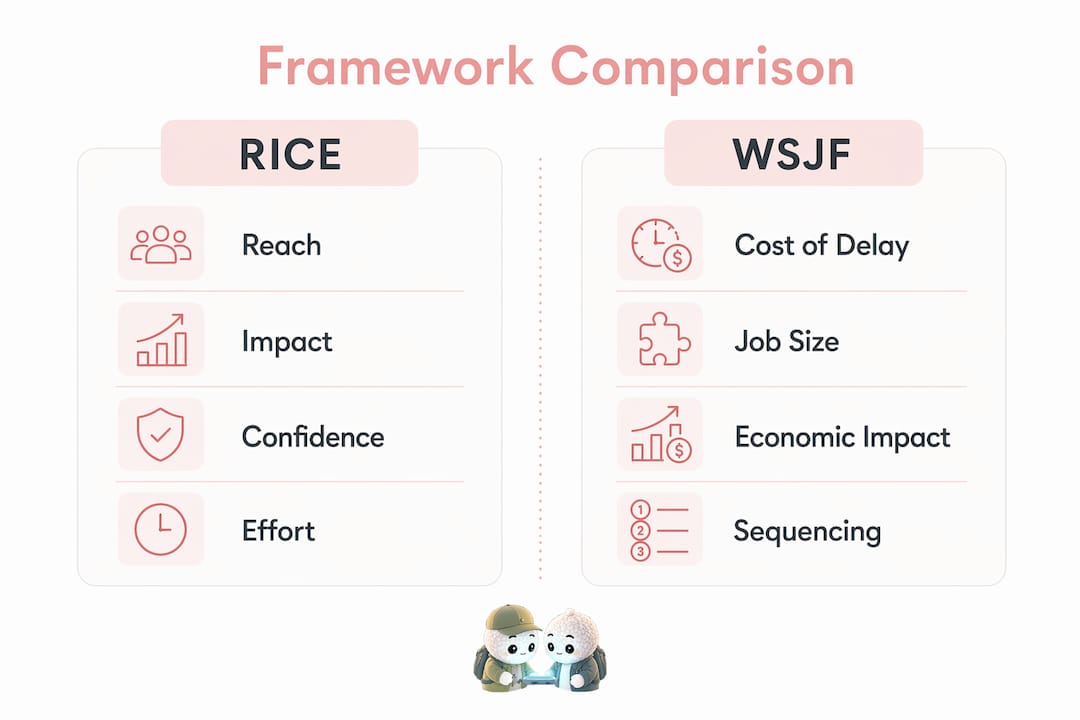
| Feature | RICE | WSJF |
|---|---|---|
| Formula | Reach × Impact × Confidence ÷ Effort | Cost of Delay ÷ Job Duration |
| Primary focus | Granular scoring of individual trends | Portfolio-level sequencing by urgency |
| Confidence handling | Explicit confidence percentage reduces overestimation | Embedded in Cost of Delay estimation |
| Best suited for | Comparing trends with similar time horizons | Time-sensitive decisions where delay has economic cost |
| Key limitation | Effort estimates can be gamed or poorly calibrated | Requires credible Cost of Delay figures, which are hard to produce |
| Typical user | Product and strategy analysts | Portfolio managers and SAFe practitioners |
The RICE framework scores trends by multiplying Reach, Impact, and Confidence, then dividing by Effort. The Confidence dimension is its most distinctive feature. It penalises trends supported by weak evidence, which disciplines optimism and compels additional research before investment is committed. A trend with a 40% confidence score effectively loses more than half its apparent value in the final ranking.
WSJF, by contrast, prioritises by dividing Cost of Delay by job size. The logic is that the economic cost of waiting is often more decision-relevant than the absolute size of the opportunity. A trend that will be irrelevant in six months ranks higher than a larger trend that remains accessible for three years. Shifting prioritisation conversations from subjective importance to Cost of Delay clarifies economic urgency and materially improves decision quality.
Many practitioners use RICE for granular scoring of individual trends but switch to WSJF for portfolio-level sequencing where urgency dominates. The two frameworks are complementary rather than competing.
Pro Tip: When building your first scoring model, start with RICE. Its four dimensions are concrete enough to calibrate quickly. Once your team has a shared understanding of scoring scales, layer in Cost of Delay analysis for the top-ranked cohort to test whether urgency changes the sequence.
What are the common pitfalls in trend prioritisation governance?
The most expensive mistakes in trend prioritisation are not analytical errors. They are governance failures that corrupt the process before scoring begins.
- Skipping criteria consensus: When teams score trends before agreeing on what each criterion means, results reflect individual interpretation rather than organisational strategy. The output looks quantitative but behaves like a vote.
- Inconsistent scoring scales: A team where one analyst uses a 1-to-5 scale and another uses a 1-to-10 scale produces rankings that cannot be compared. Scale definitions must be documented and enforced.
- Opaque rankings: When stakeholders cannot trace a trend's final score back to its inputs, they challenge the result rather than the trade-off. Ranking transparency ensures stakeholders understand weightings, can trace rankings to inputs, and focus discussions on genuine trade-offs rather than process disputes.
- Treating single spikes as trends: Refusing to treat single spikes as trends reduces fads being prioritised and improves strategic momentum by focusing on structurally durable shifts. A signal that appears once in one dataset is not a trend. It is an anomaly.
- Infrequent reviews: Markets shift. A trend that ranked third in January may be irrelevant by April. Governance requires scheduled review cycles, not just an annual planning exercise.
The solution to most of these pitfalls is documentation. A scoring guide that defines each criterion, specifies the scale, and provides worked examples for each score level removes the ambiguity that allows subjective bias to re-enter the process. Ranking models succeed with consistent criteria, scoring scales, and weightings. Without this governance, comparison validity and stakeholder trust both erode.
How to apply trend prioritisation to emerging market opportunities
Applying these methods to emerging markets requires additional steps beyond standard framework scoring. The signal environment is noisier, data quality is uneven, and the consequences of misreading a trend are amplified by capital commitment cycles.
- Define the unit of analysis first. Before scoring any trend, specify whether you are measuring at country level, sector level, or consumer cohort level. Mixing these produces double counting and incomparable scores.
- Apply signal filtering. Confirm directional persistence across multiple data sources before a trend enters the scoring queue. The anatomy of a trend approach requires duration filtering beyond short spikes, driver validation, and multiple demand and outcome measures. A trend must show consistent direction across at least two independent signal lenses to qualify.
- Build country or segment scorecards. For emerging market analysis, a focused scorecard approach prioritising higher-quality selective opportunities is recommended over broad exposure. Scorecard factors include growth quality, foreign reserves, reform trajectory, and market liquidity. These inputs feed directly into the strategic alignment and risk criteria of your primary scoring model.
- Test lead-lag relationships. Operational best practice includes lead-lag testing to avoid misattributing causality and to adjust prioritisation timing appropriately. A trend that appears to lead a market outcome may actually be a lagging indicator of a deeper structural shift.
- Translate rankings into investment sequencing. A ranked list is not a decision. Convert the top-ranked cohort into a sequenced investment plan with defined entry points, resource commitments, and review triggers.
The table below illustrates how a scorecard translates into sequencing decisions for three hypothetical emerging market trends.
| Trend | RICE score | Cost of Delay (monthly) | Recommended sequence |
|---|---|---|---|
| Digital payments infrastructure | 84 | High | Act within 90 days |
| Green manufacturing adoption | 61 | Medium | Plan for Q3 entry |
| Consumer health data platforms | 47 | Low | Monitor and reassess |
Ontherice's emerging trend scouting guide provides additional steps for improving early detection and validation before trends reach the scoring stage.
Key takeaways
Effective trend prioritisation requires consistent criteria, transparent scoring, and governance discipline applied before any framework produces reliable results.
| Point | Details |
|---|---|
| Define criteria before scoring | Agree on criterion definitions and scales with all stakeholders before any trend is evaluated. |
| Use RICE for granular scoring | RICE's Confidence dimension penalises low-evidence trends and compels additional research before investment. |
| Apply WSJF for urgency sequencing | Cost of Delay converts time-sensitivity into an economic metric that improves portfolio-level decisions. |
| Filter signals before scoring | Require directional persistence across multiple data sources before a trend enters the prioritisation queue. |
| Maintain transparent rationale | Document scoring assumptions so stakeholders can trace rankings to inputs and focus on trade-offs. |
Why governance matters more than the formula you choose
Most articles on trend prioritisation spend the majority of their words explaining RICE or WSJF. I have found that the choice of framework is almost never the reason a prioritisation process fails. The reason it fails is governance.
I have worked with teams that implemented RICE perfectly on paper and still produced rankings nobody trusted. The problem was not the formula. It was that three different analysts applied the Confidence dimension using three different mental models of what "evidence" meant. One treated a single analyst report as high confidence. Another required two independent data sources. The scores were incomparable, and the ranking was meaningless.
The fix was not switching to WSJF. It was writing a two-page scoring guide that defined each confidence band with a concrete example. That document changed the quality of every subsequent prioritisation cycle.
I am also sceptical of teams that treat prioritisation as a one-time annual exercise. Markets in 2026 move faster than annual planning cycles. The organisations I have seen gain genuine advantage from trend prioritisation treat it as a live process. They maintain a dynamic scorecard, update signal inputs monthly, and review rankings whenever a material new data point emerges. AI-assisted tools are beginning to make this continuous approach practical at scale, and platforms like Ontherice are built precisely for that operating model.
The uncomfortable truth is that a mediocre framework applied consistently with strong governance outperforms a sophisticated framework applied inconsistently. Start simple. Govern rigorously. Refine as your context evolves.
— Aidil
Discover smarter trend rankings with Ontherice

Ontherice is built for analysts and business professionals who need to move from raw market signals to ranked, defensible trend lists without manual data assembly. The RankingsGeneratorEngine applies evidence-driven scoring across global data points to produce transparent, traceable trend rankings aligned with the best practices covered in this article. For emerging market intelligence specifically, SignalsInternational delivers curated signal streams that feed directly into scoring models, improving confidence scores and reducing the risk of prioritising noise over structurally durable shifts. Explore both tools to see how automated ranking infrastructure supports the governance discipline your prioritisation process requires.
FAQ
What is trend prioritisation in business strategy?
Trend prioritisation is the structured process of scoring emerging market trends against consistent criteria and sequencing them to guide resource allocation. It replaces opinion-led decisions with a repeatable, evidence-based ranking system.
When should I use RICE versus WSJF for trend evaluation?
Use RICE for granular, criteria-based scoring of individual trends where evidence quality varies. Apply WSJF at the portfolio level when time-sensitivity and Cost of Delay are the dominant decision factors.
How do I avoid subjective bias in trend scoring?
Define each scoring criterion with concrete examples and a fixed scale before evaluation begins. Calibration sessions where multiple analysts score the same trend independently reveal where criterion definitions need tightening.
What makes a trend signal reliable enough to prioritise?
A reliable trend signal shows directional persistence across multiple independent data sources, has an identifiable driver, and extends beyond a single short-term spike. Single-dataset anomalies do not qualify as trends for prioritisation purposes.
How often should trend prioritisation rankings be reviewed?
Rankings should be reviewed at least quarterly, with ad hoc reviews triggered by material new data points. Annual-only reviews are insufficient in fast-moving markets where signal conditions change within weeks.