
AI trend detection works best as a multi-stage pipeline that extracts topics, scores weak signals against strong ones, then forecasts momentum. The strongest systems combine automated scoring with human validation, not one or the other.
Done properly, that pipeline gets you three concrete things:
- Signals flagged while they're still weak, often weeks before they show up in search volume
- A quantified score, not a gut feeling, for how likely a signal is to grow
- A forecast of momentum, so you can rank candidate trends instead of drowning in them
For teams that want this working without building it from scratch, Ontherice runs exactly this pipeline as a live platform, with transparent scoring and real-time queries across finance, tech, brands, and products.
Key Takeaways
Reliable AI trend detection depends on combining frequency-and-velocity scoring with human review, since automated systems find candidates but people judge relevance.
| Point | Details |
|---|---|
| Use a five-stage pipeline | Ingest, extract, score, forecast, and review, never skip the human validation step. |
| Score with dynamic thresholds | Combine document frequency and update rate rather than raw counts to catch weak signals early. |
| Choose density-based clustering | HDBSCAN tolerates noisy outliers better than forcing every document into a cluster. |
| Weight sources by provenance | News and research carry higher credibility; social data needs heavier de-biasing. |
| Ontherice runs this pipeline live | Its scoring, ranking, and live AI queries map directly to the stages described above. |
Table of Contents
- What is AI trend detection and when do you actually need it?
- How does the AI trend-detection pipeline actually work?
- How do you tell a weak signal from noise?
- Which algorithms and models fit each pipeline stage?
- What should a team checklist look like before building or buying?
- How do you measure whether the system is actually working?
- Build versus buy: when does a platform actually make sense?
- How OnTheRice puts this pipeline to work for you
- Frequently asked questions
- Sources
What is AI trend detection and when do you actually need it?
A trend, in any rigorous sense, is a directional movement backed by evidence over time. Not a spike, not a single viral post. Something with a slope, sustained across a window, that a human or model can point to and defend.
Manual monitoring works fine when you're tracking a handful of known competitors or keywords. It breaks down once you're scanning hundreds of thousands of documents across news, social platforms, and product pages daily. That's where automated detection earns its place.
- Scale. No analyst team reads a million documents a day; a pipeline does.
- Speed. Automated scoring flags candidate signals in near real time, not at the end of a weekly review.
- Consistency. The same thresholds apply every time, so you're not comparing this week's judgement call to last month's.
The limitation nobody advertises: automated systems are excellent at surfacing candidates and poor at judging which ones actually matter to your business. That's still a human call.
How does the AI trend-detection pipeline actually work?
The pipeline runs in five stages, and skipping any one of them is usually where teams get burned.
Ingestion. Pull raw data from news, social platforms, research repositories, product pages, and search behaviour, tagging each item with its source and timestamp. Provenance tracking matters here because a claim sourced from a single low-quality forum shouldn't carry the same weight as one corroborated across three independent outlets.

Extraction. Convert raw text into embeddings and group semantically related documents into topics. This is where noisy, inconsistent phrasing across sources gets collapsed into a single coherent signal.
Scoring. Apply temporal scoring to detect bursts. A topic that suddenly accelerates in document count and update frequency looks very different from one that's simply always been discussed.
Forecasting. Rank candidate trends by projected momentum, not just current volume, so you can prioritise the handful worth acting on.
Review. Route the top-ranked candidates to a human analyst before they inform a decision.
- Ingestion needs provenance tags on every item, not just the content
- Extraction should group by meaning, not keyword overlap
- Scoring must account for update velocity, not raw document counts
- Forecasting should rank, not just flag
- Review closes the loop and feeds corrections back into the model
Pro Tip: Build the feedback loop before you scale ingestion volume. A pipeline that ingests ten times more data without a way to correct its own mistakes just produces ten times more noise for your analysts to sort through.
How do you tell a weak signal from noise?
This is the part most vendors gloss over, and it's the part that actually determines whether your team trusts the output. BERTrend classifies topics into noise, weak signals, or strong signals by combining document counts with update frequency, then applying percentile thresholds, commonly P10 and P50, alongside slope-based checks to catch acceleration.
The logic is straightforward once you see it laid out:
- Below the P10 threshold on document frequency: likely noise, unless update rate is climbing sharply
- Between P10 and P50 with a positive slope: weak signal worth tracking
- Above P50 with sustained update frequency: strong signal, ready for forecasting
Static, keyword-based tracking misses this entirely, because it treats document count as the only variable. A research critique of static keyword approaches argues that effective detection has to weigh document frequency against update rate simultaneously, or slow-burning topics with low volume but rising velocity get dismissed as irrelevant.
One number worth remembering: BERTrend's popularity metric applies an exponentially growing decay to topics that stop receiving updates, which stops a once-hot but now-dormant topic from being misread as a fresh weak signal.
Window size matters too. Too short, and you're chasing noise; too long, and genuinely emerging signals get buried in historical averages. Most implementations settle on rolling windows of a few days to a few weeks, tuned against how fast the sector in question actually moves.
Which algorithms and models fit each pipeline stage?
Embedding choice sets the ceiling on everything downstream, so start there. Sentence-transformer embeddings feeding a vector search index are the standard for semantic grouping, letting you cluster documents by meaning rather than shared vocabulary.
For topic extraction, neural topic models like BERTopic generally outperform older approaches such as LDA or NMF on messy, short-form text, because they lean on embeddings rather than word co-occurrence counts. Clustering underneath BERTopic is usually handled by HDBSCAN, a density-based method that doesn't force every document into a cluster, which matters when a chunk of your data really is just noise.
- Embeddings: sentence-transformer models feeding a vector index for semantic search
- Topic modelling: BERTopic or comparable neural approaches over LDA/NMF for short, noisy text
- Clustering: HDBSCAN for density-based grouping that tolerates outliers
- Forecasting: time-series models selected via AutoML rather than hand-picked once
- Interpretability: large language models for zero-shot labelling of clusters against expert-defined categories
On forecasting, manually picking a model for every topic doesn't scale. An AutoML pipeline that automates clustering, topic modelling, and forecasting selection, using successive halving to pick the strongest performer, reported a best-trial RMSE of 7.099 in testing, while cutting the manual tuning burden considerably. Successive halving lowers compute cost by discarding weak candidate models early rather than training every option to completion, and penalised coherence metrics stop bloated topic lists from gaming the score.
What should a team checklist look like before building or buying?
Run through this before committing budget either way:
- Confirm your data sources and provenance tracking. Know exactly where each signal originates and how recent it is, or your scoring will be unreliable from day one.
- Decide compute and cadence. Real-time scoring is expensive; daily or hourly batches are usually sufficient outside fast-moving sectors like crypto or breaking product launches.
- Set a model governance and retraining schedule. Topic models drift as language and events shift; quarterly retraining is a reasonable default for most sectors.
- Build an evaluation plan before launch, not after. Decide upfront what precision and recall look like for a hit, and who signs off on flagged trends before they reach decision-makers.
- Plan for cold-start categories. New products, new brands, and niche sectors need synthetic-query generation or comparable workarounds, or they'll be invisible for months.
Pro Tip: Mix-Policy DPO, a technique for balancing on-policy and off-policy signals during continual model training, is worth asking any vendor about directly. It's what lets a model adapt to new trends without forgetting what it already learned, and plenty of production systems skip it and pay for that later.
How do you measure whether the system is actually working?
Precision, recall, and F1 tell you whether flagged signals turn out to be real trends and whether you're missing genuine ones. Forecasting accuracy is best tracked with RMSE, comparing predicted momentum against what actually happened over the following weeks.
- Precision and recall on flagged signals should be reviewed periodically against outcomes
- RMSE on momentum forecasts, tracked per sector since volatility varies wildly
- Rolling-window backtests, retraining on older data and testing against what actually happened next
- Human audit sampling, spot-checking a percentage of flagged signals every cycle
Successive halving isn't just for training, it's a sound approach to ongoing model selection too: cheaply eliminate underperforming candidates before committing compute to the finalists, a method the AutoML pipeline research validates directly.
Where systems typically fail: stale topics misclassified as fresh weak signals (fixed with decay-weighted scoring), and coordinated social spam inflating document counts (fixed with source-weighted de-biasing rather than raw counting).
Build versus buy: when does a platform actually make sense?
Building your own pipeline makes sense when you have genuinely proprietary data or need custom models tuned to a narrow domain no off-the-shelf tool covers. For most teams, that's not the situation.
Speed and transparency usually win. If you can't explain why a signal scored the way it did, you can't defend the decision it informs. Before buying anything, ask vendors how they classify weak signals, what data they ingest, and whether scoring logic is visible or a black box.
How OnTheRice puts this pipeline to work for you
Everything above, ingestion, extraction, scoring, forecasting, and review, is what Ontherice runs as a live system rather than a theoretical blueprint. Its engines scan global public data across finance, technology, crypto, jobs, brands, and products, then surface ranked signals with transparent scoring you can actually interrogate instead of taking on faith.

The practical advantage over building this in-house: you get real-time momentum rankings and live AI queries on day one, without months of engineering time spent on embedding pipelines and forecasting models. If you want structured, sector-specific outputs for enterprise use, the B2B signals feed delivers that directly. For a lower-commitment starting point, run the free diagnostic against a sector you already track and compare what it surfaces against your own analysts' shortlist this week.
Frequently asked questions
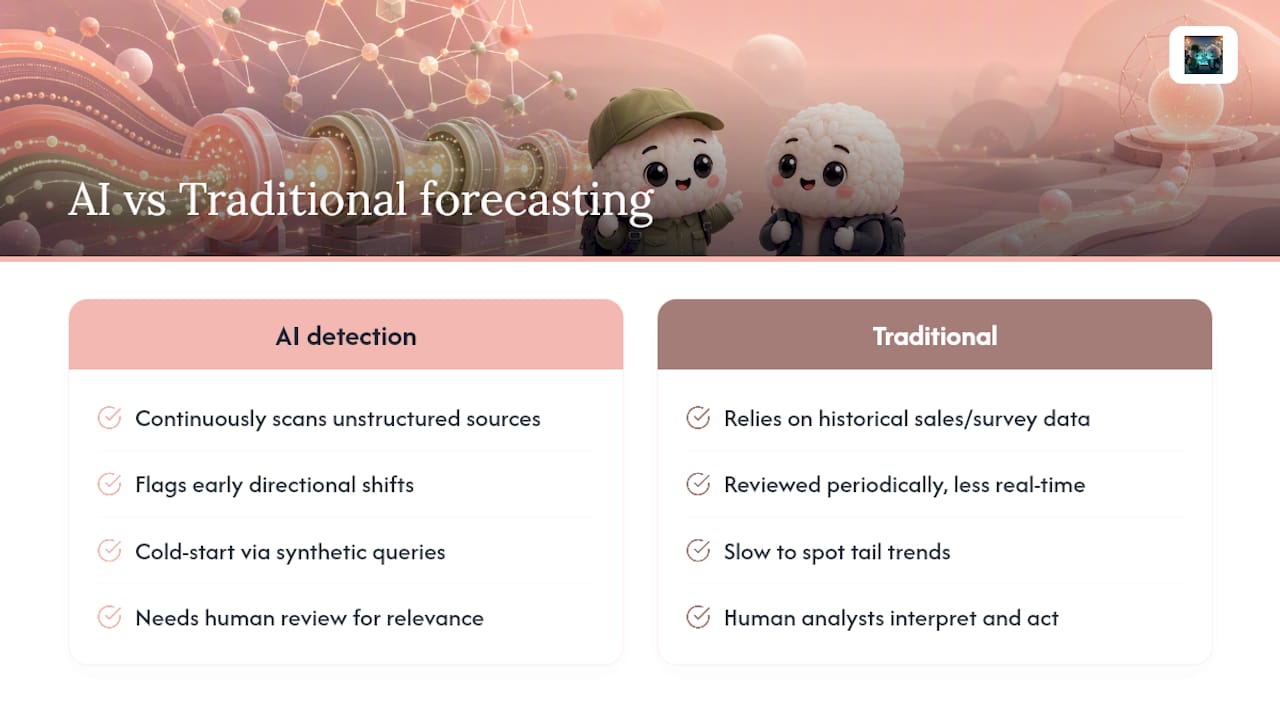
What is the difference between AI trend detection and traditional trend forecasting? Traditional forecasting typically relies on historical sales or survey data reviewed periodically. AI trend detection continuously scans unstructured sources, news, social platforms, product pages, to flag directional shifts while they're still forming.
Can AI trend detection replace human analysts entirely? No. Automated scoring is reliable at surfacing candidate signals at scale, but judging business relevance and acting on a flagged trend still needs a human review step, as outlined in the pipeline above.
How early can AI trend detection actually spot a trend? With cold-start mitigation, such as synthetic query generation from a continually-updated language model, systems can flag tail trends before they generate meaningful search volume, ahead of most manual monitoring.
What counts as a false positive in trend detection, and how common is it? A false positive is usually a stale topic misread as a fresh weak signal, or a spike driven by coordinated spam rather than genuine interest. Decay-weighted scoring and source-weighted de-biasing are the standard mitigations.
Does AI trend detection work for niche or low-volume sectors? Yes, provided the pipeline accounts for low document counts with velocity-based scoring rather than volume thresholds alone. This is precisely where cold-start techniques matter most.
Sources
Not all sources deserve equal weight, and treating them as equal is a common reason systems produce noisy, contradictory scores. News and research papers tend to carry high provenance but slower velocity. Social platforms move fast but need heavier de-biasing, since volume there reflects attention as much as substance.
- BERTrend: Neural Topic Modeling for Emerging Trends Detection
Similarweb's AI Trend Analyzer demonstrates this by merging keyword search behaviour with real-time web signals to explain sudden demand spikes rather than just flagging them.
Cold-start topics, ones with almost no search history, are the hardest case. Generating synthetic queries from newly published content using a continually-updated large language model has been shown to improve early detection of tail trends that wouldn't otherwise surface until search volume caught up. Ontherice's market intelligence approach leans on this kind of multi-source blending rather than any single feed.