

TL;DR:
- Trend crossovers confirm that price momentum has already shifted rather than predict future moves.
- Their lag and dependence on market regime require careful filtering, including time consolidation and higher-timeframe analysis.
- Used properly as directional filters, crossovers support strategic positioning rather than precise entry timing in trending markets.
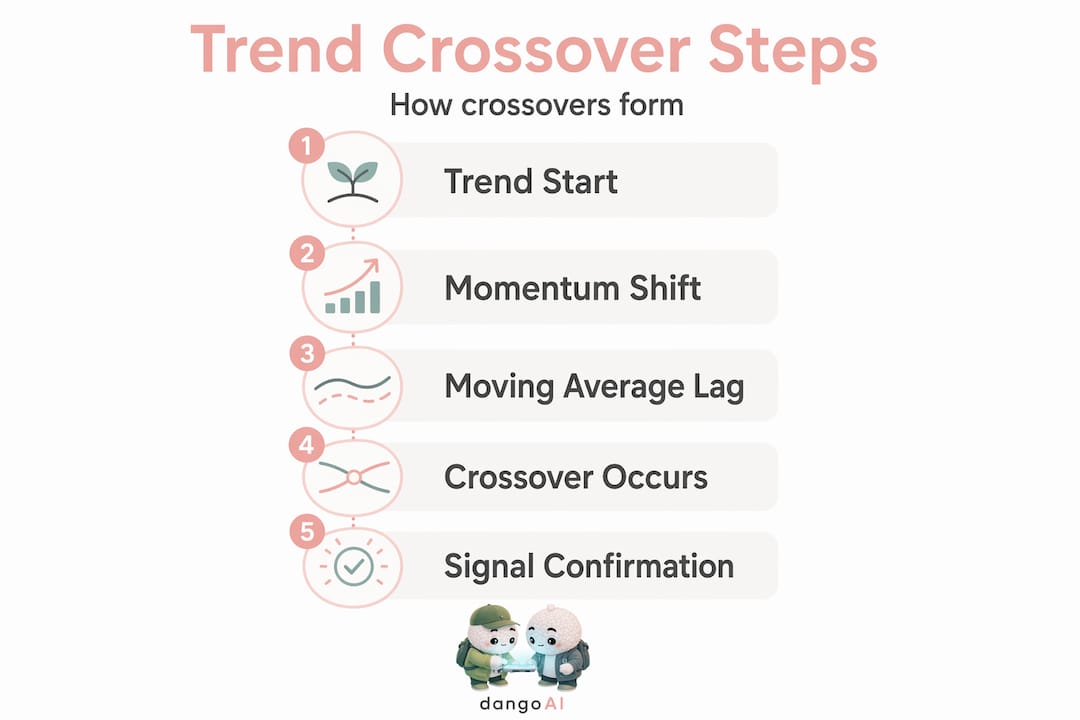
Most professionals assume trend crossovers predict what markets will do next. That assumption is why trend crossovers occur in the conversation so frequently, yet get applied so poorly. A crossover does not forecast a move. It confirms that one has likely already begun. The faster moving average, representing recent price consensus, has overtaken the slower one, representing the broader historical consensus. That intersection is a lagging confirmation, not a crystal ball. Understanding why trend crossovers occur, what causes them, and when to trust them changes how you read any market, whether you are tracking equities, innovation cycles, or sector momentum.
Table of Contents
- Key takeaways
- Why trend crossovers occur: causes and mechanics
- The deeper mechanics: momentum, consensus, and regime
- Limitations and pitfalls of crossovers alone
- Applying crossover insights in practice
- My perspective on crossover discipline
- How Ontherice turns crossover intelligence into real signals
- FAQ
Key takeaways
| Point | Details |
|---|---|
| Crossovers confirm, not predict | Moving average intersections reflect momentum shifts that have already begun, not future price moves. |
| Lag is by design | Crossovers lag by 3-8 candles, meaning early move segments are typically missed before a signal fires. |
| Market regime determines reliability | Crossovers work well in trending markets and produce frequent false signals in sideways conditions. |
| Filter before you act | Requiring a consolidation period of 20 candles before acting significantly reduces whipsaw risk. |
| Use as a directional filter | Professional traders set market bias with crossovers, then wait for price action signals at key levels to time entries. |
Why trend crossovers occur: causes and mechanics
To understand the causes of trend crossovers, you need to understand what moving averages actually measure. A moving average is a smoothed representation of consensus price over a defined period. The 10-day exponential moving average (EMA) tells you what participants have collectively agreed prices are worth over the past 10 days. The 50-day simple moving average (SMA) tells you the same thing over a much longer window.

A crossover happens when recent consensus overtakes broader consensus. The fast average shifts more quickly because it weights recent data more heavily. When buying pressure accelerates, recent prices climb above the longer-term average, causing the two lines to intersect. That intersection is the crossover.
The three most common crossover configurations are:
- SMA crossover. Two simple moving averages calculated by equally weighting each period's close. Common pairings are 10/50 or 20/100 for short to medium term analysis.
- EMA crossover. Exponential moving averages apply more weight to recent closes, making them more responsive. The 9/21 EMA pairing is popular for short-term momentum tracking.
- Golden Cross and Death Cross. The institutional benchmarks. A Golden Cross forms when the 50-day SMA crosses above the 200-day SMA. A Death Cross is the reverse. These are long-term trend confirmation signals watched by institutional desks globally.
The lag in crossovers is a mathematical certainty, not a flaw in signal design. Because moving averages smooth historical data, they always reflect where price was, not where it is heading. Understanding this is the foundation for using crossovers intelligently rather than reactively.
Pro Tip: For shorter-term analysis, EMA crossovers respond faster and reduce lag compared to SMA pairings. However, this also means more false signals in noisy data environments, so pair them with volume confirmation.
The deeper mechanics: momentum, consensus, and regime
The causes of trend crossovers become clearer when you frame markets as a continuous negotiation between participants with different time horizons. Short-term traders react quickly. Long-term investors move slowly. A crossover marks the moment short-term consensus overtakes long-term consensus, reflecting a genuine shift in collective opinion about price direction.
Several specific forces drive that shift:
- Momentum acceleration. When price gains velocity, recent closes jump above older averages faster. This is what produces sharp, clean crossovers during strong trending moves.
- Momentum deceleration. In decelerating markets, the fast average begins to flatten and eventually converges with the slow average. This convergence phase precedes many crossover events.
- External catalysts. Earnings surprises, policy shifts, macroeconomic data releases, or significant sector news can compress the timeline of consensus change, triggering crossovers within just a few sessions.
- Whipsaw conditions. In range-bound markets, prices oscillate around a midpoint. Both averages flatten and remain close together. Crossovers fail every 5-10 candles in these conditions, generating noise rather than signal.
The market regime is perhaps the single most consequential factor influencing trend changes and crossover reliability. In a trending market, the fast average tends to remain persistently above or below the slow average, which means each crossover carries higher informational weight. In a sideways market, the averages intertwine constantly, and acting on each signal is a reliable way to accumulate losses.
Typical crossover lag runs between 3 and 8 candles after the move begins. On a daily chart, that is 3 to 8 trading days of missed movement before a signal fires. For a professional making allocation decisions, that delay is significant. It explains why crossovers serve as trend confirmation rather than timing precision tools.
| Market condition | Crossover reliability | Recommended approach |
|---|---|---|
| Strong uptrend | High | Use as directional bias; look for pullback entries |
| Strong downtrend | High | Use as bearish filter; look for rally rejection entries |
| Sideways consolidation | Low | Avoid crossover signals; wait for breakout confirmation |
| Volatile, no clear trend | Very low | Require additional filters before acting |
Pro Tip: Before acting on any crossover signal, identify the market regime first. A 200-day moving average slope is a quick reference. If it is rising, you are likely in a trending environment where crossovers carry more weight.
Limitations and pitfalls of crossovers alone
The lag problem is central to trend crossover analysis. By the time the fast average crosses the slow average, price may have already moved 15 to 30 per cent from its turning point. The Golden Cross confirms trend changes often months after the actual bottom, which makes it a poor entry timer even while being a reliable directional signal.
Acting immediately on a crossover is a well-documented mistake. Entering on the cross produces risk-to-reward ratios of approximately 1:1.5 rather than the 1:3 that professional setups target. You are buying confirmation at a cost: the early, highest-probability portion of the move has already occurred.
False signals during consolidation present a related problem. Transaction costs, spread costs, and stop-outs accumulate quickly when you treat every crossover as a trigger in choppy conditions. Range-bound markets are particularly brutal for crossover-dependent approaches because:
- Both moving averages flatten, creating constant proximity
- Price oscillations produce repeated crossings with no sustained follow-through
- Each failed signal requires a new stop-out before the next signal fires
- Costs compound over multiple failed trades, damaging overall performance
Crossover patterns also tempt analysts into binary thinking: above the line is bullish, below is bearish. Real markets are more textured. A crossover firing during a major resistance zone, or against a higher-timeframe trend, is far less reliable than one aligning with both structure and momentum. Context is not optional.
Applying crossover insights in practice
The shift from misuse to effective use comes down to one reframing. Crossovers define direction, not timing. Professional traders use crossovers as directional filters and then wait for price to offer a low-risk entry setup within that context.
Here is a practical approach to applying crossover intelligence:
- Identify the crossover and direction. A bullish crossover sets a bullish bias. A bearish crossover sets a bearish bias. Do nothing else at this stage.
- Confirm the market regime. Check the slope of the 200-period average. A rising slope confirms a trending environment where the crossover signal has higher validity.
- Apply the consolidation filter. Requiring approximately 20 candles of price consolidation after the crossover before considering entry filters out most false signals caused by market noise.
- Wait for a price action trigger. Look for a pullback to a key support or demand zone, followed by a rejection candle (pin bar, engulfing candle, or inside bar). This is your entry trigger.
- Align multiple timeframes. If the daily chart shows a bullish crossover and the weekly chart confirms an uptrend, the probability of a sustained move increases substantially.
For strategic market analysts and innovation researchers, the AI-driven trend discovery approach mirrors this logic. Signals from individual data points carry more weight when the broader macro or sector context confirms the same directional shift.
The Golden Cross and Death Cross deserve specific mention in long-term contexts. These are not day-trading signals. They are framework tools for understanding where an asset or sector sits in its larger cycle, much like understanding where an industry sits in its innovation S-curve. Using them as entry triggers is a category error. Using them to inform strategic positioning over quarters is exactly what they are built for.
| Crossover type | Best use case | Typical lag | Reliability in trends |
|---|---|---|---|
| 9/21 EMA | Short-term momentum tracking | 2 to 4 candles | Moderate |
| 20/50 SMA | Medium-term trend confirmation | 4 to 8 candles | Good |
| 50/200 SMA (Golden Cross) | Long-term strategic positioning | Weeks to months | High in secular trends |
My perspective on crossover discipline
I have seen more professionals get burned by crossovers than by almost any other analytical tool. Not because crossovers are unreliable, but because people treat them as instructions rather than information. The moment you start entering positions the instant two lines cross, you have transferred control of your decision-making to a lagging mathematical construct.
What I have found actually works is treating crossovers as the start of a hypothesis, not the conclusion. The crossover tells me the market's recent opinion has shifted. That is worth noting. What I then need is evidence that this opinion shift is durable, not a temporary noise event. That evidence comes from price behaviour at structure levels, from volume confirming the move, and from higher-timeframe alignment.
The filtering discipline is where most analysts give up too early because it means sitting on your hands after a signal fires. Waiting for 20 candles of consolidation, or for price to pull back and retest a level, feels like missing the trade. In reality, you are avoiding the worst part of the trade and waiting for the part where probability actually favours you.
My strongest advice is this: learn to read market regime before you read the crossover. A crossover in a trending regime is a different instrument entirely from a crossover in a flat, noisy market. Treat them accordingly, and your results from crossover-based signals will change dramatically.
— Aidil
How Ontherice turns crossover intelligence into real signals
Identifying why trend crossovers occur is one thing. Acting on that understanding at scale across multiple sectors is another challenge entirely.

Ontherice is built precisely for that second challenge. The platform's AI engines continuously scan global data to detect the kind of consensus shifts that precede and accompany crossover events across markets, sectors, and innovation cycles. Rather than relying on a single lagging indicator, Ontherice applies multi-signal analysis that reduces noise and surfaces momentum before it reaches mainstream visibility. If you are managing strategic decisions across industries, tools like B2BSignals and AIOpportunities provide the filtered, context-aware intelligence that raw crossover data alone cannot. Combine crossover confirmation logic with AI-powered trend rankings and you have a genuine analytical edge.
FAQ
What causes a trend crossover to occur?
A trend crossover occurs when a faster moving average, representing recent price consensus, crosses a slower moving average representing broader historical consensus. It reflects a shift in collective market opinion, typically driven by momentum acceleration, external catalysts, or changes in buying and selling pressure.
Why do trend crossovers lag price movements?
Crossovers lag because moving averages smooth historical price data mathematically. By the time the fast average overtakes the slow average, the move has already begun 3 to 8 candles earlier, meaning the crossover confirms rather than predicts the shift.
When do trend crossovers produce false signals?
False signals occur most often in sideways or range-bound markets, where both averages flatten and prices oscillate without sustained direction. In these conditions, crossovers can fail repeatedly every 5 to 10 candles, generating consistent transaction losses.
What is the best way to filter crossover signals?
Waiting for approximately 20 candles of consolidation after a crossover fires before acting is one of the most effective filters. Combining this with higher-timeframe trend alignment and price action confirmation at key structure levels reduces whipsaw risk substantially.
Are the Golden Cross and Death Cross reliable entry signals?
No. The Golden Cross and Death Cross are long-term trend confirmation tools. They typically confirm trend changes months after an actual price bottom or top, making them unsuitable as entry timing signals but valuable for strategic directional positioning.