

TL;DR:
- Trend diffusion is a structured process that explains how and why new ideas spread through social systems over time, beyond just going viral. Recognizing the diffusion stages, adopter segments, and communication channels enables better anticipation of market shifts and optimal timing for strategic interventions. Accurate analysis requires combining quantitative diffusion indexes with qualitative insights into social dynamics to detect early signals before trends reach critical mass.
Trend diffusion is widely misunderstood. Most professionals treat it as a synonym for "going viral" or assume it simply describes how quickly an idea spreads. That framing misses the point almost entirely. What is trend diffusion, at its core, is a structured process: how and why new ideas or behaviours spread through a population over time via communication channels within a social system, as established in Rogers' foundational diffusion of innovations model since 1962. Understanding this distinction matters enormously for anyone attempting to anticipate market shifts, inform strategy, or forecast adoption trajectories before competitors do.
Table of Contents
- Key takeaways
- Trend diffusion explained: the theoretical foundation
- Adopter categories and the S-curve
- How trend diffusion actually works
- Measuring trend diffusion: indexes and their limits
- Trend diffusion in practice: applications across sectors
- My perspective on what trend diffusion really demands
- Spot diffusion signals before they go mainstream
- FAQ
Key takeaways
| Point | Details |
|---|---|
| Diffusion is not just spreading | Trend diffusion is a complex interaction of communication, social evaluation, and individual decision-making across time. |
| Adopter segments are unequal | Populations adopt at different rates; recognising which segment is active tells you where a trend actually sits in its lifecycle. |
| The S-curve predicts critical mass | Adoption follows a logistic growth curve, and identifying the inflection point helps professionals time strategic interventions. |
| Diffusion indexes measure breadth, not intensity | Quantitative diffusion metrics show how many sectors are moving, but require pairing with uncertainty measures to avoid misleading conclusions. |
| Early signal detection creates advantage | Professionals who map adopter segments and communication channels gain a timing edge over those who wait for mainstream confirmation. |
Trend diffusion explained: the theoretical foundation
The formal study of trend diffusion begins with Everett Rogers' Diffusion of Innovations, first published in 1962 and now one of the most cited works in social science. Rogers argued that diffusion is not accidental. It is governed by five interacting elements, and understanding these elements is what separates a rigorous analysis from a guess.
The five elements Rogers identified are:
- The innovation — the idea, practice, or product being adopted, which may be technological, behavioural, or organisational in nature.
- The adopters — the individuals or organisations making adoption decisions, each operating within their own risk tolerance and information environment.
- Communication channels — the pathways through which information about the innovation travels, ranging from interpersonal networks to mass media.
- Time — the rate at which adoption proceeds, which varies substantially across innovations and social contexts.
- The social system — the broader community, institution, or market within which diffusion occurs, including its norms, power structures, and internal networks.
Alongside these elements, Rogers described the individual adoption decision process as a five-stage sequence: awareness, interest, evaluation, trial, and adoption, with the possibility of rejection at any stage. This is a critical point. Diffusion does not proceed automatically once awareness is established. Each stage introduces friction, and a trend can stall at evaluation if the perceived risk outweighs the perceived benefit.
For market analysts, this framework reframes how you read adoption data. A low adoption rate is not simply "slow uptake." It may indicate a specific bottleneck at the evaluation or trial stage, which points to a particular type of intervention. Knowing the stage is as useful as knowing the rate.
Adopter categories and the S-curve
Adoption across populations is uneven by nature. Rogers categorised adopters into five distinct segments based on when they adopt relative to the broader population.
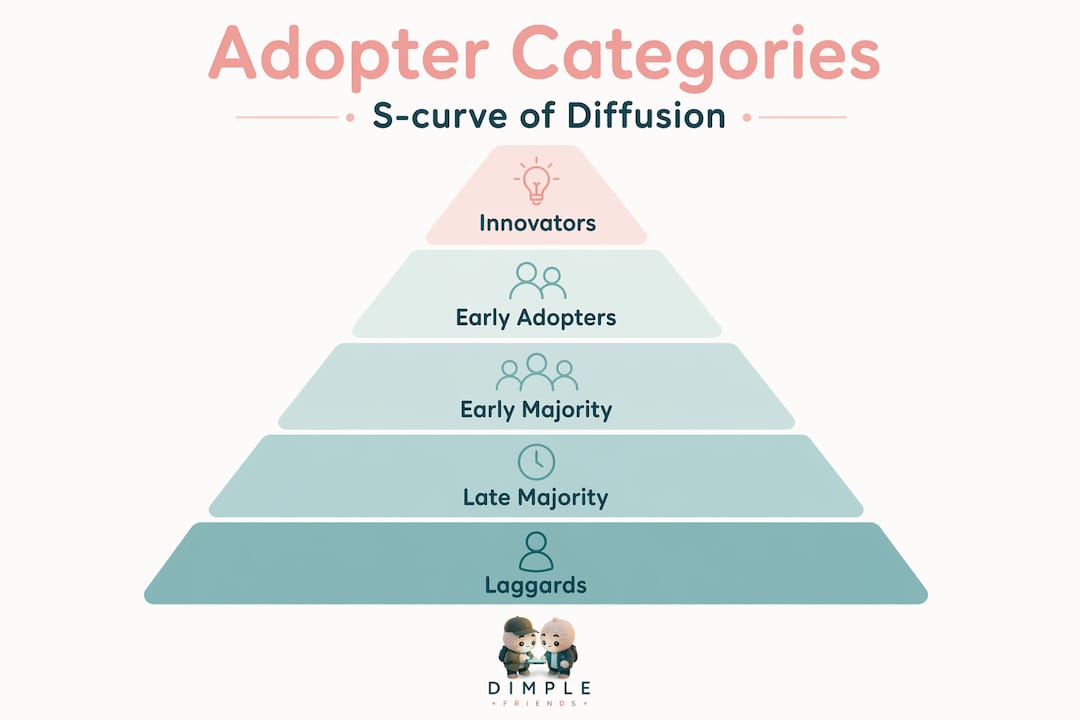
| Adopter group | Share of population | Defining characteristic |
|---|---|---|
| Innovators | ~2.5% | High risk tolerance, technical orientation, motivated by novelty |
| Early adopters | ~13.5% | Opinion leaders, socially connected, shape perception for others |
| Early majority | ~34% | Deliberate, follow social proof, adopt once uncertainty reduces |
| Late majority | ~34% | Sceptical, adopt due to peer pressure or economic necessity |
| Laggards | ~16% | Resistant to change, often adopt only when no alternative remains |
These segments do not simply describe personality types. They represent different decision-making environments and information needs. Early adopters respond to novelty and differentiation. The early majority responds to social proof and demonstrated reliability. Marketing or policy strategies calibrated to one segment will largely fail with another.
The aggregated adoption rate across these groups produces the well-known S-curve: slow initial uptake among innovators, a steep acceleration once the early majority engages, and a plateau as laggards reluctantly come aboard. The inflection point on that curve, where growth peaks before levelling off, corresponds closely to the concept of critical mass. Once a sufficient proportion of the population has adopted, continued diffusion becomes self-sustaining regardless of external promotion. For professionals tracking trend lifecycles, identifying when a trend approaches this inflection point is one of the most commercially valuable signals available.
Pro Tip: When mapping adoption data onto the S-curve, plot quarterly cohorts rather than cumulative totals. This reveals whether you are in the acceleration phase or approaching plateau, which cumulative charts systematically obscure.
How trend diffusion actually works
The mechanics of trend diffusion go well beyond passive spread. Effective diffusion depends on communication channels and social decision processes operating within networks, not on the intrinsic quality of the innovation itself. This is why objectively superior products regularly lose to inferior alternatives that diffuse more effectively.
Several forces drive or constrain diffusion in practice:
- Opinion leaders and change agents. Change agents and opinion leaders amplify diffusion by actively promoting innovations across and within social systems. In professional markets, a respected analyst endorsing a methodology, or a regulator mandating a practice, can accelerate diffusion by years.
- Mass media versus interpersonal channels. Mass media is highly effective at creating awareness, particularly in the early stages. Interpersonal communication, however, is far more persuasive at the evaluation and trial stages, where uncertainty is highest. Understanding which channel dominates at which stage is fundamental to trend diffusion in marketing strategy.
- Perceived attributes of the innovation. Rogers identified five attributes that determine adoption speed: relative advantage over existing alternatives, compatibility with existing values and practices, complexity, trialability, and observability. An innovation that scores well on all five diffuses far faster than one with a single critical weakness.
- Structural barriers. Common barriers include limited awareness, high adoption cost, perceived complexity, and social norms that actively discourage deviation. In organisational contexts, inertia and governance structures add further friction that can delay adoption by entire budget cycles.
The practical implication is that what drives trend diffusion is rarely the trend itself. It is the communication architecture surrounding it and the social context in which potential adopters are operating.
Measuring trend diffusion: indexes and their limits

Quantitative measurement of diffusion has become a distinct discipline, particularly in economic analysis. Diffusion indexes are statistics reflecting the breadth of change across sectors, constructed from qualitative survey responses and used by economists for timely sectoral insights.
The construction is straightforward: a diffusion index (DI) typically assigns a score to each surveyed entity based on whether a measured variable increased, remained unchanged, or decreased. These scores are aggregated to produce a single index value, often normalised around 50. Values above 50 indicate that more entities are reporting improvement than deterioration.
| DI value range | Interpretation | Typical application |
|---|---|---|
| Above 50 | Majority reporting expansion or improvement | Employment growth, consumer sentiment, manufacturing output |
| At 50 | No net change across the surveyed population | Transition or inflection signals |
| Below 50 | Majority reporting contraction or decline | Recessionary indicators, falling adoption |
Economic diffusion indexes measure breadth of adoption across populations, distinct from intensity of change. Two sectors with identical DI values may be experiencing very different underlying dynamics. One may show moderate, uniform movement; the other may show extreme divergence between a minority of strong gainers and a majority of moderate losers. Both produce the same headline number.
This is a well-documented limitation. Diffusion indexes alone can be misleading without considering uncertainty and polarisation, since the same index values can mask fundamentally different underlying intensities. Rigorous analysis therefore pairs DIs with confidence intervals, dispersion statistics, and polarisation indices to distinguish genuine consensus from a noisy average.
Pro Tip: When using diffusion indexes to track market trends, always request the underlying dispersion data alongside the headline figure. A DI of 55 built on near-universal modest gains tells a very different story than one built on 30% of respondents reporting sharp gains and 45% flat.
Trend diffusion in practice: applications across sectors
Understanding diffusion theory is valuable. Applying it to live market analysis is where it becomes commercially relevant. The trend diffusion process plays out across sectors in ways that directly inform strategic positioning.
Consider a few concrete examples:
- Technology markets. The adoption of cloud computing followed a textbook S-curve. Enterprise adoption accelerated sharply once early majority firms witnessed proven cost and reliability outcomes from early adopters. Practitioners who mapped adoption data to diffusion stage models could identify the inflection point years before mainstream press declared cloud "standard practice."
- Consumer goods and fashion. Streetwear entered luxury retail through a clearly segmented adopter pathway: subculture innovators, style-forward early adopters, and eventually mainstream retailers. Brands that tracked this diffusion early built inventory and distribution ahead of mass demand.
- Organisational change. In human resources and management, practices like agile working or diversity reporting diffuse through firms via regulatory signals and peer pressure within industry groups. Knowing which segment of organisations has adopted tells HR professionals where the profession is heading, not where it currently sits.
The strategic implications are substantial. For professionals monitoring market behaviour, the importance of trend diffusion lies not in the endpoint but in the stage. Understanding how trends shape business decisions requires knowing whether you are looking at a trend in the innovator phase, approaching critical mass, or already plateauing.
Practically, this means:
- Segment your market by adopter type before allocating resources to adoption campaigns.
- Identify the opinion leaders and gatekeepers in your specific social system, as they control the communication channels that matter most.
- Monitor not just adoption rate but adoption breadth across sub-sectors to catch diffusion accelerating in adjacent markets.
- Pair qualitative channel monitoring with quantitative diffusion metrics to capture both the speed and the direction of movement.
My perspective on what trend diffusion really demands
I have spent considerable time working with analysts who treat diffusion as a straightforward concept, something that can be summarised in a growth curve and left at that. In my experience, that confidence is the primary source of costly forecasting errors.
What I have found is that the social and communicative dimensions of diffusion are consistently underweighted. Professionals tend to focus on the S-curve because it is visual, intuitive, and satisfying. But the curve is an output. It describes what happened. The communication channels, the opinion leader networks, the perceived attributes of the innovation — those are the inputs. Understanding the inputs is what lets you anticipate the curve before it is visible in the data.
I am also sceptical of single-metric approaches to diffusion measurement. Relying on a single diffusion metric risks oversimplification, and I have seen this play out repeatedly when headline DI values are cited without the accompanying dispersion data. A market that looks uniformly positive on a headline index can be masking a polarised landscape where a small cohort of aggressive adopters is pulling the average upward while the majority remains inert. That distinction matters enormously for timing and resource allocation.
My practical recommendation is to treat diffusion analysis as inherently multi-layered. Use quantitative indexes to track breadth. Use qualitative channel monitoring to track the communication dynamics. Use adopter segmentation to locate where you are in the cycle. And treat any single signal, however compelling, with appropriate scepticism until it is corroborated across multiple dimensions.
— Aidil
Spot diffusion signals before they go mainstream
The theoretical clarity is only as useful as your ability to act on it in real time. For professionals who need to move from understanding diffusion to detecting it early across live markets, Ontherice provides the infrastructure to do exactly that.

Ontherice's AI-driven engines scan global data points across sectors, extract meaningful signals from noisy adoption data, and produce ranked insights calibrated to where trends sit in their diffusion cycle. The B2B signals platform is built specifically for professionals tracking adoption breadth and market penetration patterns across business environments. For those identifying emerging opportunities before critical mass, the AI opportunities tool surfaces diffusion-stage signals across sectors, giving you the timing advantage that manual monitoring cannot match. Explore early market insights from Ontherice's intelligence pipeline.
FAQ
What is trend diffusion in simple terms?
Trend diffusion describes how and why new ideas, behaviours, or products spread through a population over time via communication channels within a social system. It is a structured process, not simply the speed of spread.
How does trend diffusion work?
Diffusion proceeds through five adoption stages — awareness, interest, evaluation, trial, and adoption — and is shaped by communication channels, opinion leaders, and the perceived attributes of the innovation being adopted.
What are the main factors affecting trend diffusion?
The primary factors include the innovation's relative advantage, compatibility with existing practices, perceived complexity, trialability, and observability, alongside the role of communication channels, change agents, and social norms within the adopting population.
What is a diffusion index and how does it relate to trend diffusion?
A diffusion index is a quantitative measure of how broadly change is occurring across a population or sector. It captures the breadth of adoption rather than the intensity, and must be paired with dispersion and uncertainty measures for accurate interpretation.
Why does trend diffusion matter for market strategy?
Understanding diffusion stages and adopter segments allows professionals to time market entry, target communication to the right audience, and identify inflection points before mainstream data confirms them, creating a measurable competitive advantage.