

TL;DR:
- Trend amplification involves automated systems boosting content reach based on early engagement signals. Recognizing velocity, or views per day on recent content, is essential for early detection of rising trends.
Trend amplification is the process by which automated platform systems push certain content far beyond its initial audience, driven by engagement signals such as predicted relevance, watch duration, and interaction rates. The practical upshot: a piece of content that earns early traction gets shown to progressively larger audiences, creating a feedback loop between visibility and engagement that can reshape consumer behaviour within days. Platforms including TikTok and YouTube are the clearest examples of this at scale, and under the EU's Digital Services Act, they are now required to document how those amplification decisions are made. Tools like Ontherice surface these signals early, before a trend reaches the mainstream feeds where everyone else is already watching.
Pro Tip: Track views per day on newly published content, not lifetime view counts. A video posted yesterday pulling strong daily numbers is a far more reliable amplification signal than an older video sitting on a large but slowly accumulating total.
Table of Contents
- How does trend amplification actually work?
- Why does trend amplification matter for your strategy?
- What are the risks and ethical concerns of amplified trends?
- How do you spot and measure trend amplification early?
- A practical playbook for when you detect amplification
- How Ontherice detects and interprets trend amplification
- Key takeaways
- The part most brands get wrong
- Useful sources for further reading
How does trend amplification actually work?
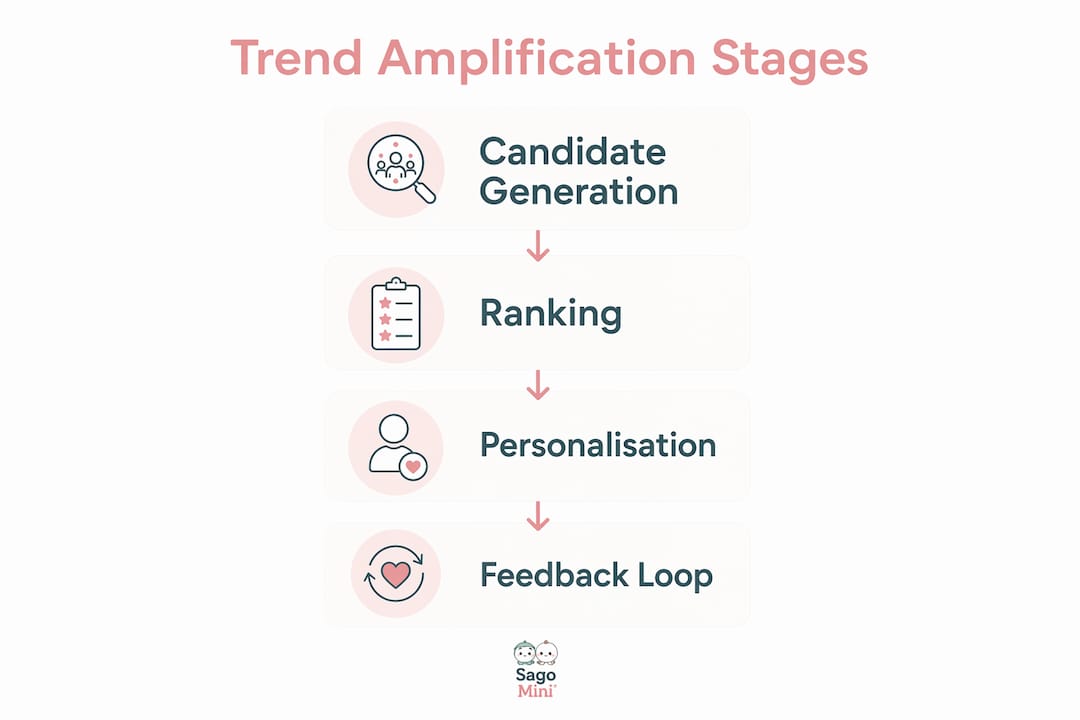
The pipeline runs in four stages: candidate generation, ranking, personalisation, and the feedback loop. Understanding each stage tells you where the real leverage is.

Recommendation systems first generate a pool of candidate content from across the platform, then apply machine-learning ranking models to sort that pool by predicted engagement. The signals doing the heavy lifting include predicted relevance (how well the content matches a user's history), view duration or watch completion, click-through rate, and interaction rates such as likes, shares, and comments. Small ranking adjustments applied across millions of users shift exposure dramatically, which is why a modest early-engagement spike can translate into a massive reach increase within hours.
Personalisation layers on top of ranking, tailoring the distribution to individual users based on prior behaviour. This is where the feedback loop closes: higher exposure generates more engagement signals, which improve the content's ranking, which generates still more exposure. The cycle accelerates until the content either saturates its addressable audience or gets suppressed by moderation systems.
Format matters too. Short-form video amplifies faster than long-form because completion rate and rapid engagement cycles feed recommendation loops more quickly. A 30-second clip on TikTok or YouTube Shorts can complete its amplification arc quickly, often within a few days; a 20-minute documentary might take weeks to reach the same inflection point.
| Signal | What it measures |
|---|---|
| Predicted relevance | Estimated match between content and a user's interest profile |
| Watch completion rate | Proportion of the video a viewer watches before leaving |
| Interaction rate | Aggregate of likes, comments, shares and saves per impression |
| Click-through rate | Share of users who tap through after seeing a thumbnail or preview |
| Velocity | Rate at which views accumulate per day on recently published content |
Why does trend amplification matter for your strategy?
Amplification signals are demand signals. When a topic, format, or product category starts accelerating on TikTok, Instagram, or X, it often precedes a measurable shift in search volume and purchase intent. Strategy teams that read those signals early can move on product positioning, creative testing, and inventory decisions before competitors notice the shift.
The business impacts are concrete:
- Product demand signals: a sudden amplification spike around a product category can indicate emerging consumer appetite, giving procurement and product teams a lead time advantage.
- Creative testing: amplified formats reveal what emotional framing is resonating right now, reducing the guesswork in campaign concepting.
- Competitor blind spots: brands that monitor amplification across their category often spot a rival's emerging narrative before it reaches mainstream press.
- Reputation sensitivity: the same mechanism that lifts a positive story can accelerate a negative one; teams need monitoring in place before a crisis, not after.
The risk-opportunity trade-off is worth stating plainly. Amplification creates a window, typically narrow, in which participation is rewarded. Miss it and you are producing content into a saturated space where the algorithm has already moved on. Jump in without validating the signal and you risk associating your brand with a trend that collapses or turns controversial. Early market insights are only useful when paired with a clear filter for relevance and brand fit.
What are the risks and ethical concerns of amplified trends?
Amplification and suppression are two sides of the same system. Platforms use moderation to suppress harmful or non-compliant content, but this dual role can inadvertently silence dissenting or minority voices, particularly when moderation models are trained on data that reflects existing biases.
The ethical harms are not abstract. Amplification can accelerate the spread of misinformation by rewarding emotional charge over factual accuracy. It can reinforce stereotypes when recommendation systems surface content that confirms existing user biases. And it can marginalise communities whose content is disproportionately flagged by moderation, even when that content is legitimate.
Red flags to watch for in your own monitoring:
- Rapidly polarising engagement patterns (high shares but also high negative comments) often indicate a trend driven by outrage rather than genuine interest.
- Sudden drops in a previously rising signal can indicate moderation suppression rather than organic decline.
- Tokenised participation, where a brand appears to engage with a cultural moment without genuine connection, tends to produce a sharp backlash.
The practical ethical guidelines are straightforward: be transparent about your participation, attribute original creators, and avoid piggybacking on moments of cultural pain or political tension. If the connection between your brand and a trend requires more than one honest sentence to justify, that is a reliable signal to step back.
How do you spot and measure trend amplification early?
Velocity is the single most reliable early indicator: views per day on recently published content, not lifetime totals. A video posted 18 hours ago pulling strong daily numbers tells you the algorithm is actively distributing it. An older video with a large total but slowing daily rate tells you the window is closing.
| Metric | What it reveals | Where to source it |
|---|---|---|
| Velocity (views/day) | Whether a trend is still rising or plateauing | Platform analytics, Ontherice signal feeds |
| Watch completion rate | Depth of audience interest; high completion drives further ranking | YouTube Studio, TikTok Analytics |
| Engagement amplification ratio | Engagement relative to reach; high ratio signals algorithmic favour | Social listening tools, platform APIs |
| Share rate | Organic distribution beyond the algorithm | Platform native analytics |
| Crowdedness | Volume of similar content entering the space | Ontherice signal feeds, manual search |
A practical monitoring checklist for strategy teams:
- Set velocity alerts on your primary platforms (TikTok, YouTube, Instagram, X) for keywords and formats relevant to your category.
- Check signal feeds at least once daily for innovation scouting; for reputation monitoring, set real-time alerts with a lower threshold.
- Cross-reference platform signals with search trend data to confirm whether amplification is translating into broader intent.
- Log crowdedness alongside velocity: a rising trend in a crowded space has a shorter participation window than one still in its early phase.
Pro Tip: Pair velocity data with a crowdedness check before committing creative resources. A trend that is rising fast but already crowded with near-identical content is a window that is closing, not opening.
A practical playbook for when you detect amplification
The decision framework is: observe, validate, adapt, act or escalate. Each node has a clear trigger.
Observe when a signal is early and unproven. Watch the velocity for 24 hours before committing resources. A genuine amplification event will sustain or accelerate; a false spike will flatten.
Validate by asking three questions: Is this trend relevant to what we actually do? Does participating sound like us? And is the trend still rising, or merely popular? If the connection to your brand requires a stretch, skip it. Audiences feel the reach instantly, and a forced fit costs more in credibility than it gains in reach.
Adapt rather than copy. Preserve the trend's emotional container, the underlying tension or format that made it spread, and fill it with material only your brand can credibly provide. A bookkeeping firm riding a "things I wish I knew at 22" format should post financial lessons for freelancers, not generic life advice. You can test product concepts derived from trend signals before committing to a full campaign.
Act or escalate based on timing. Publish across TikTok, YouTube, Instagram, and X simultaneously while the trend is still rising; staggered publication wastes the window. If a trend carries reputational risk, escalate internally before publishing: notify your communications lead, log the signal and your assessment, and define a clear pause trigger.
For potential harms, the escalation checklist is: identify who internally owns the decision to pause, set a threshold (e.g. a specific negative sentiment ratio) that triggers an automatic review, and document any moderation incidents for future reference.
How Ontherice detects and interprets trend amplification
Ontherice surfaces AI-powered amplification signals before they reach mainstream awareness, giving strategy teams a lead-time advantage. The platform runs multiple AI engines across noisy data sources, filters out low-signal noise, and produces ranked, explainable insights that teams can act on without needing to interpret raw data themselves.
The methodology combines:
- Signal ingestion from social platforms, search indices, and sector-specific data sources
- A model ensemble approach that cross-validates signals across multiple algorithms to reduce false positives
- Noise filtering that distinguishes genuine amplification from bot-driven or artificially inflated spikes
- Human validation steps that flag edge cases and contextualise signals within regulatory and cultural context
Aidil, who leads trend filtration and lifecycle analysis at Ontherice, describes the workflow this way:
The platform is transparent about its limitations: no signal feed eliminates false positives entirely, and human review remains a necessary step before committing significant resources. Ontherice recommends treating its outputs as a prioritised shortlist for human judgement, not a replacement for it. Regulatory context, including the Digital Services Act framework, informs how the platform documents amplification and suppression events for clients operating in regulated sectors.
Key takeaways
Trend amplification is an operational signal, not a vanity metric: teams that measure it correctly and respond within the right window gain a genuine strategic advantage.
| Point | Details |
|---|---|
| Core definition | Automated systems boost content visibility beyond its initial audience, driven by engagement signals. |
| Most reliable early signal | Velocity (views per day on recent content) outperforms lifetime view counts for early detection. |
| Measurement priority | Track velocity, completion rate, share rate, and crowdedness together for a reliable read. |
| Ethical guardrails | Avoid amplifying harmful trends; watch for polarising engagement and moderation suppression signals. |
| First tactical step | Observe for 24 hours, validate brand fit, then adapt the trend format before publishing across all platforms simultaneously. |
The part most brands get wrong
Most teams treat trend amplification as a content problem. It is not. It is a timing and judgement problem, and those two things are harder to systematise than a content calendar.
The brands that consistently benefit from amplification are not the ones with the fastest production pipelines. They are the ones that have built a reliable signal-reading habit: checking velocity before crowdedness, validating brand fit before drafting, and publishing everywhere at once rather than rolling out over three days. The window on short-form platforms is genuinely narrow, and a staggered rollout is often a window missed entirely.
There is also a subtler point that most guides skip. Algorithmic design choices are not neutral. When a platform amplifies emotionally charged content, it is not simply reflecting what audiences want; it is actively shaping what they see and, over time, what they expect. Professionals who treat amplification as a social force rather than a neutral metric make better decisions about when to participate and when to stay out.
Ontherice is built on exactly that premise: that early signals are only useful when they come with enough context to make a sound judgement call.
Useful sources for further reading
- Algorithmic amplification — Wikipedia: a solid overview of how recommendation systems generate and rank candidates, with references to academic literature on platform design.
- Trend Amplification or Suppression: The Dual Role of AI in Influencing Viral Content (IJGIS): the primary academic source for the dual amplification-suppression framing, ethical concerns, and regulatory context including the Digital Services Act.
- DOI reference for the above paper: direct DOI link for citation and verification.
- Trend amplification — Fiveable: accessible definition of the feedback loop mechanism between visibility and engagement.
- Ontherice signal taxonomy and ranking logic: explains how Ontherice scores and ranks signals, useful for teams evaluating the platform's methodology.
- Ontherice AI opportunities feed: the primary landing page for teams seeking live amplification signals and AI-discovered market opportunities.
- Ontherice blog: what is trend filtration: Aidil's companion guide on filtering signals from noise, directly relevant to the measurement and playbook sections above.