

TL;DR:
- Proactive trend spotting involves systematically detecting and testing early signals before they become mainstream, giving a strategic advantage. It relies on frameworks like the SIGNAL→PROOF→BET loop and filters such as convergence, persistence, and amplification to validate genuine trends. Building an organization-wide capability with quarterly reviews, explicit decision criteria, and continuous monitoring enables sustained foresight and informed decision-making.
Proactive trend spotting is the deliberate process of detecting and testing emerging signals before they reach mainstream awareness, giving business professionals and investors the strategic advantage of acting on evidence rather than hindsight. Unlike reactive analysis, which responds to trends already visible in headlines, this guide to proactive trend spotting covers systematic frameworks such as the SIGNAL→PROOF→BET loop, weak signal filtering, and structured foresight methods drawn from sources including DiscoverResults, Sitra, and the OECD. The goal is not to predict a single fixed future but to build a repeatable capability that converts ambiguous early signals into bounded, testable decisions.
What are the essential frameworks for detecting emerging trends early?
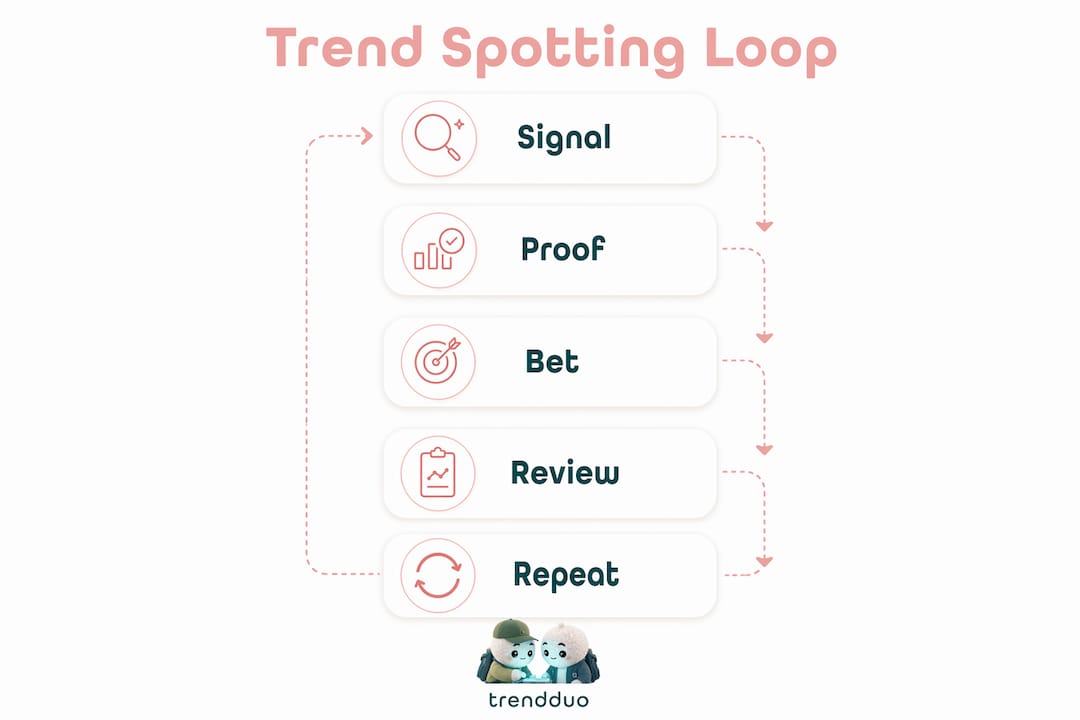
The most reliable way to detect emerging trends is to replace intuition with a repeatable detection loop that captures weak signals, converts them into falsifiable claims, and runs bounded experiments with clear kill criteria. This is the SIGNAL→PROOF→BET loop, and it is the structural backbone of any serious trend analysis technique. Without it, teams accumulate observations but never reach a decision.
The three stages work as follows:
- Signal capture. Gather raw observations from customer calls, support tickets, hiring posts, operator backlogs, and niche community forums. These sources surface behavioural shifts weeks before they appear in industry reports.
- Proof construction. Convert each signal into a falsifiable claim. Instead of "consumers seem more interested in X," write "if this trend is real, we will see Y metric rise by Z within 90 days." Falsifiability is what separates a hypothesis from a hunch.
- Bounded bet. Design a small, reversible experiment with a defined test window and explicit kill criteria. Durability and asymmetry are the two dimensions that matter most: how long is the trend likely to persist, and does the potential upside justify the cost of testing?
The asymmetric bet principle is particularly underused. Most teams size their experiments based on confidence, but the correct variable is payoff ratio. A low-confidence signal with a 10:1 payoff asymmetry deserves a small test. A high-confidence signal with a 1.2:1 payoff does not.
Pro Tip: Build a shared signal log in Notion, Airtable, or a simple spreadsheet where anyone in the organisation can submit observations. The act of logging forces specificity and creates an auditable record for quarterly reviews.

How can weak signals be filtered to reduce false positives?
Weak signals are, by definition, ambiguous. The challenge is not finding them. The challenge is distinguishing genuine early indicators from noise. Three filters applied in sequence reduce false positives significantly.
- Convergence. The same signal appears independently across unrelated sources. A phrase appearing in a Reddit thread, a customer support ticket, and a hiring post simultaneously carries more weight than the same phrase appearing three times in one community.
- Persistence. The signal recurs over multiple observation periods rather than appearing once and fading. A signal that survives two consecutive quarterly scans is worth escalating to the proof stage.
- Amplification. The volume and diversity of discussion around the signal is growing. Convergence, persistence, and amplification reviewed quarterly give teams a structured basis for upgrading or downgrading a signal's priority.
Sitra's weak signal framework adds a useful structural layer. It organises detection into three parts: preparation, scanning, and interpretation. Preparation defines the scope and sources. Scanning captures tangible and intangible shifts such as legislation, changing values, and emerging world views. Interpretation resists the temptation to jump to conclusions and instead maps symptoms before speculating on alternative futures.
One of the most overlooked detection locations is upstream community behaviour. Research from Later.com shows that phrases spreading across unrelated comment sections indicate forming cultural vocabulary one to two weeks before trends peak in mainstream content. This means the measurement location matters as much as the metrics themselves. Monitoring niche forums, Discord servers, and specialist subreddits gives you a one to two week lead over analysts watching mainstream social platforms. For practical examples of this approach, the Ontherice guide to niche trend signals covers community-driven detection in detail.
The OECD's horizon scanning methodology extends this further. It combines weak signal detection with desk research, expert surveys, and megatrend analysis to explore alternative future scenarios rather than committing to a single prediction. For investors and market analysts operating across sectors, this multi-scenario framing prevents the costly mistake of over-indexing on one plausible future.
| Filter | What it checks | Practical source |
|---|---|---|
| Convergence | Same signal across unrelated channels | Customer calls, forums, hiring posts |
| Persistence | Signal recurs over multiple periods | Quarterly signal log reviews |
| Amplification | Growing volume and diversity of discussion | Social listening, specialist communities |
Pro Tip: When scanning for upstream signals, prioritise communities where practitioners talk to each other rather than communities where consumers talk about products. Operator forums and specialist Discord servers surface structural shifts, not just sentiment.
What practical steps turn early signals into validated trend bets?
Detecting a signal is the easy part. The harder discipline is translating it into a decision. A decision matrix combining two dimensions, durability likelihood and payoff asymmetry, gives analysts a structured basis for prioritising which signals deserve resources. Signals that score high on both dimensions move immediately to the proof stage. Signals that score low on both are logged and monitored. Signals with high durability but low asymmetry are watched but not tested until the cost of testing falls.
The process for moving from signal to validated bet follows four steps:
- Frame the narrative. Describe the signal as a behaviour shift, not a buzz word. "Operators in logistics are hiring for roles that did not exist 18 months ago" is a narrative. "Supply chain AI is trending" is noise.
- Define observable conditions. Write down what you would need to see to confirm or falsify the trend within a specific time window. This is the proof construction stage of the SIGNAL→PROOF→BET loop.
- Run a bounded experiment. Set a test window of 30 to 90 days, a budget ceiling, and a kill criterion. If the observable condition is not met by the deadline, the signal is downgraded, not abandoned.
- Link to a business lever. Research from Pulsar Platform shows that signal-to-strategy translation requires matching the trend narrative to a specific response type: editorial, product, market positioning, or governance. Applying a marketing response to a governance signal is a common and expensive mistake.
Recalibrating assumptions quarterly is not optional. Markets shift, signals evolve, and a trend that looked durable in Q1 may show persistence failure by Q3. The Ontherice guide to acting on detected trends provides a practical decision sequence for this recalibration process.
Pro Tip: Set a hard rule: no signal moves to the bet stage without a written kill criterion. Teams that skip this step accumulate zombie experiments that consume resources and distort future signal assessments.
How to embed trend spotting as a continuous organisational capability
A single trend spotting exercise delivers a one-time advantage. A continuous capability delivers compounding advantage. The difference lies in cadence, criteria, and culture.
- Establish a quarterly scanning cadence. Monthly is too frequent for most organisations to act on findings. Annual is too slow to catch fast-moving signals. Quarterly reviews align with most planning cycles and give signals enough time to demonstrate persistence.
- Define explicit decision criteria. Every signal in the log should carry one of four labels: ignore, watch, test, or commit. Without kill criteria and cadence, accumulation of signals causes slow learning and poor prioritisation. The label forces a decision and prevents the log from becoming a graveyard of unactioned observations.
- Broaden the input network. Industry forums, internal feedback channels, expert networks, and regulatory announcements all carry signals. Organisations that rely solely on external market research miss the signals visible only from inside their own customer relationships.
- Separate interpretation from action. Confusing narrative signals with inputs to premature marketing activity is one of the most common failure modes. The interpretation stage should produce a framed hypothesis, not a campaign brief.
- Reward early, uncertain observations. Teams that only surface signals they are confident about self-censor the most valuable inputs. Create psychological safety for submitting weak, ambiguous observations. The filtering process exists precisely to handle uncertainty.
For organisations building this capability from scratch, the Ontherice resource on strategic trend exploration covers OECD-style structured foresight applied to technology and market intelligence contexts. Tools such as Big Move Guard from Big Move Algo also support convergence and amplification tracking across financial market signals, which is particularly relevant for investors running systematic scanning processes.
Key takeaways
Proactive trend spotting works because it replaces intuition with a structured loop of signal capture, falsifiable proof construction, and bounded experimentation reviewed on a consistent quarterly cadence.
| Point | Details |
|---|---|
| Use the SIGNAL→PROOF→BET loop | Capture signals from behavioural sources, convert to falsifiable claims, and test with kill criteria. |
| Apply three filters to reduce noise | Convergence, persistence, and amplification separate genuine signals from one-off observations. |
| Match signals to the right business lever | Editorial, product, governance, and marketing responses are not interchangeable. Match deliberately. |
| Measure upstream, not downstream | Niche community behaviour precedes mainstream content by one to two weeks. Monitor there first. |
| Build cadence, not one-off exercises | Quarterly reviews with explicit ignore/watch/test/commit labels sustain compounding foresight advantage. |
Why most trend spotting fails before it starts
I have watched capable analyst teams spend months building signal libraries that never produce a single decision. The failure is almost never a shortage of data. It is a shortage of discipline at the proof stage.
The temptation is to collect signals indefinitely because collection feels productive. Writing a falsifiable claim feels risky. What if the claim is wrong? That discomfort is precisely the point. Most leaders fail by focusing on obvious headline changes and ignoring the subtle symptoms that actually indicate emerging trends. The subtle symptoms are uncomfortable to act on because they are uncertain. A falsifiable claim forces you to sit with that uncertainty and define what evidence would resolve it.
The second failure I see consistently is mismatched responses. A team detects a genuine cultural shift, frames it correctly, and then hands it to the marketing department to "do something with." The result is a campaign that arrives too early, speaks to an audience that does not yet exist at scale, and gets cancelled after poor results. The signal was real. The response type was wrong. Pulsar Platform's signal-to-strategy research is the clearest articulation I have encountered of why this mismatch happens and how to prevent it.
The teams that build durable foresight capabilities share one habit: they treat the kill criterion as a gift, not a failure. When an experiment hits its kill criterion, they learn faster than competitors who are still waiting for certainty. That speed compounds.
— Aidil
Accelerate your trend spotting with Ontherice
Ontherice is built for exactly this kind of systematic signal work. The platform's AI engines scan global data points across sectors, extract meaningful signals from noisy markets, and produce real-time rankings that show what is gaining momentum before it reaches mainstream awareness.

For business professionals and investors running the SIGNAL→PROOF→BET loop manually, Ontherice's AI opportunities platform automates the signal gathering and initial filtering stages, cutting the time from observation to testable hypothesis. The AI tools directory complements manual scanning methods with purpose-built instruments for trend validation and insight generation. You can also monitor live weak signals across industries through the general signals feed, which functions as a continuously updated input layer for your quarterly scanning cadence.
FAQ
What is proactive trend spotting?
Proactive trend spotting is the systematic process of detecting and validating emerging market signals before they reach mainstream awareness, using structured frameworks rather than intuition. The goal is to convert ambiguous early observations into testable hypotheses and bounded decisions.
How does the SIGNAL→PROOF→BET loop work?
The loop captures raw signals from behavioural sources such as customer calls and hiring posts, converts them into falsifiable claims with observable conditions, and runs bounded experiments with defined kill criteria and time windows to validate or discard each signal.
What are the three filters for reducing false positives?
Convergence, persistence, and amplification. A signal that appears independently across unrelated sources, recurs over multiple observation periods, and shows growing discussion volume is far more likely to represent a genuine emerging trend than a single isolated observation.
Where do early trend signals actually originate?
Early signals most often originate in upstream community behaviour, specifically in niche forums and comment sections, before they appear in mainstream content. Monitoring practitioner communities and specialist platforms gives analysts a one to two week lead over those watching mainstream social media.
How often should organisations review their signal logs?
Quarterly reviews align with most planning cycles and give signals sufficient time to demonstrate persistence. Each signal should carry an explicit label of ignore, watch, test, or commit to prevent the log from accumulating unactioned observations and slowing organisational learning.