

TL;DR:
- Soft trend analysis identifies uncertain market possibilities through signals from multiple sources. Combining search trends, community insights, reviews, and competitor actions helps validate emerging opportunities early. Recognizing signals, such as velocity and maturation, guides strategic actions before trends become mainstream.
Soft trend analysis is the process of identifying future market possibilities that are uncertain but actionable through distinct signals and cross-validation. Unlike hard trends, which are near-certain shifts such as demographic ageing or regulatory change, soft trends are possibilities that may or may not materialise depending on how conditions evolve. Knowing how to analyse soft trends gives business analysts and strategists a measurable edge, because the window between early signal and mainstream adoption is where the highest-value decisions get made. This guide covers the prerequisites, step-by-step methodology, common pitfalls, and strategic application of soft trend analysis, drawing on frameworks used by Google Trends, Product Hunt, and niche community monitoring.
What data sources and prerequisites do you need for soft trend analysis?
Soft trend analysis requires a minimum of four signal sources working together. Cross-validating customer reviews, search trends, social conversations, and competitor listing changes over a 90–180 day period significantly reduces false positives. No single source is sufficient on its own.
The four core data types analysts should monitor are:
- Search volume data. Google Trends is the standard starting point. Look for sustained upward movement, not single spikes.
- Social and community signals. Reddit threads, Discord channels, and niche forums surface unmet demand before it appears in mainstream data.
- Customer reviews. Aggregate review themes from product listings over a 90–180 day window to detect language shifts.
- Competitor product changes. New feature launches, pricing adjustments, and listing updates signal where incumbents are placing bets.
The review window matters. A 90-day snapshot captures noise. A 180-day window reveals whether a signal is building or fading. Analysts who use only 30-day data routinely mistake seasonal spikes for structural trends.
Pro Tip: Set up a dedicated monitoring folder or dashboard that aggregates all four signal types weekly. Reviewing them together, rather than in isolation, is what makes cross-validation practical rather than theoretical.

| Data type | Typical source | Value in trend confirmation |
|---|---|---|
| Search volume | Google Trends | Establishes baseline and growth trajectory |
| Community complaints | Reddit, Discord, niche forums | Reveals unmet demand before mainstream visibility |
| Customer reviews | Product listings, app stores | Tracks language shifts and emerging pain points |
| Competitor changes | Product Hunt, listing updates | Confirms category-level investment and directional bets |
Monitoring niche community platforms for recurrent unmet demand complaints reveals latent opportunities absent from mainstream indicators. When five or more unique complaints about the same usability problem appear within 30 days on a single community platform, that pattern signals a structural demand gap, not random dissatisfaction.
How to execute a step-by-step process for identifying soft trends
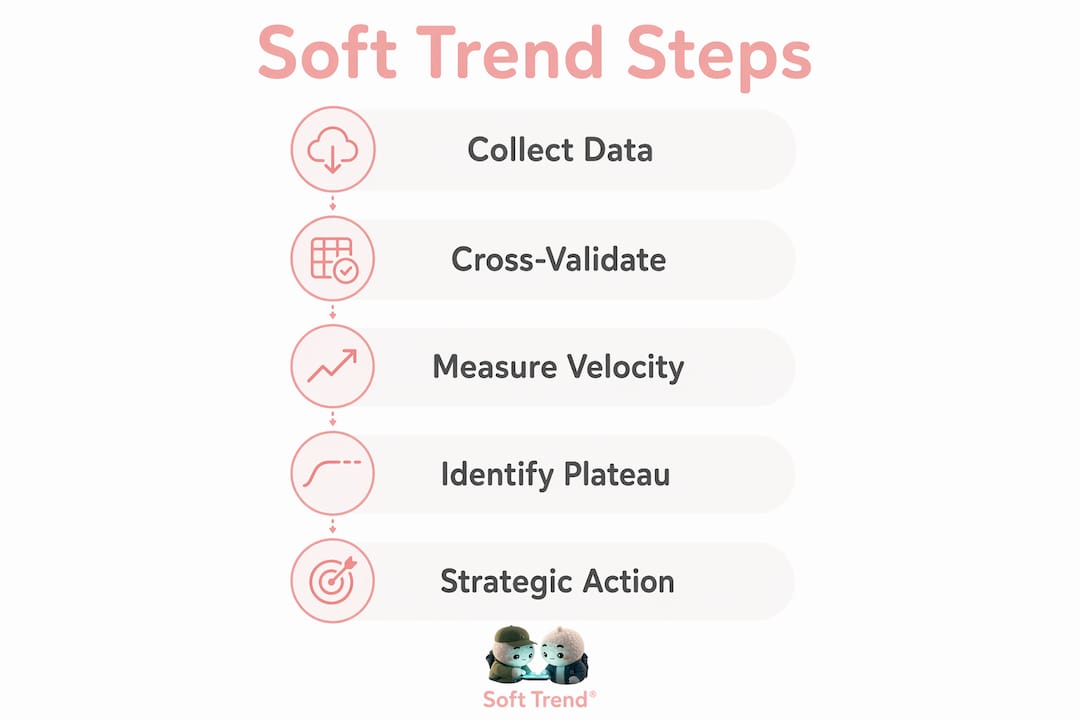
A reliable methodology for identifying soft trends follows five sequential steps. Skipping any step increases the risk of acting on noise rather than signal.
-
Define your category scope. Set clear boundaries for the market or product category you are monitoring. Vague scopes produce vague signals. A scope like "AI-assisted legal document review" yields far more useful data than "legal technology."
-
Gather signals across all four data types. Pull search volume data, community mentions, review themes, and competitor activity simultaneously. Use a consistent 90–180 day window for all sources to make comparison valid.
-
Cluster themes. Group signals by the underlying problem or behaviour they describe. A cluster of complaints about "slow onboarding" across three platforms is a theme. A single mention is not.
-
Compare volumes against your baseline. A reliable soft trend signal requires search volume at least double the trailing 12-month baseline, combined with three to five related product launches on Product Hunt within 90 days. Both conditions together carry far more weight than either alone.
-
Cross-validate across platforms. Cross-platform signals yield higher confidence than signals appearing on a single platform. If the same theme appears in search data, community forums, and competitor product updates simultaneously, the signal strength is materially higher.
One metric that separates experienced analysts from beginners is narrative velocity. Content volume doubling within 48 hours is a stronger predictive indicator than absolute volume. A topic generating 200 articles in two days is more significant than one generating 2,000 articles over six months. Velocity signals that a conversation is accelerating, not just present.
Pro Tip: Run your full five-step process monthly for active categories and quarterly for adjacent ones. Trends that matter rarely appear and disappear within a single monitoring cycle. Consistency of observation is what separates signal from coincidence.
An example from the tech sector illustrates this well. In the early months of AI-powered code review tools gaining traction, search volume for related queries doubled over a 12-month baseline. Product Hunt saw a cluster of new launches in the category within a 90-day window. Community threads on developer forums surfaced recurring complaints about manual code review bottlenecks. All three signals aligned before any major publication covered the category. Analysts who structure trend opportunities effectively using this kind of multi-source triangulation consistently identify opportunities three to six months ahead of mainstream coverage.
What common mistakes occur in soft trend analysis, and how do you avoid them?
The most common error in soft trend analysis is confusing category-level volume growth with a specific trend signal. When an entire market segment grows, every topic within it shows upward movement. That growth does not mean every sub-topic is a genuine emerging trend.
Do's and Don'ts for soft trend analysis:
- Do monitor at least four signal sources before drawing conclusions.
- Do track narrative velocity alongside absolute volume.
- Do set a defined baseline period of 12 months before declaring a trend.
- Don't act on a single-platform signal without cross-validation.
- Don't mistake a seasonal spike for a structural shift.
- Don't ignore signals of trend maturation once you have entered a category.
Trend maturation is a signal that analysts frequently overlook once they are already invested in a category. Plateauing volume and standardised competitor messaging indicate that a trend has moved from emerging to established. At that point, early-entry growth strategies no longer apply. The window for differentiation has narrowed considerably.
Customer language leads brand language by 3–9 months on emerging trend topics. This means that when competitors start using a specific term in their marketing, customers have already been using it for the better part of a year. Analysts who monitor review language rather than competitor advertising stay ahead of the cycle rather than reacting to it.
Pro Tip: When you notice that three or more competitors have adopted identical messaging around a feature or benefit, treat that as a saturation signal, not a validation signal. The opportunity has likely already peaked for early movers.
Understanding when a trend has plateaued is as valuable as spotting it early. Analysts who fail to recognise saturation continue allocating resources to a category that no longer offers differentiation.
How do you apply soft trend insights to strategic decision-making?
Distinguishing hard trends from soft trends is the foundation of sound strategic planning. Hard trends are future certainties that provide a stable foundation for investment. Soft trends are future possibilities that offer innovation opportunities precisely because their outcomes are not yet fixed. Effective strategists use both together.
The table below shows how strategic responses differ by trend type and maturity stage.
| Trend type | Maturity stage | Recommended strategic response |
|---|---|---|
| Hard trend | Any stage | Build core infrastructure and compliance around it |
| Soft trend (early signal) | Emerging | Pilot, test, and monitor without full commitment |
| Soft trend (validated) | Growing | Allocate resources and develop differentiated positioning |
| Soft trend (plateauing) | Maturing | Reassess investment and prepare to pivot |
Timing is the variable that most analysts underestimate. Acting too early on a soft trend means investing in a category that may not materialise. Acting too late means entering a saturated market. The signal cluster methodology described above gives analysts a structured basis for timing decisions rather than relying on intuition alone.
Narrative velocity plays a direct role in prioritising which validated trends deserve immediate resource allocation. When content volume around a topic doubles rapidly, the window for differentiation is open but closing. Analysts who monitor cross-sector signals consistently are better positioned to act within that window.
Identifying the right moment to act requires careful monitoring of signal maturation and competitor behaviour to avoid over-investment. The goal is not to be first at all costs. The goal is to be early enough to build a defensible position before the category becomes crowded.
Soft trend insights also feed directly into broader forecasting cycles. Analysts who feed validated soft trend signals into quarterly planning reviews give their organisations a structured mechanism for incorporating uncertainty into strategy, rather than treating it as a risk to be avoided.
Key takeaways
Soft trend analysis delivers its highest value when analysts combine multi-source signal validation, narrative velocity monitoring, and maturation awareness into a single repeatable process.
| Point | Details |
|---|---|
| Use four signal sources | Cross-validate search data, community signals, reviews, and competitor changes to reduce false positives. |
| Apply the 12-month baseline | Require search volume at least double the trailing 12-month baseline before classifying a signal as a trend. |
| Track narrative velocity | Content volume doubling in short windows predicts trend emergence more reliably than absolute volume. |
| Recognise maturation signals | Plateauing volume and standardised competitor messaging indicate the early-entry window has closed. |
| Time decisions deliberately | Act on validated soft trends during the growth stage; reassess and pivot when saturation signals appear. |
Why I think most analysts are looking at soft trends the wrong way
The standard advice on soft trend analysis focuses almost entirely on what to look for. After years of working with market signals across multiple sectors, I have found that the harder skill is knowing what to ignore.
Most analysts I have worked alongside treat volume as the primary indicator of trend strength. They build dashboards that surface the highest-volume topics and assume that is where the opportunity lies. The problem is that high volume usually means the trend is already well-known. The genuinely valuable signals are low-volume, high-velocity, and concentrated in communities that most analysts never visit.
The niche community layer is consistently underweighted. A cluster of complaints on a specialist Discord server or a recurring thread on a low-traffic subreddit often predicts category shifts months before any search volume movement is detectable. These signals require qualitative reading, not just quantitative monitoring. That is uncomfortable for analysts trained to trust numbers above all else.
My honest view is that the best soft trend analysts are also good readers of human frustration. They understand that a complaint is a demand signal in disguise. When enough people articulate the same problem in the same language, a market is forming around the solution. The data confirms what the community already knows.
The frameworks in this article give you the structure. But the instinct for which signals matter comes from spending time in the communities where your market lives, not just in your analytics dashboard. Both are necessary. Neither alone is sufficient.
— Aidil
Ontherice and AI-powered signal discovery for analysts
Soft trend analysis at scale requires more than manual monitoring across four data sources. Ontherice applies multiple AI engines to scan global data points, extract meaningful signals from noisy markets, and produce real-time rankings across sectors.

For analysts who need to move from signal detection to validated insight quickly, Ontherice's global market intelligence tools surface emerging trends before they reach mainstream awareness. The platform's ranking system is transparent, allowing analysts to interrogate why a signal is rising rather than simply accepting a score at face value. Ontherice also supports live AI-based inquiries, so analysts can test hypotheses against real-time data rather than waiting for the next reporting cycle. For teams building a repeatable soft trend monitoring process, that combination of speed and transparency is where the platform earns its place in the workflow.
FAQ
What are soft trends in business analysis?
Soft trends are future market possibilities that are uncertain but detectable through early signals. They differ from hard trends, which are near-certain future events, because their outcomes depend on conditions that have not yet resolved.
How do you validate a soft trend signal?
Validation requires cross-referencing at least four signal sources: search volume, community conversations, customer reviews, and competitor activity. A signal appearing across multiple platforms carries significantly higher confidence than one isolated to a single source.
What is narrative velocity and why does it matter?
Narrative velocity measures how quickly content volume around a topic is growing. Content volume doubling within 48 hours is a stronger indicator of trend emergence than high absolute volume, because it signals acceleration rather than sustained presence.
How do you know when a soft trend has peaked?
Plateauing search volume combined with standardised competitor messaging are the two primary maturation signals. When multiple competitors adopt identical language around a feature, the early-entry window has typically closed.
How often should analysts review soft trend signals?
Active categories warrant monthly reviews. Adjacent or lower-priority categories should be reviewed quarterly. Consistency of observation over time is what separates genuine trend signals from short-term noise.