

TL;DR:
- Microtrends signal early consumer behavior shifts before they become mainstream, offering a competitive advantage.
- They differ from macrotrends by operating within niche communities and peaking within weeks or months.
Most market analysts dismiss microtrends as noise. Too niche, too fast, too risky to act on. That instinct is understandable but costly. Understanding why identify microtrends matters is not a question of trend-chasing. It is a question of signal intelligence. Microtrends reveal where consumer behaviour is shifting before the mainstream catches up, and the gap between early signal and mass awareness is precisely where competitive advantage lives. This guide breaks down what microtrends are, why they deserve a place in your analytical framework, and how to act on them without losing strategic discipline.
Table of Contents
- Key takeaways
- Microtrends defined: how they differ from other trend types
- Why identifying microtrends matters for strategy
- How to spot and validate microtrends
- Nuances and challenges in leveraging microtrends
- Applying microtrend insights to decisions
- My take on microtrend identification
- Discover microtrend signals with Ontherice
- FAQ
Key takeaways
| Point | Details |
|---|---|
| Microtrends signal early shifts | Microtrends surface consumer behaviour changes weeks or months before macrotrends confirm them. |
| Velocity matters more than volume | A trend doubling in discussion within 48 hours predicts market movement better than a larger plateaued trend. |
| Early movers earn higher engagement | Brands adopting microtrends before saturation see 40 to 60% higher engagement rates than late adopters. |
| Treat them as experiments, not certainties | Microtrends are most useful when approached as low-cost hypotheses to test market appetite. |
| Institutional memory prevents whiplash | Tagging and categorising microtrends in dashboards stops teams from overreacting to every new signal. |
Microtrends defined: how they differ from other trend types
A microtrend is a pattern of behaviour, preference, or demand that emerges within a specific niche audience, grows quickly, and typically peaks within weeks to a few months before either fading or graduating into a broader trend. They are not a watered-down version of macrotrends. They occupy an entirely different function in your analytical toolkit.
To understand the distinction clearly, consider this comparison:
| Trend type | Duration | Scale | Audience focus | Strategic use |
|---|---|---|---|---|
| Megatrend | Decades | Global | Mass population | Long-range planning |
| Macrotrend | 3 to 10 years | Industry-wide | Broad demographic | Strategic positioning |
| Microtrend | Weeks to months | Niche or subcultural | Specific community | Early signal detection |
| Seasonal trend | Cyclical | Market-wide | Context-dependent | Campaign timing |
Where macrotrends confirm what is already happening at scale, microtrends tell you what a specific group is starting to care about. They are the early tremors before the earthquake. A community of fitness enthusiasts migrating from protein shakes to collagen peptides is a microtrend. When that behaviour spreads to mainstream health retail two years later, it becomes a macrotrend. The analysts who spotted it early had time to act.
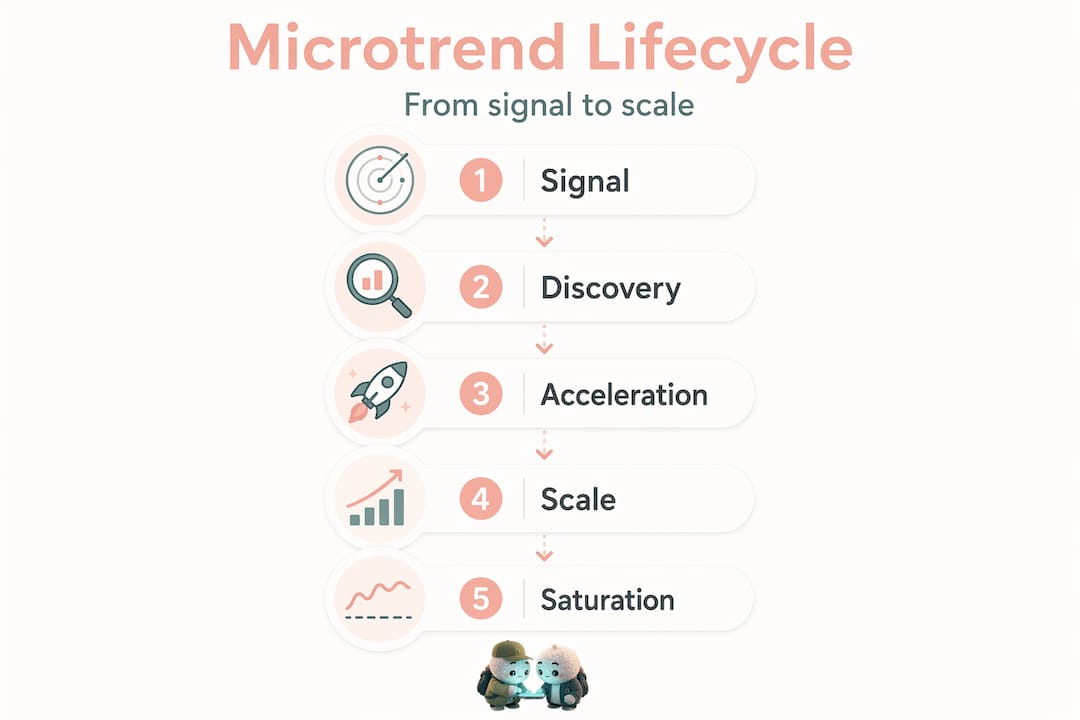
Understanding the trend lifecycle stages is what separates reactive teams from proactive ones. Microtrends sit at the very beginning of that lifecycle.
Why identifying microtrends matters for strategy
The case for tracking microtrends is not theoretical. There is measurable commercial value in getting there first. Brands that adopt early see 40 to 60% higher engagement when they act on a microtrend two to four weeks before it saturates the market. That window is narrow, which is exactly why having a structured monitoring approach matters.
Here is what microtrend identification delivers in practice:
- Early consumer intelligence. Microtrends reveal what niche audiences are beginning to prioritise, giving you first sight of demand shifts before competitors notice them at scale.
- Authentic brand connection. 92% of audiences prefer community-driven, micro-viral content over mass marketing. Microtrends let you speak directly to those communities at the moment they are forming, not after they have been commercialised.
- Niche positioning before the crowd arrives. If you can identify a microtrend in its early stage, you can establish authority, partnerships, or product positioning in a space that is not yet competitive.
- Lower-cost market research. Rather than commissioning expensive primary research, microtrend signals offer inexpensive early indicators of what is and is not resonating with specific audiences.
- Risk mitigation through early testing. When you treat a microtrend as a small experiment rather than a full strategic pivot, you gather real market data without overcommitting resources.
The flip side is equally instructive. 70% of brand trend activations fail because teams chase volume without validating whether the trend is actually relevant to their audience. Identifying microtrends properly is not about jumping on everything that moves. It is about separating signals from noise.
Pro Tip: Focus your monitoring on velocity and acceleration rather than raw volume. A conversation that doubles in size over 48 hours tells you more about future trajectory than one that already has ten times the mentions but has plateaued.

How to spot and validate microtrends
Spotting a microtrend requires discipline and the right infrastructure. Here is a practical framework that moves from detection through to validation:
-
Monitor niche platforms and subcultural signals. Mainstream channels confirm trends that have already arrived. The real signals come earlier, from Reddit subcommunities, Discord servers, early-adopter TikTok niches, and specialised forums. Set up tracking for these sources before you track the mainstream.
-
Measure velocity, not just volume. Topics that double in discussion volume within short periods forecast market movement more reliably than large but static conversations. Build velocity metrics into your dashboards from the start.
-
Look for multi-source signal convergence. A microtrend becomes worth acting on when the same signal appears across different channels simultaneously. If search interest is climbing, social discussion is accelerating, and engagement on related content is spiking at the same time, that convergence is meaningful.
-
Tag and categorise every signal you observe. Tagging microtrends in dashboards builds institutional memory. When a signal resurfaces later, or when a related trend emerges, your team has context rather than starting from scratch. This is what prevents reactive decision-making.
-
Run a short validation sprint. Before committing strategy or budget, test the microtrend's commercial fit with a 30 to 90-day experiment. Publish targeted content, run a small paid test, or introduce a limited product variant. Measure actual audience response, not just social noise.
-
Distinguish fads from signals. Ask whether the trend is tied to a deeper behavioural or values shift, or whether it is purely aesthetic and novelty-driven. Fads burn bright and vanish. Signals that connect to underlying changes in how people live, work, or spend tend to have longer trajectories.
Pro Tip: Use a trend-spotting workflow with dedicated sprint cycles rather than monitoring ad hoc. A structured spotting process turns microtrend detection from an occasional lucky find into a repeatable analytical capability.
Nuances and challenges in leveraging microtrends
Getting microtrend identification right is harder than the theory suggests. There are several failure modes that experienced analysts still fall into:
- Strategic whiplash. When teams react to every new signal without categorisation or filtering, they exhaust resources and confuse stakeholders. The antidote is institutional memory through tagging, which lets you build a record of what you observed, acted on, and learned.
- Over-investment in transient trends. A microtrend that peaks in three weeks and disappears is not a failure. It is a data point. The problem arises when teams treat every microtrend as a long-term strategic bet. Scale your investment to match the confidence level of your validation evidence.
- Psychological amplification effects. Microtrends exploit dopamine pathways, particularly in younger consumer segments, where novelty itself is the value driver. This means microtrend adoption can look like genuine demand when it is partly impulse behaviour. Separating sustained engagement from novelty spikes matters.
- Speed versus relevance tension. Moving fast is valuable. Moving fast in the wrong direction is expensive. Before activating on a microtrend, test whether it actually aligns with your brand's positioning and your audience's genuine needs.
- Confusing correlation with causation. A spike in discussion about a topic does not automatically mean your audience is ready to buy. Microtrend signals need layering with intent data before they translate into commercial decisions.
Consider a scenario where a beauty brand notices a surge in interest around a specific skincare ingredient in niche wellness communities. If they launch a full product line without testing whether their existing customer base shares that interest, they have conflated cultural signal with commercial demand. The brands that get this right test first, scale second.
Applying microtrend insights to decisions
Knowing why monitor microtrends is only half the equation. The other half is knowing how to convert what you observe into decisions that move the business.
The most practical application is content and campaign timing. When you detect a microtrend at velocity, you have a short window to produce content that speaks directly to an engaged, curious audience before the space becomes crowded. Being early here earns disproportionate visibility and credibility.
Product teams can use microtrend signals to prioritise feature development or variant testing. Rather than relying solely on annual research cycles, microtrend monitoring feeds a continuous stream of demand intelligence into the product roadmap. Small adjustments, a new flavour, a different format, a repositioned use case, can be tested against a real signal rather than a hypothesis built in isolation.
For competitive edge through trend detection, the key is integrating microtrend monitoring into your standard analytics workflow rather than treating it as a separate project. Build it into your weekly reporting, your quarterly strategy reviews, and your campaign planning process. Microtrend data becomes exponentially more useful when compared longitudinally.
The impact of early trend adoption compounds over time. Analysts who develop microtrend literacy do not just catch individual signals faster. They develop calibrated intuition for what signals are worth following, which is a capability that is genuinely difficult to replicate.
My take on microtrend identification
I have observed enough trend cycles to know that the most dangerous thing you can do with a microtrend is believe you have found the next big thing. The second most dangerous thing is ignoring it entirely.
What I have come to believe is that microtrends should be treated as cheap research experiments, not directives. When a microtrend fades without becoming a macrotrend, that is not a wasted signal. It is data that tells you what your market considered and rejected, which is often more valuable than knowing what they adopted.
The institutional memory point matters more than most teams realise. I have seen organisations react to the same trend category three separate times because no one had recorded what they observed and learned the first two times. Tagging is not administrative housekeeping. It is how you build analytical capital over time.
My honest recommendation is to blend agility with a review gate. Move fast to detect and experiment. Move deliberately to scale. The teams that do this consistently do not just catch more microtrends. They waste fewer resources on the wrong ones, and they get progressively better at distinguishing genuine signals from the noise.
— Aidil
Discover microtrend signals with Ontherice

If the framework above describes where you want to be but not yet where you are, Ontherice is built for exactly this gap. The platform uses multiple AI engines to scan global data points across markets and surfaces what is gaining momentum before it reaches mainstream awareness. You are not browsing noise. You are looking at ranked, scored signals that have already been filtered for velocity and relevance.
Market analysts can explore AI-powered opportunities across sectors and interact with live trend queries in real time. For those monitoring financial signals and consumer behaviour shifts, the AI tools catalogue provides structured access to detection capabilities that make microtrend monitoring a repeatable process rather than a manual effort. Ontherice is where the signals live before the rest of the market sees them.
FAQ
What exactly is a microtrend?
A microtrend is a pattern of behaviour or preference that emerges within a niche audience, grows rapidly, and peaks within weeks to a few months. Unlike macrotrends, they operate at subcultural scale and often serve as early indicators of larger market shifts.
Why should analysts track microtrends rather than macrotrends alone?
Macrotrends confirm what is already happening at scale, while microtrends reveal what is beginning to shift within specific communities. Tracking both gives you confirmation of the present and intelligence on the near future.
How do you distinguish a genuine microtrend from a passing fad?
Look for multi-source signal convergence across search, social, and engagement data, and assess whether the trend connects to an underlying behavioural or values shift. Purely novelty-driven spikes tend to collapse quickly. Signals tied to deeper changes in how people live or spend tend to persist.
When is it too late to act on a microtrend?
Brands that act two to four weeks before saturation earn the highest engagement advantage. Once a microtrend reaches mainstream coverage, the competitive window has largely closed, though there may still be value in category credibility rather than first-mover positioning.
How often should microtrend monitoring be reviewed?
Weekly monitoring with a monthly consolidation review is the most practical rhythm for most analyst teams. Microtrend signals move fast, and a monthly-only review cycle means you will consistently miss the actionable window.