

Evaluating trend proxies is the difference between acting on a real market shift and chasing noise. A trend proxy is a measurable short-term signal used in place of a slow-moving outcome you actually care about, such as long-term retention or revenue growth. The problem is that proxies can drift, degrade, or simply never have been the right fit to begin with. Without ongoing assessment, you are making strategic calls on a foundation you have never tested.
Core benefits of evaluating trend proxies:
- Improved sensitivity: Well-evaluated proxies detect shifts far earlier than traditional north star metrics
- Reduced false signals: Disciplined assessment filters noise from genuine directional movement
- Business context alignment: Evaluation confirms proxies reflect your specific market conditions, not generic patterns
- Causal validity: Assessment links proxy movement to real underlying dynamics, not coincidental correlation
- Faster decisions: Verified proxies let AI systems act with confidence rather than waiting for lagging indicators
AI-driven trend detection depends entirely on the quality of the proxies feeding it. Ontherice's signal scoring system applies this logic directly, ranking emerging market signals by validated proxy strength rather than raw data volume.
Table of Contents
- Common misconceptions that make proxy evaluation so easy to skip
- Best practices for evaluating trend proxies with AI tools
- Why theoretical grounding matters as much as the numbers
- How to embed proxy evaluation into your decision-making cycle
- Ontherice gives you validated signals, not raw noise
- Key takeaways
Common misconceptions that make proxy evaluation so easy to skip
The most dangerous assumption professionals make is that a proxy chosen once stays valid indefinitely. Data science practitioners are explicit on this: proxy effectiveness depends on experiment noise and sample size, both of which change constantly. A proxy that worked well in a large-scale test may be unreliable in a smaller, faster one.
A second misconception is that more sensitivity always means better. Sensitivity and directionality pull in opposite directions. Push a proxy to detect the faintest signal and it starts picking up movement unrelated to your north star outcome. The goal is balance, not maximisation of either property alone.
Business intelligence guidance adds a third caution: without evaluation, teams focus on raw spikes rather than trend slope and durability. A spike looks dramatic. A durable slope is what actually justifies capital allocation.
Key pitfalls to avoid:
- Reusing the same proxy across different experiment sizes without rechecking fit
- Ignoring noise levels that make a proxy unreliable in smaller tests
- Treating short-term spikes as structural signals without decomposition
- Skipping causal mapping, leaving proxies vulnerable to confounding variables
- Assuming proxy movement mirrors underlying reality without validation
Best practices for evaluating trend proxies with AI tools
Sensitivity and directionality are the two properties that define a proxy's quality. Sensitivity measures whether the proxy detects a statistically significant effect. Directionality measures whether it moves in the same direction as the long-term outcome you care about. Research from arXiv found proxy metrics that were 8.5 times more sensitive than short-term north star metrics while maintaining directional accuracy, achieved through multi-objective optimisation rather than single-metric selection.

Composite proxies outperform single ones. Aggregating multiple auxiliary metrics into a weighted combination achieves a Pareto-efficient balance of sensitivity and accuracy that no individual metric can reach alone. The optimal weighting is not fixed; it shifts with the noise level of each new experiment.
Pro Tip: Avoid the proxy-only trap. Always pair quantitative proxy evaluation with a causal framework check. If you cannot explain why a proxy should move when your target outcome moves, the correlation you are seeing may be spurious.
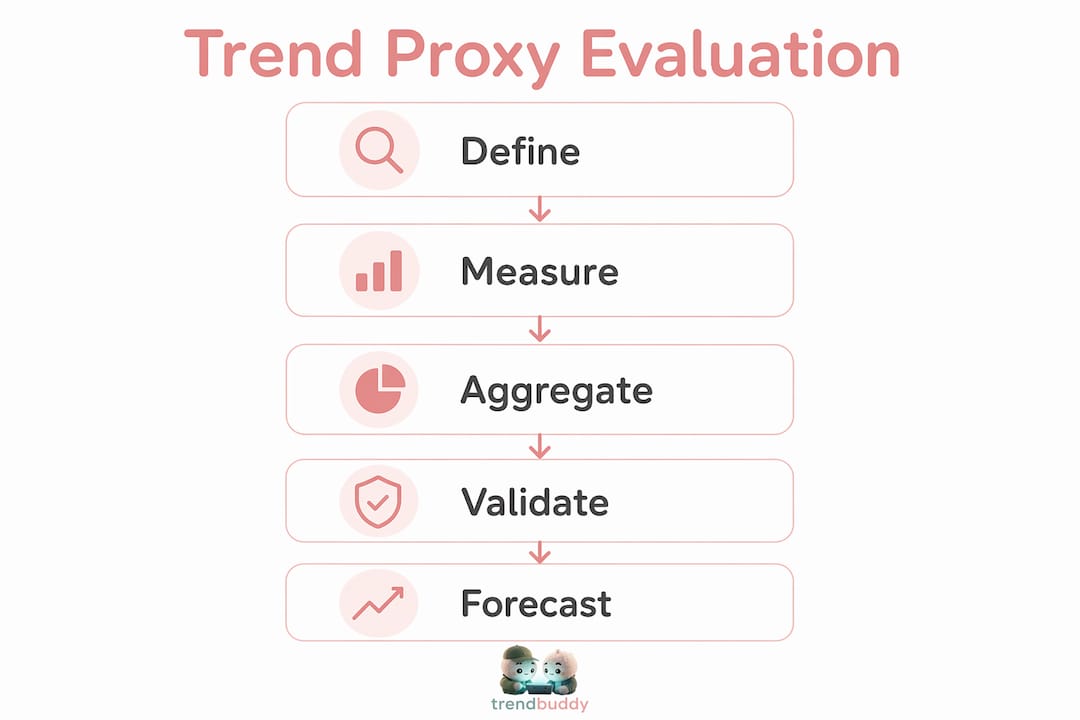
Proxy evaluation lifecycle steps:
- Validate before deploying: Confirm the proxy has genuine sensitivity issues that justify its use
- Monitor with holdbacks: Use held-back experiment groups to track whether proxy performance degrades over time
- Adjust for noise: Recalibrate proxy weights when experiment size or market conditions change
- Dimension analysis: Segment proxy performance by cohort, region, or product line to catch divergence early
- Document changes: Governance around proxy definitions prevents apparent trend shifts that are actually measurement changes
Step-by-step trend forecasting built on validated proxies produces forecasts that hold up under scrutiny. Without that foundation, even sophisticated AI models amplify the wrong signals.
Why theoretical grounding matters as much as the numbers
Political science research makes a point that applies directly to market analysis: proxy-based analyses that lack causal framework produce biased estimates and unreliable standard errors. The proxy captures noise and contamination from unrelated concepts, and the analysis reflects that contamination rather than the underlying dynamic you intended to measure.
Causal diagrams are the practical tool here. They force you to articulate what concept the proxy is supposed to represent, what other variables might influence it, and whether the relationship between proxy and outcome is direct or mediated. That exercise alone catches most proxy contamination problems before they reach a decision.
Biased proxies are not automatically useless. Statistical research shows that combining biased proxies with known bias adjustments can still maximise ranking accuracy. The condition is that the bias must be understood and signed, not ignored.
Foundational principles for proxy theory alignment:
- Map each proxy to a specific causal pathway before deployment
- Sign the bias: determine whether contamination pushes estimates high or low
- Run robustness checks across different time periods and market conditions
- Test inferential reliability by comparing proxy-based conclusions against known outcomes
Trend attribution in strategic decisions depends on this theoretical layer. Without it, you are attributing movement to causes that may have nothing to do with what actually drove the signal.
How to embed proxy evaluation into your decision-making cycle
Continuous evaluation reduces overreaction. Structured trend analysis requires consistent inputs, clear definitions, and a regular review rhythm to build institutional memory and reduce misinterpretation. Teams that review proxies on a fixed cadence learn what normal volatility looks like, which means they recognise genuine inflection points earlier.
Embedding evaluation into workflows also changes how leadership interprets AI outputs. Rather than reacting to every data movement, teams focus on whether the slope of a proxy is strengthening or weakening over multiple periods. That shift in focus is what separates disciplined market intelligence from reactive noise-chasing.
Steps for embedding proxy evaluation into strategy:
- Schedule monthly proxy reviews for operational signals, quarterly for strategic ones
- Correlate proxy movements with actual downstream outcomes to validate ongoing fit
- Use Excel for trend benchmarking to track proxy performance against historical baselines
- Incorporate scenario modelling when regulatory or competitive conditions shift
- Bring in domain expertise to contextualise quantitative proxy signals
Ontherice gives you validated signals, not raw noise
Most AI market tools hand you data and leave the proxy evaluation to you. Ontherice takes a different approach. Its AI engines score emerging signals using validated proxy metrics, filtering out noise before it reaches your screen. You get directional intelligence on what is gaining momentum, not a feed of unprocessed data points requiring manual interpretation.

For B2B professionals tracking early market signals, B2B signal discovery on Ontherice applies proxy scoring across sectors in real time. For broader opportunity identification, the AI opportunities platform surfaces trends that have passed proxy validation thresholds before they hit mainstream awareness. Start exploring what Ontherice is tracking in your market today.
Key takeaways
Evaluating trend proxies is the foundation of reliable AI-driven market intelligence: without it, sensitivity gains are meaningless and strategic decisions rest on unverified signals.
| Point | Details |
|---|---|
| Sensitivity vs directionality | Proxy metrics can be 8.5 times more sensitive than north star metrics yet still require directionality checks to remain valid. |
| Composite proxies outperform single metrics | Aggregating auxiliary metrics into weighted composites achieves a Pareto-efficient balance no single proxy can match. |
| Causal mapping prevents bias | Linking proxies to causal frameworks catches contamination before it produces biased strategic conclusions. |
| Regular cadence reduces overreaction | Monthly and quarterly proxy reviews build institutional memory and distinguish durable slopes from transient spikes. |
| Ontherice applies this at scale | Ontherice scores emerging market signals using validated proxy metrics, delivering directional intelligence before trends reach mainstream awareness. |