
Trend synthesis is the act of combining signals from multiple, often unrelated sources to produce an insight that none of those sources contains on its own. It is not about reading more data. It is about generating something genuinely new from the collision of different inputs. Where trend analysis breaks information down to find patterns within it, synthesis builds information up into a higher-order understanding that transcends any single dataset.
The distinction matters because most organisations drown in data but starve for direction. Synthesis is the process that converts noise into a clear, usable perspective.
Key elements of trend synthesis include:
- Integration across domains: drawing signals from culture, technology, economics, and behaviour simultaneously
- Emergent insight: producing conclusions that could not be extracted from any individual source, no matter how carefully read
- Creative discipline: requiring both structured method and informed judgement to connect disparate ideas
- Irreducibility: the output cannot be reconstructed simply by returning to the original inputs
How does synthesis differ from analysis and summarising?
This is where most people get confused, and the confusion is costly. Analysis and synthesis are opposites in direction, not synonyms. Analysis breaks a complex thing into parts to understand each component. Synthesis takes separate parts and constructs something new from them.

Summarising is a third operation entirely. It condenses existing information without adding anything. A summary of five reports is still just five reports, compressed. Stopping at summarisation is one of the most common mistakes in research and strategy work, precisely because it feels productive without being transformative.
| Process | Purpose | Output | Approach |
|---|---|---|---|
| Analysis | Understand components | Breakdown of parts | Deconstructive |
| Summarising | Condense information | Shorter version of inputs | Reductive |
| Synthesis | Generate new insight | Emergent, irreducible understanding | Constructive |
The practical differences worth keeping in mind:
- Analysis asks "what is happening here?" Synthesis asks "what does all of this mean together?"
- A summary is reducible to its inputs. A synthesis is not.
- Analysis is a prerequisite for synthesis, not a substitute for it.
Why trend synthesis matters for strategic insight
The volume of available trend data has grown faster than most teams' capacity to make sense of it. Synthesis is what cuts through trend overload to produce the cross-category connections that actually inform product development, brand positioning, and cultural strategy.
Consider what synthesis enables in practice:
- Product development: connecting a shift in consumer values with a gap in the market to identify a genuinely new opportunity
- Cultural trend mapping: linking signals across fashion, food, and technology to spot a macro shift before it peaks
- Brand communications: understanding not just what audiences want, but why, by reading across behavioural, social, and economic signals simultaneously
- Innovation planning: using synthesised insight to structure trend opportunities rather than chase individual signals reactively
Synthesis also changes how teams make decisions. When insight is emergent rather than aggregated, it carries a clarity that raw data cannot. Synthesis answers the question "What does all this mean, and how do we move forward from here?" That is precisely the question most strategy meetings fail to resolve.
Pro Tip: When you feel overwhelmed by competing trend reports, that is usually a signal that you are aggregating rather than synthesising. Stop collecting and start connecting.
How to conduct trend synthesis: a practical process
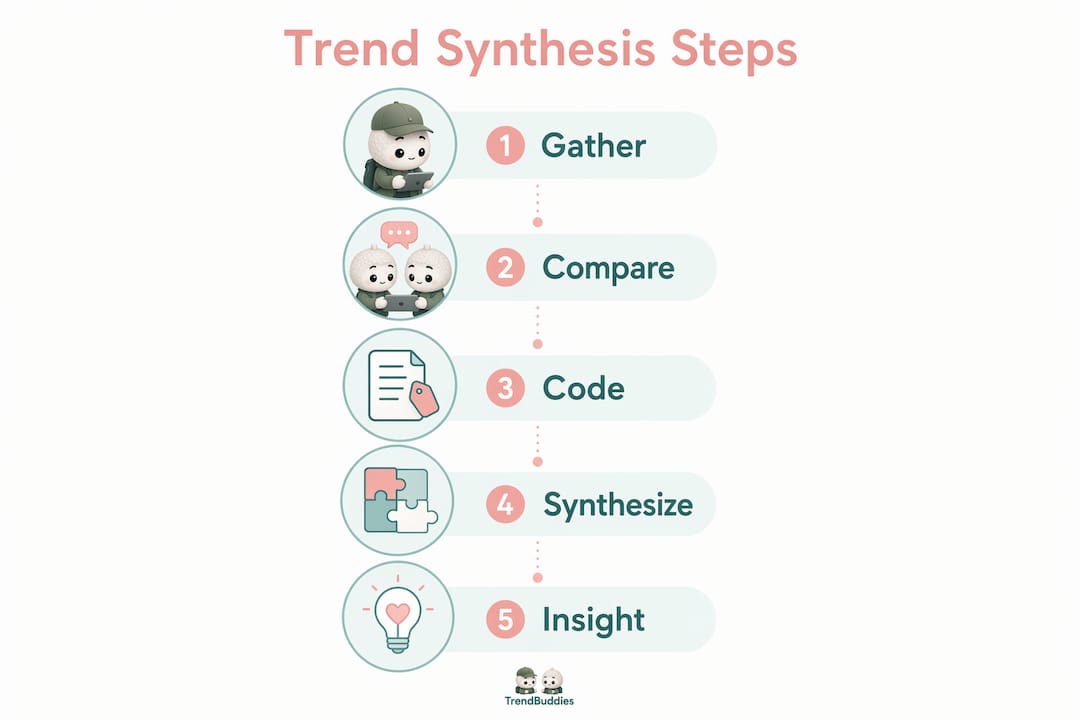
Effective synthesis follows a repeatable structure. Without one, it collapses into intuition dressed up as insight. A 30-60-90 day pipeline is one of the most practical frameworks for teams building this capability.
-
Collect from diverse sources. Pull signals from at least three distinct domains: quantitative data, qualitative research, and cultural observation. Single-domain collection produces analysis, not synthesis.
-
Define your taxonomy. Assign ownership and categorise incoming signals within the first 30 days. Without a shared classification system, different team members will interpret the same signal differently.
-
Apply fixed evaluation lenses. Use technical feasibility, operational risk, and economic impact as consistent filters. If a lens cannot be assessed, classify the signal as exploratory rather than discarding it.
-
Run pilots with success criteria. By day 60, test your synthesised hypotheses against real conditions. Define what a successful outcome looks like before you begin, not after.
-
Articulate the emergent insight. Write the synthesis as a standalone claim: "When X and Y are combined, they suggest Z." Then test it. If Z could have been found in any individual source, you have summarised, not synthesised.
-
Retire low-value feeds. By day 90, cut the sources that consistently produce noise rather than signal. A leaner, higher-quality input set produces sharper synthesis.
-
Iterate with rollback conditions. Define explicit rollback conditions before committing to any synthesised insight. Markets shift. An insight that was accurate in January may be stale by March. Rollback conditions prevent teams from building strategy on outdated foundations.
Pro Tip: Cross-comparison matrices and thematic coding are two of the most effective techniques for integrating signals from different domains. They force you to look for structural parallels rather than surface similarities.
Synthesis as a mindset: the UK perspective in 2026
The most capable strategists and designers in the UK do not treat synthesis as a one-off exercise. They treat it as a continuous discipline, a way of processing the world rather than a project deliverable. Design leaders increasingly advocate synthesis as a mindset that shifts professionals from passive consumers of information to active architects of strategy.
This matters in the UK context because British organisations face a particular version of trend overload: a market that sits at the intersection of American cultural exports, European regulatory shifts, and its own distinct consumer behaviour. Reading across those three domains simultaneously, and producing a coherent strategic view, is a synthesis problem. Tools like AI data extraction can surface candidate signals at scale, but the evaluative and creative act of connecting them remains a human one.
AI tools can surface candidate trends, but human interpretation and sensemaking remain critical to generate unique, usable insights. The machine expands the search space. The strategist does the synthesis.
Best practices for building synthesis as an organisational capability:
- Treat synthesis as a pipeline, not a project. Assign ownership, set review cadences, and build it into planning cycles.
- Use visual thinking tools such as affinity diagrams, concept maps, and ecosystem diagrams to externalise and share emerging connections.
- Distinguish between thick data (emotionally and contextually rich signals) and thin data (metrics without meaning). Synthesis needs both.
- Avoid the trap of premature closure. The most valuable insights often emerge from holding two apparently contradictory signals in tension long enough to find the third idea that resolves them.
For teams looking to synthesise trend stories with greater rigour, the shift from ad hoc interpretation to a structured pipeline is where the real capability gain lies.
Key takeaways
Trend synthesis is the highest-value operation in any information pipeline: it produces emergent insight that no individual source contains, and it is the step that converts data into strategic direction.
| Point | Details |
|---|---|
| Synthesis builds; analysis breaks down | Analysis deconstructs data into parts; synthesis constructs new insight from separate inputs. |
| Summarising is not synthesis | Condensing information produces a shorter version of what you already had, not something genuinely new. |
| Fixed evaluation lenses matter | Applying technical feasibility, operational risk, and economic impact filters keeps synthesised insights strategically relevant. |
| Rollback conditions prevent stale insight | Defining when to invalidate a synthesised view stops teams committing to outdated strategic positions. |
| Human judgement remains central | AI tools expand the signal search space, but the emergent insight itself requires human sensemaking to generate. |
Explore emerging trends with Ontherice

Ontherice uses multiple AI engines to scan global data points, extract meaningful signals, and surface emerging AI opportunities before they reach mainstream awareness. If you want to move from reading trend reports to actually synthesising what they mean for your market, Ontherice gives you the ranked signals and real-time intelligence to do it. Explore what is gaining momentum right now at ontherice.org.