
TL;DR:
- Trend synthesis transforms scattered signals into evidence-based narratives that guide decisions.
- It relies on a strong infrastructure, including a tagged signal database, clustering by tension, and human review.
Synthesising trend stories is the process of transforming scattered data points and signals into coherent, evidence-based narratives that guide real decisions. This is not the same as summarising headlines or listing what is popular. The recognised industry term for this practice is trend synthesis, and it sits at the intersection of data analysis, editorial judgement, and strategic communication. For content creators, marketers, and business analysts, mastering this process means the difference between reacting to trends and anticipating them. This guide covers the full workflow: from building your signal database to crafting narratives that demand action.
How to synthesise trend stories: the foundational workflow
Effective trend synthesis starts with infrastructure, not instinct. A broad, deep, and carefully tagged database is the non-negotiable starting point. Without it, you are pattern-matching against incomplete evidence, which produces unreliable narratives.

The core concept to understand is the "trend brick." Every signal you collect, whether a social post, a patent filing, a consumer complaint, or a niche forum thread, is a trend brick. It is a building block, not a finished insight. Raw signals must never be mistaken for trends; they require tagging and clustering before synthesis can begin. This distinction alone eliminates the most common mistake analysts make.
Your synthesis workflow needs four components working together:
- A signal database that captures sources across categories, regions, and time periods
- A tagging system that labels each signal by theme, tension, audience, and geography
- AI-assisted filtering to surface patterns across large volumes of noisy data
- Human editorial review to add context, remove false positives, and assess strategic relevance
| Component | Function | Example |
|---|---|---|
| Signal database | Stores and organises raw inputs | Tagged repository of articles, posts, and reports |
| AI filtering tools | Clusters signals by theme or tension | Pattern recognition across thousands of entries |
| Tagging system | Enables future retrieval and comparison | Labels such as "sustainability," "Gen Z," "Southeast Asia" |
| Human editorial layer | Adds context and removes noise | Analyst review of AI-generated clusters |
Pro Tip: Build your tagging taxonomy before you start collecting. Retrofitting tags to an existing database is time-consuming and inconsistent. Agree on your core label set upfront and review it quarterly.
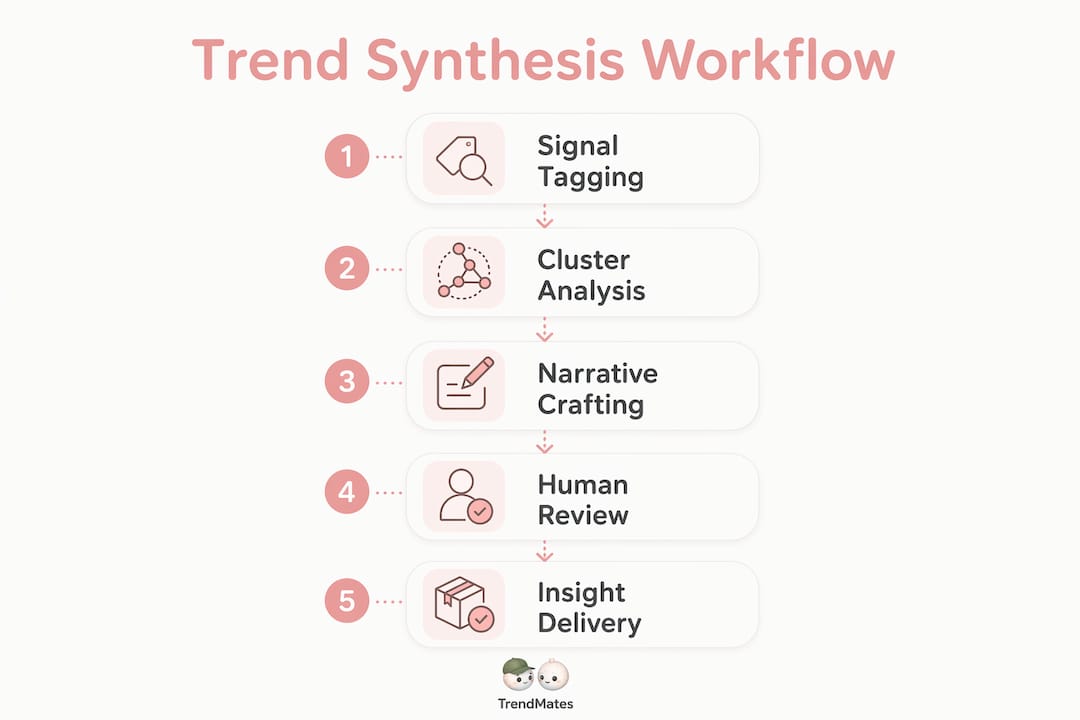
The trend spotting workflow you choose will shape everything downstream. Invest in the infrastructure first.
How do you identify and cluster trend signals?
Clustering is where raw data becomes meaningful. The goal is to group signals that share an underlying tension or cultural shift, not just a surface topic. True trends are clusters of signals linked by shared tensions, not isolated posts or headlines. A single article about cold-water swimming is a signal. Fifty signals across fitness, mental health, and anti-pharmaceutical sentiment form a cluster worth investigating.
Follow this sequence to build reliable clusters:
- Collect broadly. Pull signals from at least three distinct source types: media, consumer behaviour data, and expert commentary. Single-source clusters are fragile.
- Tag immediately. Apply your taxonomy at the point of collection. Delayed tagging introduces inconsistency and gaps.
- Group by tension, not topic. Ask what underlying shift or conflict connects these signals. "Quiet luxury" and "anti-fast fashion" share a tension around conspicuous consumption. That shared tension is the cluster's spine.
- Allow standalone signals. Not every signal belongs to a cluster yet. Forcing weak signals into existing trends creates false positives. Label them "weak signal" and revisit monthly.
- Use affinity diagrams. Physically or digitally map signals into groups. This visual step reveals connections that keyword searches miss.
- Test cluster coherence. Ask: if this cluster were a trend, what would it predict? If you cannot answer clearly, the cluster is not ready for narrative building.
Pro Tip: Tag every signal with a "why now" note. Context decay is real. A signal that made sense in january may be irrelevant by april. The timestamp and context note tell you whether a cluster is accelerating or fading.
Multidisciplinary trend analysis consistently produces stronger clusters than single-domain approaches. Pull signals from adjacent industries to stress-test your groupings.
How do you craft actionable trend narratives?
A trend cluster becomes a trend story only when it carries a clear argument. The narrative must answer three questions: what is happening, why it is happening now, and what it means for a specific decision. Effective trend storytelling demands clarity on what is new and why now, not just volume of headlines.
Structure every trend narrative with these elements:
- Context: What signals form the cluster, and over what timeframe?
- Drivers: What cultural, economic, or technological forces are accelerating this trend?
- Evidence: Which specific data points, case studies, or behaviours confirm the pattern?
- The "so what" clause: What decision does this trend inform? A campaign pivot? A product roadmap change? A new audience segment?
The "so what" clause is the most neglected part of trend writing. A "so what" clause on every trend brief connects trends to decisions and prevents analysis without action. Without it, even a well-researched narrative becomes a curiosity rather than a tool.
| Narrative approach | Strength | Risk |
|---|---|---|
| Signal-led | Grounded in evidence | Can feel fragmented without a clear argument |
| Tension-led | Reveals underlying cultural forces | Requires strong editorial judgement |
| Decision-led | Directly tied to business action | May oversimplify complex signals |
Use multi-stage AI prompts to draft narrative sections, then apply human review to sharpen the argument and remove hype language. AI excels at summarising evidence. Humans excel at framing the argument and assessing strategic weight.
Pro Tip: Write your "so what" clause before you write the narrative body. It forces you to commit to an argument upfront and prevents the common trap of describing a trend without ever landing on its implications.
For practical examples of structuring trend opportunities, the process of moving from cluster to narrative becomes significantly clearer with worked examples.
What are the most common challenges in synthesising trends?
Most synthesis failures are predictable. Recognising them early saves weeks of rework.
- Mistaking signals for trends. A single viral moment is not a trend. Require a minimum cluster size before building a narrative.
- Over-relying on AI summaries. Over-reliance on AI to summarise trend reports produces generic outputs lacking strategic depth. AI is a drafting tool, not a thinking tool.
- Failing to segment. Trend signals must be segmented by region, product, channel, or audience to reveal actionable drivers. A global trend may be irrelevant in your specific market.
- Ignoring signal decay. Trends have velocity. A cluster that was accelerating six months ago may now be plateauing. Track direction and speed, not just presence.
- Skipping the feedback loop. Editorial and agentic feedback loops that allow re-tagging and reclassification are vital. Static clusters become stale.
The most dangerous output in trend work is a confident-sounding narrative built on a single source or a poorly tagged cluster. Defensibility requires evidence, not just fluency. Before publishing any trend story, ask: could I name three distinct signals from three distinct sources that support this claim? If not, the narrative is not ready.
Pro Tip: Run a "red team" check on every trend story before it goes out. Ask a colleague to argue against the trend using the same signal pool. If the counter-argument is easy to make, your cluster needs more evidence or tighter framing.
Real-time trend insights reduce the risk of publishing narratives built on stale or thin evidence.
How should AI and human expertise work together in trend synthesis?
The most effective trend synthesis combines AI's pattern recognition with human editorial judgement. Neither works well alone. The future of trend work is human with machine. Purely AI-based summaries produce generic results lacking nuance and evidence.
The key is separating the two pipelines. AI-based trend systems should separate data gathering and analysis with different prompts and quality assurance stages. Conflating the two produces muddled outputs where raw signals are treated as confirmed trends.
A practical collaboration model looks like this:
- AI handles: signal ingestion, initial tagging suggestions, cluster mapping, and first-draft narrative summaries
- Humans handle: editorial QA, context addition, "why now" framing, "so what" clause writing, and final defensibility checks
- Iterative loop: human feedback re-enters the AI system to refine tags and reclassify signals over time
Pro Tip: Design separate prompts for data gathering and for analysis. A prompt that asks AI to "find signals about X" should never be the same prompt that asks it to "write a trend story about X." Mixing these tasks degrades output quality on both fronts.
AI tools in trend prediction work best when the human analyst defines the question and evaluates the answer. AI fills the gap between those two steps.
Key takeaways
Effective trend synthesis requires tagging every signal as a trend brick, clustering by underlying tension, and always concluding with a "so what" clause that connects the narrative to a specific decision.
| Point | Details |
|---|---|
| Tag signals immediately | Apply your taxonomy at collection to maintain consistency and enable reliable clustering. |
| Cluster by tension, not topic | Group signals around shared cultural or economic forces, not surface-level subject matter. |
| Always include a "so what" clause | Every trend narrative must conclude with a specific decision implication to avoid analysis without action. |
| Separate AI and human roles | Use AI for pattern recognition and drafting; use humans for context, framing, and defensibility checks. |
| Build feedback loops | Re-tag and reclassify signals regularly to keep clusters accurate and narratives current. |
Why I think most trend stories fail before they are written
The failure happens at the tagging stage, not the writing stage. I have reviewed dozens of trend reports from experienced analysts, and the pattern is consistent: the narrative sounds confident, but the underlying cluster is thin. Three signals from the same publication, tagged with the same broad label, do not constitute a trend. They constitute a media moment.
The "trend brick" framework changed how I approach this. Treating every signal as a building block rather than a conclusion forces patience. You collect, you tag, you wait for the cluster to earn its narrative. That discipline is uncomfortable, especially when a client wants a trend report by friday. But the alternative is publishing something that falls apart under the first serious question.
The other failure I see constantly is the missing "so what." Analysts write beautifully about what is happening and why. Then the report ends. No decision. No implication. No action. Trend analysis is a continuous loop of defining metrics, tracking changes, and deciding actions. The loop only closes when someone makes a choice. If your trend story does not force a choice, it is not finished.
My advice: embed synthesis into a repeatable rhythm. Monthly signal reviews, quarterly cluster audits, and annual narrative refreshes. Trends are not events. They are processes. Treat them accordingly.
— Aidil
Ontherice: AI-powered tools for trend synthesis
Ontherice is built for exactly this kind of work. The platform uses multiple AI engines to scan global data points, surface weak signals, and generate rankings across sectors, giving you the raw material for reliable trend clusters before they reach mainstream awareness. For content creators, marketers, and business analysts who need to move from signal to narrative quickly, the AI opportunities on Ontherice provide a structured starting point. You can also explore the general signals feed to see live signal data organised by category, making the tagging and clustering process significantly faster. Ontherice combines the breadth of AI-driven data gathering with the transparency needed for defensible, evidence-backed trend storytelling.
FAQ
What is trend synthesis in simple terms?
Trend synthesis is the process of grouping related signals into clusters and building evidence-based narratives that explain what is changing and why it matters for a specific decision.
How many signals do you need before building a trend narrative?
There is no fixed number, but a reliable cluster requires signals from at least three distinct source types. A single-source cluster is a media moment, not a trend.
What is a "trend brick"?
A trend brick is any individual signal, such as an article, a consumer behaviour data point, or a forum post, treated as a building block rather than a finished insight. Signals require tagging and clustering before they form a trend.
Why does the "so what" clause matter in trend stories?
Without a "so what" clause, a trend narrative describes change without guiding action. Every trend brief needs a decision implication to prevent analysis without action.
How do AI tools fit into trend synthesis?
AI tools handle signal ingestion, initial clustering, and first-draft summaries. Human analysts add context, frame the argument, and write the "so what" clause. The two roles must stay separate to produce defensible outputs.