

TL;DR:
- Tutorials are essential for establishing auditable, repeatable processes that improve trust and reduce AI hallucinations. They transform AI-driven insights from risky guesswork into credible, strategic intelligence, especially in fast-changing markets. Most organizations overlook the importance of tutorials, risking fragmented workflows and loss of institutional knowledge as AI tools evolve.
The rush to deploy AI-driven market intelligence tools has created a paradox for many business leaders: more data, yet less certainty. Organisations invest heavily in platforms promising real-time signals and predictive rankings, only to find that unstructured outputs, opaque sourcing, and inconsistent workflows erode trust rather than build it. The missing piece is rarely the technology itself. It is the tutorial framework that teaches teams how to use these tools in ways that are auditable, repeatable, and genuinely actionable. This guide examines exactly how tutorials bridge that gap.
Table of Contents
- Why tutorials matter for AI-powered market intelligence
- Core functions of tutorials: from mechanics to trust
- Tutorialised agent workflows: continuous, not ad hoc
- Tutorials for trend discovery and market gap analysis
- What most leaders miss about tutorials and market intelligence
- Get started with AI-driven market intelligence tutorials
- Frequently asked questions
Key Takeaways
| Point | Details |
|---|---|
| Tutorials anchor trust | They transform AI market intelligence from guesswork into auditable, reliable insight. |
| Enable repeatable workflows | Stepwise guidance supports continuous monitoring and faster trend detection. |
| Accelerate trend discovery | Tutorials make market gap and trend spotting a structured process, not just luck. |
| Mitigate AI risks | Evidence pipelines and source audits prevent hallucinations and reduce errors. |
Why tutorials matter for AI-powered market intelligence
AI-powered intelligence tools are, in many cases, genuinely powerful. But power without structure is dangerous in a professional context. Most platforms produce what practitioners call "black-box outputs": results that appear confident but offer no visible chain of evidence. For a board member or senior analyst trying to justify a strategic pivot, an unverifiable output is not just unhelpful; it is a liability.
Tutorials address this by establishing what should happen at each stage of an intelligence workflow. They define how data is gathered, which sources qualify as reliable, and how outputs should be structured so they can be reviewed, challenged, and built upon. This is not about slowing down analysis. It is about making analysis worth trusting.
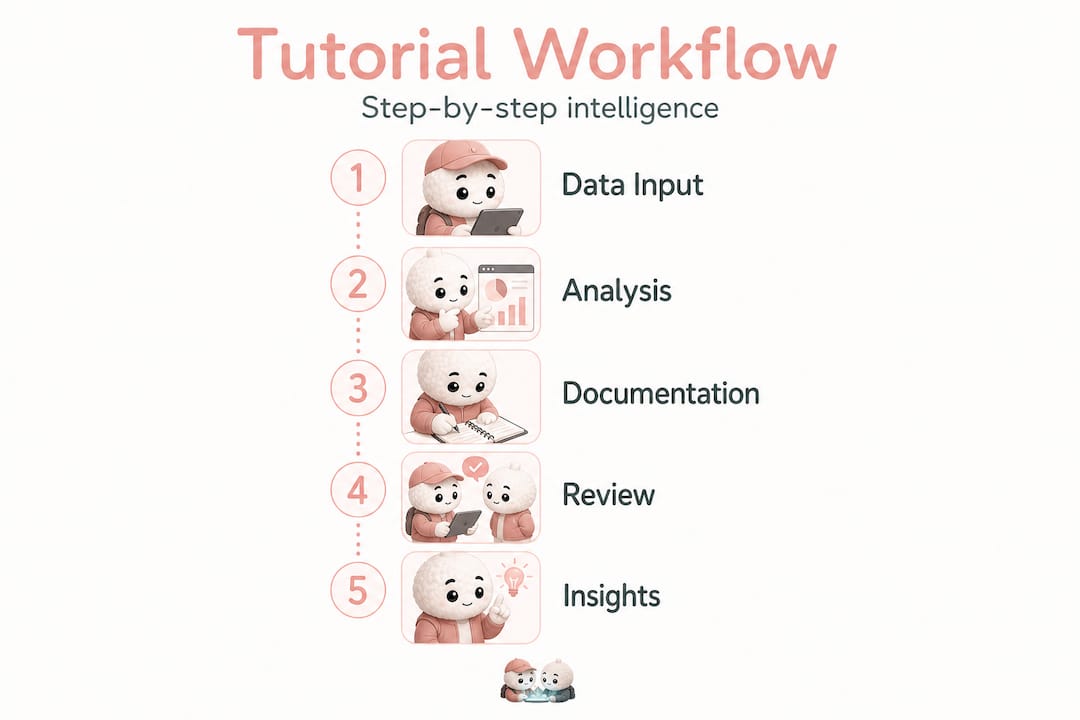
The step-by-step market intelligence approach matters because it forces teams to document decisions, not just results. When an analyst can show why a trend was flagged rather than just that it was flagged, the intelligence becomes auditable. That auditability is what separates strategic insight from expensive noise.
As
confirm, tutorials help leaders and analysts implement mechanics that reduce hallucination risk and increase traceability, two of the most persistent problems in AI-assisted research. AI hallucinations, where a model confidently states something false, are significantly less likely when a tutorial has pre-defined which sources feed the model and how outputs are cross-checked.Common pitfalls when working without tutorials:
- Unverifiable data accepted as fact because no source pipeline was established
- Missed context due to reliance on a single AI pass rather than layered evidence gathering
- Inability to trace claims back to their origin when challenged by stakeholders
- Inconsistent outputs because different analysts run queries differently
- Inability to identify when an AI model has drifted or started producing biased results
"Tutorials shift market intelligence from risky guesswork to auditable insight."
That shift is not trivial. In competitive markets where decisions about product launches, market entry, or capital allocation depend on the quality of intelligence, auditability is a strategic asset.
Core functions of tutorials: from mechanics to trust
Understanding why tutorials matter is only the beginning. The more practical question is how they deliver value at the operational level. Good tutorials do not simply tell analysts what buttons to press. They build a structured evidence pipeline that transforms raw AI outputs into trusted intelligence.
S&P Capital IQ Pro materials specifically highlight that best-practice tutorials for leaders focus less on "prompting" alone and more on establishing the evidence pipeline, the sequence of steps that determines which data enters the system, how it is processed, and how outputs are validated. This is a fundamentally different mindset from simply typing a query and accepting whatever the model returns.
The contrast between tutorial-guided and ad hoc AI usage is significant:
| Dimension | Tutorial-guided usage | Ad hoc AI usage |
|---|---|---|
| Traceability | Full source documentation | Rarely documented |
| Auditability | Reproducible steps | Varies by analyst |
| Repeatability | Standardised workflow | Inconsistent |
| Output structure | Pre-defined format | Freeform |
| Risk level | Managed and verifiable | Unpredictable |
The table above illustrates why organisations that rely on unguided AI queries consistently produce results that cannot be defended in a boardroom or strategy session. Tutorial-guided usage forces consistency and creates outputs that hold up under scrutiny.
Core functions that effective tutorials deliver:
- Evidence gathering: Define which data sources are admissible and how they should be accessed, whether through databases, news feeds, patent filings, or social signals.
- Source qualification: Establish criteria for determining whether a source is reliable, timely, and relevant to the intelligence task.
- Structured outputs: Mandate a consistent format for presenting findings so that results can be compared across time periods, markets, or analysts.
- Audit link-back: Require that every claim in an output links back to the specific source that supports it, creating a traceable chain of evidence.
These four functions are what real-world AI intelligence strategies depend on to produce insights that are repeatable and credible rather than one-off curiosities.
Pro Tip: When auditing market insights from any AI platform, demand tutorials that explicitly show their source pipeline. If a vendor cannot demonstrate where their data originates and how it is validated, treat their outputs with caution regardless of how polished the interface appears.
Tutorialised agent workflows: continuous, not ad hoc
One of the most significant shifts that tutorial-based approaches enable is the move from reactive, one-off analysis to continuous, automated intelligence gathering. Many organisations still treat market intelligence as a project: something you commission when a decision looms. That model is increasingly inadequate in fast-moving sectors where competitive signals can emerge and dissipate within days.

Continuous intelligence means your team is always monitoring, not just occasionally looking. This is only sustainable when workflows are standardised through tutorials. Without a tutorial framework, continuous monitoring quickly becomes chaotic, with different team members pulling data in different ways and producing results that cannot be reconciled.
As Claude Lab's tutorial demonstrates, tutorialised agent workflows operationalise market intelligence as continuous monitoring rather than ad hoc analysis. The practical difference is significant for competitive intelligence leaders.
| Dimension | Static intelligence | Real-time intelligence |
|---|---|---|
| Cadence | Monthly or quarterly | Daily or continuous |
| Update method | Manual research | Automated agent workflows |
| Risk profile | High (slow to detect threats) | Lower (early warning signals) |
| Trend detection speed | Weeks to months | Hours to days |
| Analyst burden | High | Reduced through automation |
The data above makes the case for investment in continuous workflows. A competitor can reposition, a regulatory change can land, or a consumer sentiment shift can begin and be well underway before a quarterly intelligence cycle even begins. Tutorialised workflows close that gap.
Workflows most commonly enabled by tutorial-based continuous monitoring include:
- Competitor scanning: tracking product launches, pricing changes, and hiring signals across defined rivals
- Price monitoring: detecting shifts in market pricing within specific categories or geographies
- Trend detection: identifying rising signals in consumer behaviour, technology adoption, or regulatory movement before they reach mainstream commentary
- Sentiment analysis: measuring how target audiences feel about brands, categories, or themes in near real time
Pro Tip: Standardise your tracking dimensions before you build any continuous workflow. Decide in advance what you are measuring, how often, and against which baseline. This ensures results remain comparable across time rather than becoming a collection of disconnected snapshots.
Competitive trend monitoring becomes genuinely powerful when these workflows are codified through tutorials rather than left to individual interpretation.
Tutorials for trend discovery and market gap analysis
Perhaps the most commercially valuable application of tutorial frameworks is in the discovery of emerging trends and the identification of market gaps. This is where the difference between a lucky analyst and a repeatably effective intelligence function becomes most visible.
Without a structured tutorial, trend discovery tends to rely on intuition, serendipity, and whoever happens to be reading the right publications. With a tutorial, it becomes a repeatable discipline. As Coursera's market analysis guidance confirms, tutorials improve the ability to discover emerging trends by providing stepwise techniques for trend identification and market gap discovery.
A practical step-by-step example for trend identification:
- Data gathering: Pull structured signals from pre-qualified sources including search trend databases, industry publications, patent filings, and social listening tools.
- Sentiment scanning: Apply sentiment analysis across gathered data to identify which topics are generating increasing positive or negative attention within your target market.
- Gap mapping: Cross-reference identified trends against existing product or service offerings in your category to locate where demand is emerging but supply is lagging.
- Competitive positioning: Assess which competitors, if any, are already addressing identified gaps, and evaluate the strength of their current positioning relative to the opportunity.
- Signal scoring: Rank identified trends and gaps by signal strength, growth trajectory, and strategic relevance to your organisation's priorities.
This approach converts what would otherwise be an opinion-led exercise into a documented, evidence-supported process. Critically, it can be run again by a different analyst and produce comparable results because the tutorial defines the method, not just the goal.
The InfraNodus platform, cited in Coursera's market analysis guidance, frames dedicated tutorials for sentiment analysis, competitive intelligence, innovation and trends, and content gap analysis as core tasks in any mature intelligence function. This framing reinforces the idea that tutorials are not supplementary materials but foundational components of serious market intelligence work.
Common market gaps surfaced through tutorial-guided discovery:
- Underserved customer segments within a growing category
- Geographic markets where demand signals are rising but established players have minimal presence
- Product features that consumers consistently request but competitors consistently overlook
- Timing opportunities where demand is building ahead of available supply
AI-driven trend identification is most effective when these tutorials are embedded into the analytical process from the outset rather than applied after the fact. And for those tracking broader shifts, staying current with market intelligence trends provides the strategic context that keeps tutorial-driven discovery focused on what genuinely matters.
"Tutorials shift trend discovery from luck to repeatable results."
That shift is the commercial argument for embedding tutorials into your intelligence function. Luck is not a competitive advantage. Repeatability is.
What most leaders miss about tutorials and market intelligence
Here is an uncomfortable observation: most organisations that invest in AI-driven market intelligence tools spend the majority of their attention evaluating features, interface quality, and data coverage. Very few ask the harder question, which is whether the tool comes with tutorials that make its outputs auditable and reproducible.
This is a strategic error. Tool features become commoditised quickly. The evidence pipeline that your team builds around a tool, guided by strong tutorials, is not commoditised. It becomes institutional knowledge. It compounds over time as your team refines its approach and as the tutorials evolve to reflect new market conditions.
There is also an organisational resilience argument that rarely gets made. When tutorials document not just what a workflow does but why each step exists, new analysts can onboard faster, reproduce past work, and identify when outputs look anomalous. Without tutorials, the departure of one experienced analyst can wipe out years of methodological knowledge. With them, that knowledge lives in the process, not the person.
The deeper value of tools linked to dynamic market tools is not the data volume they process. It is whether they equip your team with the transparency needed to defend decisions when they are challenged.
Pro Tip: Make regular tutorial reviews a board-level governance item. As AI models update and market conditions shift, the tutorials that guide your intelligence workflows need to be reviewed for drift. Algorithmic drift, where a model begins producing systematically different outputs due to underlying changes, is a real risk that tutorial reviews can catch before it corrupts your intelligence.
"The real advantage is not just more insight. It is sustainable, auditable market intelligence that leaders can trust."
The organisations that will maintain competitive advantage in the next decade are not necessarily those with the most powerful AI tools. They are those that have built the most transparent, reproducible, and institutionalised intelligence workflows around those tools. Tutorials are the mechanism that makes that possible.
Get started with AI-driven market intelligence tutorials
The principles covered in this guide are not theoretical. They are directly actionable using the right platforms. OnTheRice.org is designed specifically to help business leaders and analysts move from reactive information consumption to proactive, tutorial-guided trend discovery.

OnTheRice scans global data points, extracts rising signals, and scores emerging trends across diverse markets in real time. For leaders ready to apply the tutorial frameworks discussed here, B2BSignals offers structured intelligence for business-to-business markets, while AIOpportunities surfaces emerging opportunities in the AI sector with transparent scoring. AiTools provides ranked, auditable signals across the AI tools landscape. These platforms pair the signal intelligence you need with the transparency that makes it trustworthy.
Frequently asked questions
How do tutorials reduce mistakes in AI-driven market intelligence?
Tutorials enforce evidence collection and traceability at each step, making it significantly less likely for AI outputs to be mistaken or unverified before reaching decision-makers.
What is the difference between ad hoc and continuous market intelligence workflows?
Continuous workflows are tutorial-guided and monitor markets in real time, whereas ad hoc analysis only captures a snapshot of conditions at a single point in time.
Which key tasks are best addressed with market intelligence tutorials?
Trend identification, sentiment analysis, competitive mapping, and market gap discovery deliver the most value when guided by tutorials, as InfraNodus' structured approach to each task demonstrates.
How do tutorials help organisations adapt to fast-changing markets?
By standardising workflows and qualifying sources in advance, tutorials equip teams to spot market shifts consistently and evaluate emerging information against a reliable, pre-established framework rather than reacting on instinct.