

TL;DR:
- Clear objectives and key questions are essential for effective market intelligence.
- Combining primary and secondary data with analysis techniques creates strategic insights.
- Effective dissemination and continuous improvement drive decision-making impact.
Most organisations sit on mountains of market data yet struggle to translate it into decisions that move the needle. The gap between information and action is where competitive advantage is won or lost. Market intelligence follows a systematic process of five to seven steps, but very few teams execute it with the rigour needed to generate measurable impact. This guide walks you through each stage, from setting sharp objectives to disseminating intelligence that actually changes behaviour, with practical shortcuts for analysts and decision-makers who need results, not theory.
Table of Contents
- Establishing objectives and key questions
- Gathering primary and secondary data
- Analysing and synthesising market intelligence
- Disseminating insights and acting on intelligence
- What most market intelligence guides miss: a pragmatic perspective
- Unlock advanced market intelligence with OnTheRice solutions
- Frequently asked questions
Key Takeaways
| Point | Details |
|---|---|
| Set clear objectives | Well-defined questions and goals prevent data overload and ensure intelligence is actionable. |
| Balance data sources | Combining primary and secondary research delivers richer insights and strategic edge. |
| Prioritise analysis | Focus on synthesis and actionable frameworks to deliver real impact, not just information. |
| Communicate for action | Effective reporting drives adoption and embeds intelligence in decision-making. |
| Continuous improvement | Regular review and adaptation maximise market intelligence ROI and competitive advantage. |
Establishing objectives and key questions
Every effective market intelligence programme begins with a deceptively simple question: what decision does this intelligence need to support? Without a clear answer, teams end up collecting data for its own sake, producing reports that gather dust and consuming budget without generating value. Clarity at this stage is not optional; it is the single biggest predictor of whether your intelligence effort will matter.
The most reliable way to establish focus is to define Key Strategic Questions (KSQs) alongside Key Intelligence Topics (KITs). KSQs are the high-level questions your executives genuinely need answered, such as "Which adjacent markets represent the highest growth opportunity in the next 18 months?" or "How is our largest competitor repositioning its pricing strategy?" KITs are the thematic categories that feed those questions, for example competitor activity, regulatory shifts, or customer behaviour changes.
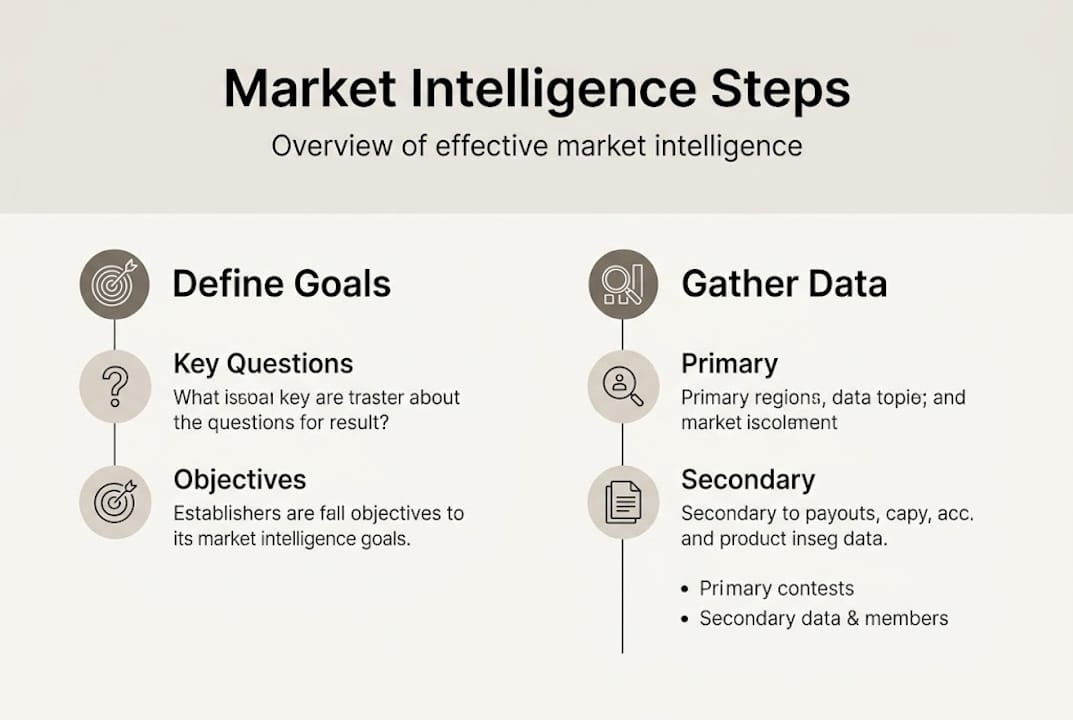
To surface genuine KSQs, run structured briefing sessions with senior stakeholders. Ask them what keeps them awake at night, what decisions they are facing in the next quarter, and what information gaps make them uncomfortable. This process often reveals that different functions have conflicting priorities, which is exactly the kind of tension you need to resolve before a single data point is collected.
Here is a practical checklist for this stage:
- Define two to four KSQs that map directly to live business decisions
- Assign an owner to each KSQ who will be accountable for acting on the findings
- Identify the minimum viable intelligence needed to answer each question
- Set a delivery timeline that aligns with the relevant decision window
- Agree on the format stakeholders will actually use (briefing note, dashboard, verbal summary)
Pro Tip: Use templates for reports and briefing structures from the outset. Standardised formats reduce the cognitive load on both producers and consumers of intelligence, making it far easier to scale the process across teams.
A well-scoped objective also prevents the most common failure mode in market intelligence: data overload. When every question is equally important, nothing is prioritised, and analysts spend their time aggregating rather than thinking. Radical clarity at the objective-setting stage is what separates intelligence programmes that drive strategy from those that merely describe it.
Gathering primary and secondary data
With objectives locked in, the next challenge is sourcing the right data without drowning in it. Market intelligence draws from two distinct streams, and understanding the difference between them is critical for building a complete picture.
Primary data is information you generate directly: win/loss interviews, customer advisory panels, expert calls, proprietary surveys, and field observations. It is time-consuming and sometimes expensive, but it is also the only source of signals that your competitors cannot access from the same reports you are reading. Primary research is essential for non-public signals, and it is where genuine strategic differentiation lives.

Secondary data includes published reports, news feeds, regulatory filings, patent databases, earnings call transcripts, and AI-driven platforms. It is faster and cheaper, but it is also available to everyone, which means it rarely provides a lasting edge on its own.
| Data type | Speed | Cost | Uniqueness | Best use |
|---|---|---|---|---|
| Primary (interviews, surveys) | Slow | High | Very high | Non-public signals, deep context |
| Secondary (reports, databases) | Fast | Low to medium | Low | Market sizing, trend confirmation |
| AI-driven platforms | Very fast | Medium | Medium | Early signal detection, volume scanning |
The practical challenge is that 55% of intelligence teams report data overload as a significant barrier. The solution is not to collect less data; it is to collect more deliberately. Before you open a single database, map each data source back to a specific KSQ. If a source cannot answer a question you have already defined, it does not belong in your collection plan.
For early signal detection at scale, platforms that scan social trends signals across global markets can surface momentum shifts weeks before they appear in formal research. Pair these with structured primary interviews and you have a collection approach that is both wide and deep.
Pro Tip: Rotate your primary research panel every six months. Over time, regular contacts develop an awareness of what you are looking for and unconsciously shape their answers to meet your expectations, which degrades signal quality.
Analysing and synthesising market intelligence
Data collection is where most teams spend the majority of their time. Analysis is where the value is actually created. This distinction matters enormously: World Class CI teams, which represent the top 7% of practitioners, consistently prioritise analysis over monitoring, and it shows in their outcomes.
Selecting the right analytical framework depends on your KSQs. A few of the most effective options:
- SWOT analysis: Best for synthesising internal capability gaps against external market dynamics. Most useful when tied to a specific strategic decision rather than used as a generic audit.
- Competitor profiling matrix: Maps rivals across dimensions such as pricing, product capability, go-to-market approach, and financial health. Reveals where competitors are vulnerable and where they are investing.
- Trend detection and scenario modelling: Identifies directional shifts in the market and stress-tests your strategy against plausible futures. Particularly valuable in fast-moving sectors.
- Porter's Five Forces: Useful for assessing structural attractiveness of a market segment, especially when evaluating entry or exit decisions.
"The difference between intelligence and information is synthesis. Raw data describes the world; synthesised intelligence tells you what to do about it."
GenAI tools have transformed the speed of analysis, particularly for summarising large document sets, generating first-draft competitor profiles, and identifying thematic patterns across hundreds of sources. However, GenAI risks producing polished outputs that lack genuine depth when not grounded in proprietary data or retrieval-augmented generation (RAG) approaches. The output looks authoritative but may simply reflect the same publicly available consensus your competitors are reading.
To get the most from AI tools for analysis, feed them your own primary research, internal sales data, and proprietary signals rather than relying solely on open-web queries. This is what transforms a generic summary into a genuinely differentiated insight. Exploring AI-driven opportunities in your specific sector can also surface competitive angles that standard frameworks miss. Cross-referencing these findings against business signals adds another layer of validation before you commit to a recommendation.
The synthesis step is where you move from "here is what we found" to "here is what it means and what we recommend." Every analysis output should end with a clear, defensible recommendation tied directly to one of your original KSQs.
Disseminating insights and acting on intelligence
Producing excellent analysis and failing to communicate it effectively is one of the most common and costly mistakes in market intelligence. The format of your output should be determined by the audience and the decision it needs to support, not by what is easiest to produce.
The most effective intelligence outputs include:
- Battlecards: Concise, one-page competitor summaries designed for sales teams. They answer the question "how do we win against this competitor today?"
- Executive intelligence briefs: Two to three page summaries that connect market signals to strategic options. Written for speed, not comprehensiveness.
- Live dashboards: Real-time views of key metrics and signals, useful for ongoing monitoring but only valuable when tied to defined thresholds that trigger action.
- Scenario briefings: Structured presentations that walk decision-makers through plausible futures and their implications for current strategy.
Embedding intelligence into workflows is what separates teams that inform decisions from those that merely produce reports. Schedule intelligence reviews at the same cadence as your strategic planning cycles. Make it a standing agenda item in leadership meetings. Actionable reports lose their value rapidly when they sit outside the decision-making process.
Measuring impact is equally important. Teams that track utilisation rates, decision influence metrics, and downstream revenue outcomes are far better positioned to secure ongoing investment in their intelligence function. Useful metrics include:
- Number of decisions directly informed by intelligence outputs
- Time from signal detection to strategic response
- Revenue or cost outcomes attributable to intelligence-driven decisions
- Stakeholder satisfaction scores from intelligence consumers
Pro Tip: For structured intelligence reporting frameworks, use a consistent template that includes a one-sentence "so what" at the top of every output. Stakeholders who are time-pressed will read that sentence even when they skip everything else.
Continuous improvement is the final element. After each major intelligence cycle, run a brief retrospective: what signals did you miss, what sources underperformed, and which outputs generated the most decision impact? This feedback loop compounds over time and is what builds genuinely world-class intelligence capability.
What most market intelligence guides miss: a pragmatic perspective
Most guides to market intelligence focus heavily on the mechanics of data collection and spend far too little time on the harder problem: building the organisational habits that make intelligence stick. The uncomfortable truth is that the tools matter far less than the questions you ask before you open them.
Conventional wisdom overvalues monitoring. Scanning dashboards and aggregating reports feels productive, but it rarely produces the insight that changes a strategic decision. The teams that consistently outperform do so because they spend more time on analysis and synthesis, not because they have access to better data sources.
There is also a growing risk of over-reliance on secondary and recycled data. When every team in your industry is reading the same reports and querying the same AI tools with the same prompts, the resulting intelligence converges. It describes the consensus, not the edge. Primary research, proprietary signals, and genuine analytical rigour are what create differentiation.
For lean teams, the answer is radical focus. Pick fewer questions, go deeper on each one, and resist the temptation to cover everything. The expert AI tools insights available today are powerful, but they amplify the quality of your questions rather than substitute for them. Ask better questions and you will get better intelligence, regardless of which platform you use.
Unlock advanced market intelligence with OnTheRice solutions
The framework above works best when supported by tools that automate the time-intensive parts of data gathering and signal detection, freeing your team to focus on analysis and strategic synthesis.
OnTheRice is built precisely for this. Its AI engines continuously scan global data points to surface AI-powered market opportunities before they reach mainstream awareness, giving your team the early-mover advantage that manual monitoring simply cannot match. For B2B analysts, real-time business signals track momentum shifts across sectors as they happen. And for organisations operating across borders, international trend signals provide the geographic breadth that single-market tools miss. Explore how OnTheRice can accelerate every step of your intelligence process.
Frequently asked questions
What is the difference between market intelligence and market research?
Market intelligence is continuous and forward-looking, designed to inform ongoing strategic decisions, while market research is project-based and typically focused on answering specific questions within a defined timeframe.
Why is primary data essential for strategic decisions?
Primary data provides non-public signals and richer context that secondary sources cannot replicate, enabling decisions that go beyond the industry consensus available to all competitors.
How can teams avoid data overload?
Teams reduce overload by anchoring every data source to a pre-defined strategic question. 55% of intelligence teams cite overload as a barrier, and the solution is deliberate scoping before collection begins, not after.
What are the key benchmarks for market intelligence ROI?
Empirical benchmarks show CI ROI at 5.2x, with teams that use intelligence tools decisively delivering 12% higher revenue growth than those that do not.