
Hiring trend signals track the open roles, hiring velocity and department-level headcount changes a company posts publicly, and they exist because a job advertisement is one of the earliest paper trails a business leaves before it spends money elsewhere. Sales teams, recruiters and market analysts use them to spot capability build and procurement intent weeks before a press release confirms it. The single most useful move: prioritise accounts showing first-of-role postings or a sharp rise in hiring velocity, since both point to fresh budget rather than routine turnover.
TL;DR:
- First-of-role postings or rapid hiring velocity increases strongly indicate new budget approval rather than routine turnover, meriting priority.
- Signals are triggered by public events like job postings, edits, or executive statements, with data sources varying in freshness and reliability.
- Department-specific hiring patterns reveal different strategic intentions, such as engineering for infrastructure or sales for market expansion.
- Combining hiring signals with funding, leadership changes, and sector trends increases accuracy, reducing false positives from hiring noise.
- Most signals come from public data, requiring ethical use focused on company or department levels, avoiding targeted profiling of individuals.
Table of Contents
- What creates a hiring trend signal in the first place
- What department-level signals actually tell you
- Inside a signal: the fields that actually matter
- How sales, recruiters and analysts actually use these signals
- Reading the metrics without chasing noise
- How Ontherice builds and checks its signals
- Combining hiring signals with the rest of your market intelligence
- What this looks like in practice
- The tooling landscape for tracking hiring signals
- Privacy and ethics: what's fair game and what isn't
- Common pitfalls before you act on a signal
- Try Ontherice's real-time hiring signal feeds
- Sources
- FAQ
What creates a hiring trend signal in the first place
A signal is not a guess. It's triggered by a specific public event: a new posting appears, an existing one gets edited, a careers page adds a department that wasn't there last week, or an executive mentions a hiring push on LinkedIn. Funding announcements and M&A filings often arrive first and explain why the postings follow days or weeks later.
Data sources vary a lot in freshness. Careers pages update the moment a company publishes a role, but scraping them at scale is messy. Applicant Tracking Systems (ATS) like Greenhouse or Lever expose structured data through public job boards, which is cleaner but sometimes lags the careers page by a day or two. Job boards themselves aggregate from both and add their own indexing delay. Executive posts on social platforms are the fastest indicator of intent but the least structured.
The pipeline that turns this into something usable runs in three steps:
- Event capture: a posting, edit, or public statement is detected across a data source.
- Classification: the event is tagged by department, seniority, location and whether it's a new role or a backfill.
- Threshold and emission: once enough activity clears a set bar (a velocity threshold, a headcount percentage), a signal is emitted with a strength rating.
What department-level signals actually tell you
Different departments hiring tells you different things about what a company is about to do, which is why treating "hiring is up" as one undifferentiated blob wastes the most useful part of the data.
- Engineering (roles like Staff Backend Engineer, Platform Engineer): usually points to product build or infrastructure investment.
- Sales (Enterprise Account Executive, Sales Development Rep): often signals a new territory push or a product ready to sell.
- Marketing (Demand Generation Manager, Product Marketing Lead): frequently precedes a launch or rebrand.
- Product (Senior Product Manager): tends to follow funding, since new PM headcount usually means new roadmap money.
- Finance (Controller, FP&A Analyst): can indicate preparation for a raise, audit, or acquisition.
- Legal (Corporate Counsel): sometimes precedes M&A activity or regulatory expansion.
- HR and security (Talent Partner, Security Engineer): HR growth often follows a funding event; security hiring frequently follows a compliance requirement or breach.
First-of-role postings, where a company hires for a title it has never had before, deserve more weight than a backfill. A backfill just replaces someone who left. A first-of-role posting means new budget was approved for a function that didn't exist, which is a stronger procurement or capability signal every time.
Inside a signal: the fields that actually matter
A well-built hiring trend signal isn't a single number. It's a small-structured record, and each field answers a different question about how urgent or reliable the signal is.
- Open role count: total live postings tied to the signal.
- Open roles as % of headcount: normalises the count so a five-person startup adding two roles reads correctly against a 2,000-person company adding twenty.
- Sample titles: the actual job titles, which tell you whether this is engineering, sales, or something narrower.
- Source links: direct links to the postings, so you can verify the claim yourself rather than trusting a black box.
- Location and posted date: geography plus timing, which matters for territory expansion reads.
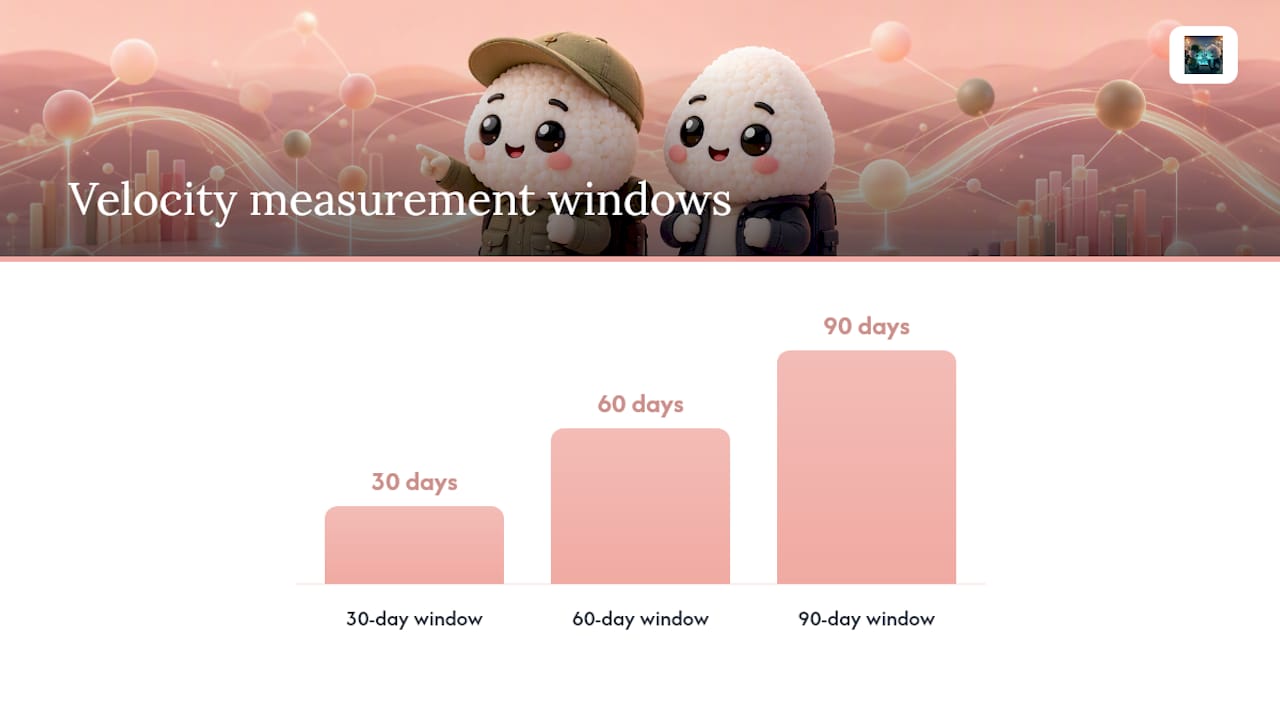
Derived metrics turn raw postings into something you can act on. Signal strength bands (low, medium, high) summarise multiple inputs into one glance. Velocity measures roles opened within a 30, 60 or 90 day window, and a fast 30 day spike reads very differently from the same count spread over 90 days. Shelf-life is how long a role stays open; a posting live for 100 days with few applicants tells a different story than one filled in a week. Repost density flags roles that keep getting relisted, often a sign of a hard-to-fill requisition rather than growth.
Refresh cadence changes how you should treat the signal. A daily-refresh feed catches a spike almost as it happens, but daily data also carries more noise, a role posted and pulled within 48 hours can trip a threshold that a weekly rollup would smooth out. Weekly refresh trades speed for stability. The market backdrop matters too: the Job Openings and Labor Turnover Survey put the US hires rate at approximately 3.2% in July 2026, with job openings near 7 million, reflecting a low-hire, low-fire environment where a genuine spike stands out more than it would in a hotter market.
How sales, recruiters and analysts actually use these signals
Three roles read the same data completely differently, and each has a workflow worth stealing.
- Sales and business development triage accounts by signal strength and use the specifics as messaging hooks. A first-of-role Head of Data posting is a better opener than "I noticed you're growing," because it names the exact gap your product might fill. Timing matters: reach out inside the signal window, while the role is still open, not after it's filled and the buying moment has passed.
- Recruiters and talent acquisition teams use signals two ways: sourcing companies actively hiring for roles similar to their own client mandates, and spotting difficult-to-fill requisitions through the combination of long shelf-life and low applicant counts. That combination is a strong cue that a company might need outside recruitment help, which shapes how a preferred supplier list (PSL) pitch gets built.
- Market analysts roll signals up across a sector to build capability-build heatmaps, tracking where AI infrastructure hiring or security hiring is clustering before it shows up in earnings calls. ManpowerGroup's Q4 2026 outlook found 62% of employers were hiring for changing roles and skills rather than like-for-like replacement, which is exactly the pattern department-level signals are built to catch early.
Pro Tip: Set a recurring weekly review of only first-of-role signals in your target accounts. It takes ten minutes and surfaces the highest-confidence prospects before your competitors' generic "companies hiring" alerts do.
Reading the metrics without chasing noise
Not every uptick in postings is worth acting on, and treating raw counts as gospel is the fastest way to waste a sales team's time.
Velocity, roles opened in a window divided by headcount, is the first filter. The same single role at a 5,000-person company is statistical noise.
- First-of-role postings mean new budget, so they should always outrank backfills in priority.
- Repeated reposts of the same requisition usually mean the company can't fill it internally and may be open to external recruitment support.
- Long shelf-life plus low applicant counts together flag a hard-to-fill role, often the clearest vendor or staffing opportunity in the whole feed.
- Stacked signals raise confidence fast. Funding round, then an executive hire, then a hiring spike in the department that executive leads, is a much stronger pattern than hiring alone. Signalbase's analysis of company lifecycle stages treats this funding to exec to hiring sequence as the clearest read on where a business actually sits.
When you see hiring activity without any of funding, leadership change or a public statement backing it, treat the signal as low confidence. Isolated data points are common; Indeed's HiringLab noted the vacancy-to-unemployment ratio sitting near 1.0 in mid-2026, a market where postings alone, without corroborating context, tell you less than they would in a tighter labour market.
How Ontherice builds and checks its signals
Ontherice runs multiple AI engines across noisy public data to extract hiring, funding and executive-move signals, then scores and ranks them with a transparent methodology rather than a black-box score you have to trust blindly. That transparency matters because a signal without a visible source link is just an assertion.
Guides like how AI trend detection works as a pipeline, not a single tool explain how Ontherice stitches funding, leadership and hiring events together rather than treating each in isolation. The honest limit worth stating plainly: any public hiring signal is a leading indicator, not proof. It should be stacked against funding news and executive changes before you commit real sales effort or research time to it. Your own CRM notes and client conversations, which Ontherice has no visibility into, often remain the single most predictive layer you have, and no external feed replaces that.
Combining hiring signals with the rest of your market intelligence
A hiring signal answers "is this company building something?" It doesn't answer "should I care?" That second question needs context from elsewhere.
Layer funding data first. A Series B announcement followed three weeks later by five engineering postings is a materially stronger story than either fact alone. Layer executive moves next: a new VP of Sales starting almost always precedes a sales hiring wave within their first quarter, since new leaders typically rebuild their own team before doing anything else.
Sector-level labour data adds a baseline you can measure a specific company against. The BLS's 2023 employment review found growth concentrated in government and healthcare while information and transportation shrank, a reminder that a single company's hiring spike means something different depending on whether its whole sector is expanding or contracting. A software company hiring engineers during a sector-wide slowdown is a much stronger individual signal than the same hiring during an industry-wide boom, where everyone is doing it.
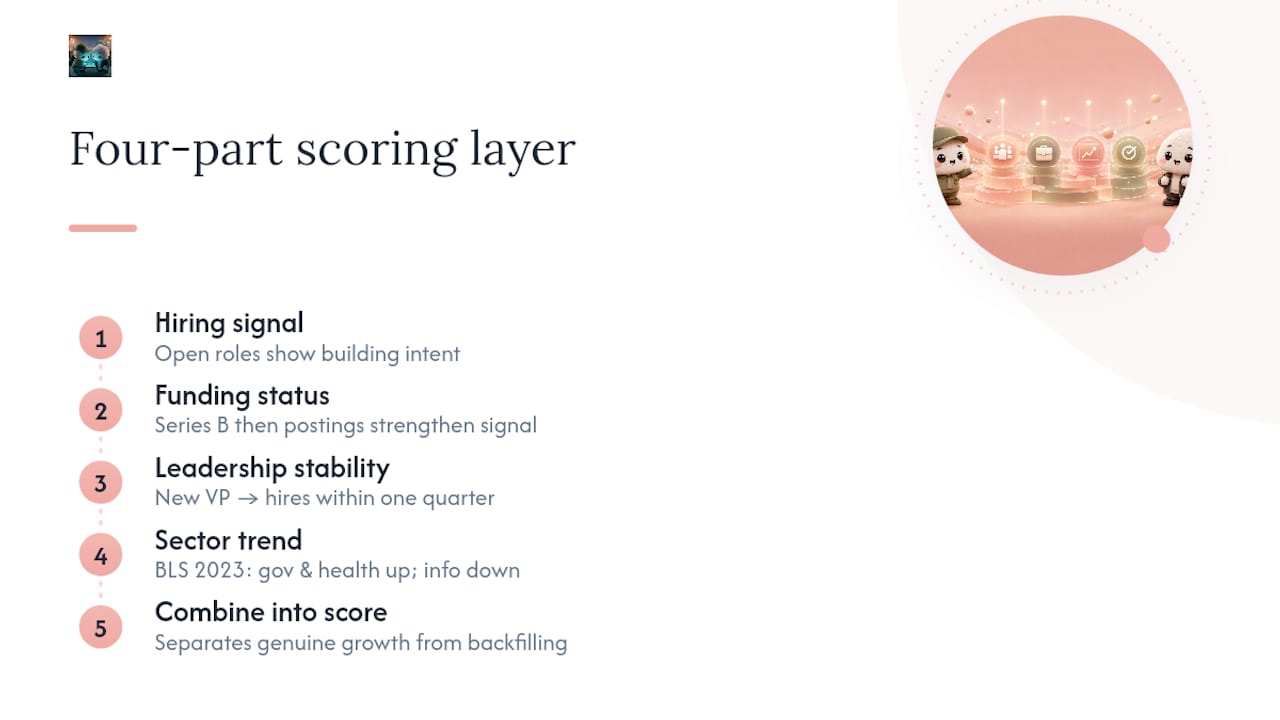
Practically, this means building a simple internal scoring layer: hiring signal strength, plus recent funding status, plus leadership stability, plus sector trend direction. None of those four inputs is reliable alone. Together, they catch the false positives that pure hiring-count models miss, a company backfilling after a layoff round can look identical to genuine growth if you only look at open role counts. Cross-referencing against sector data and funding history is what separates a real growth story from a company simply replacing people who quit.
What this looks like in practice
A staffing agency targeting mid-market logistics firms noticed a client prospect posting three Warehouse Operations Manager roles inside a 20 day window, a velocity spike well above that company's historical hiring pace. Cross-checked against a recent funding round the same firm had closed two months earlier, the pattern closely matched the funding to exec to hiring sequence enough to justify an immediate outreach, well ahead of the company running its own recruitment drive publicly.
A B2B sales team selling observability software used first-of-role Site Reliability Engineer postings as a qualifying filter. Companies posting that title for the first time were, in the team's own account of the pattern, meaningfully more likely to have an active infrastructure budget conversation happening than companies simply backfilling an existing SRE seat. The title itself became the qualifying question, replacing a discovery call that used to take thirty minutes.
A market analyst tracking enterprise AI adoption built a rolling heatmap of "AI/ML Engineer" and "Head of AI" postings across a sector, using the shift from experimental to operational hiring roles as a leading proxy for where real infrastructure spend was landing months before quarterly earnings confirmed it. Guides such as AI trend examples and real-world strategy cover this kind of capability mapping in more depth, showing how AI-specific hiring often precedes broader operational spend by a full quarter or more.
Each case shares the same underlying discipline: nobody acted on a single posting. They stacked hiring data against funding, timing, or sector context, and only then moved.
The tooling landscape for tracking hiring signals
Most teams start with manual monitoring: Google Alerts on a target list, or a recruiter manually checking careers pages every Monday. It works at small scale and fails completely past about twenty accounts, since nobody has time to check two hundred careers pages by hand every week.
ATS-level data, pulled from platforms like Greenhouse, Lever and Workday, gives structured fields (title, location, posted date) but usually needs to be aggregated across many companies to be useful at scale, which is exactly the gap purpose-built signal platforms fill. AI-driven platforms like Ontherice run that aggregation continuously, classifying events and emitting scored signals rather than raw postings, so the output arrives as a ranked shortlist instead of a spreadsheet of job links.
The practical trade-off is speed versus control. Manual tracking gives full control over which companies you watch but doesn't scale. Automated platforms scale to hundreds or thousands of accounts but ask you to trust their classification logic, which is exactly why transparent scoring matters more here than in most SaaS categories: if you can't see why a company scored "high" on hiring velocity, you can't sanity-check it against your own judgement. A pipeline explained openly, source links included, beats a score with no visible working every time.
Privacy and ethics: what's fair game and what isn't
Hiring trend signals are built almost entirely from public data: published job postings, public ATS listings, and things executives choose to say publicly on platforms like LinkedIn. That's meaningfully different from scraping private employee data, internal HR systems, or anything an individual hasn't chosen to make public, and the distinction matters for how you use this responsibly.
The ethical line sits less around whether the data is public and more around what you do with it. Using aggregate hiring patterns to inform a sales pitch is standard competitive intelligence. Using individual-level data to target or profile specific employees crosses into territory that's both ethically murky and, depending on jurisdiction, legally risky. Resources like Roll With Paid's employer guidance are a useful reminder that hiring data touches real compliance obligations on the employer side too, not just the analyst reading it from outside.
Good practice: keep the unit of analysis at the company or department level, not the individual. Don't infer anything about a named person's job security, compensation, or personal circumstances from a posting. And be transparent internally about where a signal comes from, since a sales rep repeating a stat they can't source loses credibility fast if a prospect asks where it came from.
Common pitfalls before you act on a signal
Seasonal hiring spikes and ATS defaults can mimic urgency that isn't real. Always check the actual posting date against a company's historical pattern before treating a spike as news. Retail and hospitality, for instance, hire predictably every autumn regardless of growth.
Verify with stacked signals, funding, an executive change, or explicit deadline language in the posting, before committing outreach time. Where you have it, your own CRM notes and past conversations remain a private signal no public feed can replicate.
— Aidil
Try Ontherice's real-time hiring signal feeds
The service provides continuously scored signal cards across thousands of companies, each with source links you can verify yourself rather than a black-box number to trust on faith. Every card carries the same transparent ranking logic covered above, open role counts, velocity, shelf-life, so you're not guessing why an account scored "high."

Getting started costs nothing. The free tier covers baseline signal browsing, and Access Points unlock deeper cards, sector rankings and interactive AI queries when you need to go further on a specific account or vertical. If your work leans toward enterprise-scale monitoring across a full target list, the SignalsInternational product is built for exactly that volume. For broader, general-purpose trend feeds beyond hiring alone, GeneralSignals covers the wider set. Either way, the next step is the same: create a free account and run your first target list through it this week.
Sources
- Job Openings and Labor Turnover Survey (JOLTS) — BLS
- US labour market snapshot — Indeed HiringLab
- Global hiring outlook strengthens for Q4 as workforce transformation drives demand for new skills — ManpowerGroup (PR Newswire)
FAQ
What are hiring trend signals?
Hiring trend signals are structured alerts built from public hiring activity, job postings, careers page changes, and executive statements, that flag when a company is actively building a team or capability, often before that intent becomes public news.
Why is it so hard to get a job right now?
The labour market has settled into a low-hire, low-fire pattern; the BLS reported a 3.2% hires rate in July 2026 with fewer layoffs but also fewer new openings, meaning fewer roles are turning over even though existing jobs are relatively stable.
Why is Gen Z struggling to get hired?
Much of the friction comes from employers increasingly hiring for specific new skills tied to changing technology rather than filling generic entry-level slots, a shift ManpowerGroup linked to 62% of employers hiring for changing roles rather than straightforward replacement.
How current do hiring trend signals need to be to be useful?
It depends on the use case: sales outreach benefits from near-daily refresh to catch a window while it's open, while sector-level analysis on platforms like Ontherice can work well with weekly rollups that smooth out noise.