
TL;DR:
- Market trends form from internal feedback loops among participants, independent of external news.
- Understanding this endogenous process helps improve forecasting and risk management strategies.
Endogenous trend formation is the process by which market trends develop from within the trading system itself, driven by recursive feedback among participants rather than external news or shocks. Analysts who attribute every major price move to headlines are working with an incomplete model. The perception-action-structure cycle, where participant behaviour alters prices and altered prices reshape subsequent behaviour, generates persistent trends without any external trigger. Understanding endogenous trend formation explained through this lens changes how you forecast, manage risk, and read market signals. This article draws on empirical research from 2026 to give you a working framework for that shift.
How feedback loops create and sustain endogenous trends
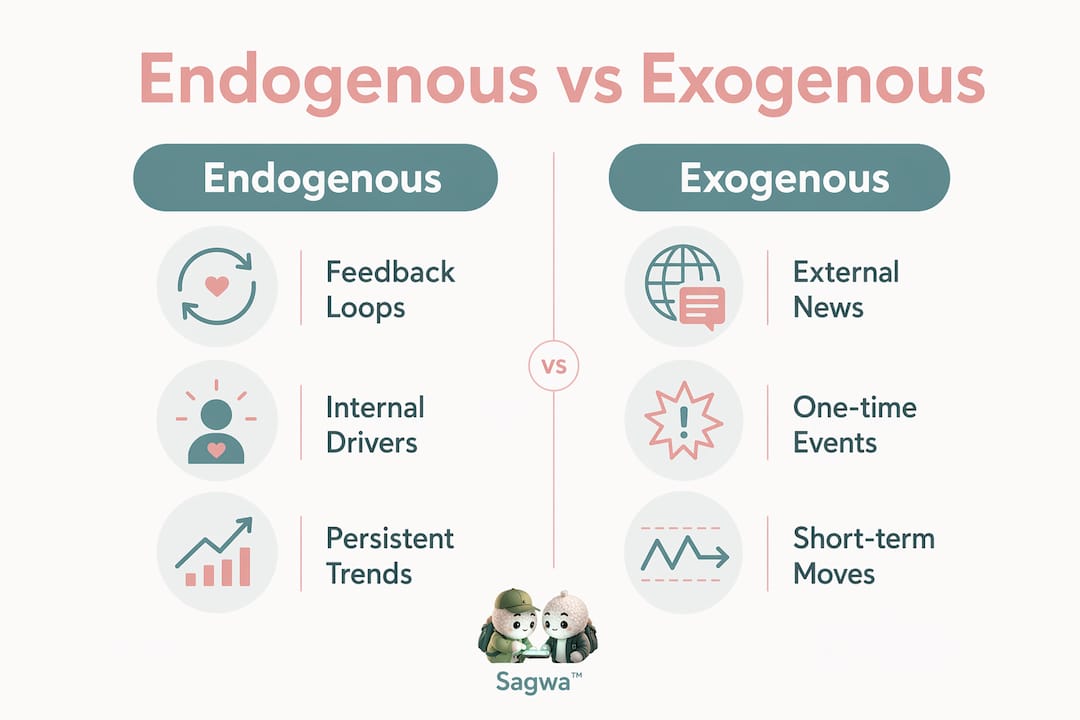
Endogenous trends persist because of two competing forces: reinforcing feedback and balancing feedback. Reinforcing feedback amplifies price movements. When rising prices attract more buyers, those buyers push prices higher still, creating a self-sustaining cycle. Balancing feedback works in the opposite direction, absorbing extremes and pulling prices back toward equilibrium.

George Soros formalised a version of this in his concept of reflexivity, where market participants' beliefs about prices actively shape the prices themselves. That is not a philosophical point. It is a structural feature of how markets operate, and it means trends can persist long after any original external catalyst has faded.
Key mechanisms that drive endogenous trend persistence include:
- Reinforcing feedback: Rising prices attract momentum traders, whose buying pushes prices further, extending the trend.
- Balancing feedback: Liquidity providers and contrarian traders absorb extremes, acting as a natural brake on runaway moves.
- Reflexivity: Participant expectations alter market structure, which then validates or invalidates those expectations.
- Algorithmic amplification: Algorithms trained on recent price data amplify endogenous instability, intensifying feedback loops rather than dampening them.
Algorithmic trading deserves particular attention here. Research published in 2026 shows that markets may shift toward oscillatory dynamics and local instability as algorithms interact within endogenous feedback environments. That finding runs counter to the assumption that more automation produces more efficient, stable markets.
Pro Tip: When you observe a trend persisting well beyond any identifiable news catalyst, treat it as a signal of active reinforcing feedback rather than evidence of a fundamental shift. Check volume patterns and order flow for confirmation.
Buyer-side and seller-side illiquidity both play a moderating role. Liquidity asymmetries act as stabilisers, dampening upward and downward price overreactions respectively. This means the same endogenous engine that creates trends also contains a natural self-correcting mechanism, though that mechanism can be overwhelmed when feedback is sufficiently strong.
What do mathematical models reveal about trend formation?
The most rigorous recent work on endogenous trend formation comes from agent-based and stochastic models that reproduce observed market behaviour without invoking external shocks.
A 2026 study using a Hopf bifurcation framework found that as institutional capital increases, markets shift from stable equilibrium to self-sustained nonlinear oscillations with a critical exponent of approximately 0.5. That transition does not require retail herding or news events. It arises purely from nonlinear feedback and the structural properties of price impact.
The square-root price impact function is central to this finding. Linear price impact models cannot produce self-sustained endogenous cycles. The nonlinearity of the square-root function is what enables limit cycles to form and persist. This is a significant constraint on which mathematical frameworks are actually useful for modelling real markets.
"Self-sustained oscillations in agent-based market models require nonlinear square-root price impact; linear assumptions preclude such endogenous cycles. The implication is that standard linear models systematically underestimate the capacity of markets to generate their own persistent trends."
Hawkes process models offer a complementary empirical lens. By measuring the branching ratio of trading activity, researchers can quantify how much of current trading volume is triggered by prior trading rather than by new information. Endogenous trading intensity measured this way strongly predicts price overreaction, and its impact exceeds that of external information shocks. Stronger endogenous intensity predicts greater price reversals, while higher liquidity dampens those overreactions.
| Model type | Core mechanism | Key finding |
|---|---|---|
| Hopf bifurcation | Nonlinear feedback with institutional capital | Endogenous limit cycles at critical exponent ~0.5 |
| Hawkes process | Branching ratio of trading activity | Endogenous intensity exceeds external shock impact |
| Square-root impact | Nonlinear price impact function | Essential for self-sustained oscillations |
| Adaptive algorithmic | Learning responsiveness in feedback environments | Faster learning increases instability |
These models collectively confirm that trend formation in finance is not primarily a response to information. It is a structural property of how markets are built.
How do endogenous trends differ from exogenous influences?
Exogenous trends are price movements caused by new information arriving from outside the market system: earnings announcements, central bank decisions, geopolitical events. Traditional financial theory treats most significant price moves as exogenous. That assumption is increasingly difficult to defend.
Markets' largest price moves often occur without corresponding news. Price changes do not scale proportionally with news magnitude. That mismatch points directly to self-generated market dynamics rather than information processing.
The practical distinction matters for analysts because:
- Attribution errors: Blaming a large move on a minor news item leads to flawed risk models and poor forecasting.
- Timing mismatches: Exogenous models predict sharp, immediate responses to news. Endogenous trends build gradually and persist after the catalyst has passed.
- Reversal patterns: Endogenous overreactions, measured via Hawkes branching ratios, predict subsequent reversals. Exogenous moves driven by genuine fundamental shifts do not revert in the same way.
- Signal extraction: Separating endogenous from exogenous components in economic time series requires methods that adapt to the data rather than imposing fixed assumptions.
On that last point, the Hodrick-Prescott filter, long a standard tool for trend extraction in macroeconomics, imposes a fixed smoothing parameter. A nonparametric approach that adapts smoothing windows to the data performs better at capturing underlying trend changes driven by endogenous factors. This method links estimated trends directly to economic fundamentals rather than to an arbitrary smoothing constant.
The distinction between endogenous and exogenous trends is not binary. Both forces operate simultaneously. The analytical challenge is estimating their relative contributions at any given moment. Analysts who treat every move as exogenous will consistently misread the persistence and reversal characteristics of the trends they are tracking. Understanding how to analyse trend cycles with this dual framework produces materially better forecasts.
Practical implications for market analysts and business strategists
Recognising endogenous trend formation changes what you look for and how you act on what you find. The following steps reflect how analysts can incorporate this understanding into day-to-day practice.
- Measure endogenous intensity directly. Use Hawkes process branching ratios or similar self-excitation metrics to quantify how much of current market activity is internally generated. A high branching ratio signals elevated feedback and greater reversal risk.
- Adjust your reversal expectations. When endogenous intensity is high, price moves are more likely to overshoot and reverse. Build that asymmetry into your risk models rather than assuming mean reversion is random.
- Monitor algorithmic participation. Increased algorithmic activity strengthens feedback mechanisms, intensifying trend persistence. Track changes in algorithmic share of volume as a leading indicator of feedback strength.
- Treat liquidity as a moderating variable. Buyer-side and seller-side illiquidity dampen endogenous overreactions. When liquidity thins, feedback loops face fewer natural brakes and trends can extend further than models predict.
- Adopt adaptive trend estimation. Replace fixed-parameter filters with methods that adapt to economic fundamentals, giving you a more accurate read of where the underlying trend actually sits.
- Resist over-attribution to news. When a trend persists for days or weeks after a news event, the driver is almost certainly endogenous feedback, not the original catalyst. Adjust your narrative accordingly.
Pro Tip: Build a simple dashboard that tracks both Hawkes branching ratios and bid-ask spreads together. When branching ratios rise and spreads widen simultaneously, endogenous overreaction risk is at its highest. That combination is your clearest early warning signal.
The role of temporal trends in market decisions becomes far clearer once you separate internally generated persistence from externally driven shifts. Strategists who make that separation consistently gain a timing advantage over those who do not.
Key takeaways
Endogenous trend formation is a structural property of markets, driven by recursive feedback loops that persist independently of external news or information shocks.
| Point | Details |
|---|---|
| Feedback loops drive persistence | Reinforcing and balancing feedback create and moderate trends without any external catalyst. |
| Nonlinear models are necessary | Square-root price impact is required for self-sustained oscillations; linear models miss this entirely. |
| Endogenous intensity predicts reversals | High Hawkes branching ratios signal overreaction and elevated reversal risk in subsequent periods. |
| Algorithms amplify feedback | Greater algorithmic participation increases endogenous instability rather than improving market efficiency. |
| Adaptive methods outperform fixed filters | Nonparametric trend estimation adapts to data and links trends to fundamentals more accurately than the Hodrick-Prescott filter. |
Why I think most analysts still underestimate endogenous dynamics
The honest answer is that exogenous explanations are easier to sell. Telling a client that a 5% move happened because of a tweet is a clean narrative. Explaining that the market's own feedback architecture was primed for a large move, and the tweet was merely the match, requires more work and more confidence in your framework.
I have spent years watching analysts retrofit news stories onto price moves that were clearly self-generated. The Hawkes process research makes this concrete: endogenous trading intensity exceeds external shock impact in driving price overreaction. That is not a theoretical claim. It is an empirical finding from 2026 data. Yet the default assumption in most strategy meetings remains that big moves need big news.
The algorithmic dimension makes this more urgent, not less. Faster learning algorithms improve information processing but increase instability and oscillations. Markets are not becoming more rational as automation increases. They are becoming more reflexive. That is a different problem requiring a different analytical toolkit.
The area I think deserves the most development is real-time endogenous signal extraction. The nonparametric methods now available are a genuine improvement over fixed filters, but they are not yet standard practice in most institutional settings. Analysts who adopt them early will have a material edge in separating noise from genuine trend shifts.
— Aidil
Ontherice: AI-driven tools for endogenous trend intelligence
Identifying endogenous trends before they reach mainstream awareness requires more than a spreadsheet. Ontherice uses multiple AI engines to scan global market data, extract meaningful signals, and produce real-time rankings across sectors.

The platform's AI trend discovery tools are built specifically for analysts who need to separate internally generated momentum from external noise. Ontherice's AI opportunities tracker surfaces rising patterns across asset classes before they reach consensus, giving you the timing advantage that endogenous trend analysis demands. The ranking system is transparent, updated in real time, and designed for professionals who act on signals rather than headlines.
FAQ
What is endogenous trend formation?
Endogenous trend formation is the process by which market trends arise from internal feedback loops among participants, without requiring external news or shocks to initiate or sustain them.
How does the Hawkes process relate to endogenous trends?
The Hawkes process measures the branching ratio of trading activity, quantifying how much trading is triggered by prior trades rather than new information. A high branching ratio indicates strong endogenous intensity and predicts greater price overreaction and subsequent reversal.
Why do large price moves occur without significant news?
Price changes do not scale proportionally with news magnitude because endogenous feedback mechanisms can generate large moves independently. Reinforcing feedback among participants amplifies price movements beyond what any external catalyst alone would produce.
How do algorithms affect endogenous trend formation?
Increased algorithmic participation strengthens feedback mechanisms and amplifies endogenous instability. Research shows that faster-learning algorithms increase market oscillations rather than improving stability, making endogenous dynamics more pronounced in highly automated markets.
What is the best method for estimating endogenous trends in economic data?
Nonparametric endogenous trend estimation, which adapts its smoothing window to the data and links trends to economic fundamentals, outperforms the Hodrick-Prescott filter for capturing internally driven trend changes in economic time series.