
TL;DR:
- Context in trend analysis provides essential surrounding information that gives data meaning and guides informed decisions. It helps distinguish genuine market signals from noise by considering cultural, socio-economic, temporal, business, and environmental factors. Embedding context-rich insights into analysis improves accuracy, stakeholder trust, and decision-making speed.
Context in trend analysis is the surrounding information that gives raw data meaning and makes it fit for informed decision-making. Without it, a rising metric is just a number. With it, that number tells a story about timing, audience, market conditions, and whether a trend will last. Analysts who ignore contextual factors in trends routinely misread signals, back the wrong bets, and lose stakeholder trust. This guide explains why context matters in trend analysis, what types of context to apply, and how to build it into your workflow from the start.
Why context matters in trend analysis
Meaning arises from the intersection of data and context. A data point alone carries no inherent meaning. Interpreting it without surrounding information risks false confidence and misleading conclusions.

The role of context in analysis is to close the gap between a raw figure and a decision-ready insight. Consider a spike in search volume for a product category. Without knowing the season, the news cycle, or the competitive environment, you cannot tell whether that spike signals a lasting shift or a one-week anomaly. Context in data interpretation is what separates a trend from noise.
Three named frameworks illustrate this well. Stylix Intelligence defines cultural utility as the degree to which a trend solves a genuine psychological or social problem. The Robert Koch Institute formalises contextual indicators across health surveillance, including tobacco control policy and consumer price indices. StrategyEye identifies four socio-economic drivers, specifically wages, rent costs, credit conditions, and policy incentives, as the forces that consistently underpin market movements. Each framework treats context not as background detail but as the primary analytical input.
Business professionals and analysts who embed context from the outset produce analysis that is portable, credible, and directly tied to decisions. Those who skip it produce outputs that look rigorous but collapse under scrutiny.
What types of context are relevant to trend analysis?
Context is not a single variable. It is a cluster of distinct dimensions, each capable of changing how you interpret a signal.
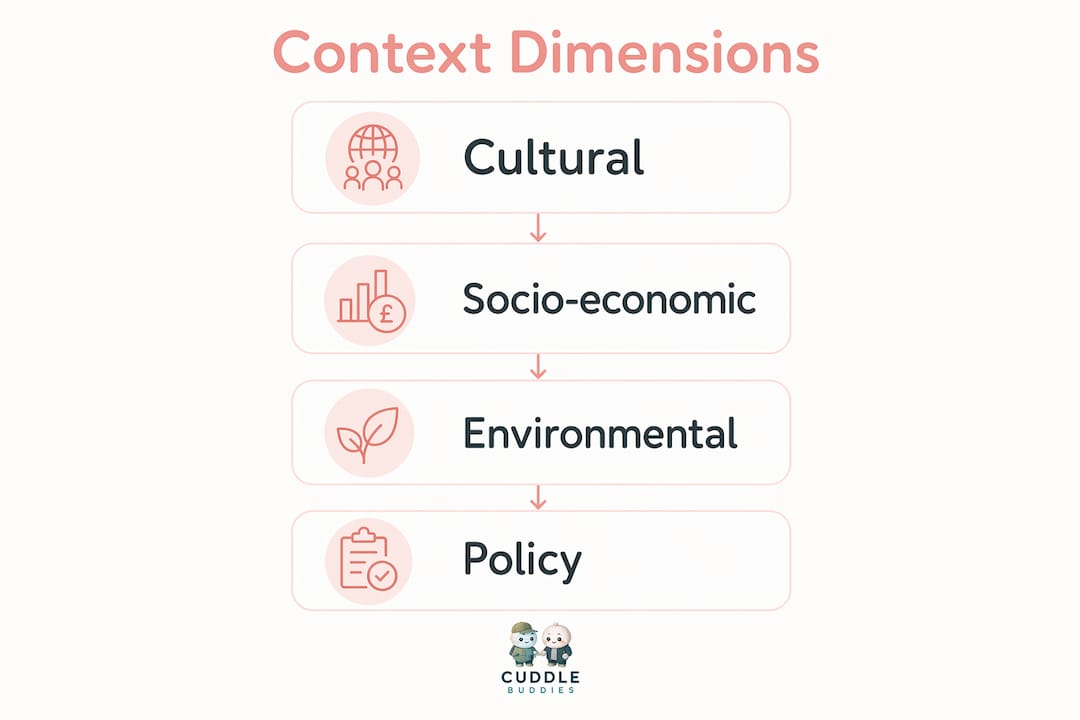
Cultural context determines whether a trend has staying power. Trends with clear cultural utility show a 67% higher rate of continuity than purely aesthetic trends. That figure means a trend solving a real social or psychological need is far more likely to become a macro force than one driven by visual novelty alone.
Socio-economic context explains the conditions that allow trends to take root. Four key socio-economic factors, specifically wages, rent costs, credit conditions, and policy incentives, drive market trends consistently. When wages stagnate and credit tightens, consumer behaviour shifts in predictable ways that raw demand data alone will not reveal.
Temporal context covers timing and seasonality. A trend that peaks every december is not growing; it is cycling. Analysts who conflate seasonal spikes with structural growth make forecasting errors that compound over time. Understanding temporal trends in market decisions is a foundational skill for anyone working with time-series data.
Business domain context ties the analysis to organisational reality. This includes:
- The company's current strategic goals and constraints
- The competitive position within the relevant market
- Operational capacity, including supply chain and production limits
- The specific audience segment the trend is expected to affect
Environmental and policy context matters most in regulated sectors. The Robert Koch Institute's surveillance framework tracks six contextual indicators, including food taxation and environmental metrics, to explain health trends. That approach is directly transferable to any sector where regulation shapes consumer behaviour.
How does context improve accuracy in trend interpretation?
Context separates short-term noise from meaningful trends. Companies that apply context-rich intelligence make decisions significantly faster than those working from raw data alone. Speed matters, but accuracy matters more. A fast wrong decision is worse than a slow right one.
The practical benefit of contextual analysis is bias reduction. Analysts working without domain knowledge are more likely to overfit data to a narrative they already believe. Ignoring business context leads to irrelevant or misleading conclusions even when the underlying analytical technique is sound. Domain knowledge is as important as technical skill.
Context also improves communication. A metric without a timeframe, a comparison point, or a business connection provides no value to a decision-maker. When you frame a metric with its relevant timeframe, audience, and market condition, it becomes a conversation starter rather than a data dump.
The risks of skipping context are concrete:
- Seasonal spikes misread as structural growth
- Correlation between unrelated variables treated as causation
- High-demand trends backed without checking supply chain capacity
- Metrics reported without business objectives, leaving stakeholders unable to act
Pro Tip: Embed your assumptions, data sources, and analysis limits directly into every output you produce. This makes your analysis portable. A stakeholder can relay your findings accurately without you in the room.
Successful analysts embed assumptions and limits within their outputs to improve clarity and transferability. This is not a documentation habit. It is a quality standard.
What are the key pitfalls when context is overlooked?
Overlooking context does not just reduce accuracy. It actively produces wrong answers that look credible.
The most common mistake is misusing KPIs. An analyst reports a 40% increase in product page visits. Without context, that figure sounds positive. With context, it might reveal that the increase came entirely from a single referral source that has since disappeared, making the trend non-repeatable and the KPI misleading.
A second pitfall is mistaking demand for sustainability. Production and supply chain capacity act as a hard ceiling on trend continuity, regardless of popularity or demand. An analyst who spots high consumer interest in a product category but ignores manufacturing constraints will overestimate how far that trend can travel.
A third pitfall is the purely aesthetic trend trap. Trends driven by visual appeal rather than cultural utility burn out quickly. Backing them without understanding the cultural context behind them leads to wasted investment and damaged forecasting credibility.
Quark Insights states directly that incomplete analysis destroys stakeholder trust. Once a decision-maker acts on a decontextualised insight and it fails, they discount future analysis from the same source. Credibility, once lost, is slow to rebuild.
"A metric without timeframe, comparison, or business connection provides no actionable value. Context transforms data into insight." — Quark Insights
The numbered sequence of failures follows a clear pattern:
- Analyst reports a metric without business context
- Stakeholder acts on the metric as if it were a trend signal
- The action fails because the metric reflected noise, not a trend
- Stakeholder loses confidence in the analyst's outputs
- Future analysis is ignored or second-guessed, reducing its value
How can professionals incorporate context into their trend analysis process?
Building context into analysis is a process, not a one-time check. It requires deliberate steps at each stage of the workflow.
The table below compares analysis without context against analysis with context across four dimensions:
| Dimension | Without context | With context |
|---|---|---|
| Metric interpretation | Raw figure only | Tied to timeframe, audience, and business goal |
| Trend signal reliability | High false positive rate | Filtered by cultural and socio-economic factors |
| Stakeholder communication | Data dump | Decision-ready narrative |
| Analysis portability | Requires analyst to explain | Self-contained with embedded assumptions |
Step 1: Build domain knowledge before you analyse. Engage stakeholders, read industry reports, and map the competitive environment. Multidisciplinary trend analysis consistently produces more reliable signals than single-source approaches.
Step 2: Define your contextual indicators upfront. For socio-economic trends, tie your analysis to wage data, rent indices, credit conditions, and relevant policy changes. For cultural trends, assess whether the trend addresses a genuine social or psychological need.
Step 3: Frame every metric with four anchors. These are the timeframe, the comparison baseline, the audience segment, and the business objective. Metrics linked to clear business objectives produce more decision-ready insights than standalone figures.
Step 4: Document assumptions and limits. State what your analysis does not cover. Specify the data sources, the date range, and the conditions under which your conclusions hold. This protects your credibility and makes your work transferable.
Step 5: Cross-reference across sectors. A trend gaining momentum in one sector often signals adjacent movement elsewhere. Cross-sector trend mapping gives analysts a broader picture and reduces the risk of tunnel vision.
Pro Tip: When tying trend interpretation to economic data, use wage, rent, and credit figures from official sources such as the Office for National Statistics or Eurostat. This grounds your analysis in verifiable context rather than assumption.
Understanding the trend lifecycle is equally important. A trend in its early adoption phase requires different contextual framing than one approaching saturation. Applying the same analytical lens across all lifecycle stages produces distorted outputs.
Key takeaways
Context transforms raw trend data into reliable, decision-ready insight by filtering noise, reducing bias, and aligning analysis with real-world conditions.
| Point | Details |
|---|---|
| Context defines meaning | Data without context risks false conclusions and misguided decisions. |
| Cultural utility predicts longevity | Trends solving real social needs show significantly higher continuity than aesthetic ones. |
| Socio-economic factors drive trends | Wages, rent, credit, and policy shape market movements more than surface demand signals. |
| Embed assumptions in every output | Portable analysis includes timeframe, sources, and limits so stakeholders can act without the analyst present. |
| Supply chain context caps trend potential | High demand alone cannot sustain a trend if production capacity cannot scale to meet it. |
Context is the skill most analysts underestimate
I have watched analysts with genuinely strong technical skills produce outputs that go nowhere. The problem is almost never the method. It is the absence of context. A regression model built on decontextualised data is a precise answer to the wrong question.
The shift I see in 2026 is that clients and stakeholders are getting better at spotting this gap. They are asking harder questions. "Why is this trend rising?" is no longer enough. They want to know whether it will last, who it affects, and what conditions would reverse it. That is a contextual question, and most standard analytical outputs do not answer it.
The misconception I encounter most often is that context is something you add at the end, in the presentation layer. It is not. Context shapes which data you collect, which metrics you prioritise, and which signals you treat as meaningful. Bolting it on afterwards produces polished-looking analysis that still misleads.
The analysts who will matter most in the next few years are those who can hold technical rigour and contextual depth simultaneously. That combination is rarer than it should be. If you are building that skill now, you are ahead of the curve.
— Aidil
Ontherice: context-rich trend intelligence for analysts
Spotting a trend signal is only half the work. Understanding what it means, and whether it will last, requires the kind of contextual depth that most data tools do not provide.
Ontherice is built for analysts and business professionals who need more than raw rankings. The AI-powered tools on the platform enrich trend signals with contextual layers, helping you assess whether a rising signal reflects genuine market momentum or short-term noise. The Rankings Generator Engine tracks and scores trend signals across sectors in real time, giving you a structured view of what is gaining ground and why. For professionals who need to act on trends before they reach mainstream awareness, Ontherice provides the contextual intelligence to do that with confidence.
FAQ
What is context in trend analysis?
Context in trend analysis is the surrounding information that gives a data point meaning. It includes timeframe, audience, market conditions, cultural factors, and business objectives.
Why does context improve trend accuracy?
Context filters noise from genuine signals and reduces the risk of false correlations. Analysts who apply socio-economic and cultural context produce more reliable and decision-ready outputs.
What happens when analysts ignore context?
Ignoring context leads to misread signals, misused KPIs, and loss of stakeholder trust. Supply chain constraints and seasonal spikes are two of the most commonly overlooked contextual factors.
How do cultural factors affect trend longevity?
Trends with clear cultural utility, meaning those that solve a real psychological or social need, show a 67% higher rate of continuity than purely aesthetic trends, according to Stylix Intelligence research from january 2026.
How should analysts document context in their outputs?
Analysts should embed assumptions, data sources, timeframes, and analysis limits directly into every output. This makes the analysis portable and ensures stakeholders can act on it accurately without the analyst present.