
AI ensemble forecasting combines several diverse models, each with its own biases and blind spots, into a single probabilistic prediction that is more robust than any one model alone. For analysts scanning for early trend signals, this matters because a single LSTM or Transformer can be confidently wrong; a well-built ensemble hedges that risk and surfaces ranked, weighted signals earlier and with better calibration. The practical patterns that make this work are model diversity, confidence gating, and explainability tools like SHAP to keep the whole thing defensible.
TL;DR:
- Combining diverse models like LightGBM, LSTM, and Transformers improves early trend signals by reducing correlated errors and incorporating different data dependencies.
- Using out-of-fold predictions with confidence gating and adaptive weighting enables ensembles to remain robust amid regime shifts and market regime changes.
- Including classical statistical models like ARIMA alongside machine learning models adds stability and interpretability, especially during sudden market shifts.
- Generally, three to five well-chosen models provide sufficient diversity, while adding more models offers diminishing returns and increases computational costs.
- Explainability tools like SHAP are essential for building trust, with feature and expert contribution breakdowns making signals transparent for stakeholders.
Table of Contents
- What is AI ensemble forecasting?
- Why does model diversity matter in an ensemble?
- How do you design a confidence-gated ensemble pipeline?
- How do you make ensemble forecasts explainable?
- Do ensembles actually beat single-model forecasting?
- How do you build a minimum viable ensemble pipeline?
- Where do traditional statistical models fit in an ensemble?
- What do real-world ensemble forecasting deployments look like?
- What goes wrong with AI ensemble forecasting?
- How much does an ensemble cost to run and scale?
- Which features should you feed an ensemble?
- How do ensembles blend text sentiment with numeric data?
- How Ontherice builds ensembles for early signals
- Try a multi-engine signal feed built on these principles
- Sources
- FAQ
What is AI ensemble forecasting?
AI ensemble forecasting is the practice of training multiple models, typically with different architectures, on the same forecasting problem and combining their outputs into one prediction. Rather than betting on a single algorithm's view of the future, you're pooling several imperfect views and letting their disagreements cancel out. Three families of techniques dominate practice, and each changes the shape of the resulting signal in a different way.
Bagging trains multiple copies of a similar model (say, several random forests) on bootstrapped samples of the data and averages the results. It mainly reduces variance, smoothing out the noise that comes from any one model overfitting a particular slice of history. It suits volatile, high-frequency signals where a single model whipsaws on noise.
Boosting builds models sequentially, with each new learner focused on correcting the errors of the last. LightGBM is the workhorse here for structured, tabular market data. Boosting reduces bias and tends to sharpen accuracy on directional calls, though it can overfit if left unchecked.
Stacking trains a meta-learner on the outputs of several base models, effectively teaching a model how much to trust each expert under different conditions. This is where genuinely heterogeneous inputs (a LightGBM model, an LSTM, a Transformer) pay off, because the meta-learner learns adaptive weighting rather than a fixed average.
- Bagging: best for short, noisy, intraday windows where variance is the enemy.
- Boosting: best for day-ahead directional calls where bias reduction matters most.
- Stacking: best for multi-week trend detection, where regime shifts mean fixed weights fail.
Why does model diversity matter in an ensemble?
Diversity is the actual engine behind ensemble gains, not the number of models you throw at the problem. Two models trained on the same architecture with slightly different hyperparameters will make correlated errors, and averaging correlated errors buys you almost nothing. The mathematical logic is bias-variance decomposition: combining models with decorrelated errors cancels noise while preserving each model's genuine signal, a point practitioner literature on model diversity treats as the single biggest lever available.
A well-diversified ensemble for early trend work typically mixes:
- A gradient-boosted tree model like LightGBM for structured numeric features (volumes, price ratios, search index scores).
- A recurrent architecture like LSTM for sequential dependencies and momentum.
- A Transformer for long-range dependencies and cross-series attention.
- A simple linear or autoregressive term as a stability anchor.
- A text or sentiment expert parsing news flow and social chatter.
CFA Institute research on ensemble learning in investment points to this kind of balance as a practical route through the curse of dimensionality that plagues finance data, where feature counts often dwarf usable sample sizes. Practitioner guidance converges on three to five diverse models as a workable ceiling, beyond which added complexity rarely buys proportional accuracy, according to a trading ensemble guide.
Pro Tip: *Before adding a sixth model, check the pairwise correlation of prediction errors across your existing base learners.
How do you design a confidence-gated ensemble pipeline?
Building an ensemble that survives contact with live markets means solving training leakage, signal thresholds, and regime change all at once. Four design choices do most of the work.
- Generate out-of-fold predictions with time-series cross-validation. Train base models on rolling or expanding windows and only let the meta-learner see predictions on folds it never touched, otherwise the stack memorises the past instead of generalising to it.
- Gate signals by confidence, not just direction. Rather than emitting a binary "buy the trend" flag, output a continuous probability score, then only surface a signal to users once it clears a defined confidence threshold. This lets position sizing scale with conviction instead of treating every signal as equally strong.
- Weight adaptively and update online. Static weights decay as market regimes shift. Recompute expert weights on a rolling basis so the ensemble leans harder on whichever base learner has recently forecast well, a pattern that helped lift win probability in a 2025 multi-expert study to around 61% across the tested window.
- Vary lookback windows across horizons. A model built for intraday signals should retrain far more often than one built for multi-week trend calls; forcing a single retraining cadence across horizons is a common design mistake.
How do you make ensemble forecasts explainable?
An ensemble that cannot explain its own decisions is a liability the moment a stakeholder asks why a signal fired. SHAP (Shapley Additive Explanations) is the standard tool here, attributing each prediction back to the features and, in a stacked setup, to the individual expert models that drove it. CFA Institute's review of ensemble learning in finance treats SHAP-style attribution as what separates a governable ensemble from a black box nobody trusts with capital.
A defensible reporting layer needs a few concrete pieces:
- Per-expert contribution breakdowns, not just an aggregate score.
- Rolling feature-importance summaries, since importance shifts with regime.
- Uncertainty bands alongside the point forecast, not instead of it.
- Reproducible pipelines with versioned models and logged retraining events.
OnTheRice's own tutorial on explainable forecasting walks through building SHAP-augmented outputs in under a second per forecast, which matters when you're gating live signals rather than producing an end-of-quarter report.
Do ensembles actually beat single-model forecasting?
Yes, and the gap is not marginal. A 2025 study testing a hybrid ensemble framework against single-technique baselines on univariate price forecasting reported a hybrid mean squared error of 41.92, against 413.26 for a pure bagging approach and 829.16 for pure boosting, according to the Springer ensemble framework study. That is roughly a tenfold error reduction against bagging alone, and it is the kind of gap that changes whether a signal is tradeable or noise.
Backtesting needs to mirror this rigour.
- Track MSE and hit rate on rolling windows, not one aggregate figure.
- Set drift thresholds: if a base model's error climbs beyond a defined band for several consecutive periods, flag it for partial retraining rather than a full rebuild.
- Keep a rollback path so a poorly retrained model can be reverted without disrupting the whole stack.
OnTheRice's playbook on fixing forecast model drift covers targeted retraining without the blind, wholesale rebuilds that waste compute and destroy continuity in a live signal feed.
How do you build a minimum viable ensemble pipeline?
You do not need five models and a governance committee on day one. A workable first version looks like this:
- Pick three genuinely diverse base learners (LightGBM, an LSTM, a simple linear baseline) and train each with time-series cross-validation.
- Generate out-of-fold predictions and combine them with soft voting or a lightweight stacking meta-learner.
- Attach SHAP explainability and a confidence gate before any signal reaches a user or a dashboard.
- Backtest for real economic outcomes (not just statistical fit) and stand up monitoring for MSE drift and prediction correlation between base models.
- Set a retraining cadence per horizon and write down an incident procedure for what happens when drift alerts fire.
Pro Tip: Resist adding a Transformer until steps one through four are stable. Sequence attention models are the highest-maintenance component in most ensembles and earn their keep only once your basics are solid. OnTheRice's guide to trend stacking for analysts walks through this build order in more detail.
Where do traditional statistical models fit in an ensemble?
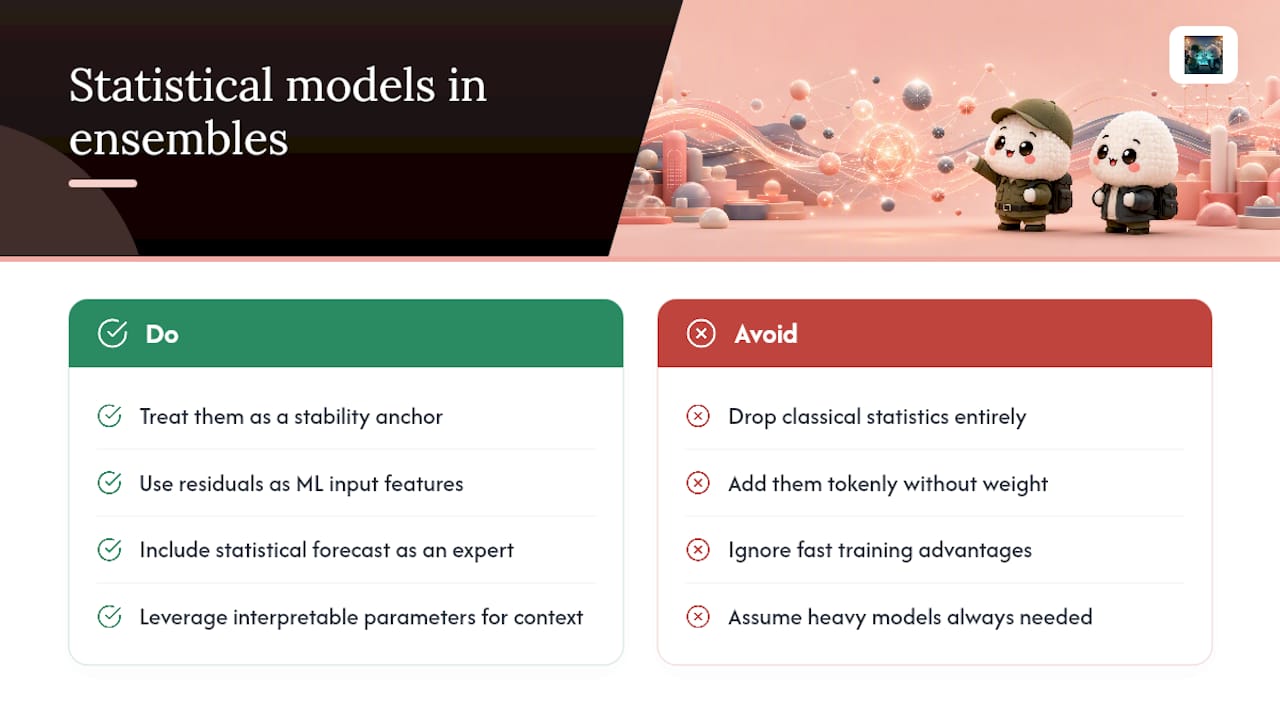
Dropping classical statistics entirely is a mistake many teams make once machine learning enters the picture. ARIMA, exponential smoothing, and simple linear regressions remain genuinely useful inside an ensemble, not as relics to be replaced. They act as a stability anchor: when a Transformer or LSTM starts producing erratic forecasts during a regime shift, a well-behaved statistical baseline keeps the stacked output from swinging wildly.
Statistical models also bring something machine learning models often lack: interpretable parameters. An ARIMA model's autoregressive and moving-average terms tell you directly how much weight the model places on recent history versus longer trends, which is useful context when a SHAP explanation for a neural network feels abstract.
In practice, integration works two ways. First, statistical model residuals (what's left over after ARIMA fits the obvious trend and seasonality) can become input features for the machine learning base learners, letting them focus on the harder, non-linear residual pattern. Second, statistical forecasts can sit as one "expert" inside the stack, contributing a vote or weighted output alongside LightGBM, LSTM, and Transformer predictions. This second approach is often the simplest way to add diversity without adding much computational overhead, since classical models train in seconds compared with the minutes or hours a deep sequence model needs.
The main risk is treating statistical models as a token inclusion rather than a genuine contributor. If a linear baseline never wins meaningful weight in your adaptive scheme, check whether your features are actually non-linear enough to need the heavier models at all.
What do real-world ensemble forecasting deployments look like?
Ensemble forecasting has moved well past academic benchmarking into operational use across several sectors that need early, probabilistic reads on where demand or attention is heading.
In retail and demand forecasting, ensembles combining boosted trees with sequence models handle seasonal demand spikes better than any single technique, since boosting captures sharp promotional effects while LSTMs track slower-moving seasonal drift. Retailers use this blend to avoid both stockouts and overordering around volatile events like product launches.
In finance and trading, multi-expert stacking has shown measurable gains over single-model approaches. A 2025 study on chaotic financial market forecasting found that a multi-expert stacking system lifted win probability to around 61% against single-expert baselines, a meaningful edge when compounded across many trades.
In technology and product trend detection, the specific use case this article is framed around, ensembles combine numeric adoption metrics (search volume, download counts, funding data) with text-based sentiment models parsing news and social commentary. This lets a signal capture not just that something is trending, but plausible context for why.
In crypto markets, where volatility and thin historical data punish single models especially hard, ensembles that blend short-horizon bagging with longer-horizon stacking have become a common architecture, precisely because no single model handles both the noise and the structural trend well on its own.
What goes wrong with AI ensemble forecasting?
Ensembles fail in fairly predictable ways, and most of the failures trace back to skipping a step rather than choosing the wrong algorithm.
Correlated base models masquerading as diversity is the most common pitfall. Teams often add a fourth or fifth model that is architecturally different on paper (say, a second gradient-boosted variant) but produces near-identical predictions to an existing model, adding compute cost without adding genuine signal.
Data leakage in the meta-learner is a close second. If the stacking layer trains on predictions the base models generated using information from the same period being predicted, backtest performance looks brilliant and live performance collapses. Strict out-of-fold generation with time-series cross-validation is the fix, not an optional refinement.
Static weighting through a regime change quietly erodes performance. An ensemble tuned during a low-volatility period will misweight its experts once volatility spikes, unless weights update on a rolling basis.
Overfitting the stacking layer itself happens when the meta-learner has too many base models and too little validation data to learn sensible weights, effectively memorising noise in how it combines experts.
Treating explainability as an afterthought creates a different kind of failure: technically sound signals that nobody trusts enough to act on, because nobody can explain why the ensemble fired.
How much does an ensemble cost to run and scale?
Computational cost scales with the number and type of base models, and Transformers are almost always the most expensive line item. A LightGBM model trains in seconds on modest hardware even with hundreds of features; an LSTM or Transformer over the same data can take considerably longer to train and needs GPU acceleration to retrain on a reasonable cadence.
The practical question is not "can we afford five models" but "does each additional model earn its compute cost in genuine diversity". A three-model ensemble (LightGBM, LSTM, linear baseline) retrained daily is cheap enough to run on standard cloud instances. Adding a Transformer for long-range dependency capture is worthwhile for multi-week horizon forecasting, but expensive to retrain hourly for intraday signals, so matching retraining cadence to horizon (as covered earlier) is also a cost control, not just an accuracy one.
Scalability concerns show up most acutely at inference time when serving live signals to many users simultaneously. Batching predictions, caching base-model outputs that do not need to update every second, and reserving the heaviest models (Transformers) for longer horizons where update frequency is naturally lower are the standard levers. Teams that skip this and retrain every model at every horizon on the same schedule tend to burn compute budget on marginal gains rather than genuine signal improvement.
Which features should you feed an ensemble?
Feature selection in ensemble forecasting differs from single-model feature engineering because you're choosing features for several models with different appetites at once. A Transformer can handle raw, high-dimensional sequences reasonably well; a linear baseline needs hand-engineered, interpretable features or it contributes nothing useful to the stack.
A practical approach splits features by what each base learner actually needs. Give the tree-based model (LightGBM) rich, engineered features: ratios, rolling statistics, lag differences, since gradient boosting handles feature interactions natively. Give the sequence models (LSTM, Transformer) raw or lightly normalised time series, letting the architecture learn temporal patterns rather than pre-computing them. Give the linear anchor a small, curated set of the most interpretable, stable features, resisting the urge to feed it everything.
Cross-model feature leakage is a subtler risk. If every base model sees an identical feature set, you've partly undone the diversity you built through architecture choice. Varying feature subsets slightly across base learners, alongside varying architecture, tends to decorrelate errors further and improve the eventual stacked output.
Feature selection also needs a decay check. Features derived from social sentiment or search trends can lose predictive value quickly as platforms and user behaviour change, so a feature that mattered a year ago may now add noise rather than signal. Reviewing feature importance on a rolling basis, not just at initial model build, catches this before it quietly degrades the ensemble.
How do ensembles blend text sentiment with numeric data?
Numeric features tell you that something is moving; text-based signals often tell you why, and combining the two is where early trend detection genuinely separates itself from lagging indicators. A sudden spike in search volume or trading activity is a fact; a sentiment model parsing simultaneous news coverage or social commentary can tell you whether that spike reflects genuine adoption or a short-lived controversy.
The mechanics usually work one of two ways. In the first, a text or sentiment model runs as its own expert inside the stack, producing a score (bullish, bearish, neutral, or a continuous sentiment index) that the meta-learner weighs alongside numeric base models. In the second, sentiment scores become input features fed directly into the numeric models, letting a LightGBM or LSTM learn how sentiment interacts with price or volume patterns rather than treating it as a separate vote.

Research on multi-expert systems backs the value of this blend, noting that combining sentiment-based text analytics with numerical data produces richer signals capturing both movement and context, rather than numeric data alone. OnTheRice's own analysis of when LLM trend analysis actually helps is a useful reality check here, since large language models are genuinely valuable for parsing unstructured text but not a universal upgrade over simpler sentiment scoring for every task. For technical choices around which language model handles this extraction work best, a broader survey of LLM capabilities for developers is worth a look before committing to one architecture.
The failure mode to watch for is treating sentiment as automatically more valuable than numeric signal simply because it feels more sophisticated. In practice, sentiment adds the most value at the margins, confirming or contradicting a numeric signal, rather than driving the forecast on its own.
How Ontherice builds ensembles for early signals
Ontherice runs on multiple AI engines scanning global data simultaneously, and the reasoning behind that architecture is exactly the diversity principle this article has laid out. No single engine sees the whole picture; each one specialises, and the ranking layer on top weighs their outputs transparently rather than hiding the combination logic behind a single opaque score.
In practice, this means a question like "is this product category actually gaining traction or just noisy this week" gets answered by cross-referencing numeric momentum against sentiment and news flow, rather than trusting one model's read. Readers who want to see the mechanics in more depth can work through the trend stacking guide or the model drift playbook, both written as hands-on walkthroughs rather than theory.
— Aidil
Try a multi-engine signal feed built on these principles
Building and maintaining a diverse ensemble, complete with confidence gating, SHAP explainability, and drift monitoring, takes real engineering time most analysts do not have spare. Ontherice's AIOpportunities feed gives you that architecture already running: multiple AI engines scoring sectors and products in parallel, with transparent rankings showing how each signal was weighted rather than a single black-box number.
For a broader sweep across finance, technology, brands, and emerging products, the general signals feed covers the same multi-engine approach across more categories. If your interest sits closer to specific tools and platforms rather than broad sector trends, the AI tools feed applies the identical diversity and confidence-gating logic to that narrower space. Either page is a reasonable place to start: pick the one closest to what you're tracking, run a live query, and see how the ranking explains its own reasoning before you commit any Access Points to deeper insight unlocks.
Sources
- Hybrid ensemble framework (2025) — Springer
- Ensemble learning in investment (CFA Institute, 2025)
- Multi-expert forecasting in chaotic financial markets (Journal of Risk and Financial Management, 2025)
- Ensemble models for trading: practitioner guide (Technical-Analysis-Pro, 2026)
FAQ
What is the difference between bagging and stacking?
Bagging averages predictions from similar models trained on different data samples to reduce variance, while stacking trains a meta-learner to weigh outputs from genuinely different model architectures, learning when to trust each one.
How many models should an ensemble use?
Three to five genuinely diverse base models is a practical sweet spot; beyond that, added models rarely contribute enough decorrelated signal to justify the extra compute cost.
Does AI ensemble forecasting really outperform single models?
A 2025 hybrid ensemble study reported a mean squared error of 41.92 against 413.26 for pure bagging and 829.16 for pure boosting, a substantial accuracy gap in favour of the ensemble.
What is SHAP and why does it matter for forecasting?
SHAP is an explainability method that attributes each prediction back to the features and models driving it, letting analysts show stakeholders exactly why an ensemble produced a given signal.
How does Ontherice apply ensemble forecasting?
Ontherice runs multiple AI engines in parallel across markets and combines their outputs into transparent, ranked signals, applying the same diversity and confidence principles covered throughout this article.
How often should an ensemble be retrained?
Retraining cadence should match forecast horizon: intraday models need frequent updates, while multi-week trend models can retrain on a slower rolling schedule tied to drift monitoring thresholds.