
TL;DR:
- Markets have shifted away from reliance on batch data processing, with live data delivering faster insights and higher margins. Implementing live data involves complex, costly infrastructure, but it offers significant benefits in fraud detection, dynamic pricing, and operational agility when aligned with specific business needs. Organizations should carefully evaluate their latency costs and strategic goals, starting small and scaling based on measurable impacts rather than technological ambition.
Batch data processing was once perfectly adequate. Markets moved slowly enough that yesterday's numbers could still guide today's decisions. That world no longer exists. Real-time businesses achieve over 50% higher revenue growth and net margins compared to bottom-quartile peers, and that gap is widening every quarter. This article explains exactly what live data is, how it differs from batch processing, what concrete advantages it delivers, and how to avoid the traps that catch even experienced teams off guard.
Table of Contents
- What is live data and how does it work?
- Core business benefits of using live data
- Is live data always worth the investment?
- Key considerations and pitfalls for live data adoption
- Why the obsession with live data can be dangerous
- How OnTheRice helps you put live data to work
- Frequently asked questions
Key Takeaways
| Point | Details |
|---|---|
| Live data boosts agility | Businesses using live data outperform peers in growth, efficiency, and customer satisfaction. |
| Cost-benefit matters | Real-time systems are powerful but come with higher expense and complexity, so fit to business needs is crucial. |
| Nuanced adoption is best | Micro-batching and targeted use cases often provide 80-90% of the value without overkill. |
| Start with strategy | Successful live data adoption aligns technology with quantifiable business outcomes, not tech trends. |
What is live data and how does it work?
Live data refers to information that is captured, processed, and made available for analysis within seconds or minutes of the underlying event occurring. Contrast that with batch data, where records accumulate over hours or days before being processed together in a single run. The fundamental difference is immediacy: live data lets you act on what is happening now, not what happened last night.
There are three primary methods for moving data in near-real time. Streaming sends each event to a processing engine the moment it occurs, with tools such as Apache Kafka or Amazon Kinesis acting as the backbone. Micro-batching groups events into very small windows, typically a few seconds, giving you most of the freshness of true streaming at a lower operational cost. Change Data Capture (CDC) monitors the transaction logs of a database rather than the data itself. Log-based CDC using transaction logs such as WAL (Write-Ahead Log) or binlog enables sub-second latency with minimal load on the source system.
Latency is the central concept to understand here. It is simply the delay between an event occurring and your system knowing about it. A trading platform that needs to react to a price move in milliseconds has a very different latency requirement from a retail chain reviewing hourly footfall numbers. Defining your acceptable latency window before choosing a technology is the single most important architectural decision you will make.
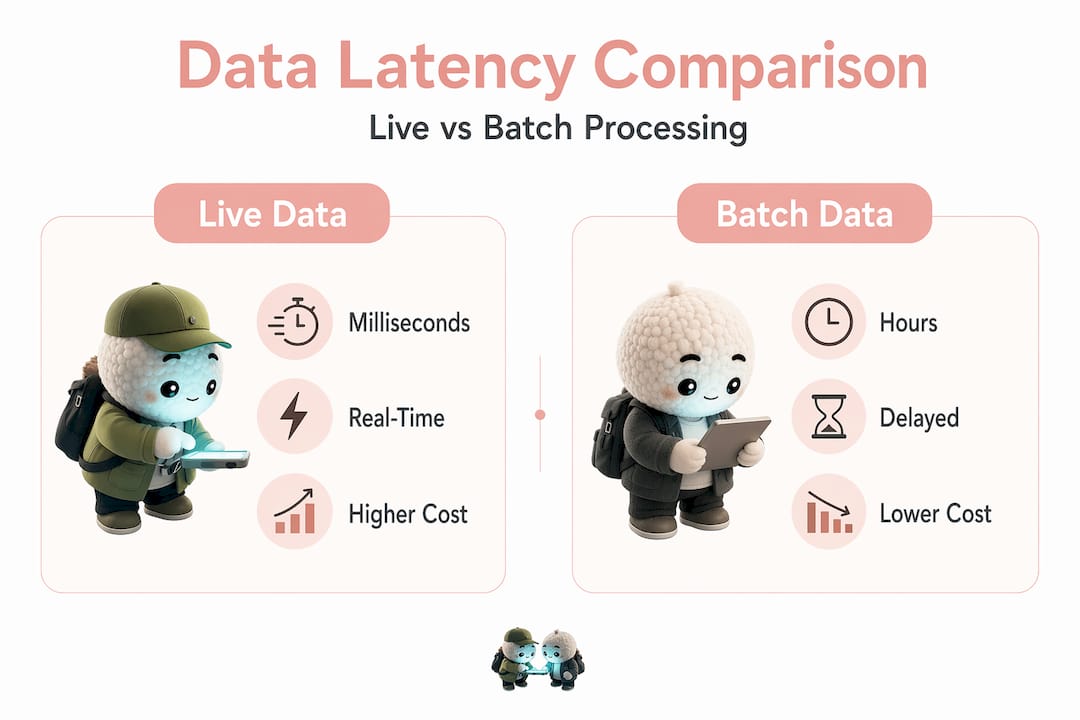
| Dimension | Live data | Batch data |
|---|---|---|
| Latency | Milliseconds to minutes | Hours to days |
| Cost | Higher (continuous compute) | Lower (scheduled runs) |
| Complexity | High (stateful processing, ordering) | Low (simple ETL pipelines) |
| Best use cases | Fraud detection, dynamic pricing, live personalisation | Monthly reporting, historical analysis, model training |
| Infrastructure | Always-on streaming platform | Scheduled jobs, data warehouse |
Professionals choosing between approaches would do well to explore dynamic market tools that can abstract some of this complexity, particularly when the goal is competitive intelligence rather than building data infrastructure from scratch.
Core business benefits of using live data
The business case for live data goes well beyond theoretical speed advantages. The numbers are tangible and consistent across industries. Companies using real-time analytics report 15% revenue growth, 23% higher operational efficiency, and 18% higher customer satisfaction compared to peers relying on batch analytics alone.
Those figures hold across a wide range of sectors, from financial services to e-commerce. Consider what 23% higher efficiency means at scale: a logistics operation spending £10 million annually on routing and dispatch could recover over £2 million simply by responding to live traffic, weather, and vehicle data rather than pre-planned routes built on yesterday's information.
"Real-time data leads to an 18% improvement in customer satisfaction, a 28% increase in engagement, and a 75% reduction in response times."
That 75% reduction in response times is particularly striking for any business running customer service, fraud prevention, or supply chain operations, where the cost of a slow response is measurable in pounds and customer loyalty.
Typical high-impact applications where live data outperforms batch:
- Fraud detection: Transaction monitoring systems flag suspicious patterns within milliseconds, stopping fraudulent payments before they clear. This is simply impossible with batch systems that process transactions overnight.
- Dynamic pricing: Airlines, ride-hailing platforms, and energy retailers adjust prices continuously based on real-time demand signals. A batch system updated every four hours leaves money on the table in both directions.
- Live personalisation: E-commerce platforms that update product recommendations based on current session behaviour, not last week's purchase history, consistently report higher basket sizes.
- Operational agility: Manufacturing lines that ingest sensor data in real time can halt a production run the moment quality metrics deviate, preventing costly waste rather than discovering the problem in the next day's QA report.
- Market intelligence: Understanding real-time analytics impact across sectors gives strategists the ability to reallocate budget and resource before a trend has even reached mainstream awareness.
The businesses capturing the most value from live data are not simply those with the most sophisticated technology. They are the ones that have clearly mapped a specific business outcome to a specific latency requirement. Exploring emerging market trends with live intelligence feeds is one of the most direct routes to that kind of outcome alignment.
Is live data always worth the investment?

Here is where many organisations go wrong: they assume that live data is universally superior and immediately begin building streaming infrastructure without properly costing the decision. The reality is more nuanced, and ignoring it is expensive.
Streaming pipelines cost 3 to 25 times more than batch equivalents, driven by the need for 24/7 compute, specialised operational skills, and significantly higher architectural complexity. A pipeline that runs nightly in batch might cost your team two weeks to build. The streaming equivalent of that same pipeline could take three months and require dedicated platform engineers to maintain it.
The key question is not "can we do this in real time?" but rather "what is the quantifiable cost of delay?" If a one-hour lag in your data costs the business more than £100,000 per year through missed decisions, lost customers, or undetected fraud, then the streaming premium is almost certainly justified. If the cost of delay is negligible, you are spending engineering budget on vanity rather than value.
A sensible decision framework looks like this:
- Quantify your latency cost. Ask specifically: what does one hour of delay cost in revenue, risk, or customer experience? Put a number on it.
- Define your acceptable latency window. Is the business impact meaningfully different at one minute versus five minutes versus one hour? If not, you have more flexibility than you think.
- Evaluate micro-batching first. Micro-batching for near-real-time needs delivers roughly 90% of the benefits of pure streaming at around 50% of the complexity and cost.
- Assess your team's operational maturity. Streaming systems require expertise in fault tolerance, state management, and backpressure handling. If your team does not have this, factor in the ramp-up cost honestly.
- Pilot before committing. Run a time-boxed proof of concept on a single use case before re-architecting your entire data stack.
Pro Tip: Most businesses gain 80 to 90% of the benefit they are seeking from near-real-time micro-batching rather than pure streaming. Start there, measure actual business impact, and only add complexity when the numbers justify it.
Understanding the right level of data sophistication for your stage is central to the market intelligence trends that are shaping competitive strategy in 2026. The leaders are not always the ones with the fastest data. They are the ones with the most purposeful data.
Key considerations and pitfalls for live data adoption
Even experienced data engineering teams run into problems with live data projects. The technical challenges are real, but the strategic ones are often more costly.
On the technical side, several edge cases routinely cause production incidents for teams that have not planned for them:
- Out-of-order events: Network delays mean events can arrive in the wrong sequence. A payment confirmation might arrive before the corresponding initiation event. Watermarking strategies in frameworks like Apache Flink help manage this, but they require careful configuration.
- Schema evolution: When the structure of incoming data changes (a new field, a renamed column), poorly designed pipelines break immediately. Handling schema evolution and exactly-once semantics via tools like Debezium CDC significantly reduces this risk.
- Data integrity under load: Streaming systems under heavy load can drop or duplicate events if not configured correctly. Exactly-once processing guarantees are achievable but come with performance trade-offs.
- Operational blind spots: Unlike a batch job that either succeeds or fails at a defined time, a streaming pipeline can degrade quietly, processing data slowly or silently skipping records. Robust monitoring is non-negotiable.
Beyond the technical, the strategic pitfalls are worth naming directly. Proponents of real-time data cite performance premiums, while critics warn of a "complexity trap" where organisations over-engineer solutions for analytics that are simply not time-sensitive. Both camps are right in different contexts, which is precisely why context-setting matters so much before any architecture decision is made.
The most common strategic pitfalls are:
- Pursuing real-time because competitors appear to be doing it, without validating whether the use case demands it
- Conflating data freshness with data quality, then discovering that faster bad data is worse than slower good data
- Building streaming infrastructure before the business questions it is meant to answer have been properly defined
- Underestimating the cost of maintaining streaming platforms long-term, especially as team members with specialist skills move on
Pro Tip: Always anchor a live data project to a specific business question with a measurable outcome. "We want to detect fraud faster" is insufficient. "We want to reduce fraud losses by 30% within six months by flagging transactions above £500 from new accounts in under 200 milliseconds" is a specification you can actually build towards and evaluate.
Studying AI trend examples from organisations that have successfully navigated these challenges, and paying attention to global data trends in infrastructure adoption, can shorten your learning curve considerably.
Why the obsession with live data can be dangerous
We have seen enough live data projects, from financial services to retail to logistics, to have a clear view on this: the technology is genuinely powerful, and the hype around it has made it genuinely dangerous.
The danger is not that real-time data does not work. It does, spectacularly, in the right context. The danger is that "real-time" has become a status signal. Teams propose streaming architectures not because the business need demands it, but because it sounds impressive in a strategy presentation. This is the complexity trap in its most common form.
We have watched businesses spend eighteen months and seven-figure sums building sophisticated streaming platforms, only to discover that the primary consumer of the resulting data was a weekly management report. A scheduled batch job would have served identically and been delivered in three weeks. The real-time infrastructure sits largely idle, burning compute budget and requiring specialist maintenance.
The analogy that comes to mind is buying a Formula 1 engine for a delivery van. The engineering is extraordinary. It is completely wrong for the job.
The businesses getting the most from live data are not the ones with the most ambitious architectures. They are the ones that started with the smallest possible live data implementation, measured its impact on a real business metric, and expanded only where the evidence supported it. They treat live data as a tool rather than a transformation. That measured approach, grounded in real-world lessons rather than vendor enthusiasm, is what separates genuine competitive advantage from expensive technical theatre.
How OnTheRice helps you put live data to work
Translating live data capability into genuine market intelligence is exactly what OnTheRice is built for.
OnTheRice removes the infrastructure burden by delivering live signals directly to business and strategy teams. The B2BSignals platform surfaces emerging commercial signals in real time, giving you the kind of early-mover awareness that streaming infrastructure alone cannot provide without months of custom build. For teams that need ranked, scored intelligence across sectors, the RankingsGeneratorEngine processes noisy global data into clear, actionable rankings updated continuously. Both platforms are designed for professionals who need to act on intelligence quickly, without needing to become data engineers first. Explore how OnTheRice can accelerate your competitive intelligence work today.
Frequently asked questions
What is the difference between live data and real-time data?
Live data and real-time data are often used interchangeably, but real-time typically implies sub-second latency, while live data can span a range from seconds to a few minutes. Log-based CDC via transaction logs enables true sub-second performance when that level of freshness is genuinely needed.
Does every business really need real-time data?
True real-time data is critical only when the cost of delay demonstrably outweighs the high complexity and expense of streaming infrastructure. Real-time is essential only when latency costs exceed the infrastructure premium, such as when a single hour's delay costs over £100,000 annually. For most organisations, near-real-time covers the vast majority of needs.
What common mistakes should teams avoid with live data projects?
Over-engineering, ignoring actual latency requirements, and neglecting data quality are the three most damaging mistakes. Critics specifically warn of the "complexity trap" where teams build sophisticated real-time systems for analytics that are simply not time-sensitive.
Is live data more expensive to run than batch analytics?
Yes, substantially. Streaming pipelines cost 3 to 25 times more than batch equivalents due to continuous compute requirements, higher operational complexity, and the specialist skills needed to maintain them reliably.
What are the most impactful use cases for live data?
Fraud detection, dynamic pricing, personalised recommendations, and operational agility all benefit most from live data's immediacy. These use cases enable competitive agility that batch analytics, with its static snapshots of past events, simply cannot match.