

TL;DR:
- Early trend adoption offers a competitive advantage by capturing first-mover benefits in branding, talent, and customer engagement. Selecting the right early adopters and timing the entry within the "Goldilocks zone" are critical for successful market crossing and scaling. Structured feedback systems and early signals help organizations learn quickly and act decisively to outperform competitors.
Early trend adoption is defined as the deliberate decision to engage with an emerging market shift before it reaches mainstream awareness, and it is the single most reliable source of asymmetric competitive advantage available to business strategists today. Companies that move during the early adoption window capture first-mover benefits across brand positioning, talent acquisition, and customer engagement that late movers simply cannot replicate. Understanding why early trend adoption matters requires more than intuition. It demands a structured framework, disciplined timing, and a clear method for selecting the right early adopters to engage. This article delivers all three.
Why early trend adoption matters: the diffusion of innovations framework
The diffusion of innovations theory, developed by Everett Rogers, is the foundational model for understanding how new ideas and technologies spread through markets. Rogers segments adopters into five categories, each with distinct characteristics and strategic implications. Understanding where your organisation sits within this model determines whether you capture an opportunity or pay a premium to enter it late.
The five adopter categories are: innovators (2.5%), early adopters (13.5%), early majority (34%), late majority (34%), and laggards (16%). The asymmetry here is the critical insight. Innovators and early adopters together represent only 16% of the market, yet they generate the social proof, feedback, and momentum that determines whether a trend crosses into the majority. For strategists, the early adopter segment is the highest-leverage entry point.
Between early adopters and the early majority sits what Geoffrey Moore termed the "chasm." This is the gap where most innovations stall. Businesses that engage early adopters effectively build the credibility and product refinement needed to cross it. Those that wait for the early majority have already missed the window to shape the narrative. Explore the trend lifecycle in detail to understand where specific opportunities currently sit.
| Adopter Segment | Market Share | Risk Tolerance | Strategic Implication |
|---|---|---|---|
| Innovators | 2.5% | Very high | Proof of concept; limited commercial scale |
| Early Adopters | 13.5% | High | Highest leverage for feedback and positioning |
| Early Majority | 34% | Moderate | Mainstream entry; competitive field already forming |
| Late Majority | 34% | Low | Commoditised market; margin compression begins |
| Laggards | 16% | Very low | Adoption driven by necessity, not strategy |
How does choosing the right early adopters shape growth?
Selecting which early adopters to engage is not a passive exercise. It is one of the most consequential strategic decisions a business makes when entering a new market. The choice determines the quality of your feedback, the accuracy of your assumptions, and your confidence when scaling.

MIT Sloan research identifies a clarity versus transferability trade-off at the heart of this decision. Early adopters drawn from familiar markets provide clearer, more interpretable signals. Early adopters drawn from your actual target market provide insights that transfer more directly to scaling success. Neither extreme is optimal on its own.
Choosing only familiar early adopters produces clean data that may not reflect the behaviour of your true audience. Choosing only target-market early adopters produces relevant data that can be harder to interpret without context. The most effective approach combines both, using familiar adopters to validate core mechanics and target-market adopters to stress-test assumptions before a full launch.
Pro Tip: Build a two-tier early adopter group: one cohort from your existing network for rapid iteration, and a second cohort from your target market for transferability testing. Run both simultaneously and compare the divergence in feedback.
When selecting early adopters, prioritise candidates who meet the following criteria:
- They experience the problem your product or trend addresses acutely and frequently.
- They have the authority or budget to act on a solution without lengthy approval cycles.
- They are willing to give structured, honest feedback rather than polite validation.
- They are visible enough within their professional community to generate social proof.
- They represent the demographic and behavioural profile of your intended mainstream audience.
Why early adopter insights matter is not just about product refinement. It is about building the evidence base that convinces the early majority to follow.
What are the timing trade-offs in early trend adoption?
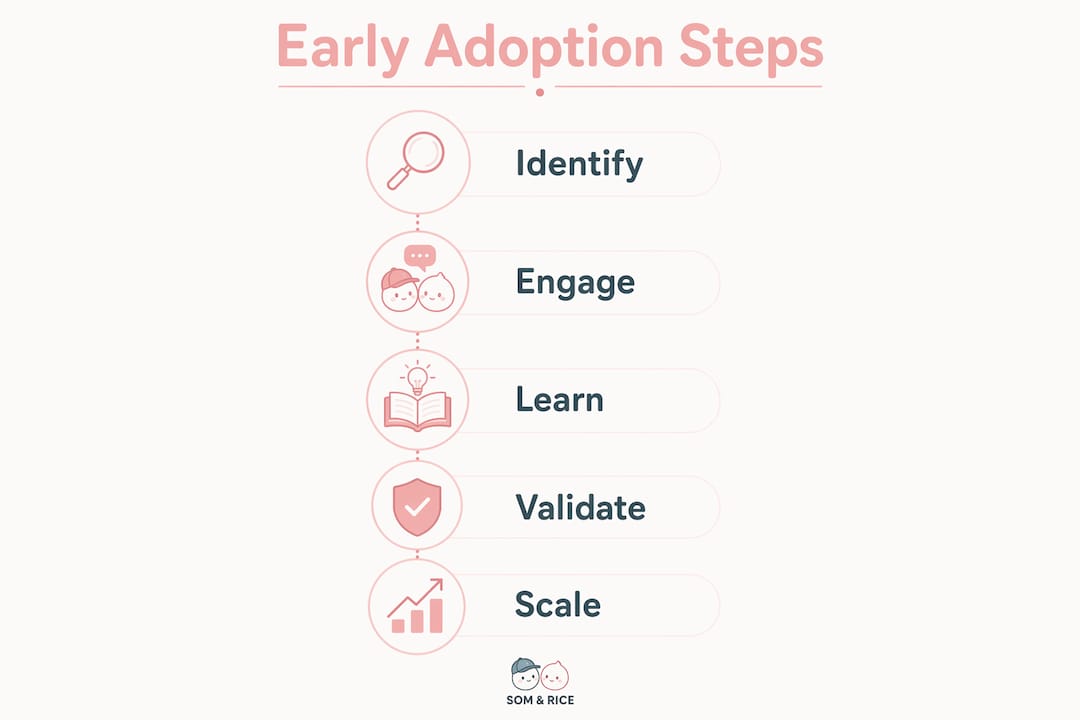
Timing is the variable that separates strategic early adoption from costly experimentation. Adopting too early causes operational drag from immature technology, while adopting too late results in permanent competitive loss as channels and talent pools become saturated. The goal is what practitioners call the "Goldilocks zone": entering after enough stability exists to build on, but before the mainstream rush eliminates differentiation.
The risks of premature adoption are real. Immature platforms carry technical debt, unreliable APIs, and support structures that are not yet fit for production use. Teams spend disproportionate time managing instability rather than building advantage. In the 2026 AI adoption wave, organisations that deployed large language model integrations in 2022 without clear use cases often found themselves rebuilding from scratch once more stable frameworks emerged.
Late adoption carries a different and arguably worse penalty. Waiting for undeniable market data often triggers a "late tax," where key hiring channels, distribution partnerships, and customer relationships are already locked up by early movers. The cost of entry rises precisely as the opportunity matures.
The most overlooked risk sits in the middle. Ambiguous commitment to a trend, neither fully adopting nor rejecting it, produces wasted resources and market thrash without any of the learning benefits. Half-adopted systems generate noise, not signal.
Pro Tip: Before committing to full adoption, run a time-boxed sandbox experiment with a defined success metric. If the metric is not met within the window, exit cleanly. If it is met, commit decisively and allocate proper resources.
Follow these steps to time your adoption effectively:
- Monitor trend signals at least six months before you intend to act, using structured signal logs rather than industry press.
- Identify whether economic plausibility, policy support, and cultural alignment are converging. All three forces must be present for adoption to achieve institutional legitimacy.
- Run a low-risk sandbox experiment with a defined exit criterion before committing operational resources.
- Set a hard decision date. Delay without a deadline defaults to the costly middle ground.
- Once committed, move at pace. Partial adoption is not a risk management strategy. It is a path to neither advantage nor learning.
How can businesses leverage early adoption for accelerated learning?
The practical value of early adoption is not just market positioning. It is the learning velocity that compounds over time. Structured early-adopter feedback loops can reduce the time to identify product friction or preference shifts from months to days or hours. That compression of learning cycles is a durable competitive asset.
The first step is building a signal log: a living document that captures falsifiable trend claims observed in your own workflows, customer conversations, and market data. Documenting these signals before they appear in industry reports gives you a validated evidence base that competitors relying on published research simply do not have. Ontherice's AI-driven platform performs this function at scale, scanning global data points to surface signals before they reach mainstream awareness.
Social proof is the mechanism that converts early adoption into mainstream momentum. Voluntary adoption cascades succeed when early adopter rewards and recognition are socially visible, not private. Publicly acknowledging early adopters within your organisation or customer community generates the observable behaviour that the early majority needs to feel safe following. For a deeper look at how AI-driven trend discovery accelerates this process, the mechanics are well documented.
| Feedback Loop Approach | Speed of Learning | Depth of Insight | Best Used For |
|---|---|---|---|
| Structured interviews | Moderate | High | Understanding root causes and unmet needs |
| In-product analytics | Fast | Moderate | Identifying friction points and drop-off patterns |
| Signal log reviews | Slow to build, then fast | Very high | Validating trend hypotheses before committing resources |
| Community observation | Fast | Moderate | Detecting emerging behaviour shifts at scale |
Pro Tip: Assign one team member as a dedicated signal curator. Their sole responsibility is to maintain the signal log, flag emerging patterns, and present a monthly synthesis to the strategy team. This role pays for itself within two quarters.
Key takeaways
Early trend adoption delivers compounding competitive advantage only when it combines disciplined timing, strategic adopter selection, and structured feedback systems.
| Point | Details |
|---|---|
| Early adopters are the highest-leverage segment | The 13.5% early adopter group generates the social proof and feedback that determines mainstream adoption. |
| Timing defines the outcome | Adopting too early creates operational drag; adopting too late triggers a "late tax" of lost channels and talent. |
| Adopter selection is a strategic choice | Balancing clarity from familiar adopters with transferability from target-market adopters shapes scaling confidence. |
| Signal logs beat industry reports | Documenting internal trend observations before they appear in published research gives you a validated lead on competitors. |
| Visible rewards drive adoption cascades | Publicly recognising early adopters generates the social proof needed to bring the early majority on board. |
The discipline behind the timing
I have watched organisations treat early adoption as a personality trait rather than a process. They celebrate being "first" without asking whether being first in this particular trend, at this particular moment, actually serves their strategy. That confusion is expensive.
The most instructive failures I have seen share a common pattern: the organisation moved on a trend because a competitor did, not because their own signal log or customer data supported it. They were reacting, not leading. The result was the worst of both worlds: the cost of early adoption without the learning benefits, because the feedback loops were never properly built.
What actually works is treating early adoption as a disciplined experiment. You define the hypothesis, set the sandbox, establish the exit criterion, and commit to a decision date. When the experiment produces signal, you move decisively. When it does not, you exit without sunk-cost paralysis. The strategic structure of trend opportunities matters as much as the trend itself.
The mindset shift required is from "are we early enough?" to "are we learning fast enough?" Speed of learning, not speed of adoption, is the durable advantage. Organisations that build that capability compound it across every trend cycle that follows.
— Aidil
Discover early signals before your competitors do
The frameworks in this article only deliver value if you have access to reliable trend signals before they become obvious. Ontherice is built precisely for that purpose.

Ontherice uses multiple AI engines to scan global data points, extract meaningful signals, and produce real-time market intelligence across diverse sectors. The AIOpportunities service identifies AI-driven trend signals at the moment they begin gaining momentum, giving you the lead time to act strategically rather than reactively. The GeneralSignals service extends that intelligence across broader markets, so your strategy is never limited to a single sector. For professionals who take the importance of trend adoption seriously, Ontherice provides the structured intelligence layer that turns the frameworks above into real decisions.
FAQ
What is the diffusion of innovations theory?
The diffusion of innovations theory, developed by Everett Rogers, segments market adopters into five groups: innovators, early adopters, early majority, late majority, and laggards. It explains how new ideas spread through markets and identifies the early adopter segment as the highest-leverage point for competitive entry.
Why do early adopters matter more than innovators?
Early adopters represent 13.5% of the market and generate the social proof and validated feedback needed to cross the adoption chasm into the mainstream. Innovators, at only 2.5%, provide proof of concept but lack the scale to drive broader market momentum.
What is the "late tax" in trend adoption?
The "late tax" is the competitive penalty paid by organisations that wait for undeniable market data before acting. By that point, key hiring channels, distribution partnerships, and customer relationships are already claimed by early movers, raising the cost of entry permanently.
How do you choose the right early adopters to engage?
According to MIT Sloan research, the optimal approach balances clarity and transferability: use familiar-market adopters for clear, interpretable feedback and target-market adopters for insights that transfer directly to scaling. Combining both cohorts produces the most reliable evidence base.
How does a signal log improve early trend identification?
A signal log is a structured document that captures falsifiable trend observations from internal workflows and customer interactions before they appear in industry reports. Maintaining one consistently gives strategists a validated lead on competitors who rely solely on published market research.