
TL;DR:
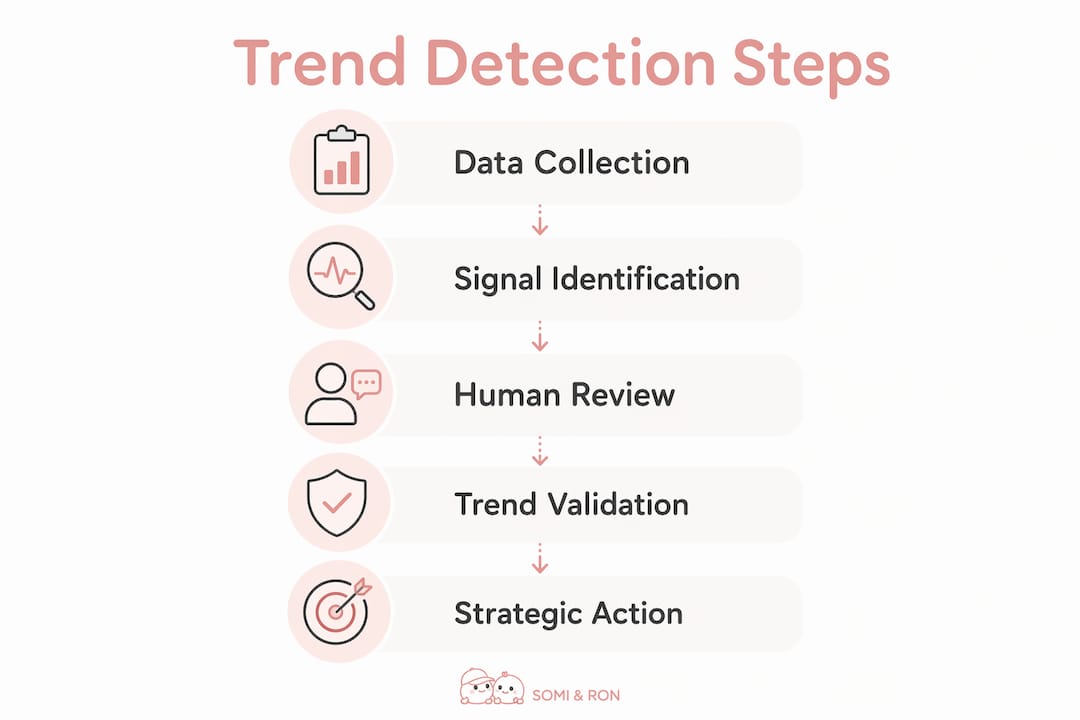
- Hidden trend detection involves identifying subtle data patterns before they become popular. It helps organizations act early, gaining advantages over competitors and reducing risks. Combining AI pattern recognition with human judgment enables effective validation of emerging signals for strategic decisions.
Hidden trend detection is the practice of identifying subtle, emerging patterns in data before those patterns reach mainstream awareness. Analysts who master this skill spot demand shifts weeks before competitors adjust their spending, giving organisations a window to act rather than react. The industry term for this discipline is signal detection, and it sits at the intersection of data science, behavioural analysis, and strategic foresight. For business professionals and analysts, the ability to read early signals is not a nice-to-have. It is the difference between setting the agenda and following it.
Why detect hidden trends before they become obvious?
Hidden trends are not the same as mature trends. A mature trend is visible in revenue reports, trade press, and analyst briefings. A hidden trend lives in search query clusters, user complaint threads, niche community discussions, and founder activity in emerging niches. By the time a trend appears in a quarterly report, the window for first-mover advantage has often closed.

The cost of late detection is concrete. Organisations that react to trends after mainstream recognition face higher customer acquisition costs, crowded markets, and compressed margins. Those that detect emerging patterns early can position products, adjust messaging, and allocate resources before demand peaks.
The benefits of early detection extend beyond competitive timing. They include:
- Sharper forecasting: Early signals give analysts a longer runway to model demand scenarios.
- Reduced innovation risk: Testing a product concept against a rising trend costs less than pivoting after a competitor launches first.
- Better risk management: Spotting a declining pattern early allows organisations to exit or hedge before losses accumulate.
- Stronger positioning: Brands that arrive early in a trend space shape the narrative rather than respond to it.
Pro Tip: Set a monthly calendar reminder to review your signal dashboard. The biggest mistake analysts make is treating trend detection as a quarterly project rather than a continuous practice.
What data sources and AI methods reveal hidden signals?
Effective signal detection draws from sources that traditional market research ignores. Standard surveys and focus groups capture what people say. Hidden trends live in what people do, search for, and complain about.
The primary data sources for uncovering emerging patterns include:
- Search query data: Rising search volumes for niche terms indicate growing curiosity before demand crystallises.
- Social sentiment: Community discussions on forums and social platforms surface language shifts before they appear in mainstream media.
- User complaints: Repeated friction points in product reviews signal unmet needs that a new entrant could address.
- Competitor messaging: Changes in how established players frame their offers often signal that they have detected a shift internally.
- Founder and funding activity: New company formations and seed rounds in a niche are a reliable leading indicator of emerging demand.
AI plays a specific role in this process. AI scans millions of daily signals across hundreds of communities to identify early shifts before they appear in standard revenue reports. That scale is impossible for human analysts working manually. The AI's job is pattern extraction from noise. The analyst's job is interpretation.
The concept of narrative velocity is central to this approach. Narrative velocity measures how quickly a particular topic or concern is spreading across independent data sources. A topic that appears in search data, then in forum discussions, then in product complaints within a short window is showing high narrative velocity. That convergence is a strong signal.
"Meaningful trends rarely use identical terminology. They arrive as clusters discerned by AI comparing data intervals rather than single snapshots. Single data points are noise, but connected micro-signals enable foreseeing meaningful innovation opportunities."
Human judgement remains non-negotiable. AI handles data processing and pattern detection, but humans determine which signals correlate with actual business outcomes. An AI model cannot know that a spike in complaints about a specific product feature matters more to your business than a spike in a tangential category.
How can businesses validate which hidden trends are worth acting on?
Not every signal is a trend. Validation is the step that separates meaningful patterns from short-term noise. Without it, organisations waste resources chasing blips.
A signal is worth acting on only when it meets specific criteria. Experienced trend-spotters validate signals through three dimensions: duration, source multiplicity, and magnitude. A signal that appears once in one channel is noise. A signal that persists across multiple independent sources for at least two weeks, and shows magnitude beyond seasonal variation, warrants attention.
The table below summarises the key validation metrics used by analysts working with structured trend frameworks.
| Validation metric | What it measures | Threshold for action |
|---|---|---|
| Founder activity | New companies entering a niche | 5 new founders within 90 days |
| Product launches | New offers targeting the same need | 3–5 launches within 90 days |
| Funding rounds | Investor confidence in a space | 1–3 seed rounds within 6 months |
| User complaints | Unmet needs in existing products | 5+ unique complaints within 30 days |
| Narrative persistence | Signal duration across sources | Sustained growth over 30 days |
These validation thresholds are not arbitrary. They reflect the minimum evidence base needed to distinguish an investable trend from a temporary spike. Applying them consistently prevents the common error of over-committing to a signal that fades within weeks.
Pro Tip: Build a simple validation scorecard with these five metrics. Any signal that clears three or more thresholds moves to your active monitoring list. Anything below that stays in observation.
Cross-source confirmation is the most reliable filter. Repeated directional changes appearing across customer language, competitor messaging, search data, and internal friction points simultaneously warrant deeper attention. When independent sources converge, the signal is real.
What are the common challenges in detecting hidden trends?
Signal detection is not clean work. The data is fragmented, the language is inconsistent, and the timeline between signal and confirmation is often frustratingly long.
The most common challenges analysts face include:
- Linguistic fragmentation: The same emerging need surfaces under different terms across different communities. AI must cluster related language rather than match exact phrases to capture the full picture.
- Signal decay: Some signals spike and disappear. Others grow slowly and steadily. Distinguishing between a fad and a durable trend requires patience and a longer observation window.
- False positives: A single viral post can mimic a trend signal. Without cross-source validation, analysts can mistake a moment for a movement.
- Data volume: The sheer quantity of available signals makes manual analysis impractical. AI is necessary, but it introduces its own risks if the monitoring focus is poorly defined.
- Organisational inertia: Even when a signal is validated, internal resistance to acting on early-stage data can delay response until the advantage is lost.
The biggest misconception is treating trend detection as a one-time project instead of a continuous monthly cadence. The "blurry stage" of a trend, where signals are present but not yet obvious, is precisely when early detection delivers the most value. Missing that window by running analysis only quarterly means arriving late every time.
The solution is rhythm. Monthly observation cycles, consistent data sources, and a defined validation framework reduce both false positives and missed signals. Analysts who build this cadence into their workflow outperform those who run ad hoc analyses.
How can organisations embed trend detection into their strategy?
Trend detection delivers value only when it connects to decisions. A monitoring system that generates reports nobody reads is not a competitive advantage. The goal is to wire signal detection directly into the decisions that benefit most from early information.
A practical integration process follows these steps:
- Identify the decisions that benefit from early signals. Pricing changes, product roadmap decisions, and market entry choices all benefit from trend data. Start there.
- Select 5–10 signals linked to those decisions. Selecting a focused set of signals tied to key monthly business decisions improves focus and response agility. Monitoring everything produces noise.
- Set alert thresholds. Define what constitutes a meaningful change for each signal. A 20% increase in complaint frequency is different from a 5% uptick.
- Build cross-departmental visibility. Share signal reports with product, marketing, and commercial teams simultaneously. Trends that only reach one department create fragmented responses.
- Create response playbooks. For each monitored signal category, define in advance what the organisation will do if the signal crosses the action threshold. This removes decision latency when a trend confirms.
- Refine monthly. Drop signals that consistently produce noise. Add new ones as business priorities shift.
Pro Tip: Assign a named owner to each signal category. Signals without owners get ignored. Owners without authority get frustrated. Match the two deliberately.
Real business scenarios illustrate why this matters. A consumer goods analyst monitoring user complaints about packaging sustainability spots a rising cluster of complaints six weeks before a competitor launches a recyclable alternative. With a response playbook already in place, the organisation fast-tracks its own packaging change and reaches market simultaneously rather than three months behind.
Key takeaways
Detecting hidden trends early is the single most reliable way to shorten the gap between data capture and strategic decision-making.
| Point | Details |
|---|---|
| Early detection advantage | Proactive teams spot demand shifts weeks before competitors, creating a window to act rather than react. |
| Validation is non-negotiable | Signals must persist for at least two weeks, appear in multiple sources, and show meaningful magnitude before warranting action. |
| AI and human judgement together | AI extracts patterns at scale; analysts determine which signals connect to real business outcomes. |
| Monthly cadence beats quarterly | Continuous observation captures the blurry early stage of trends that one-off analyses consistently miss. |
| Connect signals to decisions | Monitoring focused on 5–10 signals tied to specific business decisions produces focus, not noise. |
Why I think most organisations are still getting this wrong
Aidil here. After years of working with analysts and business teams on market intelligence, the pattern I see most often is this: organisations invest in data tools and then use them to confirm what they already believe. They run trend analysis after a competitor launches something new, not before. That is not trend detection. That is post-mortem analysis dressed up as foresight.
The mindset shift required is uncomfortable. Early signals are, by definition, ambiguous. They do not arrive with confidence intervals or executive summaries. They arrive as weak, scattered, inconsistent data points that require interpretation. Most organisations are not culturally set up to act on ambiguity. They want certainty before committing resources, and by the time certainty arrives, the trend is mainstream.
The analysts I have seen succeed at this are the ones who treat uncertainty as the raw material, not the obstacle. They build validation frameworks precisely because they know the data will be messy. They run monthly cycles because they know a single snapshot will mislead them. They connect signals to decisions because they know that insight without a decision pathway is just interesting reading.
The future of this discipline will be shaped by AI systems that get better at clustering linguistic variation and tracking narrative velocity across more data sources simultaneously. But the human layer, the judgement about which signals matter to your business, will not be automated away. The organisations that build that capability now will have a compounding advantage as the tools improve.
— Aidil
Ontherice: AI-powered signal detection for serious analysts
Ontherice is built specifically for the kind of analysis this article describes. Its AI engines scan global data points across multiple markets, extract meaningful signals from noisy datasets, and produce real-time rankings that show what is gaining momentum before it reaches mainstream awareness. Analysts can use the AI opportunities platform to surface emerging market signals and validate them against cross-source data, cutting the time between detection and decision. For those who want to go deeper, the market intelligence tools on the Ontherice blog explain how to build a monitoring workflow around the signals the platform surfaces.
FAQ
What does "hidden trend detection" mean in practice?
Hidden trend detection means identifying emerging patterns in data, such as rising search queries, user complaints, or founder activity, before those patterns appear in mainstream reports or competitor activity.
How far in advance can analysts detect a hidden trend?
Proactive teams can spot demand shifts up to three weeks before competitors adjust their spending, giving organisations a meaningful window to prepare a response.
What makes a signal a confirmed trend rather than noise?
A signal becomes a confirmed trend when it persists for at least two weeks, appears across multiple independent data sources, and shows magnitude that exceeds seasonal or random variation.
Why is monthly monitoring better than quarterly analysis?
Monthly cadence captures the blurry early stage of a trend when competitive advantage is greatest. Quarterly analysis typically arrives after the trend has already become visible to the broader market.
Can AI replace human analysts in trend detection?
AI handles the data processing and pattern extraction at scale, but human analysts determine which signals connect to specific business outcomes. The two functions are complementary, not interchangeable.