

TL;DR:
- Tracking latent trends enables organizations to gain a 6 to 18-month strategic advantage by detecting early market signals before mainstream recognition occurs. Systematic, multi-layer validation of signals fosters proactive decision-making, resource allocation, and organizational agility in response to emerging shifts. Embedding continuous trend scanning into business processes ensures early positioning and sustained competitive differentiation.
Tracking latent trends is the practice of systematically identifying early, subtle market signals before they become obvious mainstream shifts, giving organisations a measurable competitive edge. In the industry, this discipline is more formally known as weak signal analysis or horizon scanning, and understanding why track latent trends matters is the difference between shaping markets and reacting to them. Organisations using systematic scanning frameworks identify patterns 6 to 12 months earlier than those relying on traditional reports, which carry an 18-month delay from research to mainstream keynote. That gap is where strategic advantage is won or lost. Ontherice was built precisely to close it.
Why track latent trends before they go mainstream
A latent trend is a signal that exists in the data long before it registers in mainstream media, analyst reports, or industry conferences. The concept maps closely to what cultural strategists call the Cultural Zero Moment of Truth: the earliest detectable behavioural shift before any visible recognition occurs. Brands that detect these originating changes innovate more effectively than those tracking lagging data. By the time a shift appears in a Forbes headline or a Gartner Magic Quadrant, the window for first-mover advantage has already closed.

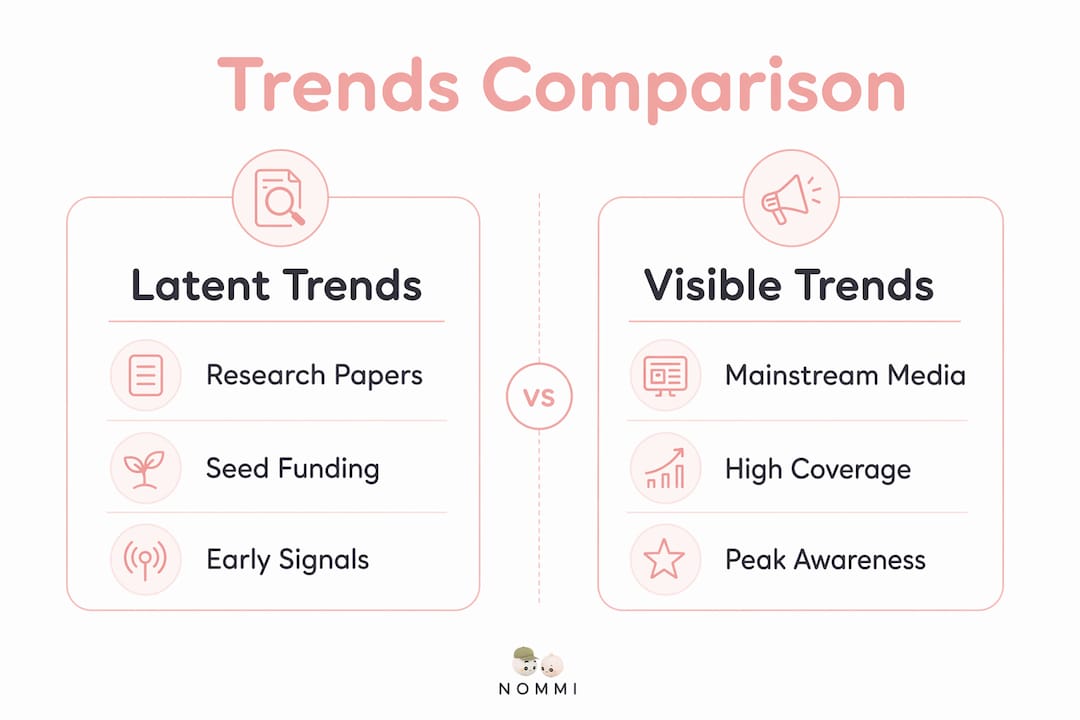
The distinction between latent and visible trends is not merely academic. It determines whether your organisation is setting the agenda or scrambling to catch up. Latent signals appear first in niche research publications, seed funding announcements, open-source repository activity, and specialist community forums. Visible trends appear in mainstream press, large-scale consumer surveys, and keynote presentations. The gap between these two stages is precisely where the most valuable strategic decisions are made.
Consider how the rise of large language models played out. The academic signals were present in arXiv preprints and small developer communities years before ChatGPT made the technology a household name. Organisations monitoring those early layers had time to build internal capability, form partnerships, and position products. Those waiting for mainstream coverage were left reacting.
Latent vs visible trends: a comparison
| Signal type | Where it appears | Strategic window |
|---|---|---|
| Latent trend | Research papers, seed funding, niche forums | 6 to 18 months before mainstream |
| Emerging trend | Trade press, early adopter communities | 3 to 6 months before mainstream |
| Visible trend | Major media, analyst reports, keynotes | At or past peak adoption |
When a topic hits three major mainstream publications in the same week, it has likely already peaked. That is not a signal to act on. It is a signal that the opportunity has passed.
How do organisations benefit from monitoring latent trends?
The benefits of latent trend analysis extend well beyond being first to market. They compound across strategy, operations, and culture in ways that are difficult to replicate once a competitor has established an early position.
Competitive positioning. Organisations that detect signals early can shape market narratives rather than respond to them. A product team that spots a behavioural shift 12 months out has time to build, test, and iterate. A team that spots it at peak media coverage is building under pressure, with competitors already ahead.
Resource allocation. Early awareness allows marketing and product budgets to be directed towards rising opportunities before demand inflates costs. Paid media, talent acquisition, and partnership negotiations all become more favourable when you move before the crowd.
Reduced strategic missteps. Systematic market trend analysis creates clarity beyond data overload, preventing reactionary strategies and costly misinvestments. Organisations that react to hype spikes rather than genuine trends waste significant capital on short-lived opportunities.
Organisational reflexes. Successful organisations treat trend tracking as an ongoing discipline, creating organisational reflexes for faster strategic responses. Gartner research highlights improved adaptability with structured foresight. This is not a one-off exercise. It is a capability that strengthens with practice.
- Identify the signal layer where your industry's latent trends first appear (academic, funding, community, or open-source).
- Assign ownership of scanning to specific team members with clear documentation responsibilities.
- Set decision triggers: define in advance what signal strength justifies a strategic response.
- Review and refine your filters quarterly to reduce noise and improve signal quality.
- Align trend insights directly with product roadmaps and campaign calendars.
Pro Tip: Do not wait for consensus before acting on a latent signal. By the time your entire leadership team agrees a trend is real, it is almost certainly visible, and the advantage has narrowed considerably.
What methods are effective for identifying latent trends?
Identifying genuine latent trends requires scanning across multiple independent data layers simultaneously. Relying on a single source, whether that is social media volume, news coverage, or analyst reports, produces a distorted picture. Cross-layer validation across research, funding, and community discussion reduces false positives and identifies genuine latent trends. A trend needs confirmation from at least three independent sources across layers to be treated as credible.
The four primary signal layers worth monitoring are: academic and research publications (arXiv, PubMed, SSRN), early-stage funding activity (Crunchbase, AngelList seed rounds), specialist community discussions (Reddit, Discord servers, GitHub issues), and open-source project activity (star growth, fork rates, contributor counts). Each layer reveals a different facet of an emerging shift. Together, they provide triangulation.
Velocity matters more than volume. Doubling usage in 48 hours signals mainstream adoption more reliably than slow, steady volume growth. A topic discussed by 200 people this week, up from 100 last week, is a stronger latent signal than one discussed by 10,000 people with no growth trajectory. This is the metric most analysts miss when they focus on absolute numbers rather than rate of change.
Comparing signal sources by reliability and timing
| Source | Signal timing | Reliability | Best used for |
|---|---|---|---|
| Academic preprints | 12 to 24 months early | High | Technology and science sectors |
| Seed funding rounds | 9 to 18 months early | High | Commercial and product trends |
| Niche community forums | 6 to 12 months early | Medium | Consumer behaviour shifts |
| Social media volume | 1 to 3 months early | Low | Confirming, not discovering |
| Mainstream press | At or past peak | Very low | Validation only |
A common pitfall is confusing hype spikes for genuine trends. A sudden surge in social media mentions following a viral post or a celebrity endorsement does not constitute a latent trend. Distinguishing meaningful weak signals requires filters for convergence, persistence, and amplification across multiple scanning zones. If a signal appears in only one layer and fades within two weeks, it is noise.
Pro Tip: Track open-source repository activity on GitHub as a leading indicator for technology trends. A project gaining 500 stars in a week with no press coverage is a far stronger latent signal than one with 5,000 stars and a TechCrunch article.
How can businesses integrate trend tracking into strategy?
Embedding latent trend awareness into business processes requires more than a quarterly review of industry reports. It demands a structured scanning rhythm, clear documentation, and direct links between trend insights and decision-making.
Weekly documentation of competitor activities reveals patterns and missed market opportunities that annual reports never surface. Monitoring your top three competitors weekly is a minimum baseline for trend awareness. Extend this to monitoring the funding activity and hiring patterns of companies two stages ahead of your own, and you gain a forward-looking view of where your market is heading.
Scenario planning is the most practical tool for converting latent trend data into strategic decisions. Once a signal is confirmed across multiple layers, build two or three scenarios around its potential trajectory. Define the inflection point at which each scenario would require a different organisational response. This prevents the paralysis that often accompanies ambiguous early signals and gives teams a clear mandate to act when conditions are met.
Aligning trend insights with product development cycles is where the real value is captured. A product team working on an 18-month roadmap needs latent trend data today, not when the trend becomes visible. Build a direct feed from your scanning process into product planning sessions, and treat trend signals as inputs alongside customer research and technical feasibility assessments.
- Establish a weekly scanning cadence with assigned owners for each signal layer.
- Use a shared documentation tool such as Notion or Confluence to log signals with dates, sources, and confidence ratings.
- Set explicit decision triggers: for example, "if this signal appears in three independent layers within 60 days, we escalate to leadership."
- Review and update your scanning filters every quarter to account for shifts in where your industry's signals first appear.
- Connect trend insights directly to your strategic trend exploration process and product roadmap reviews.
Continuous scanning rhythms and disciplined frameworks distinguish professionals who anticipate trends from those who react late. This is a capability, not a task. The organisations that build it systematically outperform those that treat trend awareness as an occasional exercise.
Key takeaways
Tracking latent trends gives organisations a 6 to 18-month strategic window that disappears entirely once a signal reaches mainstream visibility.
| Point | Details |
|---|---|
| Latent vs visible signals | Latent trends appear in research and funding layers long before mainstream press coverage. |
| Cross-layer validation | Confirm signals across at least three independent sources to separate genuine trends from noise. |
| Velocity over volume | A signal doubling in 48 hours is more predictive than high but static mention counts. |
| Organisational reflexes | Weekly scanning and documentation build the institutional speed needed to act on early signals. |
| Decision triggers | Define in advance the signal strength that justifies a strategic response to avoid paralysis. |
The discipline most businesses still underestimate
I have watched organisations invest heavily in market research and still get blindsided by shifts that were visible in the data 12 months earlier. The problem is almost never a lack of information. It is a lack of the right scanning infrastructure and the discipline to act on weak signals before they become obvious.
The most common mistake I see is treating trend tracking as a research function rather than a strategic one. When scanning is owned by a research team that reports quarterly, the insights arrive too late to influence decisions. The organisations that genuinely benefit from early market insights are those where trend data flows directly into product, marketing, and leadership conversations on a weekly basis.
There is also a tendency to over-rely on intuition. Experienced analysts often trust their instincts about where a market is heading, and sometimes they are right. But intuition without a systematic framework produces inconsistent results. The professionals who consistently anticipate shifts are those who have built multi-source confirmation habits and apply them without exception, even when a signal feels counterintuitive.
The future challenge is not access to data. It is building the organisational capacity to act on ambiguous signals before they become certain. That requires patience, process, and a genuine tolerance for acting under uncertainty.
— Aidil
Start tracking signals before your competitors do
Ontherice is built for exactly this challenge. The platform's AI engines scan global data points across multiple signal layers, extracting genuine emerging signals from noisy markets and delivering real-time rankings and scores before trends reach mainstream awareness.
Whether you are monitoring a specific sector or scanning broadly for the next significant shift, Ontherice provides the systematic framework and AI-powered detection that manual scanning cannot match. Explore the AI opportunities tool to see which signals are gaining momentum right now, ranked by velocity and cross-layer confirmation. The window for early advantage is open. The question is whether your organisation is positioned to use it.
FAQ
What are latent trends in business?
Latent trends are early, subtle market signals that exist in niche data layers before they reach mainstream awareness. They typically appear in academic research, seed funding activity, and specialist community discussions months or years before mainstream media coverage.
Why monitor latent trends rather than visible ones?
Visible trends at peak media coverage mark the end of the strategic advantage window. Monitoring latent trends gives organisations 6 to 18 months of lead time to position products, allocate resources, and build capability before competitors recognise the shift.
How do you identify a genuine latent trend?
A genuine latent trend requires confirmation from at least three independent signal sources across different layers, such as research publications, funding rounds, and community discussions. Signals appearing in only one layer or fading within two weeks are typically noise rather than trends.
What is the role of velocity in trend detection?
Signal velocity, measured as the rate of growth in mentions or activity, is more predictive than absolute volume. A signal doubling in 48 hours indicates accelerating adoption and is a stronger early indicator than a high but static mention count.
How often should businesses scan for latent trends?
Weekly scanning is the recommended minimum for meaningful trend awareness. Monitoring competitors and signal layers weekly reveals patterns that quarterly or annual reviews consistently miss, and builds the organisational reflexes needed for faster strategic responses.