

TL;DR:
- Emerging theme analysis detects rapidly growing, significant patterns in data to inform strategic decisions before they become mainstream. It combines qualitative coding with bibliometric methods, enabling real-time tracking of new research trends and market signals. Continuous monitoring improves interpretation accuracy and helps organizations capitalize on opportunities early.
Emerging theme analysis is the practice of systematically detecting and interpreting new, significant patterns within qualitative data or research outputs to inform strategic decisions. For business professionals and analysts, it sits at the intersection of qualitative research and market intelligence, drawing on frameworks like Braun and Clarke's six-phase thematic analysis and bibliometric clustering methods such as K-means and the Leiden algorithm. Emerging topics possess three defining attributes: radical novelty, rapid growth in mentions, and internal semantic coherence. These attributes distinguish a genuine emerging theme from background noise, making the method far more disciplined than casual trend-spotting.
What is emerging theme analysis and why does it matter?
Emerging theme analysis is a structured process for identifying and interpreting patterns that are gaining significance within a body of data, whether that data comes from customer interviews, academic literature, or social media signals. The standard industry term for its qualitative foundation is thematic analysis, but emerging theme analysis extends that foundation by focusing specifically on themes that are new, growing, and not yet mainstream.

The distinction matters for business analysts. A retrospective thematic study tells you what customers thought last year. Emerging theme analysis tells you what is beginning to matter now, before competitors have noticed. That timing advantage is the core value proposition of the method.
AI tools help automate coding and theme extraction at scale, improving consistency across large and complex datasets. That scalability has made emerging theme analysis practical for organisations working with thousands of data points rather than dozens of interview transcripts.
How does thematic analysis provide the qualitative foundation?
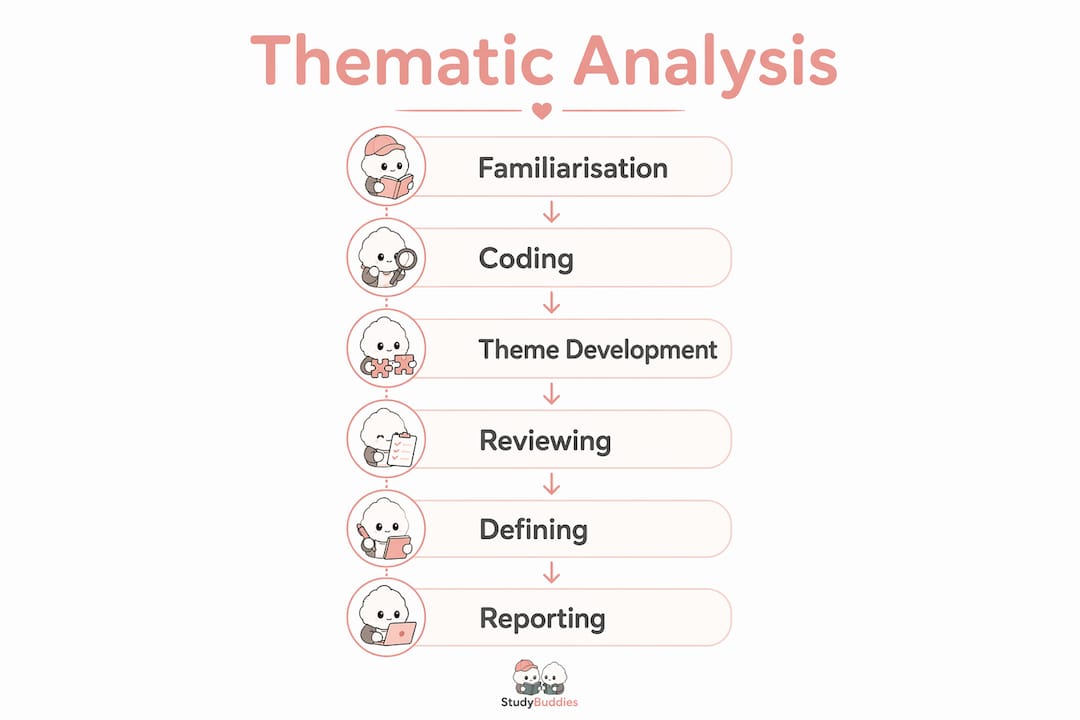
Thematic analysis is a structured six-phase qualitative method widely used across the social sciences to interpret patterns in data. The six phases are: familiarisation with the data, generating initial codes, searching for themes, reviewing themes, defining and naming themes, and producing the final report. Each phase builds on the previous one, and the process is iterative rather than linear.
| Phase | Activity |
|---|---|
| 1. Familiarisation | Read and re-read data; note initial observations |
| 2. Coding | Generate concise labels for meaningful data segments |
| 3. Theme searching | Group codes into candidate themes |
| 4. Theme reviewing | Test themes against the full dataset for coherence |
| 5. Defining themes | Articulate the essence and scope of each theme |
| 6. Reporting | Weave themes into a coherent analytical narrative |
The researcher's role is active throughout. Experienced researchers reject the idea that themes simply emerge spontaneously. Themes are constructed through iterative data engagement and the analyst's theoretical positioning. This is not a weakness of the method. It is a feature that allows analysts to bring domain expertise to bear on raw data.
Thematic analysis applies across surveys, customer interviews, employee sentiment studies, and market research. The challenge is balancing data richness against analytic depth. A dataset of 500 interview transcripts offers breadth, but each additional transcript reduces the time available for deep engagement with any single response.
Pro Tip: When coding large datasets, complete a full coding pass on a small pilot sample of 10–15 records before scaling up. Piloting reveals coding inconsistencies early and saves significant rework later.
How are emerging topics detected through bibliometric and AI-driven approaches?
Bibliometric analysis scales the qualitative logic of thematic analysis to thousands of research documents simultaneously. InCites' bibliometric tools identify over 10,000 emerging topics clustered into 25 research categories, updated monthly using K-means clustering on semantic data. That monthly refresh cycle means analysts can track topic trajectories in near real time rather than waiting for annual literature reviews.
The contrast between the two approaches is worth understanding clearly.
| Dimension | Qualitative thematic analysis | Bibliometric emerging topic detection |
|---|---|---|
| Data source | Interviews, surveys, open-text responses | Academic papers, patents, citation networks |
| Scale | Tens to hundreds of records | Thousands to millions of documents |
| Core method | Researcher-led coding and theme construction | K-means clustering, Leiden algorithm |
| Update frequency | Project-specific | Monthly or continuous |
| Output | Rich interpretive themes | Ranked topic clusters with growth signals |
| Strength | Depth and contextual nuance | Speed and breadth of coverage |
AI-driven detection adds a further layer. Analysis of 80,814 AI papers from top conferences between 2017 and 2025 found that emerging topics in AI research show abrupt topical phase transitions, typically within 1–3 years after marginal presence, with a recall rate of 63% using early-warning signatures. That finding has a direct implication for business analysts: by the time a topic reaches mainstream coverage, the early-mover window has often already closed.
Advanced bibliometric analysis blends manual qualitative synthesis with automated text mining workflows using R packages such as bibliometrix and tm for data cleansing and clustering. This hybrid approach manages noisy data while preserving the interpretive rigour that pure automation cannot replicate. Platforms tracking AI trend signals use similar logic to surface early-warning patterns before they reach mainstream awareness.
Pro Tip: Do not rely on a single clustering algorithm. Run K-means and Leiden algorithm in parallel on the same dataset and compare outputs. Discrepancies between the two often point to genuinely contested or transitional themes worth investigating further.
What are the common challenges in emerging theme identification?
The most common mistake analysts make is assuming themes will reveal themselves if they simply read enough data. Themes are actively constructed by the researcher through iterative coding and theoretical positioning. Treating theme construction as passive observation produces vague, overlapping categories that cannot support strategic decisions.
Methodological rigour is the antidote. A 16-item checklist is advised for thematic analysis to counterbalance researcher subjectivity and coding inconsistencies. Using a checklist forces analysts to document their coding rationale, making the process auditable and reproducible.
Several other challenges appear consistently in practice:
- Data breadth versus depth. Larger datasets improve representativeness but reduce the time available for deep engagement with individual records. Analysts must set explicit limits on dataset size relative to available analysis time.
- Outlier responses. Edge cases often signal genuinely novel themes before they appear at scale. Dismissing low-frequency codes too early is a common source of missed emerging signals.
- Theme drift. A theme defined early in a project may shift in meaning as new data arrives. Emergent theme monitoring is a continuous process that tracks theme evolution throughout the research lifecycle to maintain alignment with shifting participant and market realities.
- Automation bias. AI coding tools improve speed and consistency, but they inherit the biases present in their training data. Human review of AI-generated codes remains non-negotiable for high-stakes analysis.
Combining qualitative and quantitative methods addresses most of these challenges. Qualitative coding provides interpretive depth. Bibliometric clustering provides breadth and early-warning signals. Neither method alone is sufficient for serious market intelligence work.
Pro Tip: Keep a dedicated log of low-frequency codes that do not fit your current themes. Review this log at the end of each analysis phase. Several of the most commercially significant emerging themes start as single-digit-frequency outliers.
How does emerging theme analysis apply to business intelligence?
Business analysts use emerging theme analysis to identify nascent market opportunities before they reach mainstream awareness. The method applies directly to customer feedback analysis, competitive intelligence, technology scouting, and product development prioritisation.
The practical applications cluster into four areas:
- Consumer sentiment shifts. Coding open-text survey responses and social listening data reveals emerging concerns or desires that quantitative metrics miss entirely. A theme appearing in 8% of responses today may represent 40% of conversations within 18 months if it follows a topical phase transition pattern.
- Technology trend detection. Topics like reasoning models and multimodal large language models showed early-warning signatures in academic literature well before they dominated industry coverage. Analysts tracking emerging AI opportunities can use bibliometric signals to time product and investment decisions more precisely.
- Benchmarking and collaborator identification. Bibliometric platforms surface not just which topics are growing but which organisations and researchers are driving them. That intelligence supports partnership decisions and competitive positioning.
- Stakeholder communication. Thematic insights presented through visual dashboards convert complex analytical outputs into decisions. A ranked list of emerging themes with growth trajectories is far more persuasive to a leadership team than a dense qualitative report.
Monitoring theme evolution continuously across research phases ensures relevance to changing participant views and market contexts. Treating emerging theme analysis as a one-time project rather than an ongoing process is the single most common reason organisations miss the signals they were looking for. Ontherice applies this continuous monitoring logic through AI engines that scan global data points and surface trend scouting signals in real time.
Key takeaways
Emerging theme analysis combines qualitative coding rigour with bibliometric detection methods to identify new, significant patterns before they reach mainstream awareness.
| Point | Details |
|---|---|
| Definition is precise | Emerging themes require novelty, rapid growth, and semantic coherence to qualify as genuine signals. |
| Themes are constructed | Analysts actively build themes through iterative coding; passive reading of data produces weak results. |
| Use a 16-item checklist | Methodological checklists counterbalance subjectivity and make thematic analysis auditable. |
| Combine methods | Qualitative coding and bibliometric clustering together outperform either approach used alone. |
| Monitor continuously | Theme meaning shifts over time; one-time analysis misses the evolution that matters most for strategy. |
My honest view on where most analysts go wrong
The biggest misconception I encounter is that emerging theme analysis is primarily a technology problem. Analysts invest in AI coding tools, bibliometric platforms, and clustering algorithms, then wonder why their outputs feel thin. The technology accelerates the process. It does not replace the interpretive judgement that makes the output useful.
The phase transition research is genuinely striking. The finding that AI topics can move from marginal to dominant within 1–3 years, with detectable early-warning signatures, should change how analysts allocate attention. Most organisations are still running annual literature reviews. By the time those reviews are complete, the transition has already happened.
What I find most underrated is the value of outlier codes. Every analyst I respect keeps a running log of low-frequency patterns that do not fit the current coding frame. Those outliers are where the next cycle's dominant themes are hiding. Dismissing them because they represent 2% of responses is a category error. Emerging means small right now.
The convergence of AI tools with traditional qualitative methods is genuinely productive, but only when analysts maintain critical oversight. Automated coding tools trained on historical data will systematically underweight genuinely novel signals because novelty, by definition, is underrepresented in training data. The human analyst's job is precisely to catch what the algorithm cannot see yet.
— Aidil
Ontherice and the case for continuous theme monitoring
Identifying an emerging theme once is useful. Tracking how it evolves week by week is where the competitive advantage actually lives.

Ontherice uses multiple AI engines to scan global data points, extract meaningful signals, and produce real-time rankings across diverse markets. The platform's AI opportunities tracker applies the same early-warning logic described in this article, surfacing topics that are gaining momentum before they reach mainstream coverage. For analysts who want to move from periodic thematic reviews to continuous signal monitoring, Ontherice provides the infrastructure to do that at scale. Explore the platform's AI tools suite to see how automated detection and human-readable rankings work together.
FAQ
What is emerging theme analysis in simple terms?
Emerging theme analysis is the process of identifying new, growing patterns in qualitative or bibliometric data before they become widely recognised. It combines coding techniques with detection methods to surface signals early.
How does emerging theme analysis differ from standard thematic analysis?
Standard thematic analysis interprets patterns across a fixed dataset. Emerging theme analysis focuses specifically on patterns that are new and growing, using continuous monitoring and bibliometric tools to track their trajectory over time.
What three attributes define an emerging topic?
An emerging topic requires radical novelty, rapid growth in mentions, and internal semantic coherence. All three attributes must be present for a topic to qualify as genuinely emerging rather than simply uncommon.
How quickly can an emerging topic become dominant?
Analysis of AI research papers shows that emerging topics can transition from marginal to dominant within 1–3 years, with early-warning signatures detectable before the transition occurs.
What is the best way to maintain rigour in thematic analysis?
A 16-item methodological checklist is the recommended standard for counterbalancing researcher subjectivity and ensuring coding decisions are transparent and reproducible.