
TL;DR:
- Emergent market behavior arises from complex interactions among participants, producing macro patterns unpredictable by traditional models. Understanding these dynamics allows analysts and firms to anticipate regime shifts and strategically influence market evolution. AI and agent-based models enhance predictive accuracy by capturing feedback loops, path dependence, and context-specific biases to inform decision-making.
Emergent market behaviour is defined as macro-level market patterns that arise spontaneously from the interactions of many individual participants, producing collective outcomes no single actor could generate alone. Complexity economics, developed by scholars including W. Brian Arthur at the Santa Fe Institute, frames phenomena such as market crashes, asset bubbles, and innovation waves as emergent collective outcomes that traditional equilibrium models consistently underestimate. For business professionals and academics, grasping this concept is not a theoretical exercise. It is the difference between anticipating a regime shift and being blindsided by one.
What is emergent market behaviour and why does it matter?
Emergent market behaviour describes macro patterns arising from lower-level system interactions, reflecting both process and outcome simultaneously. Markets are not static equilibria waiting to be disturbed. They are continuously forming through the decisions, biases, and reactions of thousands of agents operating in parallel. This is the foundational distinction between complexity economics and classical theory.

The practical significance is immediate. When you model a market as a system tending toward equilibrium, you miss the feedback loops that produce herding, liquidity cascades, and signalling spirals. The 2008 global financial crisis is the canonical example: no individual bank's decision caused the collapse, yet the interaction of leverage, correlated positions, and confidence signals produced a system-wide failure that equilibrium models failed to forecast. Understanding emergent dynamics means you are analysing the interactions, not just the actors.
Complexity science also introduces the concept of path dependence, where early market conditions constrain future outcomes in ways that defy simple extrapolation. The dominance of QWERTY keyboards, the lock-in of VHS over Betamax, and the network concentration of platforms like Visa all reflect path-dependent emergent patterns. Recognising these trajectories early is where strategic advantage lives. Ontherice is built precisely on this premise: detecting signals before they consolidate into mainstream awareness.
How do micro-level interactions produce emergent market patterns?
The mechanism is straightforward in principle and complex in practice. Individual agents, whether traders, consumers, or firms, make decisions based on local information, cognitive biases, and the observed behaviour of others. These decisions alter the environment, which then shapes the next round of decisions. The result is a feedback loop that generates non-linear market dynamics such as herding and liquidity cascades.
Several specific mechanisms drive this process:
- Feedback loops: A rising asset price attracts more buyers, which pushes the price higher, which attracts still more buyers. This self-reinforcing dynamic produces bubbles without any coordinated intent.
- Herding behaviour: Agents observe the actions of peers and update their own decisions accordingly. In financial markets, this produces correlated selling during downturns that amplifies losses far beyond fundamental valuations.
- Path dependence: Early adopters of a technology or standard create network effects that make alternatives progressively less viable, regardless of their intrinsic quality.
- Signalling dynamics: Firms and investors interpret each other's moves as information, creating cascades where a single large trade triggers a chain of reactive decisions across the market.
These dynamics contrast sharply with the rational agent models taught in most MBA programmes. Classical theory assumes agents optimise independently against stable price signals. Complexity economics assumes agents adapt to each other, producing interaction-driven, path-dependent dynamics that no individual participant controls or fully understands.
Pro Tip: When building a market forecast, map the feedback loops first. Identify which variables are self-reinforcing and which are self-correcting. A model that ignores this distinction will produce confident predictions that collapse at the first inflection point.
Agent-based modelling (ABM) is the primary tool for studying these mechanisms formally. ABM populates a simulated market with heterogeneous agents, each following specified decision rules and biases, then observes what macro patterns emerge. The key methodological requirement is that micro-rule specification must be explicit and generative rather than retrospective. You specify how agents decide, not what the market should look like, and then you observe what forms. This is the analytical discipline that separates rigorous emergence research from pattern-matching dressed up as theory.
How do emergent behaviours differ across emerging and developed markets?
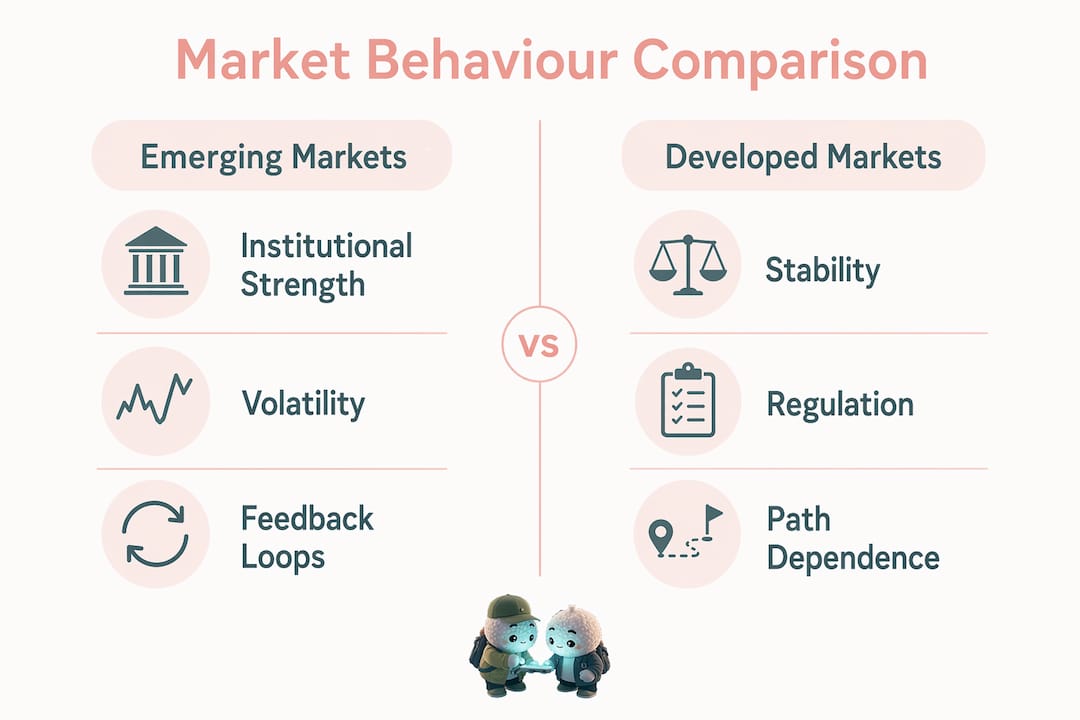
The characteristics of emergent market behaviour shift considerably depending on institutional strength and market maturity. In developed markets, strong regulatory frameworks, deep liquidity, and credible central banks act as shock absorbers. Emergent dynamics still occur, as the 2008 crisis demonstrated, but the institutional infrastructure constrains the most destructive feedback loops. In emerging markets, the picture is more varied and strategically more complex.
A 21-study synthesis on market shaping in emerging economies identifies multi-actor institutional entrepreneurship and legitimacy-building as the core mechanisms through which firms produce emergent market behaviours. This is a critical insight. In emerging markets, firms do not simply respond to market conditions. They actively shape them by co-creating norms, building ecosystems, and establishing legitimacy for new categories. The market itself is an emergent outcome of this collective activity.
The distinction between core and periphery emerging markets adds another layer. Research from the Federal Reserve Bank of New York shows that core emerging markets with stronger macroeconomic reforms, reduced foreign currency debt, and credible policy frameworks experienced lower inflation spikes and borrowing costs during recent global shocks compared to periphery markets. This means the emergent behaviour you observe during a crisis in Brazil or India will differ structurally from what you see in frontier markets with weaker institutional buffers.
| Market type | Institutional strength | Emergent behaviour during shocks | Strategic implication |
|---|---|---|---|
| Developed markets | High | Contained feedback loops, faster recovery | Focus on systemic risk and regulatory signals |
| Core emerging markets | Medium to high | Moderate volatility, policy-credible responses | Monitor reform trajectories and debt structures |
| Periphery emerging markets | Low to medium | Amplified feedback, currency and liquidity cascades | Prioritise scenario planning and exit optionality |
For strategists, this table is not just descriptive. It is a decision framework. The emergent dynamics in a periphery emerging market require a fundamentally different analytical posture than those in a developed economy. Firms that apply the same models across all contexts will systematically misread the signals.
How do agent-based and AI-driven models improve understanding of emergent dynamics?
Agent-based modelling has been the standard tool for studying emergent market dynamics for two decades. The recent integration of large language model (LLM) agents into these simulations represents a genuine methodological advance. LLM-augmented agents demonstrate herd behaviour and loss aversion that vary with context in artificial market environments, reproducing anomalies that traditional ABM struggled to capture because its agents followed fixed rules rather than adaptive reasoning.
The practical implications for analysts are significant:
- Reproducing anomalies: LLM-based simulations can replicate path dependence, momentum crashes, and sentiment-driven bubbles in ways that calibrated equilibrium models cannot.
- Testing interventions: Before a policy change or market entry, you can simulate how heterogeneous agents with realistic biases would respond, revealing second-order effects invisible to standard models.
- Identifying tipping points: Simulations reveal the conditions under which a market transitions from one regime to another, giving analysts a probabilistic map of regime shift triggers.
Pro Tip: When using agent-based or LLM-driven models, resist the temptation to validate them solely by how well they reproduce historical data. A model that fits the past by attributing patterns to emergence may simply be absorbing omitted external shocks. Specify your micro-rules explicitly and test them against out-of-sample scenarios.
The modelling pitfalls are real. Failing to specify mechanisms risks misattributing correlation to emergence rather than to external shocks. This is not a minor technical concern. It leads to strategies built on false causal stories, which fail precisely when the market environment changes. For deeper context on how network effects shape emergent dynamics in technology markets, the interaction between micro-level adoption decisions and macro-level platform dominance is a textbook case of this modelling challenge.
Why does recognising emergent behaviour improve strategic decision-making?
The strategic value of understanding emergent market behaviour lies in its predictive asymmetry. Most competitors are analysing individual actors, sectors, or macroeconomic indicators in isolation. Analysts who track interaction patterns, feedback loops, and institutional dynamics see regime shifts forming before they become consensus.
"Markets are not puzzles to be solved but systems to be understood. The analyst who maps interactions rather than just outcomes will always see the turn before the crowd does." This framing, consistent with complexity economics, captures why emergent thinking is a durable competitive advantage rather than a passing methodology.
Firms operating in emerging markets face a specific version of this challenge. Short-term KPIs often misinterpret emergent patterns still forming through legitimacy-building and institutional engagement. A new market category in Southeast Asia or Sub-Saharan Africa may show weak early metrics not because the opportunity is absent but because the institutional ecosystem has not yet co-evolved to support it. Firms that exit on the basis of short-term signals miss the emergent upside entirely.
Scenario planning is the most direct application. By mapping the feedback loops and institutional conditions that govern a market, you can construct scenarios that reflect genuine system dynamics rather than linear extrapolations. This is how firms like McKinsey and BlackRock approach macro risk. It is also the analytical logic behind Ontherice's signal detection architecture, which scans for disruptive trend signals before they reach mainstream visibility. For a broader view of how dynamic market tools translate emergent insights into strategic decisions, the connection between complexity theory and real-time analytics is direct and practical.
Key takeaways
Emergent market behaviour requires analysing interaction patterns, feedback loops, and institutional contexts rather than individual actors or static equilibrium states.
| Point | Details |
|---|---|
| Core definition | Macro market patterns arise from micro interactions, not from any single participant's actions. |
| Feedback loops drive dynamics | Herding, liquidity cascades, and signalling spirals are the primary mechanisms producing emergent outcomes. |
| Institutional context shapes emergence | Core emerging markets absorb shocks differently from periphery markets due to policy credibility and reform depth. |
| AI models advance analysis | LLM-augmented agent simulations reproduce context-dependent biases and anomalies that traditional models miss. |
| Strategic value is asymmetric | Analysts tracking interaction dynamics identify regime shifts and innovation waves before consensus forms. |
Emergent behaviour and the limits of conventional market thinking
I have spent considerable time working with market data across both developed and emerging economies, and the single most persistent mistake I see from otherwise rigorous analysts is treating markets as systems that return to equilibrium after a shock. They do not. They evolve. The post-shock market is a different system from the pre-shock one, shaped by the interactions and adaptations that occurred during the disruption itself.
What complexity economics gave me was not a new set of tools so much as a different question to ask. Instead of "where is this market heading?", the more productive question is "what interactions are currently reinforcing each other, and what would it take to break that pattern?" That reframe changes everything about how you read signals, weight evidence, and construct scenarios.
The hardest part is institutional patience, particularly in emerging markets. I have watched firms abandon genuinely promising positions in frontier markets because the emergent patterns forming around them looked like stagnation on a quarterly dashboard. They were not stagnation. They were legitimacy-building, the slow co-evolution of norms, ecosystems, and consumer behaviour that precedes a market inflection. The firms that stayed and shaped those ecosystems captured the upside. The ones that left read the short-term signal correctly and the long-term dynamic completely wrong.
My advice: treat every market you analyse as a system in motion, not a snapshot. Map the actors, map their interactions, and then ask what the interactions are producing that no single actor intended.
— Aidil
How Ontherice helps you track emergent market signals

Ontherice is built on the premise that emergent market patterns become visible in the data before they become visible to consensus. The platform's AI engines scan global data points, extract meaningful signals from noise, and produce real-time rankings across sectors, giving you the interaction-level view that conventional market tools miss. Whether you are monitoring a frontier market for early institutional signals or tracking technology adoption curves for path-dependent inflection points, the SignalsInternational platform delivers the cross-market intelligence you need to act before the crowd does. For broader signal coverage across domestic and global sectors, GeneralSignals integrates emergent behaviour insights directly into your strategic workflow.
FAQ
What is emergent market behaviour in simple terms?
Emergent market behaviour is when complex market-wide patterns, such as bubbles or crashes, arise from the interactions of many individual participants rather than from any single actor's decision. No one plans these outcomes; they form through collective dynamics.
How does emergent behaviour differ from normal market fluctuation?
Normal fluctuation reflects random variation around a stable equilibrium. Emergent behaviour involves feedback loops and path-dependent dynamics that push markets into new regimes, making calibration to historical averages unreliable for forecasting.
Why do emerging markets show different emergent patterns from developed ones?
Institutional strength determines how feedback loops are absorbed or amplified. Core emerging markets with stronger policy frameworks show more contained emergent dynamics during shocks, while periphery markets experience amplified volatility due to weaker buffers.
What tools are best for analysing emergent market dynamics?
Agent-based modelling and LLM-augmented simulations are the most effective analytical tools, as they specify micro-level decision rules and reproduce context-dependent biases that traditional econometric models cannot capture.
Can firms actively shape emergent market behaviour?
Yes. Research on market shaping in emerging economies shows that firms can co-create norms, build ecosystems, and establish legitimacy for new categories, directly influencing the emergent patterns that form around them over strategic timelines.